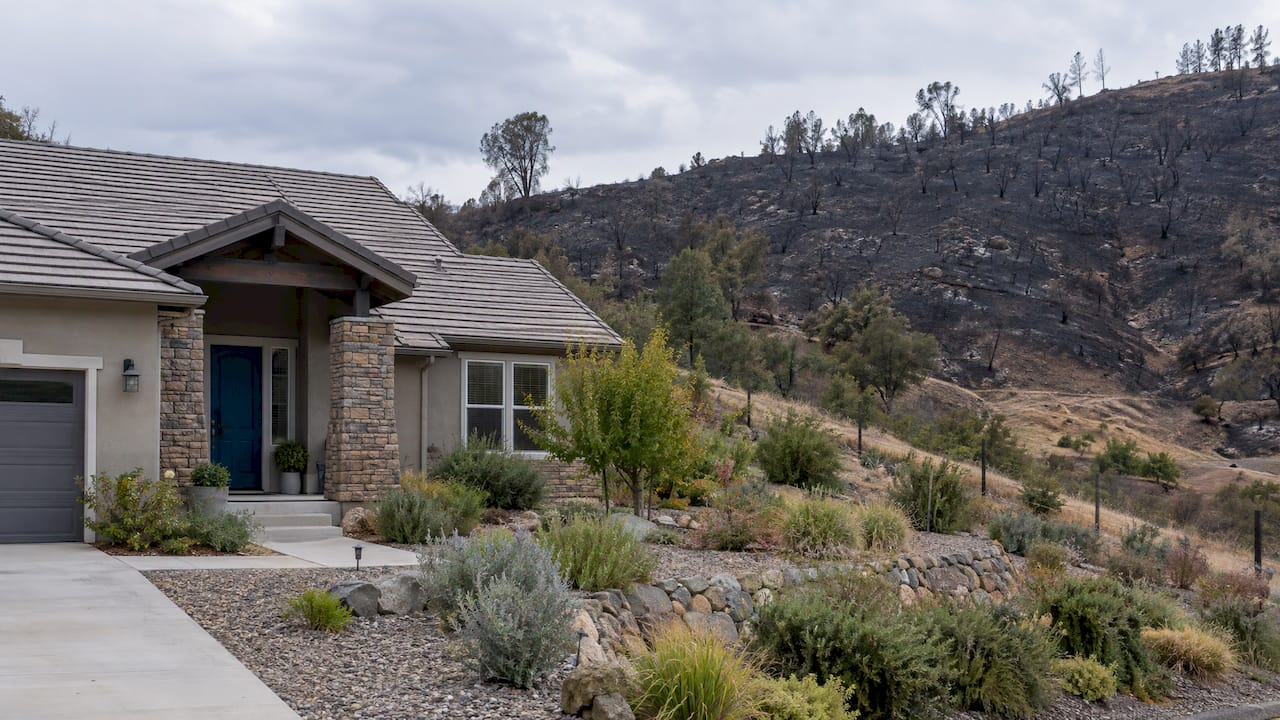
Most standard homeowners policies cover wildfire damage as part of their fire coverage. What decides how much you actually collect is the fine print: your limits, your deductible and whether your belongings are paid at replacement cost or depreciated value. In high fire risk areas, insurers may also restrict coverage or raise premiums, so the best time to check your policy is before smoke is in the air. As an independent agency, we shop several carriers for you and tailor the coverage to your home.
TL;DR
- Wildfire is normally treated as a covered fire loss under a standard homeowners policy, subject to its terms, limits and deductible.
- Check four numbers: dwelling limit, other-structures limit, personal property limit and living-expense coverage.
- Replacement cost and actual cash value can produce very different payments after the same fire.
- If you are turned down in a high fire risk area, state-run last-resort programs exist, but they are usually more basic than a standard policy.
- Review your declarations page at least once a year and photograph your belongings now, not after a loss.
Table of Contents
- Does homeowners insurance cover wildfire?
- Where wildfire payouts fall short
- Replacement cost vs. actual cash value
- Setting the right dwelling limit
- What to do if you live in a high fire risk area
- Recent changes worth knowing
- Before a wildfire: a homeowner's checklist
- After a wildfire
- Our perspective
- Get your wildfire coverage reviewed
- FAQ
- Sources
Does homeowners insurance cover wildfire?
Yes, in most cases. The Washington Office of the Insurance Commissioner says most standard homeowners and renters policies cover wildfire as part of fire coverage, with the actual policy setting the limits and terms. A typical policy splits that protection into four parts:
- Dwelling (Coverage A): the house itself and attached fixtures.
- Other structures (Coverage B): detached garages, sheds and fences.
- Personal property: furniture, clothing, electronics and other belongings.
- Additional living expenses: hotel or rental costs while your home is unlivable.
The same Washington source explains that Coverage A applies to the home and attached fixtures, while Coverage B applies to detached structures such as garages and sheds. Each part has its own limit, and a loss can use up one while another has room left.
A wildfire also does not need to burn your house down to cost you money. Smoke damage, heat damage and water from firefighting can all lead to claims. Your policy language decides how each is handled, which is why reading it matters more than assuming.
Where wildfire payouts fall short
Homeowners are usually surprised by a handful of places where the check comes in lower than expected. Knowing them in advance lets you fix them while it is cheap to do so.
Other structures are capped
Washington's regulator notes that other-structures coverage is typically limited to 10% of dwelling coverage unless you increase it. If your dwelling limit is $400,000, that means about $40,000 for everything detached. A rural property with a workshop, barn, guesthouse and fencing can exceed that quickly.
Some belongings have special limits
Policies may set lower limits for certain items, including jewelry, cash and firearms, according to the Washington OIC. Arizona's Department of Insurance and Financial Institutions adds that personal property may carry special limits for categories such as furs, coin collections and computer equipment. If you own art, watches, a collection or a high-end home office, ask about scheduling those items separately. We offer valuable belongings coverage for exactly that purpose.
Debris removal and landscaping have limits
Arizona's regulator says debris-removal and trees-and-shrubs coverage generally have limits, so check your contract for the amounts. Clearing a burned lot can be expensive, and mature landscaping is rarely covered in full.
Living expenses: find the number and the time limit
Additional living expenses are one of the most valuable parts of a wildfire claim, because displacement can last months. Your declarations page, the summary at the front of your policy, shows the limit, and the policy form explains whether it is a dollar amount, a percentage of dwelling coverage or a time period. Confirm which one you have, and ask your agent whether it still looks realistic for your area's rental market.
Replacement cost vs. actual cash value
This is the single biggest swing factor. Actual cash value (ACV) subtracts depreciation, so Washington's regulator warns it may pay far less than you expect. Replacement cost pays to rebuild or replace with new materials, up to your limit.
Here is a simple example. A 15-year-old roof and a 10-year-old sofa burn. On an ACV basis, the payment reflects what those items were worth after years of wear. On a replacement-cost basis, the payment aims at what it costs to buy or build new ones. Same fire, very different check. Our guide to replacement cost vs. ACV shows how claims pay in two stages, and our piece on roof replacement coverage matters if your roof is older, since roofs are central to wildfire risk.
After a total loss, some owners weigh whether to rebuild or sell the lot. Anyone considering selling a damaged house in Florida will find that the insurance settlement amount shapes that decision, which is another reason to understand depreciation before you need it.

Your wildfire deductible may be different
Some higher-risk areas have policies with separate, higher wildfire deductibles, according to the Washington OIC. Oregon's Division of Financial Regulation says each claim differs, so ask your insurer or agent how the deductible applies to your situation. A percentage deductible on a $500,000 dwelling can mean a much bigger out-of-pocket amount than the flat $1,000 many people remember choosing.
Setting the right dwelling limit
Underinsurance is the quiet risk in wildfire country. Rebuilding costs change with labor, materials and building-code requirements, and your limit does not rise on its own unless your policy says so. Our article on dwelling coverage limits explains how to set the number based on rebuilding cost rather than market value or what you paid for the house.
The National Association of Insurance Commissioners frames wildfire readiness as both property protection and insurance preparation, with policy review and adequate limits before a loss at the center. Those two ideas work together: a home with defensible space and a newer roof is easier to insure, and a home with the right limit is easier to rebuild.
What to do if you live in a high fire risk area
Insurers in fire-prone regions may restrict coverage, charge higher premiums or decline to renew. If that happens, work through these steps in order.
- Ask why. Find out whether the issue is the roof, vegetation, distance to a fire station or the area as a whole.
- Fix what you can. Roof condition, ember-resistant vents and clearing vegetation near the house all matter. California's Safe Homes Act (AB 888), effective January 1, 2026, created a grant program to help qualifying residents get fire-safe roofs and mitigation within five feet of the home. If you live elsewhere, check your own state's program.
- Compare carriers. Appetite for wildfire risk differs by company. This is where an independent agency helps: we are not tied to one carrier, so we can compare options for your address and your home's features.
- Consider a state last-resort plan only if the standard market says no. These programs exist for owners who cannot buy coverage elsewhere.
How state last-resort programs work
California's Department of Insurance describes the FAIR Plan as a last-resort insurer for homeowners who cannot buy insurance in the normal market, with basic property coverage for limited perils. The plan covers fire or lightning, internal explosion and smoke, and some extended perils and vandalism coverage can be added for extra premium. It does not include every traditional homeowners coverage, such as theft or liability, and a separate Differences in Conditions policy is one way to fill some of those gaps. The same department's notice puts the dwelling-fire policy maximum at $1.5 million in total across dwelling, contents, other structures and building-code upgrades.
Other states run their own programs with their own rules, so what applies in California does not automatically apply where you live. Whichever you land in, the goal is the same: get a policy in force, then rebuild the gaps around it.
Recent changes worth knowing
Rules are shifting quickly in wildfire states. The California Department of Insurance announced laws effective January 1, 2026, including SB 495, which requires insurers to pay 60% of contents limits, capped at $350,000, for qualifying wildfire total losses without a detailed inventory, and to allow at least 100 days for proof of loss after a declared state of emergency. That is a California rule. Elsewhere, your state insurance department's wildfire page is the place to confirm what applies.
On the commercial side, California's 2025 FAIR Plan expansion raised limits to $20 million per building and $100 million per location, a point that matters for developers and small business owners with property in fire-exposed areas.

Before a wildfire: a homeowner's checklist
Oregon's Division of Financial Regulation advises reviewing limits, exclusions and deductibles with your insurer or agent at least annually, and notes that the declarations page holds much of that information. Use this list:
- Read your declarations page and note each limit and deductible.
- Confirm whether dwelling and contents are replacement cost or ACV.
- Check the other-structures limit against what is actually on your property.
- Find your additional living expense coverage and what it is capped at.
- Photograph or video every room, closet and outbuilding, and store the files off-site or in the cloud.
- Keep receipts for major purchases and upgrades.
- Save your agent's phone number somewhere you can reach it if you evacuate.
Our home insurance policy review checklist walks through the same process step by step.
After a wildfire
Contact your insurer or agent as soon as it is safe, and keep records of every hotel, meal and purchase while you are displaced. State insurance departments publish help for survivors. Colorado's Division of Insurance, for example, has a 2026 wildfire page with claim-filing contacts, recovery navigation resources and a post-disaster claim guide. Check your own state's department for the equivalent.
Our perspective
Most of the wildfire conversations we have start the same way: the homeowner assumes they are covered, and nobody has looked at the numbers in years. The policy is usually fine as a starting point. What changes is the house, the rebuilding costs and the deductible.
That is why we like working as an independent agency. We can compare carriers instead of offering one company's answer, and we can tailor coverage to the home, whether that means a higher other-structures limit, scheduled valuables or an umbrella policy on top.
Our advice is simple: review your policy once a year, set the dwelling limit on rebuilding cost, and know what your deductible looks like in dollars. A short call now is far easier than a hard conversation later.
Mike
Get your wildfire coverage reviewed
We are an independent agency in Arlington, MA with more than 30 years of experience, helping individuals and families find affordable, customized home coverage across multiple states. Our home insurance options include homeowners, condo (HO-6), renters and valuable belongings coverage, and our personal umbrella adds liability protection on top.
If you are a contractor or developer working in fire-exposed areas, our builders risk insurance covers single-project and term and reporting-form policies, and we offer same-day binding for builders risk. Our business insurance covers commercial property, general liability and more. Request a quote and we will go through your limits with you.
FAQ
Is wildfire covered under a standard homeowners policy?
Generally yes. Wildfire is typically treated as a covered fire loss, subject to your policy's terms, limits and deductible. Review your declarations page or ask your agent to confirm your limits.
What if my insurer will not renew my policy because of fire risk?
Ask for the reason in writing, then compare other carriers. An independent agency can look across several companies for you. If the standard market declines you, your state may run a last-resort program with more basic coverage.
Does insurance pay for a hotel while I am evacuated?
Many policies include additional living expenses, but the amount and duration vary by policy. Find the limit on your declarations page and ask your agent how it applies if your home is unlivable.
How often should I review my wildfire coverage?
At least once a year, as Oregon's regulator advises. Also review after a renovation, a major purchase or a change in rebuilding costs.
Sources
- Wildfires and insurance, Washington Office of the Insurance Commissioner
- Is My Fire-Related Loss Covered by My Insurance Policy?, Arizona DIFI
- Wildfires, Oregon Division of Financial Regulation
- Homeowner's Insurance in Wildfire Areas, California Department of Insurance
- Home/Residential Insurance, California Department of Insurance
- New laws sponsored by Commissioner Lara, California Department of Insurance
- FAIR Plan expansion announcement, California Department of Insurance
- Wildfires, NAIC
- 2026 Wildfire Information, Colorado Division of Insurance