
Standard homeowners insurance covers sudden, accidental internal water events. A burst supply pipe, a washing machine hose that ruptures overnight, a toilet that overflows and soaks the bathroom floor — these are the types of water damage home coverage is built to handle. What it typically does not cover: flooding from outside your home, sewer backups, or damage that built up slowly because a slow drip went unaddressed for months.
Here is how your policy sections respond to covered water events:
- Dwelling coverage pays to repair or rebuild structural damage (walls, floors, ceilings) from a sudden covered water event.
- Personal property coverage reimburses you for furniture, electronics, and belongings damaged by the same event.
- Additional living expense (ALE) / loss of use covers temporary housing and extra costs if your home becomes uninhabitable.
Check your policy's declarations page for any endorsements — flood, sewer backup, or mold coverage. If you spot a gap, contact your agent before an event happens, not after.
Table of Contents
- What does a standard homeowners policy actually cover?
- What homeowners policies usually do NOT cover
- Optional coverages that fill the most common gaps
- How insurers decide whether your claim is covered
- Water damage categories: why contamination level matters
- What to do immediately after water damage
- Costs, deductibles, and what to expect from a claim
- When your water damage affects a neighbor's property
- How weather events like hurricanes and heavy rain are treated
- On-premises plumbing versus external water sources
- Key Takeaways
- What independent agents see that most homeowners miss
- Get a water coverage review from M F and T North America
- Useful sources and further reading
What does a standard homeowners policy actually cover?
The core rule every homeowner should know: sudden and accidental water damage is generally covered; gradual or maintenance-related damage is not. That single distinction drives most coverage decisions.
Covered examples under a typical policy:
- A supply line behind your refrigerator bursts while you are at work, flooding the kitchen.
- A washing machine hose ruptures and soaks the laundry room floor and adjacent hallway.
- A sudden windstorm tears off a section of your roof, and rain enters through the opening before you can cover it.
- A bathtub overflows accidentally and water seeps through the subfloor.
Each of these qualifies because the event was unexpected and happened quickly. The damage maps to policy sections this way:
| Coverage Line | What It Pays For | Typical Water-Damage Example |
|---|---|---|
| Dwelling | Structural repairs to walls, floors, ceilings | Subfloor replacement after burst pipe |
| Other structures | Detached garage, fence, shed repairs | Water damage to detached garage from covered peril |
| Personal property (contents) | Furniture, appliances, clothing | Soaked couch and electronics from appliance overflow |
| ALE / loss of use | Hotel, meals, storage while home is repaired | Temporary housing during major pipe-burst restoration |

One nuance worth knowing: even a covered sudden event can generate a partial denial if you waited too long to report it or let secondary damage (like mold) develop unchecked. The types of homeowners insurance coverage your policy includes determine both what gets paid and how much.
What homeowners policies usually do NOT cover
Exclusions are where most claim surprises happen. Knowing them ahead of time keeps you from assuming coverage that was never there.
Common water-damage exclusions:
- Flooding from outside your home. Surface water, storm surge, overflowing rivers, and heavy rain that enters through the ground are all excluded from standard policies. Flood coverage requires a separate policy.
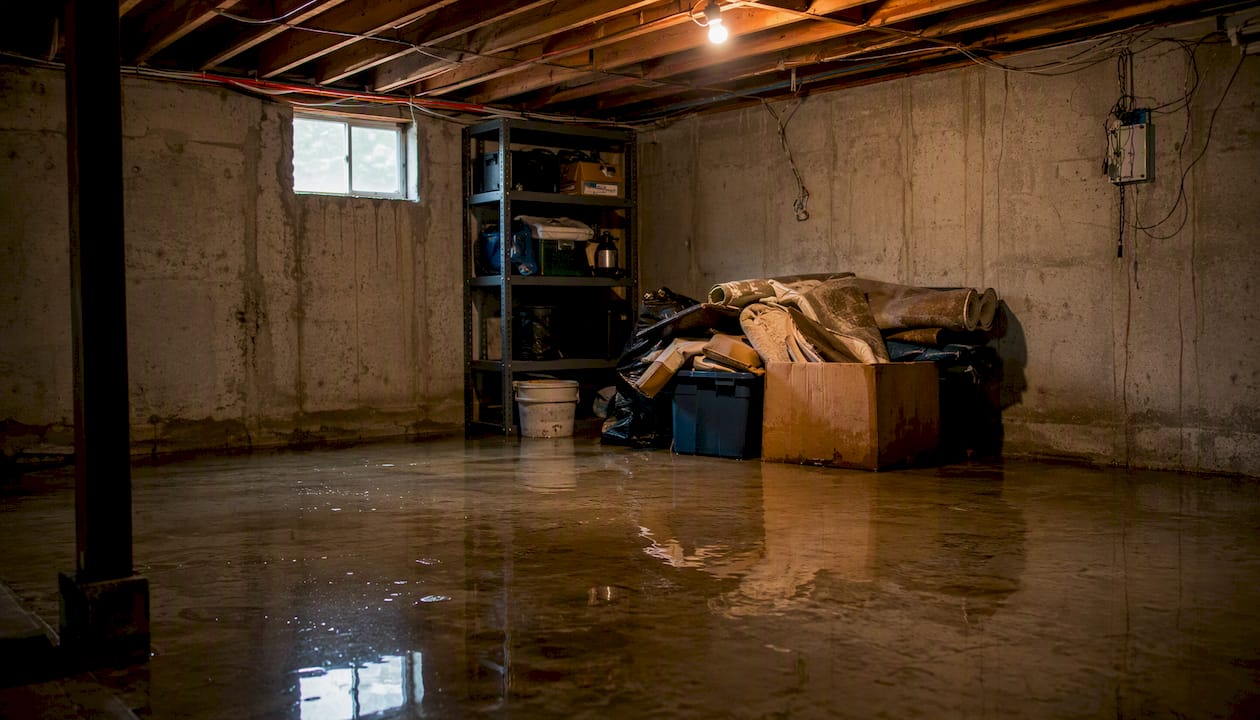
- Sewer or sump pump backup. If a municipal sewer line reverses into your basement or your sump pump fails during a storm, standard policies exclude this damage unless you have added a specific endorsement.
- Gradual leaks and poor maintenance. A slow drip under the kitchen sink that goes unrepaired for six months is not a sudden event. Insurers treat the resulting rot and mold as a maintenance failure.
- Mold from unresolved issues. Mold, rot, and ongoing seepage are typically excluded unless they result directly from a covered sudden event that was promptly reported and mitigated.
- Wear and tear. An aging water heater that corrodes and eventually leaks is a maintenance issue, not an accident.
- Earth movement. Water intrusion caused by foundation settling or soil movement is excluded.
A realistic scenario: you notice a small water stain on the ceiling and assume it is minor. Six months later, the drywall is saturated and mold has spread behind the wall. The insurer's adjuster finds evidence of a long-running slow leak. The claim is denied because the damage is categorized as neglect, not an accidental event. This is one of the most common coverage gaps homeowners encounter.
Pro Tip: Insurers expect you to act as a "prudent homeowner." Routine maintenance — checking supply lines annually, inspecting your roof after storms, testing your sump pump each spring — creates a documented record that you are managing your home responsibly. That record matters if a claim is ever disputed.
Optional coverages that fill the most common gaps
A standard policy leaves real holes. These endorsements and separate policies are worth reviewing with your agent.
Flood insurance (NFIP). Flood damage is excluded from standard homeowners policies; you need a separate flood policy. The National Flood Insurance Program (NFIP), administered by FEMA, is the primary source of flood coverage for U.S. homeowners. NFIP policies are available in participating communities and can cover both your home's structure and its contents. If your property sits in a high-risk flood zone, your mortgage lender likely requires flood insurance. Private flood policies are also available and sometimes offer higher limits or broader terms than NFIP.
Sewer-backup / sump-pump endorsement. This add-on covers damage from a backed-up drain, sewer line reversal, or sump pump failure. It is one of the most affordable endorsements available and one of the most overlooked.
Mold coverage endorsement. Limited mold coverage can sometimes be added to a policy, though terms vary widely by carrier. Coverage usually applies only to mold that results from a covered peril.
Service line coverage. This endorsement covers the underground pipes and utility lines that run from the street to your home. A water main break on your property side of the meter is your financial responsibility without it.
| Endorsement | What It Covers | Who Needs It Most |
|---|---|---|
| NFIP flood policy | Surface water, storm surge, riverine flooding | Homes in flood zones; coastal properties |
| Sewer-backup / sump pump | Drain reversal, sump pump failure | Homes with basements; older plumbing |
| Mold endorsement | Mold from a covered sudden event | Humid climates; homes with prior water history |
| Service line coverage | Underground pipes from street to home | Older homes with aging infrastructure |
Pro Tip: If your home has a basement, you almost certainly need a sewer-backup endorsement. Basement flooding from a backed-up drain is one of the most frequent water claims, and it is excluded from virtually every standard policy.
How insurers decide whether your claim is covered
Three factors drive nearly every coverage determination: the source of the water, how long the damage was present, and what you did (or did not do) about it.
The decision flow looks like this:
- Identify the source. Did water come from internal plumbing (covered if sudden), a sewer line (excluded without endorsement), or outside the home (excluded as flood)?
- Assess the timeline. Was the event sudden and recent, or has damage been accumulating over weeks or months?
- Review homeowner response. Did you report promptly, stop the source, and take reasonable steps to limit further damage?
- Insurer determination. Based on those three factors, the adjuster classifies the event as covered, excluded, or partially covered.
Insurers can deny claims when homeowners delay reporting or fail to make timely repairs. Even if the original event was accidental, damage that accumulates after you became aware of a problem is likely to be treated as a maintenance issue. Insurers prioritize the leak's source and duration — subsequent damage from a leak left unaddressed is typically denied regardless of how the leak started.
Pro Tip: Reporting quickly does two things: it starts the clock on your claim and it signals to the insurer that you acted responsibly. A same-day call to your agent after discovering water damage is almost always the right move.
Water damage categories: why contamination level matters
Restoration professionals classify water damage into three categories based on contamination level. These categories, used by restorers and recognized by insurers, directly affect remediation protocols, health risk, and the cost of your claim.
| Category | Water Source | Health Risk | Typical Outcome |
|---|---|---|---|
| Category 1 (clean water) | Broken supply line, appliance water line, clean toilet tank | Low | Drying and cleaning usually sufficient |
| Category 2 (gray water) | Washing machine discharge, dishwasher overflow, toilet bowl overflow | Moderate | Disinfection required; some materials may need replacement |
| Category 3 (black water) | Sewage backup, floodwater, rising groundwater | High | Most porous materials must be replaced; full remediation required |
Restoration professionals classify water damage into these three categories to set the appropriate safety and remediation protocols. Category 1 events are the most straightforward: dry it out, check for secondary moisture, and move on. Category 3 is a different situation entirely. Sewage-contaminated water saturates drywall, insulation, and flooring with pathogens that cannot be cleaned out — those materials must be removed and replaced.
The contamination category also influences whether your contents are repairable or must be replaced, which is a significant cost driver in any claim. A sofa soaked by a burst pipe (Category 1) can often be dried and restored. The same sofa soaked by sewage backup (Category 3) goes to the dumpster. For professional mold remediation after a Category 2 or 3 event, certified remediation services can document the scope of work in a way that supports your claim.
What to do immediately after water damage
Speed and documentation are the two things that most influence whether a claim is approved.
- Ensure safety first. Turn off electricity to affected areas before entering standing water. If you smell gas, leave and call your utility company.
- Stop the source. Shut off the main water supply if a pipe has burst. If the source is a roof opening, cover it with a tarp.
- Call emergency services or a restoration company if the damage is extensive or if Category 2/3 water is involved.
- Document everything before cleanup. Take timestamped photos and video of all affected areas, damaged belongings, and the source of the water. Note serial numbers on appliances.
- Begin reasonable mitigation. Extract standing water, move undamaged belongings out of the affected area, and place fans to begin drying. State insurance guidance consistently advises homeowners to perform reasonable mitigation promptly — failure to do so can jeopardize coverage.
- Contact your insurance agent. Report the event the same day if possible. Ask specifically what emergency repairs you are authorized to make before an adjuster visits.
- Keep all receipts. Emergency mitigation costs, hotel stays, and temporary repairs are often reimbursable. No receipt means no reimbursement.
What to photograph: the water source, all affected rooms from multiple angles, damaged belongings with close-ups, any visible mold or structural damage, and the meter or shut-off valve you used to stop the flow.
Emergency repairs — tarping a roof, boarding a broken window, extracting standing water — are generally allowed without prior insurer approval. Major structural repairs should wait for adjuster direction unless delay would cause additional damage.
Costs, deductibles, and what to expect from a claim
Your deductible applies before your insurer pays anything. Most standard homeowners policies carry a single deductible for dwelling and personal property claims. Flood policies issued through NFIP carry their own separate deductible, which applies independently of your homeowners policy deductible.
Key cost drivers in water damage claims:
- Contamination category. Category 3 remediation costs significantly more than Category 1 because of required material replacement and safety protocols.
- Square footage affected. A localized pipe burst under a sink costs far less to remediate than a burst pipe that runs through three floors.
- Structural vs. contents damage. Structural repairs (subfloor, drywall, framing) tend to be the largest line items; contents replacement adds to that total.
- Mold development. If mold is present, remediation costs increase and the timeline extends.
Filing a claim can affect your premium at renewal, particularly if you file multiple claims in a short period. Preventive measures — installing water leak detectors, maintaining appliances, and understanding why insurers require home maintenance — reduce both your risk and your long-term premium exposure.
Pro Tip: Before filing a small claim, compare the repair estimate to your deductible. If the damage is only slightly above your deductible, paying out of pocket may cost less over time than the premium increase that follows a filed claim.
When your water damage affects a neighbor's property
Water does not respect property lines. If a pipe in your home bursts and water migrates into an adjacent unit or a neighbor's basement, liability coverage in your homeowners policy may apply.
Standard homeowners policies include personal liability coverage, which can pay for property damage or bodily injury you cause to others. If your overflowing bathtub damages the ceiling of the apartment below you, your liability coverage can cover the neighbor's repair costs up to your policy's liability limit. Your dwelling coverage handles your own structural damage; their damage falls under your liability section.
A few important boundaries: liability coverage does not apply if the damage to your neighbor was caused by flooding (an excluded peril) or by a condition you knew about and failed to fix. If a slow leak in your wall eventually damages a shared wall or a neighbor's property, insurers may treat that as negligence rather than an accidental event, which can complicate or eliminate liability coverage.
If you live in a condo, the interaction between your HO-6 policy and the building's master policy adds another layer. Know which walls and systems your policy covers versus what the building's policy handles.
How weather events like hurricanes and heavy rain are treated
Weather-related water damage is one of the most misunderstood areas of homeowners coverage. The key distinction is not the weather event itself — it is the path the water took to reach your home.
Wind-driven rain that enters through a roof opening or broken window created by a covered windstorm is generally covered under your dwelling coverage. The wind damage is the covered peril; the resulting water intrusion follows.
Flooding from heavy rain that enters your home at ground level — through doors, foundation cracks, or overwhelmed drainage — is treated as flood damage and excluded from standard policies. The same storm can produce both covered and excluded damage in the same house. Water that came through a wind-damaged roof section: covered. Water that rose from the ground and entered through the basement: excluded.
Hurricane damage follows the same logic. Wind damage and wind-driven rain through a breach in the structure are typically covered. Storm surge and rising water are flood events, excluded without a separate flood damage coverage policy. Some coastal states also apply a separate hurricane or windstorm deductible, which is higher than the standard deductible and triggers specifically for named storms. Check your declarations page if you live in a coastal or hurricane-prone area.
On-premises plumbing versus external water sources
Your homeowners policy is designed around your home's systems. That boundary matters when water originates outside your property.
On-premises plumbing failures — a burst pipe inside your walls, a failed water heater, a broken supply line under your sink — are internal events. If they are sudden and accidental, they fall squarely within standard homeowners coverage. You own those pipes; your policy covers them.
Municipal water main breaks are a different situation. If a city water main breaks and water backs up into your home through your service line or flooding, that is an external event. Standard homeowners policies do not cover damage from a municipal main break. Your recourse is typically a claim against the municipality, which may or may not accept liability depending on local law and the circumstances of the break.
Service line coverage, available as an endorsement, covers the pipe that runs from the city main to your home's meter. That stretch of pipe is your responsibility, not the city's, and a failure there can be expensive. Without the endorsement, a break in that line is an out-of-pocket repair. For more on how floods, fires, and storms interact with your homeowners policy, the distinction between internal and external water sources is covered in detail.
Key Takeaways
Standard homeowners insurance covers sudden, accidental internal water events but excludes flooding, sewer backups, and damage from gradual leaks or neglect — and the right endorsements close those gaps before a claim happens.
| Point | Details |
|---|---|
| Sudden vs. gradual rule | Sudden, accidental events are covered; gradual leaks and maintenance failures are typically excluded. |
| Common exclusions | Flooding, sewer backup, mold from unresolved leaks, and wear and tear are not covered by standard policies. |
| Endorsements to consider | Flood (NFIP), sewer-backup, mold, and service line coverage each fill specific gaps a standard policy leaves open. |
| Claims checklist | Document immediately, mitigate promptly, and report the same day to protect your coverage. |
| M F and T North America | An independent agency that reviews your homeowners policy for water-coverage gaps and recommends the right endorsements for your home. |
What independent agents see that most homeowners miss
Most homeowners assume their policy covers water damage in a general sense. What they find out at claim time is that "water damage" is not a single coverage category. It is a collection of specific perils, each with its own rules, exclusions, and optional add-ons.
The two mistakes that come up most often in policy reviews: skipping the sewer-backup endorsement because it sounds unlikely ("my drains have never backed up"), and assuming mold is automatically covered because the water event that caused it was covered. Neither assumption holds up under a real claim.
When reviewing a homeowners policy for water risk, the questions worth asking are: Does the home have a basement? How old is the plumbing? Is the property in or near a flood zone? Has there been any prior water damage? Those answers determine which endorsements are worth adding and which risks are already well-covered.
If you are preparing for a policy review, have your current declarations page, any recent inspection reports, and receipts for recent plumbing or roof repairs ready. That documentation makes the conversation faster and the recommendations more precise.
Get a water coverage review from M F and T North America
Knowing the gaps in your homeowners policy is the first step. Closing them before a pipe bursts or a storm rolls through is the part that actually protects you.
M F and T North America is an independent insurance agency based in Arlington, MA, with over 30 years of experience helping homeowners across multiple states find coverage that fits their actual risk. As an independent agency, we work with multiple carriers, which means we can compare options for flood endorsements, sewer-backup coverage, and mold riders rather than pushing a single company's product. Bring your current declarations page, any recent inspection reports, photos of vulnerable areas (basement, roof, aging appliances), and recent repair receipts. We will identify the gaps and recommend the right add-ons for your home.
Request a free homeowners policy review or visit our homeowners insurance services page to learn more about what we cover.
Useful sources and further reading
- Flood Insurance — FEMA: The primary federal resource for understanding the National Flood Insurance Program (NFIP), eligibility, and how to purchase flood coverage in participating communities.
- When are water damage and mold covered by insurance? — Texas Department of Insurance (TDI): Plain-language guidance on the sudden vs. gradual rule, covered events, and mold coverage — useful for any U.S. homeowner, not just Texans.
- Leaks, water damage and mold — Washington Office of the Insurance Commissioner (WA OIC): State regulator guidance on homeowner responsibilities, mitigation expectations, and what triggers a denial.
- Three Categories of Water Damage — SERVPRO: Explains the Category 1/2/3 classification system used by restoration professionals and how contamination level affects remediation scope.
- What isn't covered by homeowners insurance? — Liberty Mutual: A clear summary of standard exclusions, including mold, rot, and seepage, with context on when limited coverage may apply.
This article provides general information about homeowners insurance and is not a substitute for professional insurance advice. Coverage terms vary by carrier, state, and policy. Confirm your specific coverage details with a licensed insurance professional or your state's insurance department.