
A reliable home insurance policy review comes down to four focused steps: use your declarations page as the roadmap, verify dwelling and contents valuation methods, check limits and deductibles for gaps (especially flood and earthquake), and take three documented actions with your agent before renewal. The NAIC recommends doing this annually, and Mfandtna's independent agents have been walking homeowners through exactly this process for over 30 years.
Start here. Pull out your declarations page right now and run through this quick checklist:
- Check the dec page: Confirm named insured, policy period, coverage limits (A–F), deductibles, and premium.
- Verify dwelling valuation: Is your dwelling limit based on replacement cost or actual cash value (ACV)? Replacement cost pays without depreciation; ACV does not.
- Spot coverage gaps: Standard policies exclude flood, earthquake, and sewer backup. Do you have separate coverage for any of these?
- Review endorsements: Confirm every rider you're paying for still applies, and check whether new ones are needed (pool, home office, solar panels).
- Prepare a loss scenario: Estimate what it would cost to rebuild your home from scratch, then compare that number to your dwelling limit.
- Schedule agent time: Book a call or meeting 4–6 weeks before your renewal date, and bring your documents.
Table of Contents
- What are the home insurance policy review steps you should follow?
- How do you read the declarations page and what fields matter most?
- Which coverage areas do you need to verify during a policy review?
- How do replacement cost and ACV affect what you actually get paid?
- How do deductibles and discounts affect your premium and out-of-pocket risk?
- What coverage gaps do standard home insurance policies leave?
- What should you ask your agent and which documents should you bring?
- How often should you review your policy and how long does it take?
- What should you do if you find a problem during your review?
- How Mfandtna supports homeowners through a policy review
- Key Takeaways
- What a real policy review looks like in practice
- Ready to review your homeowners policy with expert help?
- Useful sources and references
What are the home insurance policy review steps you should follow?
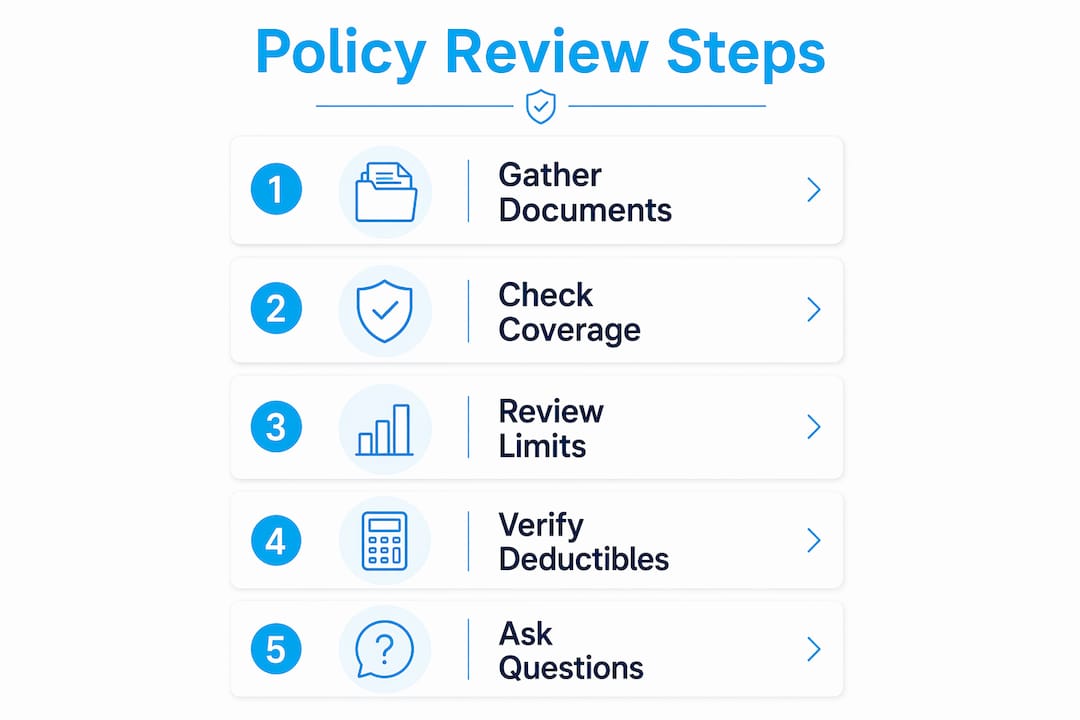
A focused review follows a clear sequence. Work through it once a year, and again after any major change to your home or household.
-
Gather your documents. Collect your full policy packet, declarations page, all endorsements and riders, recent receipts for high-value purchases, renovation permits, contractor estimates, and your mortgage lender's insurance requirements. If you don't have a paper copy, log in to your insurer's online portal or call and request one. The NAIC advises contacting the insurance company directly (not just your agent) if you haven't received your policy packet within 30 days of purchase.
-
Record the dec-page fields. Write down or screenshot: named insured, property address, policy number, policy period (effective and expiration dates), coverage A–F limits, deductibles, endorsements listed, and total premium. These numbers drive every check that follows.
-
Cross-check limits against current needs. Compare your dwelling limit to a current rebuild estimate. Compare personal property limits to your home inventory total. Flag any gap between what the policy says and what you'd actually need.
-
Read the exclusions and endorsements. Endorsements can override standard coverage language. An exclusion you missed two years ago may now be relevant if you added a pool, started a home business, or installed solar panels.
-
Run a quantified loss scenario. Estimate the cost to rebuild your home, subtract your deductible, and apply your valuation method (replacement cost or ACV). The U.S. Bank review checklist recommends bringing this scenario to your agent to test how the policy actually performs against a real loss.
-
Prepare your agent questions. Write down specific questions before the call (see Section 8 for a ready-to-use list). Bring your home inventory, renovation records, and any receipts for scheduled items.
-
Meet or call your agent. Walk through your findings, request any endorsements or limit changes, and confirm the effective date of each change.
-
Confirm everything in writing. After changes are processed, review the updated declarations page and save all documents in a secure location.
Pro Tip: Run your loss scenario before the agent call, not during it. Estimate your rebuild cost per square foot using a local contractor's ballpark figure, multiply by your home's square footage, then subtract your deductible. Bring that number to the conversation. It often reveals a gap worth fixing before renewal.
How do you read the declarations page and what fields matter most?
The declarations page is the single most useful document in your policy packet. Think of it as the policy's index: it tells you who is covered, what is covered, for how much, and for how long. Every other check in your review starts here.

According to LegalClarity's policy reading guide, policies follow a predictable structure (declarations, coverages A–F, exclusions, endorsements, conditions), and endorsements can override standard language wherever there's a conflict. That's why the dec page alone isn't enough; you have to follow its references into the full policy.
| Dec-Page Field | What It Tells You | How to Check It in the Full Policy |
|---|---|---|
| Named insured | Who is legally covered | Verify spelling matches your legal name; update after marriage or divorce |
| Policy period | Effective and expiration dates | Confirm coverage hasn't lapsed; check renewal notice timing |
| Property address | Location being insured | Confirm address is exact; a transposed digit can delay a claim |
| Coverage A (Dwelling) | Rebuild limit for the structure | Compare to a current rebuild estimate, not market value |
| Coverage B (Other structures) | Detached garage, fence, shed | Usually 10% of Coverage A; verify it covers your structures |
| Coverage C (Personal property) | Contents replacement limit | Compare to your home inventory total |
| Coverage D (Loss of use / ALE) | Living expenses if displaced | Check whether it's a dollar cap or a time cap |
| Coverage E (Liability) | Bodily injury and property damage | Check limit vs. your net worth; consider umbrella if needed |
| Coverage F (Medical payments) | Guest medical costs | Typically a smaller fixed limit; verify it's still adequate |
| Deductibles | Your out-of-pocket before insurer pays | Note flat-dollar vs. percentage-based (wind/hail) deductibles |
| Endorsements listed | Policy modifications in effect | Pull each endorsement document and read its specific terms |
| Premium | Annual cost | Use as a baseline when comparing quotes at renewal |
Which coverage areas do you need to verify during a policy review?
Coverage verification is where most homeowners find the gaps they didn't know they had. Work through each bucket carefully.
Dwelling coverage (Coverage A)
Your dwelling limit should reflect what it costs to rebuild your home from the ground up, not its market value. These two numbers can differ by tens of thousands of dollars. Many policies include an 80% coinsurance requirement: if your dwelling limit falls below 80% of the actual rebuild cost, the insurer may only pay a proportional share of a partial loss. Replacement cost coverage pays the full rebuild amount without depreciation; ACV subtracts depreciation and often leaves a significant gap. For homes in areas with rising construction costs, reviewing valuation method and limits together matters more than looking at the limit alone.
Personal property (Coverage C)
Standard policies set personal property limits at roughly 50% of the dwelling limit. That may sound like a lot until you add up furniture, electronics, appliances, clothing, and kitchen equipment. More importantly, standard policies impose sublimits on jewelry, firearms, electronics, and collectibles. A ring insured for $5,000 three years ago may be worth $8,000 today. A scheduled personal property endorsement (sometimes called a floater) provides item-specific coverage, often with no deductible and broader protection than the base policy.

Liability (Coverage E) and umbrella options
Liability coverage pays for injuries or property damage you cause to others, plus legal defense costs. Check your limit against your current net worth. If your assets have grown since you bought the policy, the standard limit may leave you personally exposed in a lawsuit. A personal umbrella policy layers additional liability coverage over your homeowners and auto policies, typically in $1 million increments, and is worth discussing with your agent if your net worth has increased.
Loss of use / additional living expenses (Coverage D)
This coverage pays for hotel, meals, and other costs if your home becomes uninhabitable after a covered loss. Verify whether your policy states a dollar cap, a time cap, or both. A dollar cap that made sense five years ago may fall short given current hotel rates.
Endorsements and sublimits to check
- Swimming pool: May require a liability endorsement or increase your liability limit.
- Home office or business equipment: Standard policies often cap business property at $2,500 or less.
- Ordinance and law: Pays the added cost to bring a rebuilt structure up to current building codes. Without it, you pay the code-upgrade cost out of pocket.
- Roof age and condition: Some policies shift to ACV for older roofs, which can dramatically reduce a claim payout.
- Solar panels: If you've added solar, confirm whether the panels are covered under Coverage A or require a separate endorsement. A solar installation can affect both your roof coverage and your overall dwelling limit calculation.
- HVAC and mechanical breakdown: Not standard; check if you have or need this endorsement.
How do replacement cost and ACV affect what you actually get paid?
The valuation method your policy uses determines the check you receive after a loss. This is one of the most consequential details in any policy review, and it's easy to overlook when you're focused on the premium.
| Valuation Method | How It Works | Best For | Potential Downside |
|---|---|---|---|
| Actual Cash Value (ACV) | Pays replacement cost minus depreciation | Lower-premium budgets | Significant out-of-pocket gap on older homes or contents |
| Replacement Cost Value (RCV) | Pays full cost to rebuild or replace, no depreciation deduction | Most homeowners | Higher premium than ACV |
| Guaranteed Replacement Cost | Pays full rebuild cost even if it exceeds the policy limit | High-value or hard-to-price homes | Available from fewer insurers; higher premium |
| Extended Replacement Cost | Adds a buffer above the stated dwelling limit | Homes in areas with volatile construction costs | Buffer may not be enough after a major regional disaster |
Replacement cost coverage pays the full repair or replacement cost without subtracting for depreciation. ACV subtracts depreciation, which can leave a gap that surprises homeowners at claim time.
Here's a simple way to test your dwelling limit. Get a rough per-square-foot rebuild cost from a local contractor (or use your insurer's estimator). Multiply by your home's square footage. Compare that number to your Coverage A limit. If the limit is lower, you may be underinsured. Then subtract your deductible from the rebuild cost to see your worst-case out-of-pocket exposure.
Pro Tip: Run this same scenario for your personal property. Walk through your home room by room and estimate what it would cost to replace everything at today's prices. Compare that total to your Coverage C limit. If the gap is large, ask your agent about increasing the limit or switching to replacement cost for contents.
How do deductibles and discounts affect your premium and out-of-pocket risk?
Deductibles and discounts are the two levers most homeowners can actually control. Understanding the tradeoff between them is worth a few minutes of math.
Flat-dollar vs. percentage deductibles: Most policies offer a flat-dollar deductible ($500, $1,000, $2,500) for standard losses. But many policies in coastal or storm-prone areas use a percentage-based deductible for wind, hail, or hurricane damage. A 2% deductible on a $400,000 dwelling means $8,000 out of pocket before the insurer pays anything on a wind claim. That's a very different number than a flat $1,000. Check your dec page carefully for separate deductible lines.
Raising your deductible: A higher deductible lowers your annual premium, but only makes sense if you can comfortably cover that amount after a loss. NAIC notes that raising your deductible is one of the primary ways to reduce premium, but you must be able to afford the higher out-of-pocket cost during a claim.
Common discounts to ask about:
- Multi-policy (bundling home and auto with the same insurer)
- New roof or wind-mitigation improvements
- Security systems, smoke detectors, or deadbolt locks
- Claims-free history
- Membership discounts (AARP, AAA, and some professional or alumni organizations)
- New home or recently renovated home
You can find additional strategies for lowering your homeowners premium on the Mfandtna website. Regular home maintenance, such as keeping up with a caulking inspection cycle, can also support eligibility for maintenance-related discounts and reduce the likelihood of a water-damage claim.
What coverage gaps do standard home insurance policies leave?
Standard homeowners policies leave out several of the most common and costly loss types. Knowing what's excluded is just as important as knowing what's covered.
Flood damage is not covered by any standard homeowners policy. Flood insurance is available through the National Flood Insurance Program (NFIP) or private insurers, but you must buy it separately. Even homeowners who don't live in a designated flood zone can experience flooding from heavy rain or storm surge. Visit FloodSmart.gov to check your flood zone and learn about NFIP coverage options.
Earthquake damage is also excluded from standard policies. Separate earthquake coverage is available as a standalone policy or endorsement, depending on your state and insurer.
Sewer backup is a frequent source of denied claims. Most standard policies exclude water damage that originates from a backed-up drain or sewer line. A sewer-backup endorsement is typically inexpensive and worth adding.
Ordinance and law gaps catch many homeowners off guard after a partial loss. If a fire damages 40% of your home and local building codes require the entire structure to be rebuilt to current standards, the added cost of code compliance comes out of your pocket without this endorsement.
Home business exposures are another common gap. Standard policies often cap business property coverage at $2,500 and may exclude liability for business activities conducted at home. A home business endorsement or a separate business owner's policy closes this gap.
For a deeper look at common coverage gaps in homeowners policies, Mfandtna has a practical resource that walks through seven of the most frequently missed exclusions.
What should you ask your agent and which documents should you bring?
A productive agent conversation starts with preparation. Bring the right documents and ask specific questions, and you'll get specific answers.
Documents to bring:
- Current policy packet (dec page plus all endorsements)
- Home inventory with photos, receipts, and serial numbers for high-value items
- Receipts or appraisals for jewelry, art, electronics, or other scheduled items
- Renovation permits and contractor estimates for any recent work
- Mortgage lender's insurance requirements (if applicable)
- Notes from your loss scenario calculation
Questions to ask your agent (based on NAIC guidance):
- Is my dwelling limit adequate to cover a full rebuild at today's construction costs?
- Am I using replacement cost or ACV for my dwelling and personal property?
- What discounts am I currently receiving, and are there others I qualify for?
- Do I have coverage for flood, earthquake, or sewer backup? Should I?
- Is my liability limit appropriate given my current net worth? Do I need an umbrella policy?
- Have there been any changes to my coverage, exclusions, or conditions since last renewal?
- Are there endorsements I should add based on changes to my home or household?
Pro Tip: Send these questions to your agent by email before the call. You'll get more thorough answers, and you'll have a written record of what was discussed.
A home inventory is the single best tool for determining whether your personal property limit is adequate. Walk through each room, photograph or video everything, and store the inventory in a cloud drive or safe deposit box. Update it during every annual review.
For answers to common policy questions before your agent call, the Mfandtna homeowners insurance FAQ covers the most frequently asked topics.
How often should you review your policy and how long does it take?
Once a year is the baseline. The NAIC frames the annual check-up as an adequacy assessment, not just a premium check. The goal is to confirm that coverage is neither too little nor too much, and that no gaps have opened up since the last review.
Beyond the annual review, schedule an additional check whenever any of these trigger events occur:
- A major renovation or addition to your home
- A significant purchase (jewelry, art, electronics, a boat)
- A change in occupancy (renting out a room, a child moving in or out)
- A new pool, trampoline, or other liability-generating feature
- A home business or side income started from your home
- A filed claim (to understand how it affects your premium and renewal terms)
Timing matters. Start your review 4–6 weeks before your renewal date. That buffer gives you time to request endorsements, get quotes from other carriers if needed, and avoid accidentally creating a coverage gap if your insurer requires underwriting changes before renewing.
How long does a review take? A focused self-review with documents in hand typically takes 30–90 minutes. A review with your agent, when you come prepared, usually runs 30–60 minutes. The preparation time (gathering documents, running a loss scenario, writing your questions) is what most homeowners underestimate.
What should you do if you find a problem during your review?
Finding a gap or an outdated limit is the whole point of the exercise. Here's how to fix it efficiently.
-
Document the specific issue. Note the policy section, the current limit or exclusion, and what you want changed. Be precise: "Coverage A limit is $320,000; current rebuild estimate is $410,000. Request increase to $420,000."
-
Contact your agent or the insurer's service department. Most changes require a written request or electronic signature. Reference your policy number and the specific section you want amended.
-
Understand the timeline. Minor changes (adding a sewer-backup endorsement, updating a scheduled item value) can take effect the same day or within a few days. Significant limit increases or new risk types (adding a pool, increasing liability to umbrella levels) may require formal underwriting review, which can take longer.
-
Confirm the effective date. Never assume a change is in effect until you have written confirmation. A coverage gap, even a brief one, can create problems if a loss occurs before the endorsement is processed.
-
Review the updated declarations page. When the change is processed, compare the new dec page line by line against what you requested. Confirm the effective date, the new limit or endorsement, and the updated premium.
-
Save all updated documents. File the new dec page and endorsements with your policy packet. Store copies in a secure location outside your home (cloud storage, safe deposit box).
If you haven't received your policy packet or renewal notice, NAIC guidance is clear: contact the insurance company directly, not just your agent. Insurers are required to deliver the policy and renewal notices; if yours haven't arrived, follow up promptly.
How Mfandtna supports homeowners through a policy review
Mfandtna is an independent insurance agency based in Arlington, MA, with over 30 years of experience helping homeowners, families, and businesses find coverage that fits their actual needs. As an independent agency, Mfandtna works with multiple carriers, which means the recommendation you get is based on your situation, not a single company's product lineup.
What a Mfandtna policy review includes:
- Document intake and dec-page capture (all coverage sections, deductibles, endorsements)
- Rebuild cost estimation to test dwelling limit adequacy
- Endorsement recommendations based on your property and household profile
- Identification of coverage gaps (flood, earthquake, sewer backup, ordinance and law)
- Assistance with submissions to carriers for limit changes or new endorsements
- Follow-up to confirm effective dates and updated dec-page accuracy
Educational resources available from Mfandtna:
- How to Read a Homeowners Insurance Policy: a guided walkthrough of policy sections and how to interpret them
- Homeowners Insurance FAQ: answers to the most common policy questions
- Types of Homeowners Insurance Coverage: a detailed breakdown of coverage A–F and valuation types
[Author credentials and background for Mike to be inserted here.]
[Client satisfaction case studies and testimonials to be inserted here, pending legal and compliance review.]
Key Takeaways
A thorough home insurance policy review starts with the declarations page and ends with written confirmation of every change you request.
| Point | Details |
|---|---|
| Start with the dec page | Record all Coverage A–F limits, deductibles, endorsements, and the policy period before anything else. |
| Check valuation method | Replacement cost and ACV produce very different claim payouts; always review both the limit and the method together. |
| Close the standard gaps | Flood, earthquake, and sewer backup are excluded from standard policies; ask your agent about separate coverage for each. |
| Review 4–6 weeks before renewal | Starting early gives you time to request endorsements, compare quotes, and avoid coverage gaps during underwriting. |
| Mfandtna can do this with you | Mfandtna's independent agents review your documents, run rebuild estimates, and recommend endorsements across multiple carriers. |
What a real policy review looks like in practice
Most homeowners treat a policy review as a paperwork chore. The ones who get the most out of it treat it as a stress test.
When I think about how a genuinely useful review unfolds, it starts before the agent call. The homeowner pulls the dec page, records the Coverage A limit, and then does one uncomfortable calculation: what would it actually cost to rebuild this house today? Not the market value, not last year's estimate. Today's number, with current labor and material costs. That figure, compared to the dwelling limit on the dec page, tells you more about your coverage than any other single check.
The next step most people skip is reading the endorsements. Not skimming them. Reading them. An endorsement that excludes coverage for a home office you started two years ago, or that shifts your roof to ACV because it's over 15 years old, changes your claim outcome in ways the dec page doesn't warn you about. The dec page lists the endorsement; it doesn't summarize what it does to your coverage.
The agent conversation is most productive when you arrive with a specific number and a specific question. "My rebuild estimate is $410,000 and my Coverage A limit is $320,000. What's the most cost-effective way to close that gap?" is a question that gets a useful answer. "Is my coverage okay?" is not. The difference between those two conversations is the preparation you do before you pick up the phone.
One more thing worth saying plainly: the annual review isn't about finding something wrong. Most years, you'll confirm that your coverage still fits and move on. But the years when something has changed, and you catch it before a claim rather than after, are the years the review pays for itself many times over.
Ready to review your homeowners policy with expert help?
Reviewing your homeowners policy on your own is absolutely doable, especially with this checklist in hand. But if you'd rather have an experienced agent walk through the documents with you, run the rebuild scenario, and flag the endorsements worth adding, Mfandtna is ready to help.
Mfandtna's independent agents work with multiple carriers and have spent over 30 years helping homeowners across multiple states find coverage that actually holds up at claim time. There's no pressure and no obligation. You bring your dec page and your questions; the team handles the rest, from document review to carrier submissions to confirming effective dates on any changes.
Schedule a homeowners insurance review with Mfandtna today, or get a quick quote at mfandtna.com/free-mass-insurance-quotes to see how your current coverage compares.
Useful sources and references
| Source | Description |
|---|---|
| NAIC Annual Insurance Check-up | Regulator guidance on annual review cadence, coverage gaps, agent questions, and home inventory. |
| NAIC Consumer Homeowners Guide (PDF) | Detailed consumer guidance on policy receipt, reading your policy, and contacting your insurer. |
| NAIC Homeowners Insurance Tips | Practical tips on deductibles, valuation methods, discounts, and bundling. |
| U.S. Bank Insurance Review Checklist | Annual review workflow with a focus on the declarations page and quantified loss scenarios. |
| LegalClarity: How to Read a Homeowners Policy | Explains policy structure (declarations, coverages A–F, exclusions, endorsements, conditions). |
| OnWealth: How to Review Your Homeowners Policy | Practical checklist covering dwelling limits, valuation methods, personal property, and ALE. |
| Mfandtna Homeowners Insurance | Mfandtna's homeowners insurance service page for professional policy reviews and quotes. |
| FloodSmart.gov | FEMA's National Flood Insurance Program resource for flood zone lookup and NFIP coverage details. (Visit directly; not linked here.) |