
Most new homeowners leave obvious gaps in their coverage without realizing it. The three most common insurance coverage mistakes new homeowners make are insuring for market value instead of rebuild cost, skipping flood and sewer-backup endorsements, and ignoring personal-property sub-limits on valuables. Fix these first:
- Check your declarations page for Coverage A (dwelling limit) and confirm it reflects rebuild cost, not purchase price.
- Confirm your exclusions — look for flood, earthquake, and sewer backup, then ask your agent about endorsements.
- Start a basic home inventory with photos, receipts, and serial numbers stored in the cloud.
The Insurance Information Institute lists insuring to market value and dropping flood coverage among the costliest homeowner errors. FEMA's National Flood Insurance Program (NFIP) and your state's insurance department are the two best public resources to check next. If your declarations page raises any questions, a 15-minute call with an agent at M F and T North America can clarify everything before a gap becomes a loss.
Pro Tip: Pull up your declarations page right now. If Coverage A is close to what you paid for the house rather than what it would cost to rebuild it, that's a red flag worth addressing today.
Key Takeaways
Avoiding insurance coverage mistakes as a new homeowner comes down to three actions: verify your rebuild cost, add missing endorsements, and document your belongings before a loss occurs.
| Point | Details |
|---|---|
| Insure to rebuild cost | Coverage A should reflect local rebuild costs, not your purchase price or market value. |
| Add excluded-peril endorsements | Flood, earthquake, and sewer backup are excluded from standard HO-3 policies; endorsements typically cost $20–$200/year each. |
| Maintain a cloud-stored inventory | Fewer than half of homeowners keep an up-to-date inventory; photos and receipts stored off-site protect your personal property claim. |
| Review after every life change | Marriage, renovations, and new valuables all require a policy update within 30 days. |
| M F and T North America | Offers independent policy reviews across multiple carriers to close coverage gaps before a loss occurs. |
Table of Contents
- What happens if your homeowners insurance lapses
- How your deductible choice affects your out-of-pocket risk
- Why major life changes require a policy update
- What policy cancellation or non-renewal actually means for you
- Why your insurer's financial strength rating matters
- Vacation and secondary homes need their own coverage
- Bundling home and auto: what you gain and what to watch
- 9. Insuring for market value instead of what it costs to rebuild
- 10. Choosing the cheapest policy without reading what it actually covers
- 11. Skipping flood, earthquake, or sewer-backup coverage because it seems optional
- 12. Underestimating personal property limits and missing sub-limits on valuables
- 13. Carrying too little liability coverage and skipping an umbrella policy
- 14. Forgetting detached structures and skipping updates after renovations
- 15. Making mistakes when you file a claim (and what to say to an adjuster)
- How to review your policy in the first 90 days after closing
- How an independent agent helps you avoid these mistakes
- What 30 years of policy reviews taught us
- Ready for a policy review? Here's how M F and T North America can help
- Quick recap: what to fix in the next 72 hours
- Sources
What happens if your homeowners insurance lapses
If your coverage lapses, even briefly, your mortgage lender has the right to purchase insurance on your behalf. This is called lender-placed insurance (also known as force-placed insurance), and it protects the lender's interest, not yours. The Washington State Office of the Insurance Commissioner confirms that lenders require homeowners insurance when a mortgage is in place and can act quickly when coverage drops.
Lender-placed policies typically cost significantly more than a standard homeowners policy and cover only the structure. Your personal belongings, liability, and additional living expenses are usually excluded entirely. The lender selects the carrier and the terms. You pay the premium, often rolled into your escrow, with no say in the coverage quality.
Avoiding this is straightforward: set a calendar reminder 45 days before your renewal date, confirm your insurer has your current contact information, and never let a policy lapse while shopping for a better rate. If you're comparing mortgage protection options alongside your homeowners coverage, keep both timelines in sync so neither lapses.
How your deductible choice affects your out-of-pocket risk
Your deductible is the amount you pay before insurance covers a claim. Choosing a higher deductible lowers your annual premium, but it raises your exposure every time something goes wrong. A $2,500 deductible instead of $1,000 might save you $150–$200 per year, but one mid-size claim means $1,500 more out of pocket.
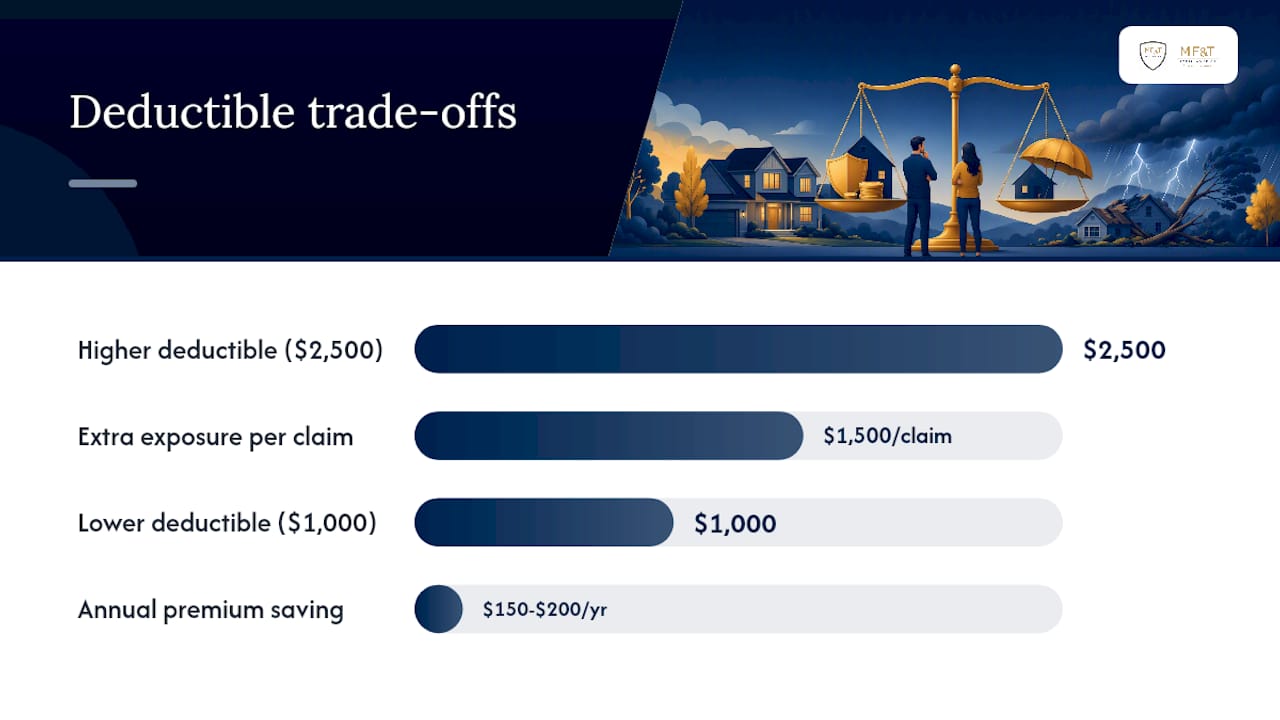
The smarter question is whether you can comfortably cover your deductible from savings without financial strain. If the answer is no, a lower deductible is worth the higher premium. EINSURANCE guidance also points out that filing small claims you could afford to pay yourself can raise your premiums and affect your claims history. So the deductible you choose should reflect both your savings cushion and your tolerance for filing small claims.
Watch for separate wind and hail deductibles in storm-prone states.
Why major life changes require a policy update
Marriage, a new baby, a home office, or a significant inheritance can all change your coverage needs overnight. Most new homeowners set their policy at closing and forget it. That's one of the more avoidable homeowner insurance errors, and it can leave real gaps.

When you marry, your spouse's belongings need to be covered. When you have children, your liability exposure grows. When you start working from home, standard homeowners policies often exclude business equipment and business liability. When you inherit jewelry or art, those items may exceed your policy's sub-limits immediately.
Review your policy within 30 days of any major life change. Call your agent, describe what changed, and ask two direct questions: "Does my current coverage address this?" and "What endorsements should I add?" A quick annual review, tied to your renewal date, catches most of these shifts before they become problems.
What policy cancellation or non-renewal actually means for you
Cancellation and non-renewal are different events with different timelines and different rights. Cancellation mid-term (before your policy expires) can happen for non-payment or material misrepresentation. Non-renewal means the insurer won't offer you another term when your current policy ends.
Both create a coverage gap if you don't act quickly. A gap of even a few days can trigger lender-placed insurance and can make it harder to find a new carrier, since insurers check prior coverage history. Your state's insurance department sets the minimum notice period insurers must give you (typically 30–60 days for non-renewal), so check your state's rules.
If you receive a non-renewal notice, start shopping immediately. Don't wait for the expiration date. Ask your current insurer why the non-renewal was issued, since some reasons (a claims frequency issue, a roof age flag) can be addressed before you lose coverage.
Why your insurer's financial strength rating matters
Choosing a carrier based on price alone without checking its financial strength is one of the quieter common insurance pitfalls. A carrier that can't pay claims is worse than no carrier at all. AM Best, Moody's, and S&P all publish financial strength ratings for insurance companies. An AM Best rating of A or better is a reasonable baseline for a homeowners carrier.
Beyond solvency, check claims satisfaction. J.D. Power publishes annual homeowners insurance satisfaction studies that score carriers on claims handling, communication, and settlement speed. A carrier with a low price and a poor claims reputation may cost you more in time, stress, and out-of-pocket costs when you actually need them.
Ask your agent directly: "What is this carrier's AM Best rating, and how do they rank on J.D. Power's claims satisfaction study?" A good independent agent will have this information ready.
Vacation and secondary homes need their own coverage
A standard homeowners policy covers your primary residence. If you own a vacation home, a cabin, or a secondary property, that structure and its contents are generally not covered under your primary policy. Leaving a secondary home uninsured is one of the more overlooked home insurance gaps new homeowners discover after a loss.

Secondary homes often face higher risk: they sit vacant for extended periods, which increases theft and vandalism exposure, and they may be in areas prone to flooding, wildfires, or severe weather. Insurers treat them differently, and premiums reflect that elevated risk.
If you rent the property out, even occasionally through a short-term rental platform, a standard secondary-home policy may not cover rental activity. You may need a landlord policy or a short-term rental endorsement. Confirm this with your agent before the first guest checks in.
Bundling home and auto: what you gain and what to watch
That's a real saving worth pursuing. The mistake is assuming bundling automatically means better coverage or the best deal on both policies.
Carriers structure bundles to retain customers, not necessarily to provide the strongest coverage on each line. You might get a competitive auto rate but a homeowners policy with lower sub-limits or fewer endorsements than a standalone policy from a different carrier would offer. Always compare the declarations pages side by side, not just the total premium.
A second common bundling error is letting the discount drive the decision on coverage limits. If bundling means accepting a $150,000 Coverage A limit when your home would cost $250,000 to rebuild, the discount isn't worth it. Ask your agent to show you the coverage comparison, not just the price comparison. For guidance on comparing insurance quotes beyond premium, M F and T North America's resource walks through what to look for on each declarations page.
9. Insuring for market value instead of what it costs to rebuild
This is the single most common and most expensive homeowner insurance error. Market value is what a buyer would pay for your home today, including the land. Replacement cost (Coverage A) is what it would cost to rebuild the structure from the ground up if it were destroyed. These numbers are often very different, and insuring to market value can leave you tens of thousands of dollars short after a major loss.
The Insurance Information Institute specifically flags this as a leading mistake. Local construction costs, material prices, and labor rates drive replacement cost, not the real estate market.
How to check your Coverage A:
- Find your declarations page and locate the "Coverage A — Dwelling" limit.
- Compare it to a local contractor's rebuild estimate or your insurer's replacement-cost estimator.
- Ask your agent whether your policy includes an inflation-protection clause that adjusts limits annually.
- Ask about an extended replacement cost endorsement (typically adds 20%–50% above your Coverage A limit) or guaranteed replacement cost if available in your state.
Pro Tip: Ask your agent for a written rebuild-cost estimate using a tool like CoreLogic or RSMeans. If the estimate exceeds your current Coverage A, request an endorsement to close the gap before your next renewal.
10. Choosing the cheapest policy without reading what it actually covers
A lower premium almost always reflects a trade-off somewhere: a higher deductible, lower sub-limits on personal property, fewer available endorsements, or a carrier with a slower claims process. New home insurance mistakes don't get more common than this one.
What lower premiums often reflect:
- Higher all-peril or wind/hail deductibles
- Personal property limits set at actual cash value (ACV) rather than replacement cost
- No sewer-backup or service-line endorsement included
- Narrower claims-handling reputation
Before you decide on price, compare these on every quote:
- Coverage A limit and how it was calculated
- Personal property limit and whether it's ACV or replacement cost
- Available endorsements and their costs
- The carrier's AM Best rating and J.D. Power claims score
Pro Tip: Request a sample declarations page and the exclusions page from each carrier before signing. If an agent won't provide these before you commit, that's a signal worth noting.
Don't assume bundling home and auto always produces the best coverage on both lines. Review each policy's limits independently before accepting a bundle discount.
11. Skipping flood, earthquake, or sewer-backup coverage because it seems optional
Standard HO-3 policies exclude flood, earthquake, sewer backup, mold, and earth movement. According to Readmypolicy, most of these gaps can be closed with endorsements that typically cost $20–$200 per year each, though flood and earthquake usually require separate policies entirely.
FEMA reports that even one inch of floodwater can cause severe damage to a home. Homeowners outside designated high-risk flood zones still file a significant share of NFIP claims, meaning your flood risk isn't zero just because you're not in a mapped floodplain.
| Coverage | Typical Annual Cost | Common Waiting Period |
|---|---|---|
| NFIP flood policy | $20–$200 per year each | 30 days |
| Private flood insurance | $20–$200 per year each | 10–30 days |
| Earthquake endorsement | $100–$300+ (varies by state/zone) | 10–30 days |
| Sewer-backup endorsement | $50–$150 | None (added at renewal or mid-term) |
Action steps:
- Check your flood zone at FEMA's Flood Map Service Center.
- Review your declarations page and exclusions section for flood and earthquake language.
- Ask your agent for NFIP and private flood quotes, then compare waiting periods.
Warning: The NFIP's 30-day waiting period means you cannot buy flood coverage the day before a storm. Add it now, not when a weather event is already forecast.
12. Underestimating personal property limits and missing sub-limits on valuables
Personal property coverage (Coverage C) pays to replace your belongings after a covered loss. Jewelry is often limited to $1,500 per item or $2,500 total. Collectibles, fine art, firearms, and electronics may carry their own sub-limits.
Scheduled personal property coverage (also called a floater or rider) lets you insure specific high-value items at their appraised value, with no sub-limit cap and often broader coverage than the base policy.
Home inventory essentials:
- Make, model, and serial number for electronics and appliances
- Purchase date and price (or current appraised value for jewelry and art)
- Photos or video of each room and its contents
- Receipts and appraisals stored in a cloud folder (Google Drive, Dropbox, or iCloud)
Fewer than half of homeowners maintain an up-to-date home inventory, according to The Insurance Scout's claims analysis. That gap shows up directly in disputed claims.
Pro Tip: Keep a copy of your inventory in the cloud and email yourself a summary annually. If your home is destroyed, you'll need that list to file a complete claim, and memory alone won't be enough.
13. Carrying too little liability coverage and skipping an umbrella policy
Standard homeowners policies typically include $100,000 in personal liability coverage. That limit covers legal costs and damages if someone is injured on your property or you're found liable for property damage. For many new homeowners, $100,000 is not enough.
A single slip-and-fall lawsuit can exceed $100,000 in legal fees and damages before a verdict is reached. If you have a pool, a trampoline, a dog, or you host frequent gatherings, your exposure is higher than average.
Quick checks to assess your liability exposure:
- Do you have significant assets (savings, investments, home equity) that could be targeted in a lawsuit?
- Do you rent out any part of your property?
- Do you have a pool, trampoline, or other attractive-nuisance features?
- Do you run a side business from home?
An umbrella policy adds $1 million or more in liability coverage above your homeowners and auto limits, typically for $150–$300 per year. It layers on top of your existing policies, so your homeowners policy pays first, and the umbrella covers the excess. If your net worth exceeds your current liability limit, an umbrella policy is worth pricing.
14. Forgetting detached structures and skipping updates after renovations
If your Coverage A is $300,000, you have $30,000 for all other structures combined. That may not be enough if you have a large detached garage or a recently installed pool.
Renovations and additions that require an immediate policy review:
- Finished basement or attic conversion
- New deck, patio, or in-ground pool
- Major kitchen or bathroom remodel
- New detached garage or large shed
- Home addition or second story
Notify your insurer within 30 days of completing a significant renovation. Undisclosed renovations are a leading cause of claim disputes. If your renovation increases the rebuild cost of your home and you haven't updated Coverage A, you're underinsured the moment the work is done. For major construction projects, ask your agent about builders risk insurance to cover the structure during the build phase.
15. Making mistakes when you file a claim (and what to say to an adjuster)
The claims process is where coverage gaps and documentation failures become expensive. The Insurance Scout's analysis found that undisclosed renovations, poor documentation, and late reporting are among the leading causes of denied or disputed homeowners claims.
Common claim mistakes:
- Failing to report damage promptly (most policies require notice within 30–60 days)
- Throwing away damaged items before the adjuster inspects them
- Admitting fault or speculating about cause before the investigation
- Filing small claims you could afford to pay yourself, which raises your premium history
What to say and what to avoid with an adjuster:
- Say: "I'm reporting a loss that occurred on [date]. Here is what I observed."
- Avoid: "I think it happened because..." or "It's probably not that bad."
- Say: "I have photos and receipts. When can we schedule an inspection?"
- Avoid: Agreeing to a settlement before you've reviewed all repair estimates.
Claim timeline:
- Discover the damage.
- Notify your insurer within 24–48 hours.
- Document everything with time-stamped photos before cleanup.
- Mitigate further damage (cover a broken window, stop an active leak).
- File the formal claim and keep a folder with all correspondence, estimates, and receipts.
Pro Tip: Keep a dedicated claim folder, physical or digital, for every loss event. Include photos, contractor estimates, adjuster contact information, and every email or call log. This documentation is your strongest protection if a claim is disputed.
How to review your policy in the first 90 days after closing
The first 90 days after closing are the highest-risk window for coverage gaps. Here's a timebound checklist:
Within 30 days:
- Pull your declarations page and verify Coverage A against a rebuild-cost estimate.
- Confirm your mortgagee clause lists your current lender with the correct address.
- Review the exclusions page for flood, earthquake, and sewer backup.
- Ask your agent for endorsement quotes on any excluded peril that applies to your location.
Within 60 days:
- Complete a room-by-room home inventory with photos and receipts.
- Confirm personal property limits and check sub-limits for jewelry, electronics, and collectibles.
- Verify your liability limit and ask your agent whether an umbrella policy makes sense.
Within 90 days:
- Set an annual policy-review calendar reminder tied to your renewal date.
- Set a second reminder for any planned renovation project.
Sample questions to ask your agent:
- "Is my dwelling insured to its full rebuild cost?"
- "Which perils are excluded, and which endorsements would close those gaps?"
- "What are my sub-limits for jewelry, electronics, and collectibles?"
- "Do I need flood or sewer-backup coverage given my location?"
- "What is this carrier's AM Best rating and J.D. Power claims score?"
If you find a gap: call your agent, request an endorsement quote, and confirm the change in writing before assuming it's in effect. Learn how to read your homeowners insurance policy so you can verify changes on your declarations page yourself.
How an independent agent helps you avoid these mistakes
An independent agent works with multiple carriers, which means they can shop your coverage across the market rather than steering you toward one company's products. For new homeowners navigating coverage decisions for the first time, that access matters.
What an independent agent does for you:
- Compares quotes across multiple carriers on coverage quality, not just price
- Reviews your declarations page for underinsurance and missing endorsements
- Sources endorsements for flood, earthquake, sewer backup, and scheduled property
- Advocates on your behalf during a claim dispute
- Conducts annual policy audits to catch gaps created by renovations or life changes
- Monitors renewal notices and alerts you to non-renewal risks before coverage lapses
Pro Tip: Ask your agent to provide a written side-by-side comparison of two policy declarations pages, including limits, deductibles, and available endorsements. That comparison tells you far more than a premium quote alone.
An independent agent can also help you avoid lender-placed insurance by tracking your renewal dates and flagging any carrier non-renewal notices early. If your insurer decides not to renew, your agent starts shopping immediately, not after the gap opens.
What 30 years of policy reviews taught us
At M F and T North America, we've spent over 30 years reviewing homeowners policies for individuals and families across multiple states. The pattern we see most often is not a dramatic coverage failure. It's a quiet one: a Coverage A limit that hasn't been updated since closing, a flood exclusion nobody flagged at settlement, a jewelry sub-limit that covers a fraction of what the client owns.
One client came to us after a kitchen fire. Their Coverage A was set at their purchase price from six years earlier. Local rebuild costs had risen significantly in that time, and they faced a meaningful out-of-pocket gap on the reconstruction. A simple annual review would have caught it.
If you'd like us to review your current policy, send us your declarations page, a list of any recent renovations, and any receipts or appraisals for high-value items. We'll identify gaps and walk you through your options in a no-obligation 15-minute call. Visit our homeowners insurance FAQ for answers to the most common questions before you call.
Ready for a policy review? Here's how M F and T North America can help
Fixing insurance coverage mistakes as a new homeowner is faster and less expensive than most buyers expect. M F and T North America is an independent agency with over 30 years of experience helping homeowners in multiple states find coverage that actually matches their risk, not just their budget.
A 15–20 minute policy review with our team covers your dwelling limit, exclusions, endorsements, liability coverage, and personal property sub-limits. Before your call, gather your current declarations page, any renovation invoices, and receipts or appraisals for valuables. We'll compare your coverage against rebuild-cost benchmarks, flag any gaps, and provide endorsement quotes where needed.
To get started, visit our homeowners insurance service page or request a free quote. No pressure, no obligation. Just a clear picture of where your coverage stands.
Quick recap: what to fix in the next 72 hours
Act within 72 hours of reading this. Mortgage lenders can place expensive force-placed insurance the moment your coverage lapses, and many endorsements (especially flood) carry waiting periods of 10–30 days before they take effect.
- Verify your Coverage A against a rebuild-cost estimate. If it matches your purchase price, call your agent today.
- Check your exclusions page for flood, earthquake, and sewer backup. Request endorsement quotes for any that apply to your location.
- Start your home inventory with a phone walkthrough of each room. Upload photos to a cloud folder before you close the app.
- Set a renewal reminder 45 days before your policy expiration date so you never face a lapse.
- Schedule a policy review with M F and T North America if any of the above raises questions. A 15-minute call now is far less costly than a coverage gap later.
Sources
- How home insurance works | Washington State Office of the Insurance Commissioner
- Readmypolicy
- 10 Common Homeowner Insurance Claim Pitfalls & How to Avoid Them - EINSURANCE
This article is general information, not a substitute for advice from a qualified financial advisor. Consult a qualified financial professional about your own circumstances before acting on anything here.