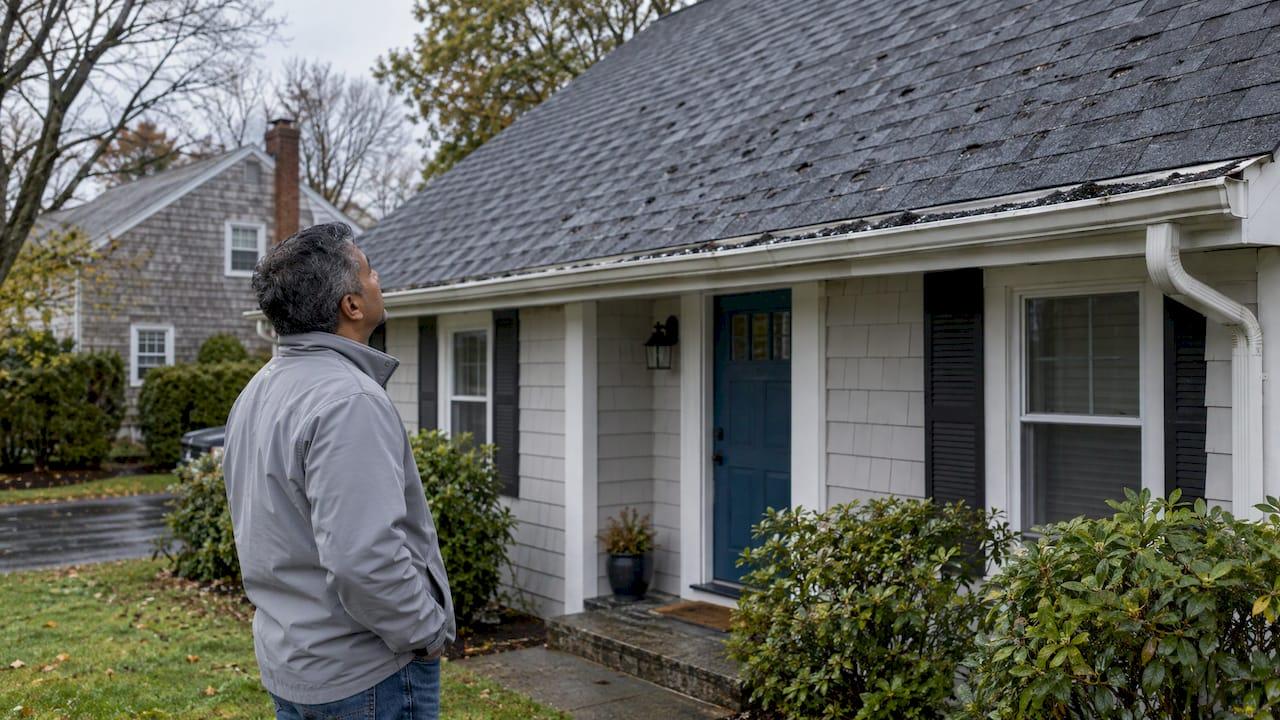
Yes, homeowners insurance can pay for a new roof, but only when a covered event damaged it, such as a hailstorm, a windstorm, a fire or the weight of ice and snow. It does not pay to replace a roof that is simply old or worn out. What you actually receive depends on three things in your policy: the cause of the damage, whether the roof is settled at replacement cost or actual cash value, and your deductible. Below, we walk through each one with worked numbers, so you know where you stand before you call anyone.
TL;DR
- A sudden, accidental event (wind, hail, fire, heavy snow or ice) is what typically triggers roof coverage. Wear, age and lack of maintenance do not.
- Replacement cost coverage pays to replace the roof with like materials without subtracting depreciation. Actual cash value coverage subtracts it, which can leave a large gap on an older roof.
- A wind/hail deductible written as a percentage of your home's insured value can be much larger than a flat deductible, and it can swallow a small roof claim entirely.
- Read your policy's roof terms before storm season, and ask your agent how your roof's age and condition affect coverage at renewal.
Table of Contents
- What homeowners insurance covers on your roof
- How roof age and condition change the answer
- Replacement cost vs. actual cash value: the biggest swing in your payout
- Your deductible can decide whether a claim pays anything
- Filing a roof claim: a step-by-step routine
- Our perspective: the best roof claim starts before the storm
- Review your roof coverage with an independent agent
- If you are a contractor or developer
- FAQ
- Sources
What homeowners insurance covers on your roof
Your roof is part of your home's structure, so it falls under dwelling coverage. Fannie Mae's insurance guide describes dwelling coverage as the part of a standard policy that pays to repair or rebuild the home. The same guide lists the perils homeowners policies typically cover, including fire or lightning, windstorm or hail, falling objects, vandalism and the weight of snow, ice or sleet.
The most common policy type is the HO-3, or special form. According to the National Association of Insurance Commissioners (NAIC), the state regulators' association, an HO-3 covers the home against all perils except those the policy lists as exclusions. In plain terms: if the cause of the damage is not on the exclusion list, the dwelling is generally protected.
The Maryland Insurance Administration puts the principle simply. Homeowners policies typically cover sudden and accidental losses from specific perils, and they do not cover maintenance. That one idea explains most roof claim outcomes.
Damage that is usually covered
- Hail that bruises, cracks or punctures shingles
- Wind that lifts, tears off or creases shingles or flashing
- A tree or large branch that falls on the roof
- Fire or lightning damage
- Roof collapse or damage from the weight of snow, ice or sleet
- Interior water damage that follows a storm opening in the roof
That last item matters. A sample broad-form policy published by the Oklahoma Insurance Department shows the logic: rain or snow damage to the inside of the home is covered when wind or hail first damages the building and creates an opening in the roof or wall. Your own policy wording may differ, so confirm it.
Damage that is usually not covered
- Wear and tear, aging and deterioration
- Faulty or inadequate maintenance
- Flood and earthquake, which Fannie Mae notes are commonly excluded and available as optional add-on coverage
- Damage from birds, rodents or insects
| Cause of roof damage | Typically covered? | What to know |
|---|---|---|
| Hail or wind | Yes, under most policies | A special wind/hail deductible may apply |
| Fallen tree or branch | Yes | Removal of the tree is often handled separately in the policy terms |
| Fire or lightning | Yes | Usually settled under dwelling coverage |
| Weight of snow or ice | Yes | Listed as a typical covered peril |
| Age, wear, deterioration | No | Treated as maintenance |
| Flood or earthquake | Usually excluded | Optional add-on coverage exists |
How roof age and condition change the answer
Two roofs can take the same hailstorm and end up with very different claim results. The reason is condition.
The Maryland Insurance Administration explains that when a covered peril like hail hits a roof that already needed maintenance because of wear or deterioration, the policy may not cover all or part of the claim. If only one section of the roof is damaged, the policy may pay to repair just that section rather than replace the whole roof.
Age also affects how your policy is written. The Texas Department of Insurance says that as roofs get older, some companies switch coverage to actual cash value at renewal, and a company might decline to cover a roof in poor condition at all. It adds that an insurer will not pay for a new roof just because the old one is worn out. The department also says your company should tell you when it changes your coverage, so read your renewal paperwork rather than filing it away.
The Ohio Department of Insurance suggests asking a few questions of your insurer. Does roof age, condition or material affect your premium? Can roof age affect renewal? Is cosmetic-only damage covered? How quickly must you report a loss? Those are good questions for your agent before a storm, not after.
If you want a deeper look at how your shingles, metal or tile affect pricing, our guides on why roof type affects insurance and how roof condition affects premiums cover it. If your house itself is older, this look at older-home premiums explains what to expect.

Replacement cost vs. actual cash value: the biggest swing in your payout
When a covered loss happens, your policy settles it one of two ways.
- Replacement cost value (RCV) pays to repair or replace the damaged part with materials of like kind and quality. The NAIC defines it as the cost to rebuild with like materials and quality.
- Actual cash value (ACV) pays the current replacement cost minus depreciation. The Texas Department of Insurance glossary defines it as the current cost to replace the property minus depreciation.
The Maryland Insurance Administration notes that with RCV, most policies require the work to be completed before you receive full reimbursement. Until then, you will likely receive the cost less depreciation. For a 20-year-old roof destroyed by a covered peril, ACV will most likely be far less than the cost of a new one.
The Ohio Department of Insurance adds a timing detail: many policies expect repairs to be finished within a reasonable period, such as 180 days from the date of loss. After that, the settlement may be limited to actual cash value. Check your policy for its own deadline.
A simple worked example
These numbers are ours, for illustration only. Say a hailstorm damages your roof and the replacement quote is $15,000.
- Under RCV: after you finish the work, the insurer pays the $15,000 cost, less your deductible.
- Under ACV: if the insurer calculates $6,000 of depreciation because of the roof's age, it pays $9,000, less your deductible. You cover the rest.
Same storm, same roof, a $6,000 difference. That is why it helps to know which basis your policy uses before the claim. For a plain-language walk-through of how claims are paid in two stages, see our guide to replacement cost vs. ACV.
One more coverage to know about is ordinance or law coverage. The NAIC describes it as paying the extra cost of rebuilding to meet new or updated building codes that did not exist when the home was built. If your town's code has changed since your roof went on, ask whether your policy includes it.
Your deductible can decide whether a claim pays anything

Many homeowners are surprised here. Some policies replace the normal deductible with a special one for wind, hail or hurricane damage. The Maryland Insurance Administration says it can be written as a flat dollar amount, for example $1,000, or as a percentage of your dwelling coverage.
Its example uses a $3,000 wind loss on a $100,000 dwelling:
| Deductible | Insurer pays |
|---|---|
| $1,000 flat | $2,000 |
| 2% hurricane deductible ($2,000) | $1,000 |
| 5% hurricane deductible ($5,000) | $0 |
The Ohio Department of Insurance stresses that a percentage deductible is based on the amount your home is insured for, not the size of the damage. A home insured for $300,000 with a 2% wind/hail deductible carries a $6,000 deductible whether the loss is large or small. With a flat $1,000 deductible, a $15,000 hail loss means the insurer pays $14,000.
Before you decide whether to file, do this arithmetic with your declarations page open:
- Get a written repair or replacement estimate.
- Find your wind/hail or all-peril deductible and calculate the dollar amount.
- Subtract it from the estimate, and adjust for depreciation if your roof is settled at ACV.
- Ask your agent or insurer how a claim would be handled under your policy.
We go further into this in our article on the wind and hail deductible, which shows how a deductible can range from a few thousand dollars to much more on U.S. homes.
Filing a roof claim: a step-by-step routine
A clear routine keeps a stressful week manageable.
- Protect the home first. Make safe, temporary repairs such as tarping an opening, and keep receipts. Stay off a damaged roof. Call a roofer or emergency service if there is an active leak or a structural concern.
- Document everything. Photograph the roof, the ceiling and any interior water damage, and note the date and cause of the storm. Keep damaged materials if you can.
- Read your policy. Look at your deductible, whether the roof is RCV or ACV, and any roof-specific endorsement or schedule.
- Report the loss promptly. The Ohio Department of Insurance lists reporting speed as a question to ask, because policies set time limits.
- Be present for the inspection. Ohio's guidance advises not letting a contractor inspect your property unattended.
- Get repair estimates. Compare the insurer's estimate to your contractor's. Ask your agent what happens if they differ.
- Complete the work and send proof. Under RCV, completion is typically what unlocks the full payment.
Choosing a roofer after a storm
Storms bring door-knocking contractors. The Maryland Insurance Administration reminds consumers to be cautious with unsolicited offers to inspect a roof and generate an insurance claim. The Ohio Department of Insurance's guidance is a good checklist:
- Read every document before you sign.
- Do not give a contractor power of attorney or let them negotiate or settle your claim.
- Pay by check or credit card rather than cash.
- Do not pay in full or sign a completion certificate until all work is finished.
If you have a policy question, ask your agent or insurer. Complaints about unmet contract terms go to your state insurance department. In Maryland, that is the Maryland Insurance Administration at 410-468-2000 or 800-492-6116.
Our perspective: the best roof claim starts before the storm
Most roof claim disputes we hear about trace back to something the homeowner could have checked months earlier: whether the roof is settled at replacement cost or actual cash value, what the wind/hail deductible really comes to in dollars, and how the insurer views the roof's age.
That is why we think the value of an independent agency shows up at renewal, not only at claim time. As an independent agency, we can shop multiple carriers, compare how each one treats roof coverage, and recommend a policy that fits your home and budget. For roofs, we like to look at the full picture: deductible type, settlement basis and how the policy responds to your roof's condition.
We have been doing this for over 30 years from Arlington, MA, and we work with homeowners and families across multiple states. A roof is one of the most expensive parts of your house. It is worth a 15-minute review each year.
Mike
Review your roof coverage with an independent agent
If you want to know exactly how your policy would treat a roof loss, our home insurance team can help. We write homeowners, condo (HO-6), renters and valuable belongings coverage, and our licensed agents give personalized recommendations based on your home. Because we are independent, we can compare carriers for you rather than offer a single company's product.

Bring your declarations page and your roof's approximate age, and we can go through the deductible, the settlement basis and what to ask at renewal.
If you are a contractor or developer
Roofers and builders carry their own risks, and they are covered by different policies than a homeowner's. Roofing businesses can read about coverage, costs and requirements for roofing contractors. Developers building new structures, where the roof is part of an active construction project, can look at our builders risk insurance, which includes single-project and term and reporting-form policies. Our site lists same-day binding as a builders risk specialty.
FAQ
Will my insurance pay for a new roof if it is just old?
No. The Texas Department of Insurance says an insurer will not pay for a new roof simply because it is old or worn out. Age-related wear is treated as maintenance. Coverage applies when a covered event, such as hail or wind, causes the damage.
Does insurance pay for a full roof or just the damaged section?
It depends on the damage and your policy. The Maryland Insurance Administration says that if only part of the roof is damaged, the policy may cover repair of that portion only. Extensive storm damage may support a full replacement under your policy terms.
Does my homeowners policy cover roof leaks inside the house?
Often, if a covered event opened the roof first. The sample policy from the Oklahoma Insurance Department covers rain or snow damage to contents when wind or hail first creates an opening in the roof. A leak from long-term deterioration is generally treated as maintenance, so check your own wording.
Will a new roof lower my premium?
It can influence it. The Ohio Department of Insurance lists roof age, condition and composition as factors to ask your insurer about, including whether a roof replacement lets an ACV policy qualify for replacement cost coverage. Ask your agent what a new roof would mean for your specific policy.
Sources
- Maryland Insurance Administration: roof replacement
- Ohio Department of Insurance: roof insurance, repair and replacement
- Texas Department of Insurance: insurance and your roof
- Texas Department of Insurance: home insurance glossary
- Fannie Mae: insurance coverage guide
- NAIC: homeowners insurance shopping tool materials
- Oklahoma Insurance Department: sample broad-form homeowners policy