
On a $300,000 home, that can mean $3,000 to $15,000 out of pocket before your insurer pays a claim. Pull out your declarations page today and call your agent if you can't find that percentage in writing.
TL;DR:
- Wind and hail deductibles typically range from 1% to 5% of your home’s dwelling limit, with higher rates in high-risk coastal areas.
- Named storm deductibles activate only during officially named storms, usually within a specific time window before and after landfall, affecting coastal homeowners most.
- Deductibles can apply per event, per season, or per year, which can significantly impact out-of-pocket costs during multiple storm hits in a single season.
- Flat-dollar wind or hail deductibles are less common but still exist; confirming endorsement details with your agent ensures accurate understanding.
- Mitigation upgrades like storm shutters and impact-resistant roofing can lower deductibles or qualify for discounts, but homeowners need documented proof for claims.
Table of Contents
- How Wind and Hail Deductibles Work in Your Policy
- How Much a Wind/Hail Deductible Actually Costs
- Named Storm vs. General Wind/Hail Deductibles: What's the Difference?
- Per Event, Per Season, or Per Year: When Do You Actually Pay?
- Finding Your Deductible on the Declarations Page: A Quick Checklist
- Ways to Manage or Reduce Your Wind/Hail Deductible Costs
- MF&T North America's Take on Wind/Hail Deductibles
- Get a Clear Answer on Your Wind/Hail Deductible
- Sources
- FAQ
How Wind and Hail Deductibles Work in Your Policy
Your wind/hail deductible lives on the declarations page, usually as its own line item separate from the "All Other Perils" deductible you're used to seeing. Carriers label it in a few different ways, and none of them are interchangeable with your everyday deductible.
Look for wording like "Windstorm or Hail Deductible," "Named Storm Deductible," or an endorsement number tied to hurricane or wind coverage. This deductible typically replaces your standard deductible for wind and hail claims specifically, not stacks on top of it. It usually applies to Coverage A (your dwelling), often extends to attached structures, and sometimes touches personal property depending on the endorsement.
Insurers use percentages instead of flat dollar amounts because storm losses scale with home value. A flat $1,000 deductible barely dents a large claim on an expensive home, while a percentage keeps the insurer's exposure and your premium more balanced against risk.
- Check the declarations page first, not the general policy booklet.
- Look for separate wind/hail or named-storm endorsement pages attached to your policy.
- Confirm whether the deductible applies to Coverage A only or extends further.
- Ask your agent to explain any endorsement number you don't recognize.
How Much a Wind/Hail Deductible Actually Costs
Wind/hail deductibles commonly range from 1% to 5% of your dwelling limit, with named-storm deductibles climbing higher in coastal, high-risk areas. That range turns into real money fast once you run the numbers on an average home.
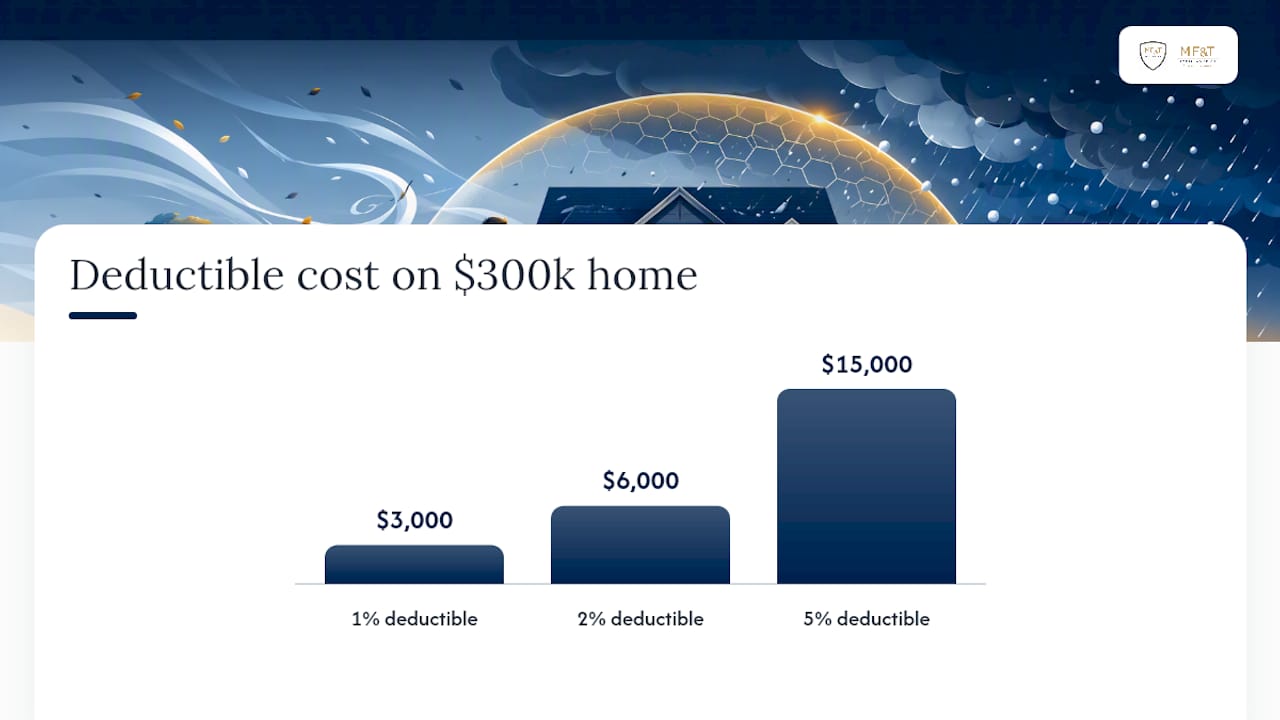
Statistic to know: on a $300,000 dwelling, a 5% wind/hail deductible equals $15,000 out of pocket before your insurer pays a dime.
Here's how the math plays out across common dwelling values:
- $200,000 home: 1% = $2,000. 2% = $4,000. 5% = $10,000.
- $300,000 home: 1% = $3,000. 2% = $6,000. 5% = $15,000.
- $500,000 home: 1% = $5,000. 2% = $10,000. 5% = $25,000.
Some policies still use a flat-dollar wind/hail deductible, often $500 or $1,000, but that's becoming less common in coastal states and high-risk wind zones. If your policy shows a flat number instead of a percentage, confirm with your agent that it hasn't been superseded by a newer endorsement.
Named Storm vs. General Wind/Hail Deductibles: What's the Difference?
A named storm deductible only kicks in when the National Weather Service or National Hurricane Center officially names the storm causing your damage. A general wind/hail deductible applies to any wind or hail event, named or not, including a random April thunderstorm that shreds your roof.
Timing windows matter here. Many named-storm endorsements start the clock when a watch or warning is issued, sometimes 12 to 24 hours before landfall, and end it 12 to 24 hours after the storm passes, according to NAIC guidance on named storm deductibles. Damage outside that window may fall under your regular deductible instead.
- Named storm deductibles trigger only during an officially named event's disclosed time window.
- General wind/hail deductibles apply to any qualifying wind or hail loss, named or not.
- Coastal homeowners are far more likely to carry a named-storm deductible than inland homeowners.
- The distinction can shift your out-of-pocket cost by thousands depending on when damage actually occurred.
This distinction matters most if you live near the coast, where carriers are more likely to require named-storm language specifically rather than a blanket wind/hail deductible.
Per Event, Per Season, or Per Year: When Do You Actually Pay?
Your deductible frequency depends on policy language that's easy to miss but expensive to overlook. Industry guidance from the Insurance Information Institute notes that deductibles can apply per event, per season, or per calendar year, and each one changes your math dramatically.
- Per event: you pay a separate deductible for every qualifying storm that causes damage.
- Per season: one deductible applies across the entire hurricane season, regardless of how many storms hit.
- Per calendar year: similar to per season, but tied strictly to the calendar rather than storm season dates.
Picture two named storms hitting your area in the same season. Under a per-event rule, you'd owe your deductible twice. Under a per-season rule, you'd typically owe it once. That single word on your declarations page can cost you thousands.
Finding Your Deductible on the Declarations Page: A Quick Checklist
Your declarations page is the single source of truth, not the marketing brochure your carrier mailed you.
- Locate your Coverage A dwelling limit at the top of the declarations page.
- Find the wind/hail or named-storm deductible line, usually near your standard deductible.
- Note whether it's listed as a percentage or a flat dollar amount.
- Copy the exact trigger language, including any per-event or per-season wording.
- Ask your agent to clarify anything unclear before storm season starts, not after a claim.
Save photos of damage, contractor invoices, and your declarations page together in one folder. That documentation speeds up any hail damage deductible or wind claim you eventually file.
Ways to Manage or Reduce Your Wind/Hail Deductible Costs
Mitigation work is one of the few levers homeowners actually control. Impact-resistant roofing, hurricane straps, and storm shutters commonly earn premium credits or better deductible options, though you'll need contractor documentation and sometimes an inspection to prove the upgrade.
- Ask whether impact-resistant roofing materials qualify for a discount before you replace your roof.
- Compare the trade-off between raising your standard deductible versus accepting a percentage-based wind/hail deductible.
- Request a mitigation credit review if you've added storm shutters, reinforced garage doors, or roof straps.
- Bring an independent agent your current policy for review if endorsement language feels unclear.
Pro Tip: Keep every contractor receipt and dated photo from mitigation work in one folder. Underwriters and claims adjusters both ask for this proof, and having it ready can speed up a credit approval or a claim payout by weeks.
An independent agency can shop multiple carriers at once, which matters because wind/hail deductible structures vary widely between insurers even for the same home.

MF&T North America's Take on Wind/Hail Deductibles
A policy review before storm season, alongside a mitigation assessment and a quote comparison across carriers, catches this early enough to actually fix it.
— Mike
Get a Clear Answer on Your Wind/Hail Deductible
An independent agency can provide homeowners with clear answers about what their specific deductible means in dollars, from licensed agents who focus on service rather than upselling. Independent agencies often shop multiple carriers side by side, offering clients a range of options rather than focusing on a single company's offerings.

If your declarations page is confusing or you're not sure whether your wind/hail deductible is 2% or 5%, a quick homeowners insurance review clears it up fast. We'll also flag mitigation credits you might be missing and pull comparison quotes so you know whether you're overpaying for coverage that doesn't match your risk. Reach out for a free quote and get a real answer on what your storm coverage actually costs before the next named storm makes the question urgent.
Sources
For deeper reading, NAIC's hurricane deductible guidance, North Carolina's windstorm and hail rules, and Massachusetts hurricane preparedness guidance all cover state-specific rules and minimums worth checking against your own policy.
This article is general information, not a substitute for advice from a qualified financial advisor. Consult a qualified financial professional about your own circumstances before acting on anything here.
FAQ
How much should a wind/hail deductible be?
A reasonable wind/hail deductible typically falls between 1% and 5% of your dwelling coverage, according to NAIC guidance. Higher percentages usually apply in coastal, high-risk zones, so what's "reasonable" depends heavily on where you live.
Does State Farm have a wind/hail deductible?
Wind/hail deductible structures vary by carrier, state, and individual policy, so there's no single universal answer for any one insurer. Check your specific declarations page or ask your agent directly, since the same carrier can offer different deductible structures in different states.
Is a wind and hail deductible the same as a hurricane deductible?
Not always. A general wind/hail deductible applies to any qualifying wind or hail event, while a named storm deductible triggers only when a storm is officially named by the National Weather Service or National Hurricane Center. Hurricane deductibles are usually a type of named storm deductible, but the terms aren't universally interchangeable across every policy.
What is a good deductible for hail damage?
A good hail damage deductible balances your premium savings against what you could realistically afford if a major hailstorm hits.