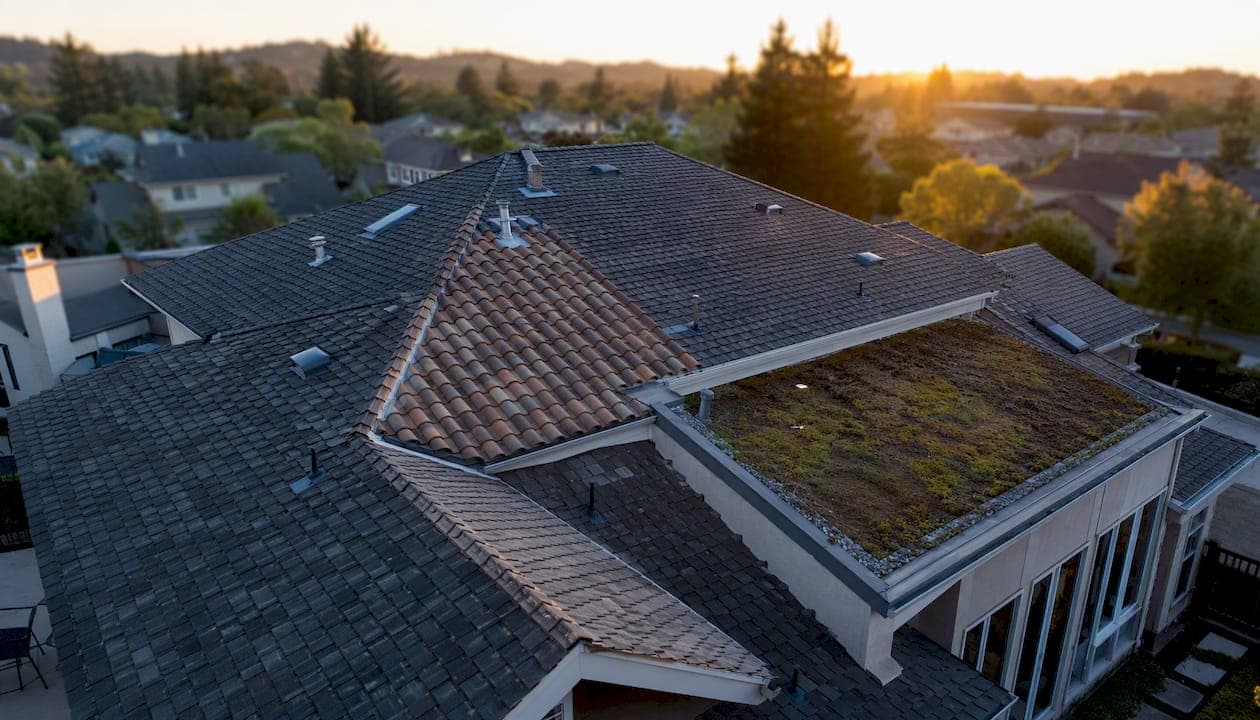
Your roof's material, age, shape, and condition are the biggest factors your insurer weighs when pricing your homeowners policy and deciding whether to renew it at all. Insurers focus so heavily on roofs because wind and hail drive 38.3% to 48.3% of homeowners claims, with several wind and hail claims filed per 100 house-years. Your roof is your home's first line of defense against exactly that kind of damage.
- Material determines expected lifespan, impact resistance, and claim payout size.
- Age triggers inspection requirements and can flip your coverage from replacement cost to actual cash value.
- Shape affects wind resistance and mitigation credit eligibility.
- Condition signals ongoing risk that underwriters can't ignore.
Pro Tip: Replaced your roof recently? Call your agent before your next renewal. An unreported upgrade means you're still paying premiums priced for your old roof.
Key Takeaways
Roof material, age, shape, and condition together determine your homeowners premium and whether your insurer offers full replacement cost coverage or restricts you to actual cash value.
| Point | Details |
|---|---|
| Age drives underwriting | Scrutiny often starts near 15 years, with nonrenewal risk rising sharply past 20 years for shingle roofs. |
| Material changes payout terms | Metal and tile typically earn longer RCV eligibility than asphalt or rolled roofing. |
| Shape affects wind credits | Hip roofs can qualify for wind mitigation discounts when at least 90% hipped. |
| Documentation prevents disputes | Save permits, invoices, and inspection reports to support underwriting and claims. |
| MF&T North America reviews your policy | A policy review checks whether your roof qualifies for carrier-specific credits or better coverage terms. |
Table of Contents
- What roof factors do insurers actually examine?
- How do RCV and ACV change your payout after a claim?
- Which roofing materials do insurers view most favorably?
- How does roof age change what your insurer expects?
- What can you do right now to lower your premium?
- When does a roof become uninsurable?
- What does the data say about roof-driven underwriting?
- Why we push documentation and timing so hard
- How MF&T North America can help with roof-driven coverage questions
- Sources
What roof factors do insurers actually examine?
Underwriters break your roof down into four categories, and each one carries different weight in how you're priced.
Material sets the baseline. Every roofing product has an expected service life, and insurers use that number to decide how long they'll offer full replacement coverage before shifting you to a depreciated payout. Materials with strong impact or fire ratings often qualify for pricing credits, since they're statistically less likely to generate a claim.
Age is the single clearest predictor carriers use. Scrutiny commonly begins around the 15-year mark, when insurers start requesting inspections, and coverage restrictions or nonrenewal become far more common once a roof is older than 20 years.
Shape and construction complexity matter more than most homeowners expect. A hip roof, with slopes on all four sides, handles wind uplift more evenly than a gable roof with two flat vertical ends. Flat roofs carry their own risk profile tied to drainage and ponding.
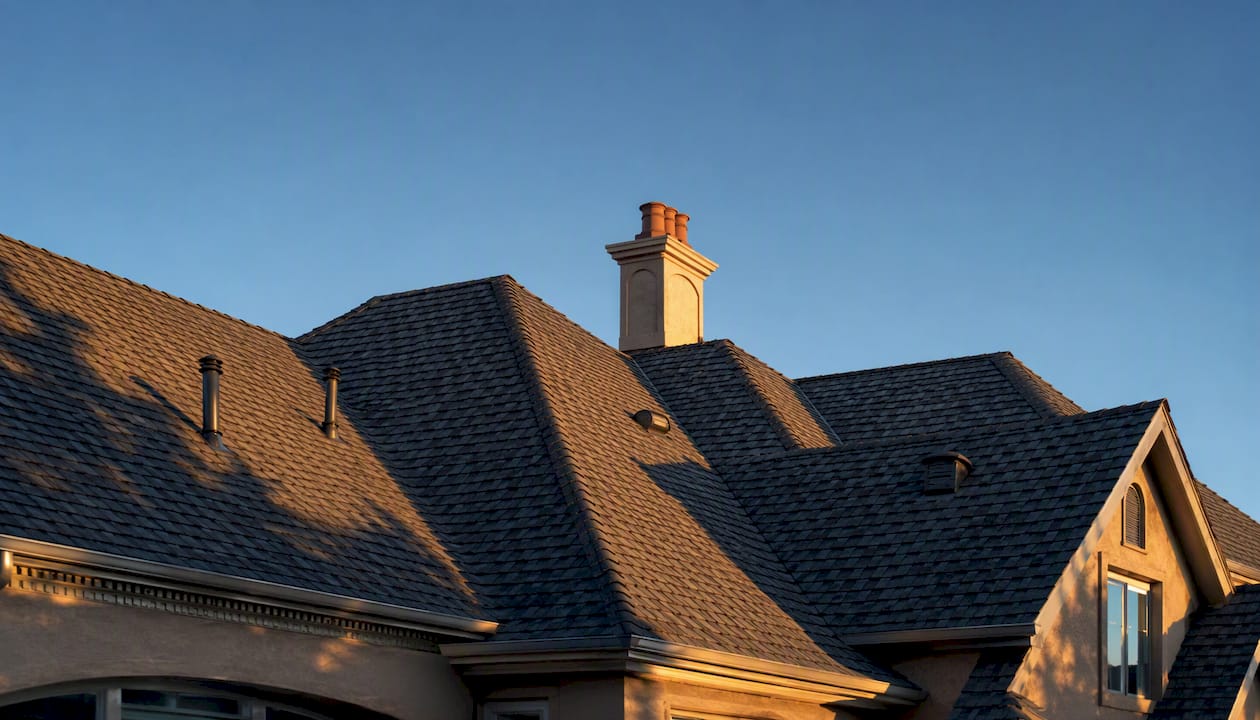
Condition and maintenance round out the picture. Insurers care about documented repairs, how many shingle layers sit on your deck, and whether attachments like skylights or solar panels create new penetration points.
Pro Tip: Keep every roofing invoice, permit, and inspection report in one folder. Underwriters and claims adjusters both ask for this documentation, and having it ready speeds up both processes.
How do RCV and ACV change your payout after a claim?
Two terms decide how much money you actually receive when your roof is damaged, and the gap between them can run into thousands of dollars.
Replacement Cost Value (RCV) pays what it costs to install a new roof of similar quality, with no deduction for age or wear. Actual Cash Value (ACV) pays that same replacement cost minus depreciation, meaning a 15-year-old roof might only net you a fraction of what a new one would cost to install.
- A $15,000 roof replacement under RCV pays close to the full $15,000.
- The same roof under ACV, depreciated for age, might pay $6,000 to $8,000, leaving you to cover the rest.
Many carriers require a fresh inspection at policy issue or renewal once a roof crosses that 15-year threshold. Depending on what the inspector finds, your insurer might add a roof payment schedule that automatically shifts payouts toward ACV, require documented repairs before renewal, or decline to renew the policy outright. Understanding the coverage types in your policy before a claim happens saves a lot of frustration later.
Which roofing materials do insurers view most favorably?
Not all roofs are underwritten the same way, even at identical ages.
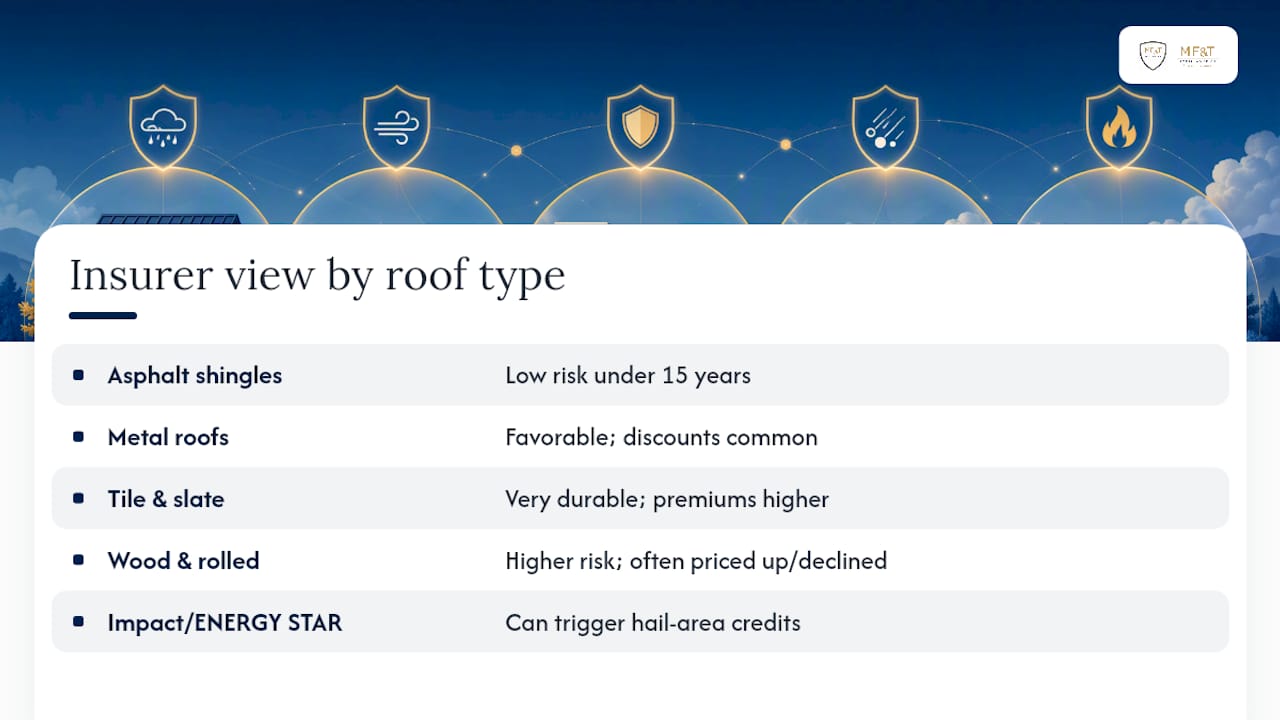
Asphalt shingles (3-tab and architectural) are the most common roofing material in the country, with architectural shingles generally lasting longer and holding up better to wind. Most carriers treat asphalt roofs under 15 years as low risk, then increase scrutiny from there.
Metal roofs typically earn favorable treatment across the board. They last decades longer than asphalt, resist wind and impact damage well, and many carriers offer premium discounts for metal or impact-rated installations, though the discount size varies by carrier and state.
Tile and slate roofs can last 50 years or more, but they cost significantly more to repair or replace per square, which keeps premiums higher even on newer installations.
Wood shakes and rolled roofing raise red flags for most underwriters. Wood shakes carry fire risk in many regions, and rolled roofing is commonly viewed as a lower-durability, higher-maintenance option that some carriers price up or decline to insure altogether.
Impact-rated products carrying a UL 2218 Class 4 rating, along with ENERGY STAR-listed roofing materials, can trigger additional credits in hail-prone areas.
How does roof age change what your insurer expects?
Think of your roof's age in four brackets, because your insurer almost certainly does.
- 0 to 10 years: Minimal scrutiny. Full RCV coverage is standard.
- 10 to 15 years: Some carriers begin requesting documentation or a basic inspection.
- 15 to 20 years: Expect inspection requirements, possible ACV restrictions, and closer underwriting review.
- 20-plus years: Nonrenewal risk rises sharply for asphalt shingle roofs specifically.
These brackets shift by carrier and by state. Florida, for example, limits refusal based solely on roof age under 15 years and allows homeowner-paid inspections to demonstrate remaining useful life. Treat these numbers as a general rule of thumb, not a guarantee.
What can you do right now to lower your premium?
A few concrete moves protect your coverage and your wallet at the same time.
- Notify your insurer immediately after any roof replacement or major repair.
- Save every receipt, permit, and inspection report in one accessible file.
- Ask about discounts for impact-resistant shingles if you're in a hail-prone region.
- Request a wind mitigation inspection, especially if you have a hip roof or sealed deck.
- Confirm your attachments (skylights, solar mounts) haven't been flagged as risk factors.
Ask specifically about wind mitigation credits, Fortified installation standards, and any state-run resilience programs your carrier recognizes. If you're timing a replacement, schedule it to finish before your renewal date, not after, so the new roof is reflected in your next rate calculation instead of your next annual review.
Pro Tip: A new roof usually restores your eligibility for full coverage rather than slashing your total premium. Most of the savings show up in the wind and hail portion of your policy, not the bill as a whole.
When does a roof become uninsurable?
A handful of red flags push carriers toward nonrenewal or outright decline: shingle roofs beyond 20 years, multiple unrepaired leaks, layered roofs with old material left underneath new shingles, extensive missing shingles, and non-permitted DIY replacements.
If any of these apply to your home, get a dated contractor inspection now. A partial permitted repair or full re-roof often restores standard eligibility, and some carriers will write an ACV-only policy as a temporary bridge while you plan the larger project.
What does the data say about roof-driven underwriting?
Wind and hail account for 38.3% to 48.3% of homeowners claims nationally, which explains why roof condition sits at the center of underwriting decisions rather than at the margins.
Roof-based rating hits hardest in catastrophe-prone states, where hurricane and hail exposure push carriers to weight roof age and material more heavily than they would in low-risk regions. A few resources are worth bookmarking:
- Triple-I (III.org): claims data and homeowner-facing risk explanations.
- FEMA Building America reports: technical guidance on roof shape and wind performance.
- Fortified standards: construction benchmarks tied to insurance credits.
- ENERGY STAR product lists: certified high-performance roofing materials.
Why we push documentation and timing so hard
We've watched too many nonrenewals happen not because a roof was actually failing, but because there was no paperwork to prove otherwise. An inspector shows up, finds an aging roof with no permit history, and the file gets flagged. That's a preventable outcome.
Invoices, permits, and impact ratings aren't paperwork for paperwork's sake. They're the evidence that turns a borderline underwriting decision in your favor, and the evidence a claims adjuster needs to pay you fairly. Part of our job is checking which carrier-specific credits you actually qualify for and helping you time a replacement so it lands before renewal, not after.
How MF&T North America can help with roof-driven coverage questions
If you're staring down a roof age threshold, a nonrenewal notice, or just wondering whether a new roof would actually move your premium, a policy review answers that question directly instead of leaving you to guess.
M F and T North America reviews your current homeowners policy against your roof's material, age, and condition, then shops carriers that treat your specific roof type most favorably. That's the real advantage: instead of calling five different carriers yourself to ask about wind mitigation credits or impact-shingle discounts, one review covers all of it. Our services include homeowners policy review, carrier shopping across multiple states, claims guidance if you're dealing with roof damage now, and help documenting upgrades so you actually receive credit for them at renewal.
Start with a homeowners insurance quote review to see whether your roof qualifies for savings you're not currently getting.
Sources
- Which roof materials help your insurance rates | Roof Policy
- Insurance Premiums by Roof Type and Age (2026): Data
This article is general information, not a substitute for advice from a qualified financial advisor. Consult a qualified financial professional about your own circumstances before acting on anything here.