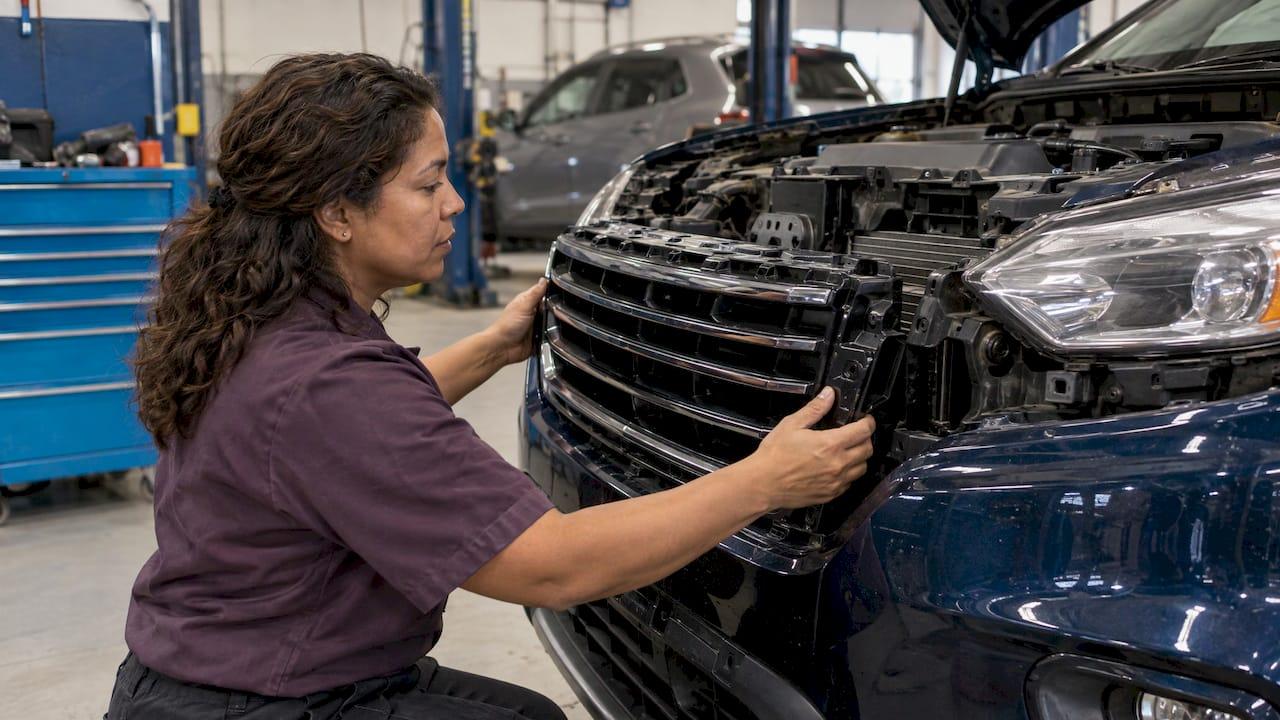
OEM parts coverage means your auto insurer agrees to repair your car with original equipment manufacturer parts, the same kind the carmaker installed. Most standard policies don't promise that. They promise to restore your car to its pre-loss condition, and the insurer often chooses how. That can mean aftermarket, used or reconditioned parts. If you want factory parts guaranteed, you usually need an OEM endorsement, a state rule that backs you up, or a willingness to pay the price difference.
This guide explains what OEM coverage is, what the endorsement does, what several states require, and how to ask for the parts you want before a claim, not after.
TL;DR
- A standard auto policy usually doesn't guarantee OEM parts. The insurer can often use non-OEM parts if they meet your state's rules.
- An OEM parts endorsement is an optional add-on. It requires collision or comprehensive coverage on the policy and is often limited to newer vehicles.
- State rules differ. Massachusetts, New Hampshire, Louisiana, California and others set their own disclosure and quality standards.
- You can usually insist on OEM parts and pay the difference between the OEM and non-OEM price.
- Decide before you have an accident. Ask your agent which carriers offer the endorsement and what it excludes.
Table of Contents
- What OEM parts coverage means
- Does standard car insurance cover OEM parts?
- What an OEM parts endorsement is
- What the law says: examples from five states
- How to ask for OEM parts after a claim
- When OEM parts are worth prioritizing
- Perspective
- Talk to an agent about your auto coverage
- FAQ
- Sources
What OEM parts coverage means
Three terms come up in every repair estimate:
- OEM parts are made by, or for, your vehicle's manufacturer. They match the original specifications.
- Aftermarket parts are made by other companies to fit your model. They are sometimes called non-OEM or AM parts.
- Used or reconditioned parts come from other vehicles or have been rebuilt.
"OEM parts coverage" isn't a separate policy. It is shorthand for one of two things: an endorsement you add to your auto policy, or a legal right your state gives you when your car is repaired after a covered loss. Either way, it only matters when you file a collision or comprehensive claim.
That's an important distinction. Liability coverage pays for damage you cause to other people's property. It does not decide the parts on your own car. Parts questions belong to your collision and comprehensive coverages, which pay for damage to your vehicle.
Does standard car insurance cover OEM parts?
Often not by promise. Your policy typically says the insurer will pay to repair or replace damaged property with property of like kind and quality. Many insurers read that as allowing equivalent non-OEM parts. If you want to learn how your own carrier reads it, the language is in your policy's physical damage section.
States then put guardrails around that practice. The most useful overview is a Connecticut General Assembly research report from 2009. It found at least 35 states had statutes or regulations on insurers requiring non-OEM crash parts. Of those:
- 31 require a disclosure statement with the repair estimate
- 20 require the maker of the non-OEM part to be identified
- 13 require the part to be of like kind and quality to the OEM part
- 6 require the customer's consent before non-OEM parts are used or required
That report is from 2009, so laws have since changed in some places. Treat it as a picture of how varied the rules are, and check your own state's insurance department for the current version.
The model regulation from the National Association of Insurance Commissioners follows the same logic. It says insurers must not require aftermarket parts unless they are at least equal to the originals in fit, quality and performance, and that newer aftermarket parts should carry permanent identification of the manufacturer. It also calls for written disclosure on the estimate, in print no smaller than 10-point type, when parts not made by the original manufacturer are used.

What an OEM parts endorsement is
An OEM endorsement is an optional addition to your auto policy. When you have a covered collision or comprehensive loss, the insurer agrees to pay for original manufacturer parts rather than pricing the repair with non-OEM alternatives.
Massachusetts offers a clear example. Bulletin 00-15, effective January 1, 2001, says insurers licensed to sell private passenger auto insurance must have the option of selling an OEM crash-parts endorsement. It applies to eligible autos up to 10 model years old that are insured for collision or limited collision and comprehensive coverage.
The same bulletin says companies offering the endorsement should tell applicants that collision and comprehensive claims, including claims under the endorsement, are subject to the Safe Driver Insurance Program. It also says consumers should be invited to consider higher deductibles. Those are the kinds of details to ask about when you compare options.
A national model proposed by the National Conference of Insurance Legislators took a related approach. It suggested insurers offer drivers a higher deductible in exchange for exclusive use of OEM crash parts if they file a claim. That was a 2009 proposal, not a law everywhere, but it shows the trade-off: more control over parts can mean a different deductible or premium.

What to check in the endorsement wording
Endorsements vary by carrier and state. Before you add one, ask:
- Vehicle age limit. Is the vehicle eligible? Massachusetts uses 10 model years, and other carriers may set their own limits.
- Required coverages. Do you need both collision and comprehensive?
- Exclusions. Does it apply to glass, for example, or to certain parts such as bumpers and trim? Carriers often word these differently.
- Deductible. Does a separate or higher deductible apply to OEM repairs?
- Claim effects. Do claims under the endorsement count the same as other claims for surcharges or safe driver ratings?
If you want to see how glass is handled separately, our guide on windshield replacement deductibles and waivers covers it.
What the law says: examples from five states
There is no single national OEM rule. Here is how a few states handle it, using their insurance departments' own descriptions.
Massachusetts
The Massachusetts Division of Insurance explains that if damage affects how your car can be driven safely, the insurer will pay to repair it with an OEM part. For non-safety parts, the insurer doesn't have to pay for OEM unless the claim happens in the first 20,000 miles on the odometer. Past 20,000 miles, state regulation allows used, reconditioned or aftermarket replacements. You can insist on OEM parts, but you pay the difference in cost.
Picture a family in Newton with a three-year-old SUV and 45,000 miles. After a fender-bender, the estimate lists an aftermarket grille and a bumper cover. Safety parts would be OEM, but the grille probably isn't covered at OEM prices unless an endorsement says so. That is exactly the case an endorsement is built for.
New Hampshire
New Hampshire is stricter for newer vehicles. Under RSA 407-D:3-a, insurers must use OEM parts for the parts covered by the statute if the vehicle was placed in service within the preceding two years and has 30,000 or fewer miles. The same applies to leased vehicles if the lease says aftermarket parts will reduce residual value. Otherwise, any aftermarket parts must be like kind and quality in fit, quality and performance.
If you lease, that lease language matters. Our guide to leased car insurance explains what lessors often require.
California
California's Department of Insurance says a non-OEM replacement part must be comparable to an OEM part in kind, quality, safety, fit and performance. The repair invoice must identify each part as used, reconditioned, rebuilt, after-market or OEM. The same guide notes that an insurer cannot require repairs at a specific shop. It can recommend one only if you ask for a recommendation, are told in writing you have the right to choose, and agree.
Louisiana
Under R.S. 51:2424, an insurer can't specify non-OEM aftermarket crash parts for your repair, and a shop can't use them, unless you are advised in writing. The written estimate must identify each part, with a disclosure in 10-point or larger type on or attached to your copy.
Mississippi
Mississippi allows non-OEM parts if they are used in line with state law and the policy and properly and safely repair the vehicle. Those parts must carry the manufacturer's logo, identification number or name, and estimates must identify each part and include the statutory disclosure.
Maine
In Maine, you have the final choice of parts, but the insurer need not pay for more expensive OEM parts. You pay the difference. Insurers also aren't required to put new parts on used vehicles.
Quick comparison
| State | Rule in plain terms | What you can do |
|---|---|---|
| Massachusetts | OEM for safety-related parts; OEM for other parts only in first 20,000 miles | Insist on OEM and pay the difference, or add the endorsement |
| New Hampshire | OEM required on vehicles under 2 years old and 30,000 miles or less (covered parts) | Check your lease terms if you lease |
| California | Non-OEM must be comparable; invoice must label each part | Review the invoice and ask about any part labeled aftermarket |
| Louisiana | Written notice required before non-OEM parts | Read the estimate disclosure before approving |
| Mississippi | Non-OEM allowed if safe and properly marked | Check each part is identified on the estimate |
| Maine | You choose parts; insurer pays only non-OEM price | Pay the difference for OEM |
How to ask for OEM parts after a claim
You don't have to accept the first estimate as final. A calm, step-by-step approach works best.
- Read the estimate line by line. Look for part labels such as OEM, A/M, LKQ, used or reconditioned. Many states require this labeling.
- Find the disclosure. If non-OEM parts are listed, your state may require a written statement on the estimate.
- Check your policy and endorsements. Look for an OEM endorsement on your declarations page.
- Ask the adjuster in writing. Request OEM parts for the items you care about and ask what the insurer will pay.
- Choose your shop. In many states, including California, the shop is your choice. A shop you trust can tell you whether a part fits and can help sort out the price difference.
- Decide on the difference. If your policy only pays non-OEM prices, you can usually pay the gap yourself to get OEM parts.
- Contact your state's insurance department if you think a required disclosure or standard was missed.
If you're also worried about your car's resale value after a repair, see our guide on diminished value claims.
When OEM parts are worth prioritizing
Not every part needs the same attention. These are situations where we see drivers most often want OEM:
- Newer vehicles. The more recent the model, the more sensors and calibrated systems sit behind bumpers, mirrors and windshields.
- Leased cars. Lease agreements can require specific repair standards.
- Safety-related components. Many states already steer these to OEM or equivalent standards.
- Cars you plan to sell soon. Buyers often ask for repair records.
For older vehicles, a quality non-OEM part that meets your state's standards can be a sensible way to keep a repair affordable. The key is knowing the choice is yours and seeing the part labels on the estimate.
Perspective
Most drivers first learn about parts rules at the worst time: when the estimate arrives. By then, the policy is set and your options are narrower.
That's why we talk about parts before a claim. As an independent agency, we aren't tied to one carrier, so we can compare how different companies word their physical damage coverage and ask which ones offer an OEM endorsement for your vehicle and state.
Our advice is simple. If you drive a newer car, lease, or care about factory repairs, ask about OEM coverage when you set up or renew your policy. Look at the age limits, exclusions and deductible, then decide with the full picture. A licensed agent can walk you through it in one conversation.
Mike
Talk to an agent about your auto coverage
If you want to know where your current policy stands on OEM parts, or you're shopping for coverage and want it in writing, our licensed agents can help you compare carriers and choose collision and comprehensive options that fit your car and budget. Learn more about our auto insurance and request a quote.
If you live in a no-fault state, your coverage mix looks a little different. Our overview of no-fault insurance states explains how PIP fits in. And if you ride, motorcycle coverage has its own parts and gap questions.
FAQ
Does car insurance cover OEM parts?
Only sometimes. Standard collision and comprehensive coverage typically pays to repair your car to its prior condition, and the insurer may use non-OEM parts if your state's rules allow it. An OEM endorsement, or a state rule for newer vehicles, can require factory parts instead.
Can I insist on OEM parts if my policy doesn't include them?
In many states, yes, but you pay the difference. Massachusetts and Maine both describe it this way: you can choose OEM, and the cost above the insurer's non-OEM payment is yours. Ask your adjuster for the figures in writing first.
Does an OEM endorsement work on any vehicle?
Not always. Eligibility rules differ by carrier and state. Massachusetts, for example, describes the endorsement for autos up to 10 model years old with collision or limited collision and comprehensive coverage. Ask your agent about the age limit and exclusions for your car.
Do insurers have to tell me when they use aftermarket parts?
In most states with rules on the subject, yes. A 2009 Connecticut research report found 31 states require a disclosure with the estimate. Louisiana and Mississippi, for instance, require each non-OEM part to be identified on it.
Can the insurance company make me use its repair shop?
Not in California, where the insurer can't require a specific shop. Other states have their own rules, so check with your state's insurance department or ask your agent before you choose.
Sources
- Massachusetts Bulletin 00-15: OEM crash parts endorsement
- Massachusetts Division of Insurance: auto insurance claims FAQ
- Connecticut General Assembly: auto insurers requiring use of aftermarket parts
- NAIC model regulation
- NCOIL proposed model act on crash parts
- New Hampshire Insurance Department: repair shop FAQ
- California Department of Insurance: So You've Had an Accident
- Louisiana Department of Insurance: auto insurance after an accident
- Mississippi Insurance Department: automobile physical damage claims
- Maine Bureau of Insurance: auto claims FAQs