Most diminished value recovery happens through a third-party claim filed against the at-fault driver's insurer, not your own. Success comes down to one thing: proving your car lost resale value even after a good repair, backed by an independent appraisal and solid paperwork. A few states change the rules. Georgia requires insurers to assess first-party diminished value automatically, while Massachusetts case law has made some first-party paths harder, pushing claimants toward the at-fault driver directly.
TL;DR:
- Most diminished value recoveries are made through third-party claims against the at-fault driver’s insurer, not your own policy.
- An independent appraisal emphasizing your car’s pre-loss value and repair quality often yields higher results than the insurer’s simplified 17c formula.
- State rules vary: Georgia requires insurers to assess first-party diminished value, while Massachusetts limits these recovery options mainly to third-party claims.
- Building a well-organized demand package with photos, repair records, and a professional appraisal increases the chance of a fair settlement.
- The cost-effectiveness of a claim depends on your vehicle’s value, damage severity, and whether your policy covers underinsured drivers, warranting a policy review beforehand.
Table of Contents
- Understanding a Diminished Value Claim: The Three Types
- Who You Can Claim Against: Third-Party vs First-Party Rules
- How Insurers Calculate Diminished Value, and Why Appraisals Beat Formulas
- Building Your Demand Package Step by Step
- Is Filing Worth It? Weighing Your Specific Situation
- Negotiating Like a Pro and Knowing When to Escalate
- What to Do This Week
- Get Your Auto Policy Reviewed Before You Negotiate
- Where to Verify the Details
- Sources
- FAQ
Understanding a Diminished Value Claim: The Three Types
A diminished value claim seeks the gap between your car's market value before the accident and its market value after repairs. Even a flawless repair job doesn't erase the fact that your vehicle now carries an accident history, and buyers pay less for that history. According to the Insurance Information Institute, that loss typically ranges from around 10% to 25% of pre-accident value, with structural or frame damage sometimes causing significantly greater loss.
There are three recognized categories, and knowing which one fits your situation shapes how you build your case:
- Inherent diminished value covers the stigma buyers attach to any vehicle with a reported accident, even after a perfect repair.
- Repair-related diminished value applies when the shop used aftermarket parts, mismatched paint, or left detectable flaws.
- Immediate diminished value measures what your car would have sold for right after the crash, before any repair.
Most claims filed today are inherent diminished value claims, since insurers generally require reasonable repair quality before you can even discuss resale stigma.
Who You Can Claim Against: Third-Party vs First-Party Rules
The vast majority of diminished value recoveries come from third-party claims filed against the at-fault driver's liability insurer. Your own policy usually excludes first-party diminished value payouts through standard language, which means filing against your own carrier after a not-at-fault accident often goes nowhere.
Georgia breaks that pattern. State rules require insurers there to assess and pay first-party diminished value on covered claims as part of standard loss adjustment. Massachusetts moves the opposite direction: recent rulings, including Cubberley v. Commerce, have narrowed recovery under standard policy forms, sometimes forcing claimants to pursue the at-fault driver personally rather than their insurer.
A few things to check before you file anywhere:
- Confirm whether your state treats diminished value as a first-party or third-party matter, since state courts vary widely on how they calculate and award these damages.
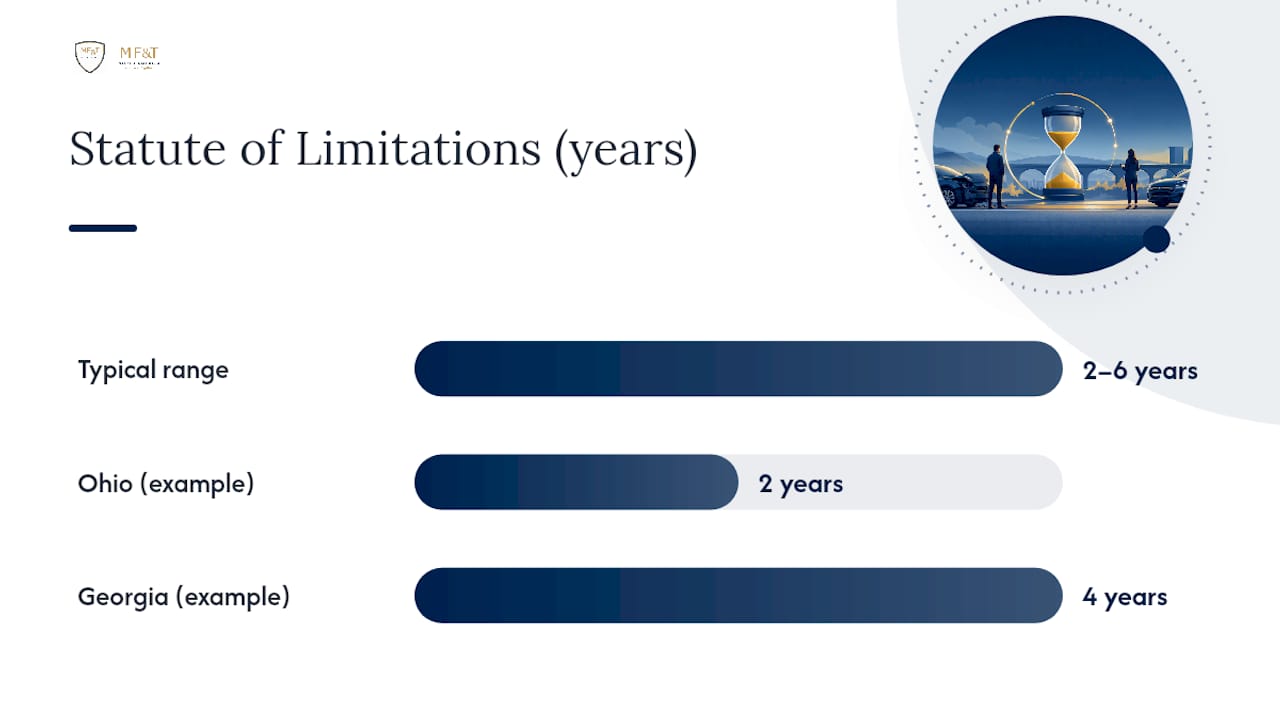
- Check your state's statute of limitations, which typically runs 2 to 6 years from the crash date. Ohio caps property damage claims at 2 years, while Georgia allows 4.
- Don't wait to check this. The clock starts on the accident date, not the repair date or the date you noticed the value loss.
How Insurers Calculate Diminished Value, and Why Appraisals Beat Formulas
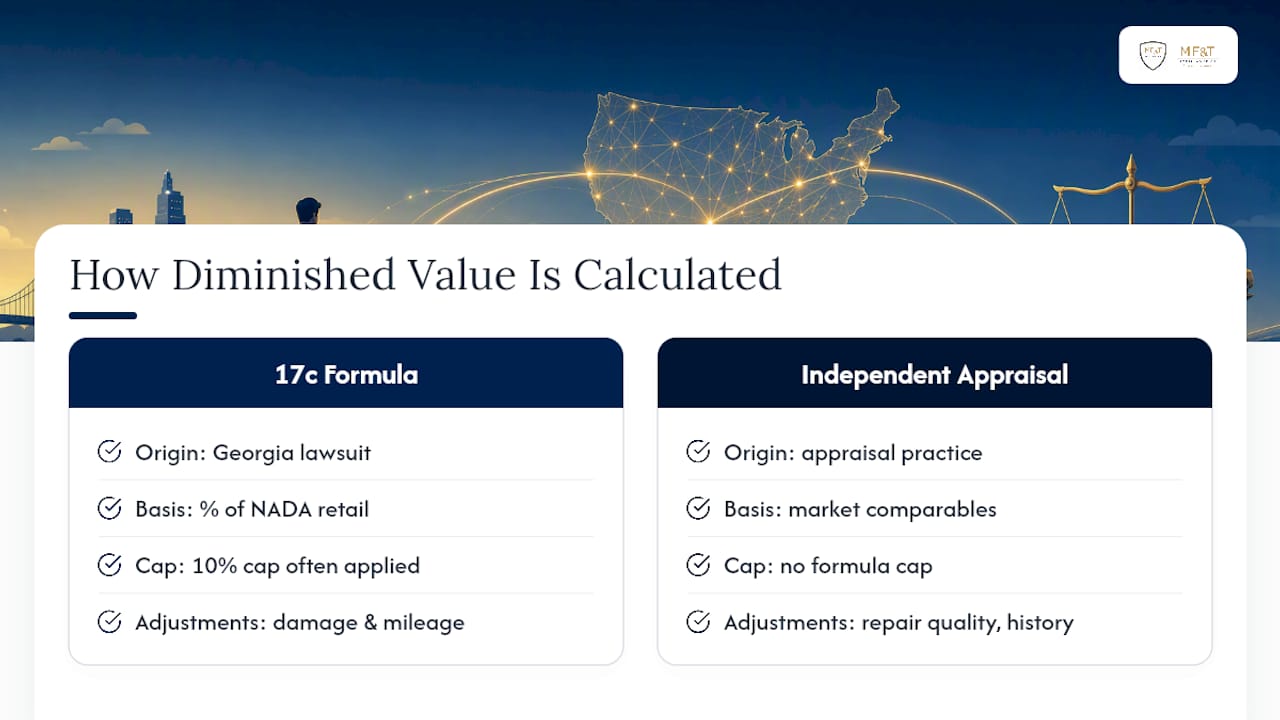
Most insurers start with a shortcut called the 17c formula. It originated from Georgia litigation: taking a percentage of your car's NADA retail value capped at 10%, then adjusting by damage and mileage modifiers. The result is often lower than what an independent appraiser finds, and that gap is not an accident.
The 17c formula is a carrier convenience born out of one lawsuit, not a nationwide legal standard. Regulators have specifically warned insurers against treating it as definitive.
That warning comes from the NAIC's own analysis of diminished value practices, and it's worth remembering every time an adjuster quotes you a 17c number as if it's final.
A defensible independent appraisal digs deeper than any worksheet. It typically documents your car's pre-loss value, evaluates the actual quality of the repair, pulls comparable market listings for identical models with clean histories, and factors in how a vehicle history report will read to a future buyer. Rebuilt-title vehicles face an even steeper valuation hit, which buyers should understand before assuming any repair fully restores resale value. Expect to pay for this level of detail, but it's often the single biggest lever in getting a fair settlement.
Building Your Demand Package Step by Step
A disorganized diminished value claim gets a lowball response or silence. An organized one gets attention. Here's the order that works:
- Document the vehicle immediately. Photograph the damage before repairs and the finished work after, and keep the police report, VIN, current mileage, and maintenance history together.
- Collect every repair record. Invoices, parts lists, and any notes about structural work or airbag deployment all strengthen your file, since those details drive value loss higher.
- Get an independent appraisal. Pair it with comparable listings or a dealer trade-in quote that explicitly references your car's accident history.
- Write a demand letter. Include your claim number, a clear evidence list, your dollar figure, and a firm response deadline. Send it by certified mail so you have proof of delivery.
- Negotiate in rounds. Ask the insurer to disclose exactly how they calculated their offer, then rebut it with your appraisal and dealer quotes. Plan on two to three rounds before you land somewhere fair, and know that small claims court is a real option if the insurer won't budge.
Pro Tip: Never accept the first counteroffer. Adjusters are trained to start low, and a documented appraisal paired with dealer quotes turns a shallow dispute into a valuation case that's much harder to wave away.
Is Filing Worth It? Weighing Your Specific Situation
Not every accident justifies the time and cost of a formal diminished value claim. A few factors tip the scale:
- Vehicle value and age. A newer, higher-value car justifies a $200 to $600 appraisal fee far more easily than an older economy vehicle worth a fraction of that.
- Damage severity. Structural or frame damage, airbag deployment, and a CARFAX entry all push potential loss well above the typical 10% to 25% range.
- Remaining policy limits. If the at-fault driver carries minimal liability coverage, collecting in full may be difficult even with a strong claim, and you may need to explore UM/UIM coverage or a direct suit against the driver instead.
Negotiating Like a Pro and Knowing When to Escalate
Never treat the first offer as a starting point for agreement. It's a starting point for pushback. A USPAP-compliant appraisal, a dealer trade-in quote, and solid comparables give you leverage an adjuster can't easily dismiss.
When picking an appraiser, look for someone with actual experience writing diminished value opinions and a methodology they can explain clearly, not just a number. Expect appraisal fees commonly in the low hundreds of dollars range, typically between a couple hundred and several hundred dollars.
If negotiation stalls, small claims court handles modest disputes well. Larger claims may call for Superior or State court, but keep your statute of limitations in mind the entire time. And if your own coverage picture is unclear, particularly around UM/UIM limits, a policy review can clarify what recovery paths you actually have.
What to Do This Week
Photograph your vehicle and gather repair invoices now, before memories or paperwork fade. Weigh whether the likely recovery justifies an appraisal fee. If it does, order one. And if you're unsure whether your own coverage could help, a quick policy review is worth the call.
— Mike
Get Your Auto Policy Reviewed Before You Negotiate
A diminished value claim usually runs through the other driver's insurer, but your own policy still shapes your options if their coverage limits fall short. An independent insurance agency can review your existing auto policy to check whether UM/UIM coverage or a personal umbrella policy could support your recovery strategy if the at-fault driver is underinsured.
This isn't an appraisal service and it isn't legal representation. It's a straightforward look at your coverage so you know exactly what protection you're working with before you negotiate. An independent agency can compare your current limits against what's actually available and flag gaps before they become a problem in your next claim. If you want that clarity, reach out through the auto insurance services page and a licensed agent can walk through your policy with you this week.
Where to Verify the Details
For the legal and industry framework behind this guide, the Triple-I's diminished value overview and the NAIC's 2023 regulatory analysis are worth bookmarking, along with your own state's statute of limitations for property damage claims.
Sources
- What is diminished value? - Triple-I®
- NAIC: Journal of Insurance Regulation paper on diminished value (2023)
- How to file a diminished value claim in Massachusetts — LegalClarity
FAQ
What States Allow Diminished Value Claims?
Most states allow third-party diminished value claims against an at-fault driver's insurer, though the rules and required proof vary by state. Georgia stands out because it mandates first-party diminished value assessment on covered claims, while Massachusetts has narrowed some first-party recovery paths through recent case law.
How Much Do You Get for a Diminished Value Claim?
Typical losses run 10% to 25% of a vehicle's pre-accident market value, though structural or frame damage can push that percentage significantly higher. Insurers often calculate a lower figure using the 17c formula, which is why an independent appraisal frequently produces a higher, better-supported number.
Can an Insurance Company Deny a Diminished Value Claim?
Yes, insurers regularly deny or undervalue these claims, especially first-party requests that standard policy language excludes. A well-documented demand package with an independent appraisal, repair records, and comparable listings makes denial harder to justify and gives you grounds to push back or escalate to small claims court.
Is It Worth Doing a Diminished Value Claim?
It's usually worth pursuing for newer or higher-value vehicles, especially after structural damage, since the potential recovery often exceeds the $200 to $600 appraisal cost. For older, lower-value vehicles with minor cosmetic damage, the math is less favorable, and a quick policy review can help you decide if pursuing it makes sense for your situation.