
Collision coverage pays for damage to your vehicle caused by a crash. Comprehensive coverage pays for losses from non-collision events: theft, weather, fire, vandalism, and animal strikes. Both pay up to your vehicle's Actual Cash Value minus your deductible. Most drivers on a loan or lease carry both, and most drivers with a newer or higher-value vehicle benefit from both even without a lender requirement. The term "full coverage" gets thrown around a lot, but it is marketing shorthand, not a formal policy term. It still leaves you responsible for deductibles and ACV limits.
Table of Contents
- How collision vs comprehensive coverage compare at a glance
- What collision coverage actually covers
- What comprehensive coverage covers and what it excludes
- How deductibles work and what they cost you
- When are collision and comprehensive actually required?
- How to decide whether you need collision, comprehensive, or both
- Which coverage applies to tricky claim scenarios?
- What M F and T North America recommends for U.S. drivers
- Key Takeaways
- The coverage decision most drivers get wrong
- Get a coverage review from M F and T North America
- Useful sources and further reading
How collision vs comprehensive coverage compare at a glance
The fastest way to see the difference is side by side.
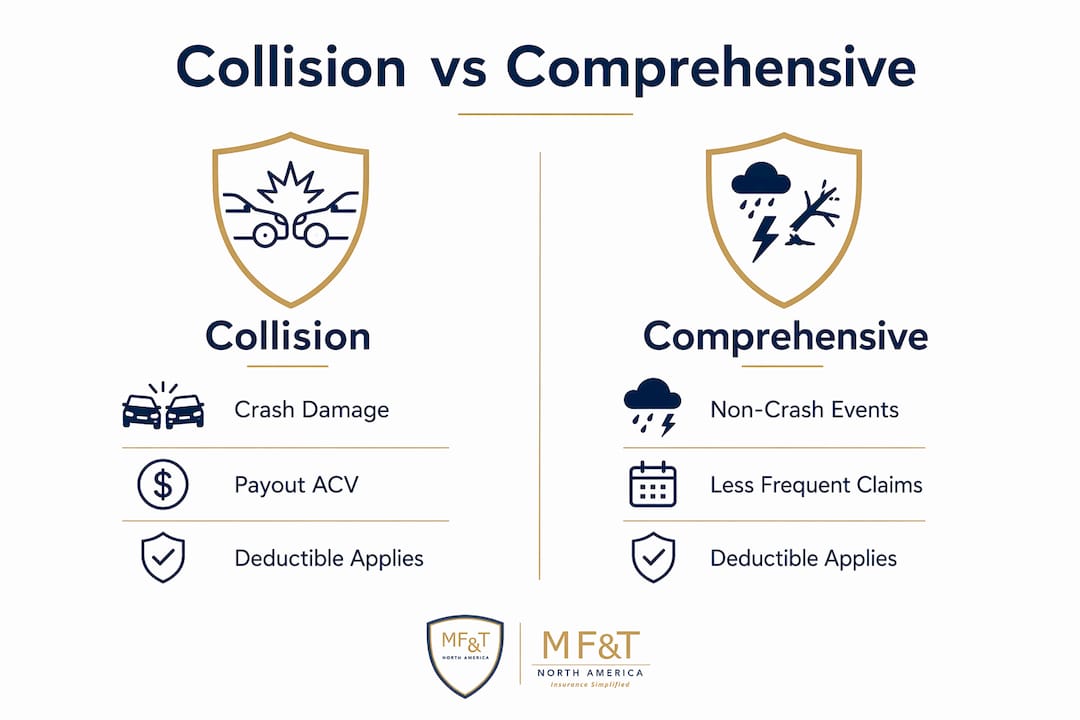
| Factor | Collision | Comprehensive |
|---|---|---|
| What triggers a claim | Impact with another vehicle or object; rollover | Theft, weather, fire, vandalism, animal strike, falling objects |
| What it pays | Repair or replacement up to ACV | Repair or replacement up to ACV |
| Deductible applies | Yes | Yes |
| Typical annual cost | ~$290/year | ~$134/year |
| Required by state law | No (in most states) | No (in most states) |
| Required by lender/lease | Almost always | Almost always |
| When to file | Your car hits or is hit by something | Your car is stolen, damaged by weather, or struck by an animal |
Concrete examples help clarify which coverage responds:
- Collision: rear-ending another car, getting hit at an intersection, backing into a pole, hitting a guardrail, rolling your vehicle
- Comprehensive: a deer strike, hail damage, a stolen vehicle, a broken windshield from a flying stone, flood damage, fire, vandalism
Both coverages cap your payout at Actual Cash Value minus your chosen deductible. Lenders and leasing companies almost always require both on financed or leased vehicles.
What collision coverage actually covers
Collision coverage pays to repair or replace your vehicle when it is damaged in a crash. The trigger is physical impact: your car hits another vehicle, strikes an object like a guardrail or utility pole, or rolls over. It does not matter who caused the accident. Even if the other driver is at fault, you can file under your own collision coverage to get repairs started quickly, then let the insurers sort out subrogation later.

Common collision scenarios include rear-end crashes, intersection collisions, single-car accidents where you hit a fence or mailbox, and pothole damage where the impact is the direct cause of the loss. What collision does not cover: mechanical breakdowns, normal wear and tear, or damage that happened while the car was parked and struck by a non-collision event like hail.
The claim flow is straightforward. You pay your deductible, and the insurer pays the remainder up to ACV. If the repair cost exceeds ACV, the vehicle is declared a total loss and you receive ACV minus your deductible. In states that offer uninsured motorist property damage coverage, that can supplement a collision claim when the at-fault driver has no insurance, though the interaction varies by state.
What comprehensive coverage covers and what it excludes
Comprehensive coverage responds to losses that are not caused by a crash. Think of it as protection against things that happen to your car rather than things your car runs into. Common covered events include:
- Theft or attempted theft
- Hail, flood, wind, and other weather damage
- Fire (including wildfire)
- Vandalism and civil disturbance
- Animal strikes (a deer, a bird, a rodent chewing wiring)
- Falling objects such as tree branches or debris
- Broken windshield from a road stone (often handled under a glass sublimit)
Comprehensive does not cover mechanical failure, engine wear, tire blowouts from road hazards alone, or damage you caused intentionally. It also will not pay for personal belongings stolen from your car. Those losses fall under your homeowners or renters policy.
Comprehensive typically costs less than collision because the claims, while sometimes large, are less frequent than crash claims. You still choose a deductible, and the same ACV cap applies. For a deeper look at covered events and exclusions, the M F and T North America comprehensive coverage guide walks through real-world scenarios in detail.

How deductibles work and what they cost you
Collision and comprehensive each carry their own independent deductible. You set them separately, and you can choose different amounts for each. A common setup is a $500 collision deductible and a $250 or $100 comprehensive deductible, since comprehensive claims (like a cracked windshield) can happen without warning and without any fault on your part.
Here is a simple example. Your car sustains $3,200 in hail damage. You have a $500 comprehensive deductible. The insurer pays $2,700. Now suppose you rear-end another car and the repair bill is $4,000. With a $1,000 collision deductible, you pay $1,000 and the insurer covers $3,000.
Raising your deductible lowers your premium. Moving from a $500 to a $1,000 deductible can reduce premiums by roughly 10–20%, though the exact savings depend on your driver profile, vehicle, and location. The trade-off is that you absorb more out of pocket when a claim hits.
Pro Tip: Set your collision deductible at the highest amount you could pay within 30 days after an accident. Set your comprehensive deductible at the amount you could absorb with no advance notice, since weather and theft do not give you time to save up.
Factors that move premiums in either direction include your vehicle's make, model, and age; your ZIP code; your driving history; and how much you drive annually.
When are collision and comprehensive actually required?
Neither collision nor comprehensive is legally required by state law in most U.S. states. State minimum auto insurance requirements typically cover liability only. The requirement to carry both usually comes from your lender or leasing company.
If you financed your vehicle, your loan agreement almost certainly requires you to maintain both collision and comprehensive until the loan is paid off. Leasing companies impose the same requirement, often with specific deductible maximums written into the lease contract. Check your loan or lease agreement and your insurer's declarations page to confirm exactly what coverages and deductible limits are required.
One gap worth knowing about: if your financed vehicle is totaled, the insurer pays ACV minus your deductible. If you owe more on the loan than ACV, you are responsible for the difference. Gap insurance covers that shortfall. It is worth asking about when you finance a new or near-new vehicle.
Key situations where coverage requirements apply:
- Active auto loan: lender requires both collision and comprehensive
- Leased vehicle: lessor requires both, often with a deductible cap (commonly $500)
- Paid-off vehicle: your choice, no lender requirement
- State minimum compliance: liability coverage only; neither collision nor comprehensive is mandated
How to decide whether you need collision, comprehensive, or both
A practical decision framework starts with your vehicle's Actual Cash Value and your combined annual premium for both coverages. The 10% rule offers a useful benchmark: if the combined annual premium for collision and comprehensive exceeds roughly 10% of your vehicle's ACV, dropping one or both becomes financially defensible because the maximum payout you could ever receive is capped at ACV minus your deductible.
Work through this checklist:
- Is the vehicle financed or leased? If yes, you are required to carry both. Stop here.
- What is the vehicle's current ACV? Check a pricing guide or ask your agent. Subtract your deductible to find your maximum possible payout.
- What is the combined annual premium? Add collision and comprehensive premiums together.
- Does the combined premium exceed 10% of ACV? If yes, dropping collision (first) is worth considering.
- Could you self-fund repairs or replacement? If a total loss would strain your finances, keep the coverage regardless of the math.
- What are your local risk factors? High deer density, flood zones, hail corridors, or high vehicle theft rates in your area tip the scales toward keeping comprehensive even on older vehicles.
- How much do you drive? High annual mileage increases crash exposure and strengthens the case for collision.
Questions to ask your agent before dropping a coverage: How much will my premium drop if I remove collision? How would a total loss be paid? Is gap insurance available and what does it cost? Are there bundling discounts I would lose?
Red flags that suggest keeping both: the car is less than five years old, you park in an unsecured area, your commute is long, your area has high theft or severe-weather risk, or you could not afford to replace the vehicle out of pocket.
Which coverage applies to tricky claim scenarios?
The insurer's determination turns on the cause of the loss, not the cost of the damage. That single principle resolves most confusing cases.
- Hitting a mailbox: collision. Your vehicle struck an object.
- Hitting a deer: comprehensive. The initiating event is an animal strike, not a traffic collision, even if the impact looks like a crash.
- Vandalism: comprehensive. Intentional damage by a third party is a non-collision loss.
- Pothole damage: collision. The vehicle made impact with a road hazard.
- Broken windshield from a stone: usually comprehensive, or a glass sublimit if your policy includes one. Check your declarations page.
- Hail damage: comprehensive. Weather is a non-collision event.
- Fire after a crash: both coverages may be involved. The crash damage falls under collision; fire damage that resulted from the crash may also be covered under collision as a direct consequence. Your agent can help sort the claim.
When the cause is ambiguous, document the scene thoroughly with photos and call your agent before filing. Insurers evaluate proximate cause and documented evidence to classify the loss. A quick call to your agent before you file can prevent delays and coverage disputes. For situations involving an uninsured driver, understanding your options for an uninsured driver claim can also help you navigate the process.
What M F and T North America recommends for U.S. drivers
M F and T North America's guidance is straightforward: carry both collision and comprehensive on any financed, leased, or newer vehicle. On older, paid-off vehicles, run the numbers before you decide.
Here is a concrete example. Say your vehicle has an ACV of $8,000. Your combined annual premium for collision and comprehensive is $900. Ten percent of $8,000 is $800. Your premium exceeds that threshold, so dropping collision is worth a conversation with your agent. Your maximum collision payout would be $8,000 minus your $1,000 deductible, or $7,000. If you could absorb a $7,000 loss or find a replacement vehicle for less, dropping collision may make financial sense. Comprehensive, at roughly $134 per year on average, is usually worth keeping even on older vehicles because theft and weather losses are unpredictable and the premium is low relative to the risk.
To get a fast, accurate quote, have the following ready:
- Vehicle VIN, year, make, and model
- Current mileage
- An estimate of the vehicle's current market value
- Your loan or lease status and lender name
- Your current coverage details and deductible amounts
The M F and T North America auto insurance coverage guide explains how collision and comprehensive fit alongside liability, gap, and other coverages in a complete policy.
Key Takeaways
Collision covers crash damage; comprehensive covers everything else, and knowing the difference helps you choose the right coverage for your vehicle and budget.
| Point | Details |
|---|---|
| Core difference | Collision = crash damage; comprehensive = theft, weather, animals, and other non-collision losses. |
| Lender requirement | Financed and leased vehicles almost always require both collision and comprehensive coverage. |
| 10% rule for older cars | If combined annual premium exceeds ~10% of your vehicle's ACV, dropping collision is worth considering. |
| Deductible strategy | Set collision deductible at what you can pay in 30 days; set comprehensive deductible at what you can absorb with no notice. |
| M F and T North America | An independent agency with 30+ years of experience that can compare quotes and help you decide which coverages fit your vehicle and budget. |
The coverage decision most drivers get wrong
Most drivers I talk to assume that once a car is "old," they should drop all optional coverages. The math does not always support that. Comprehensive coverage averages around $134 per year. For that price, you are protected against theft, hail, a deer strike, and a tree branch falling on your car overnight. None of those events give you any warning, and none of them are your fault. Dropping comprehensive to save $11 a month on a $12,000 vehicle is rarely the right call.
Collision is the coverage worth scrutinizing first on older vehicles. It costs about $290 per year on average, requires fault or impact to trigger, and the payout is capped at ACV minus your deductible. If your car is worth $6,000 and you are paying $600 a year for collision with a $1,000 deductible, your maximum net payout is $5,000. That math deserves a hard look.
The other thing drivers underestimate is the "full coverage" label. Hearing that phrase from a dealer or lender can create a false sense of security. It does not mean everything is covered. It does not eliminate your deductible. And it does not cover the gap between what your car is worth and what you owe on it. Ask your agent what is actually on your declarations page, not what the shorthand suggests.
Get a coverage review from M F and T North America
Sorting out which coverages make sense for your specific vehicle, loan status, and risk profile is exactly what M F and T North America does every day. As an independent agency with over 30 years of experience, they compare options across multiple carriers to find coverage that fits your situation and your budget, without pressure to buy more than you need.
To get a fast, no-obligation quote, have your VIN, vehicle year and make, current mileage, and loan or lease status ready. That information lets an agent run accurate numbers in minutes. Visit the M F and T North America auto insurance quote page to get started, or call to speak with an agent directly about your collision and comprehensive options.
Useful sources and further reading
- Triple-I: What is covered by collision and comprehensive auto insurance? — Industry authority on coverage definitions, average costs, and cause-of-loss classification.
- Triple-I: Auto insurance basics — Explains ACV, deductibles, and lender requirements for financed vehicles.
- M F and T North America: What Is Comprehensive Auto Coverage — Deep-dive guide on comprehensive coverage with real-world examples and exclusions.
- M F and T North America: Auto Insurance Coverage Types Explained — Covers how collision, comprehensive, liability, and gap insurance work together.
- COUNTRY Financial: Car Insurance Deductible Guide — Practical breakdown of how deductible choices affect premiums.
- NerdWallet: Collision Insurance — Guidance on proximate cause, claim documentation, and when to file.
- Insure on the Spot: Should I Drop Collision on an Older Car? — Break-even analysis for older vehicles using ACV and combined premium.