Uninsured motorist (UM) coverage pays your medical bills and, in many states, your vehicle repairs when the at-fault driver has no insurance at all. Underinsured motorist (UIM) coverage picks up where that driver's skimpy policy runs out, covering the gap between what they can pay and what you actually owe. The Insurance Research Council tracks uninsured-driver rates that make this coverage far more than a paperwork formality, and Cornell Law's Legal Information Institute confirms it's baked into insurance law in most states. M F and T North America walks clients through this exact coverage every week, because it's the one that quietly fills the biggest hole in a standard auto policy.
Key Takeaways
Uninsured motorist coverage pays your medical bills and often your vehicle repair costs when an at-fault driver has no insurance or not enough to cover your losses.
| Point | Details |
|---|---|
| UM vs. UIM | UM pays when the at-fault driver has no insurance; UIM covers the gap when their limits fall short. |
| State rules vary | 20 states and D.C. require UM/UIM; elsewhere, insurers must offer it or get a written rejection. |
| Match your limits | Set UM/UIM equal to your liability limits to avoid an out-of-pocket gap. |
| Typical added cost | Adding UM/UIM usually costs $50 to $150 per year, depending on state and limits. |
| Get a policy review | M F and T North America can check your current limits and flag gaps during a free quote review. |
Table of Contents
- What Is Uninsured Motorist Coverage, Exactly?
- Do You Really Need Uninsured Motorist Insurance?
- Is Uninsured Motorist Coverage Required by Law?
- How Much Uninsured Motorist Coverage Should You Buy?
- What Happens When You File a UM or UIM Claim?
- What Most Drivers Get Wrong About This Coverage
- Frequently Asked Questions
- Sources
What Is Uninsured Motorist Coverage, Exactly?
Uninsured motorist bodily injury (UMBI) pays for your medical care, lost wages, and pain and suffering when a driver with zero insurance causes your crash, including most hit-and-run cases. Uninsured motorist property damage (UMPD) covers your vehicle repairs in the same scenario, though several states cap it, require a deductible, or don't offer it at all.
Underinsured motorist coverage works differently. Say the at-fault driver carries only $25,000 in liability limits, but your medical bills hit $60,000. Their insurer pays out the $25,000, then your UIM policy covers the remaining $35,000, up to your own UIM limit.
- UMBI: medical expenses, lost income, pain and suffering, sometimes funeral costs
- UMPD: vehicle repair or replacement, subject to state limits or a deductible
- UIM: the gap between the at-fault driver's payout and your actual losses
- Hit-and-run: typically treated as an uninsured motorist claim since the driver can't be identified
State rules vary enough that NerdWallet's breakdown is worth a look if you're comparing options across state lines.
Do You Really Need Uninsured Motorist Insurance?
You need it because a lot of the drivers sharing the road with you can't cover what they cause. Even where UM/UIM isn't mandatory, skipping it means betting your savings on every other driver's insurance status.

Health insurance won't fully close the gap, either. It handles medical bills, but not lost wages, pain and suffering, or your health plan's own copays and deductibles, costs UMBI is built to absorb. Collision coverage handles your car regardless of fault, but it comes with its own deductible and won't touch your medical costs at all.
Here's where UM/UIM tends to matter most:
- A hit-and-run driver who's never identified
- A driver whose policy lapsed the week before your accident
- A teenager or new driver carrying only state-minimum liability limits
- A rideshare or delivery driver operating outside their commercial coverage
Pro Tip: Don't assume your health plan has you covered. Ask your agent specifically how UMBI interacts with your deductible and out-of-pocket max before you decide to skip this coverage.
Is Uninsured Motorist Coverage Required by Law?
Uninsured motorist coverage is required by law in 20 states and the District of Columbia. In most of the remaining states, insurers must at least offer you the coverage when you buy a policy, and you have to sign a written rejection if you decline it. That paperwork exists for a reason: insurers don't want anyone accidentally waiving protection they didn't understand they were giving up.
Here's how to find out where your state stands:
- Pull up your declarations page. It lists your current UM/UIM limits, or shows "rejected" if you signed a waiver.
- Check your state Department of Insurance website. Every state publishes its minimum coverage rules and whether UM/UIM is mandatory or optional.
- Call your agent directly. A quick conversation clears up more than an hour of searching state statutes, especially if you've moved recently.
- Ask about opt-out forms. If you previously declined UM/UIM, you can typically add it back at your next renewal.
Rules also shift if you move between states, so it's worth reconfirming your coverage anytime you relocate or renew with a new carrier.
How Much Uninsured Motorist Coverage Should You Buy?
Match your UM/UIM limits to your liability limits. If you carry $100,000/$300,000 in liability coverage but only $25,000/$50,000 in UM/UIM, you've created a gap where a driver with high liability but inadequate coverage for your actual losses leaves you paying out of pocket for the difference.
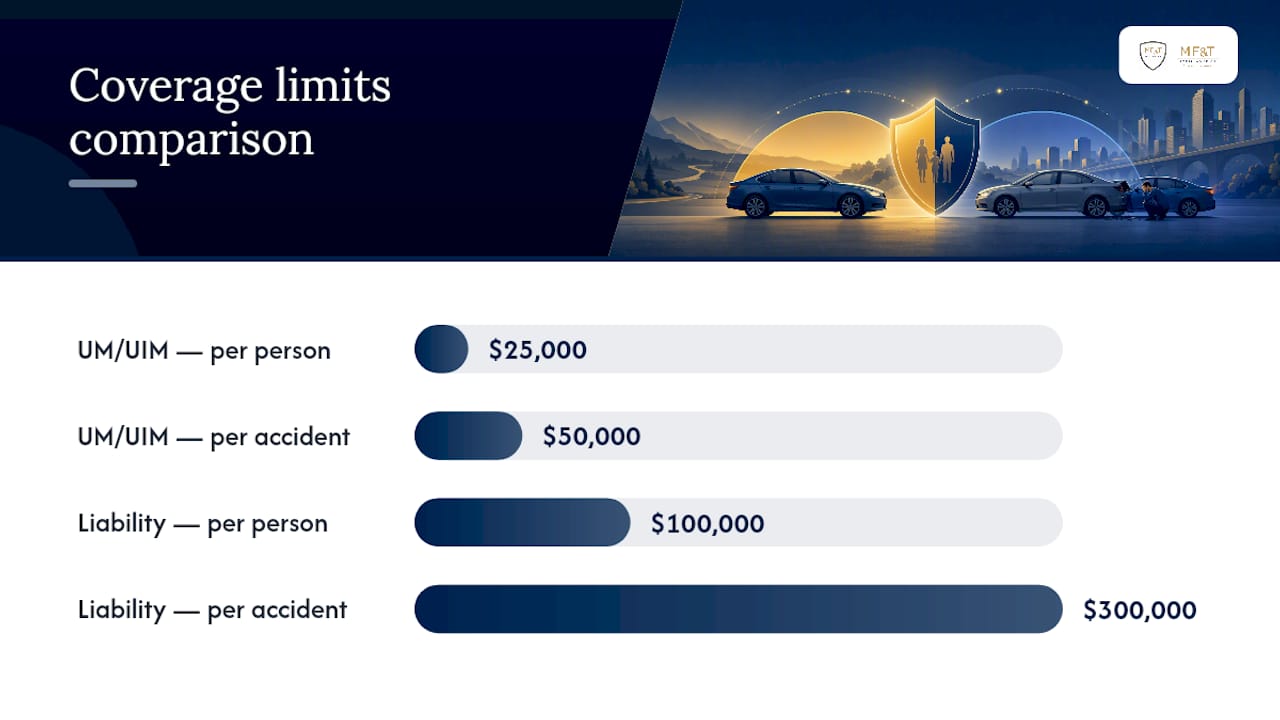
Adding UM/UIM typically runs $50 to $150 per year, depending on your state, your existing limits, and your driving history. That's a modest premium bump for coverage that can pay out tens of thousands of dollars.
Reasonable limit combinations to discuss with your agent:
- $50,000/$100,000, a common starting point in states with lower minimums
- $100,000/$300,000, a better match if you already carry higher liability limits
- Higher limits still, if you have significant assets or a family relying on your income
What Happens When You File a UM or UIM Claim?
The steps you take in the first hour after a crash often decide how smoothly your claim goes.
- Confirm everyone's safety first, then call the police so an official report exists, especially critical in hit-and-run cases.
- Photograph the scene, both vehicles, and any visible injuries before conditions change.
- Collect witness contact information while people are still on scene.
- Notify your own insurer promptly, before getting deep into conversation with the other driver or their insurer, if one exists.
- File the appropriate claim type: a UM claim if the at-fault driver has no insurance, or a coordinated UIM claim once their insurer pays out its limit.
The Texas Department of Insurance notes that documentation like police reports also supports subrogation, the process where your insurer later recovers costs from the at-fault driver and may reimburse part of your deductible.
Pro Tip: Keep every receipt, medical bill, and repair estimate in one folder from day one. Claims adjusters move faster when you hand them an organized paper trail instead of a shoebox.
How UM/UIM Fits With Your Other Coverage
UMBI often pays for costs your health insurance leaves behind, copays, deductibles, and pain and suffering that a health plan never touches. Collision coverage repairs your car no matter who caused the crash, but UMPD can still matter if you don't carry collision or if your collision deductible is high.
- Health insurance: covers medical treatment, not lost wages or pain and suffering
- Collision: repairs your car regardless of fault, subject to its own deductible
- UMBI/UMPD: fills financial gaps left by an at-fault driver who can't pay
A driver with $40,000 in medical bills, $8,000 in repairs, and two weeks of lost wages could see all three categories paid through a combination of health insurance, collision, and UM/UIM working together.
Why Trust This Guidance on Uninsured Motorist Coverage
M F and T North America has spent over 30 years helping drivers across Massachusetts and beyond sort out exactly this kind of coverage decision. The agency's auto insurance coverage guide breaks down how UM/UIM sits alongside liability and collision in a full policy.
Before your next renewal, ask your agent:
- What are my current UM/UIM limits, and do they match my liability limits?
- Is UMPD available in my state, and does it carry a deductible?
- Did I sign an opt-out form in the past, and can I reverse it now?
What Most Drivers Get Wrong About This Coverage
Most people treat uninsured motorist coverage as an afterthought, something they'll deal with if the state forces the issue. That's backwards. The states that mandate UM/UIM aren't doing you a favor they'd otherwise skip. They're recognizing a math problem: a meaningful share of drivers on the road can't pay for the damage they cause, and your own liability coverage does nothing to protect you from that.
The conventional advice, "buy the state minimum and move on," ignores the one detail that actually matters: what happens when the other driver's coverage is too thin, not absent. UIM claims trip people up more than UM claims because drivers assume having any insurance means the incident is handled. It isn't, if their limits are $25,000 and your bills are $70,000.
My honest read: prioritize matching your UM/UIM to your liability limits over almost any other add-on you're considering this renewal. It's cheap, it's underused, and it's the coverage most likely to matter on the worst day you'll have behind the wheel.
Get Your Coverage Checked Before You Need It
Reading about UM/UIM limits is one thing. Knowing whether your actual policy has a gap is another, and that's the part M F and T North America handles directly. As an independent agency, we compare your current limits against your state's rules and your own liability coverage, then tell you plainly if you're underprotected instead of just upselling you.
If you're not sure whether your policy even lists UM/UIM, or you signed a rejection form years ago without fully understanding it, request a free insurance quote and we'll walk through your declarations page together. You can also visit our auto insurance page to see how UM/UIM fits into a full policy review. Either way, it takes one phone call to find out if you're carrying a gap you didn't know about.
Frequently Asked Questions
What is uninsured motorist coverage in simple terms? It's the part of your auto policy that pays your medical bills and, in many states, your vehicle repairs when the driver who hit you has no insurance to cover the damage.
How does uninsured motorist coverage work if the other driver flees the scene? A hit-and-run is typically treated as an uninsured motorist claim, since the driver can't be identified or billed. Your UM coverage steps in as if that driver had no insurance at all.
What are the main benefits of uninsured motorist coverage? It covers medical expenses, lost wages, and pain and suffering that neither health insurance nor collision coverage fully addresses, and it protects you even when the at-fault driver can't be found.
Why does uninsured motorist coverage matter if I already have health insurance? Health insurance pays medical bills but skips lost wages, pain and suffering, and your own copays and deductibles, gaps that UMBI is specifically designed to fill.
Is uninsured motorist coverage the same as PIP? No. Personal injury protection (PIP) pays your medical costs regardless of fault, while UM/UIM specifically addresses situations where the at-fault driver lacks adequate insurance.
This article is general information, not a substitute for advice from a qualified financial advisor. Consult a qualified financial professional about your own circumstances before acting on anything here.
Sources
- uninsured motorist clause | Wex | US Law | LII / Legal Information Institute
- Facts + Statistics: Uninsured motorists | III
- Do I need uninsured motorist? | MoneyGeek
- What Is Uninsured Motorist Coverage? | NerdWallet