If you lease a car, your lease requires full coverage: liability at limits often higher than your state minimum, plus comprehensive and collision, and usually gap insurance. You, the lessee, pay every premium and deductible for the life of the lease, and that full-coverage requirement typically costs more than the minimum policy you'd carry on a car you own outright.
TL;DR:
- Lease insurance requirements typically exceed state minimums, with liability limits often around 100/300 and property damage at $50,000, plus comprehensive, collision, and gap coverage.
- Higher liability limits are driven by the leasing company's ownership stake and may trigger force-placed insurance costing two to three times the normal rate if coverage lapses.
- Full coverage costs range from $1,200 to $2,500 annually, with lease-required limits adding approximately $60 to $120 monthly for most drivers.
- Gap insurance is essential for offsetting the difference between the car’s value and lease payoff if the vehicle is totaled or stolen early in the lease.
- Matching insurance to lease terms requires careful documentation, accurate quotes, and timely proof of coverage, especially during lease transfers, early buyouts, or terminations.
Table of Contents
- What coverage does leased car insurance actually require?
- Why do lessors demand higher limits, and how does that work on your policy?
- How much does leased car insurance actually cost?
- Do you need gap insurance on a leased car?
- Why deductible caps matter more on a leased car
- How do you buy insurance that actually satisfies your lease?
- Do leased car insurance requirements vary by state?
- How do insurance claims work differently on a leased car?
- What happens if you don't carry the right insurance on a leased car?
- How do you submit proof of insurance and stay compliant?
- What should you do about insurance if you end your lease early?
- The pitfalls lessees don't see coming
- Get compliant leased car insurance without the runaround
- Sources
What coverage does leased car insurance actually require?
Every leasing company sets its own minimums, but the pattern is remarkably consistent across manufacturers and finance arms. Nearly all lessors require comprehensive and collision coverage, since the leasing company still owns the car and needs it protected against theft, weather, and crash damage, according to Progressive.
Liability limits are where leases really diverge from state law. A common lessor requirement looks like $100,000 in bodily injury coverage per person, $300,000 per accident, and $50,000 in property damage, according to MoneyGeek — far above the 25/50/25 minimums most states allow.
Here's what a typical lease insurance checklist includes:
- Bodily injury liability: often 100/300 instead of your state's 25/50 minimum
- Property damage liability: commonly $50,000, versus $10,000 to $25,000 minimums in many states
- Comprehensive and collision: required in essentially every lease agreement
- Uninsured/underinsured motorist and PIP: required where your state mandates it, regardless of lease terms
- Gap insurance: requested or required by most lessors, especially in the first year
If you're unsure how these coverages differ, our auto insurance coverage types guide breaks down each one in plain terms, and our liability limits explainer walks through why higher limits matter even outside a lease. One distinction that trips people up: being listed as an "additional insured" protects the lessor's liability exposure, while "loss payee" status means physical damage payouts go to them, not you, when the car is totaled.
Why do lessors demand higher limits, and how does that work on your policy?
The leasing company still legally owns the car, so it has a direct financial stake in protecting that asset and limiting its own liability exposure if you cause a serious accident. Higher liability limits reduce the odds that a lawsuit against you drains assets the lessor might otherwise have some claim to.
Statistic: A coverage lapse doesn't just leave you exposed. It can trigger force-placed insurance that runs two to three times normal rates, according to MarketWatch, and that policy protects the lessor's interest, not yours.
Practically, this shows up in three ways on your policy:
- Your insurer issues a certificate of insurance (COI) naming the leasing company as additional insured and loss payee.
- The lessor requires 30-day advance notice of cancellation, so a lapse doesn't happen silently.
- Federal leasing frameworks build this same logic into contract language, requiring depositing certificates and loss-payable provisions with cancellation notice terms, according to Acquisition.
Miss the notice window or let coverage lapse, and the lessor can place its own policy on the car and bill you for it.
How much does leased car insurance actually cost?
Full coverage costs meaningfully more than a bare-bones liability policy, and leasing locks you into full coverage for the entire term. National averages for full coverage on a typical driver land in the roughly $1,200 to $2,500 per year range, depending on the state and driver profile, according to CNBC Select.
Statistic: Meeting lease-required limits, rather than just state minimums, typically adds somewhere in the $60 to $120 per month range on top of a baseline liability policy, driven mostly by the jump in liability limits and the addition of comprehensive, collision, and gap.
What actually moves that number for you:
- Vehicle value and theft risk — a frequently stolen model or a pricier trim costs more to insure
- Location — dense metro areas with higher accident and theft rates cost more than rural ZIP codes
- Driving record — a clean record for three years or more earns meaningfully better rates
- Deductible choice — within the caps your lease allows, a higher deductible lowers your premium
- Credit-based insurance score — used in most states as a rating factor, though a handful of states ban it
You control your deductible, your driving habits, and how many quotes you gather. You don't control the lessor's minimum liability requirement, so budget for it rather than fighting it.
Do you need gap insurance on a leased car?
Gap insurance covers the difference between what your car is worth and what you still owe if it's totaled or stolen. Say your leased sedan gets totaled six months in: your car's actual cash value comes back at $18,000, but your lease payoff balance sits at $22,500. Without gap coverage, you owe that $4,500 difference out of pocket even though the car is gone.
Most lessors require or strongly recommend gap coverage precisely because leased cars depreciate faster than loan balances shrink in the early months, according to the Insurance Information Institute.
Where you buy it changes the price dramatically:
- Through your auto insurer: typically $20 to $40 per year, added directly to your policy
- Through the dealership: often rolled into your lease payment at a steep markup, according to Consumer Reports
Buying gap through your existing insurer is one of the easiest savings moves available. It's the same protection at a fraction of the dealer price.
Why deductible caps matter more on a leased car
Your lease agreement doesn't just set coverage types. It caps how high your deductible can go, usually somewhere between $500 and $1,000, according to MoneyGeek. Choose a $2,000 deductible to shave a few dollars off your premium, and you've technically breached your lease, even though the coverage itself still meets the liability and comprehensive requirements.
Statistic: Force-placed insurance, triggered by a lapse or an out-of-compliance policy, typically costs two to three times what a voluntary policy would run, according to MarketWatch, and it usually excludes your personal liability protection entirely.
Here's how the math actually plays out:
- Compliant policy: $1,800/year in premium, $750 deductible, full protection if you're sued
- Non-compliant policy with a $2,000 deductible: saves maybe $100/year, but breaches the lease
- Force-placed policy after a lapse: $3,600 to $5,400/year for coverage that protects only the lessor
The math rarely favors cutting corners on the deductible.
How do you buy insurance that actually satisfies your lease?
Matching your policy to lease terms is a documentation exercise as much as a shopping exercise. Get this wrong and you'll find out at delivery, when the dealer or leasing company rejects your proof of insurance.
- Read your lease agreement first and write down the exact liability limits, deductible caps, and any named-insured language before calling an agent.
- Get multiple quotes using identical limits and deductibles across every insurer, so you're comparing real apples to real apples instead of one quote at state minimums and another at lease-required limits.
- Request a certificate of insurance naming the lessor as loss payee, and deliver it to the dealer or leasing company before you drive off the lot, not after.
- Ask about every discount that applies: multi-policy bundling, safe-driver history, anti-theft devices, low-mileage usage, and continuous prior coverage.
Pro Tip: Tell your agent the exact lease-required limits and deductible cap on the first call, not the third. Mismatched quotes are the number one reason lessees end up scrambling at delivery, and a rushed policy rarely gets you the best rate.
Do leased car insurance requirements vary by state?
Lease requirements themselves come from the leasing company's contract, not from state law, so the $100,000/$300,000/$50,000 example limits tend to hold steady whether you're leasing in Texas or Massachusetts. What changes state by state is everything layered on top of that contractual floor.
States set their own liability minimums, and since lease requirements usually exceed those minimums anyway, the lease terms typically govern regardless of where you live. Where state law creates real variation:
- No-fault states (including Massachusetts, Florida, and New York) require Personal Injury Protection regardless of what your lease says, adding a coverage type many lessors don't separately address.
- Uninsured/underinsured motorist requirements are mandatory in some states and optional in others, so your total premium for identical lease-required liability limits can differ meaningfully across state lines.
- Credit-based insurance scoring is banned in a handful of states, which changes how your premium is calculated even with identical coverage.
- Minimum age and licensing rules for named drivers on a lease can affect who's allowed to drive the car without violating both state law and lease terms.
- Insurer availability and pricing varies widely by state simply due to accident rates, repair costs, and litigation environment.
The practical takeaway: don't assume a friend's lease insurance quote in another state tells you much about your own. Check your specific lease contract's required limits, then layer your state's own mandatory coverages, like PIP or UM/UIM, on top.
How do insurance claims work differently on a leased car?
Filing a claim on a leased vehicle follows the same first steps as any accident: call your insurer, document the damage, and get an estimate. Where it diverges is in who ultimately gets paid and who has to sign off.
For a total loss, your insurer's payout for the vehicle's actual cash value goes to the lessor first, since they're listed as loss payee on your policy, not to you directly. Any amount left over after your lease payoff balance is settled comes to you; if the payout falls short, gap insurance covers the difference, and without it, you owe the shortfall.
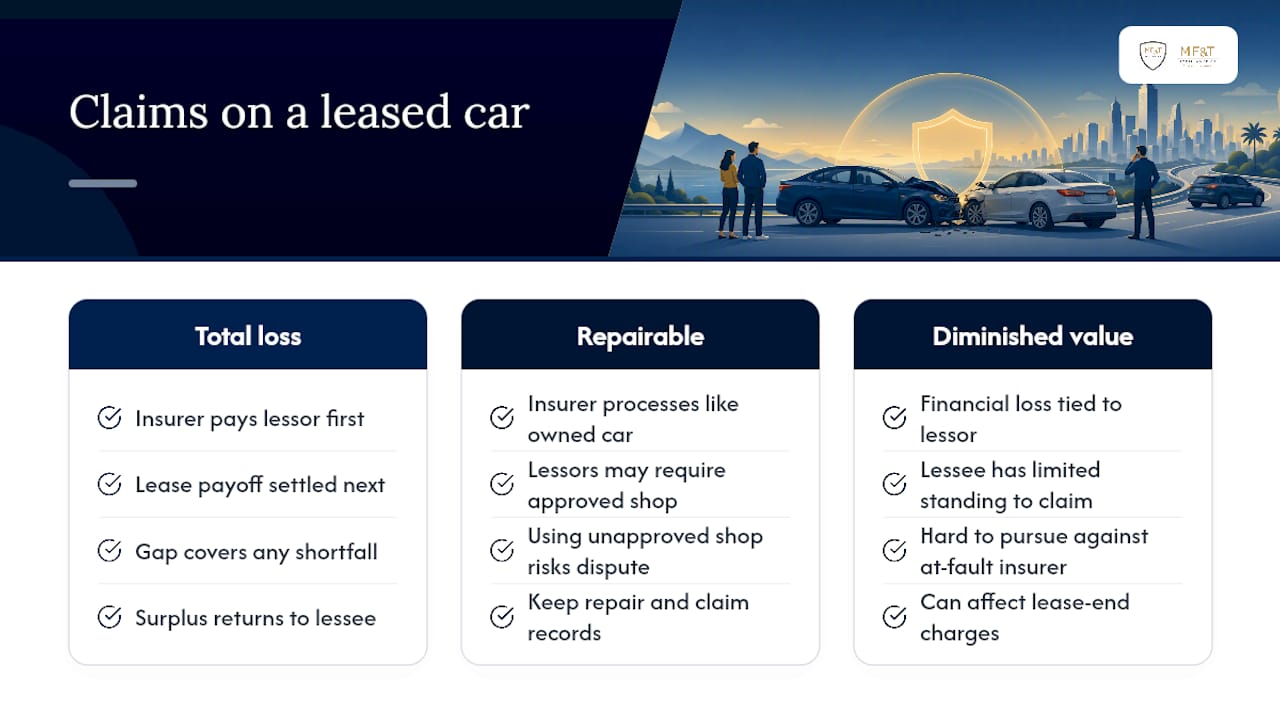
For repairable damage, the claims process looks nearly identical to an owned vehicle, but some lessors require repairs to be made at a factory-authorized or approved shop to preserve the vehicle's condition for lease-end inspection. Check your lease agreement before you pick a body shop, since using an unapproved shop can create a dispute at turn-in even if the repair itself was done well.
Diminished value claims get more complicated on a leased car. Since you don't own the vehicle, you generally have less standing to pursue a diminished-value claim against an at-fault driver's insurer than an owner would, because the financial loss from reduced resale value technically belongs to the lessor.
One more wrinkle: lease-end inspections sometimes flag prior accident repairs even when the repair was covered and completed properly, which can affect excess wear-and-tear charges. Keep your repair documentation and claim records until well after you return the car.
What happens if you don't carry the right insurance on a leased car?
Driving a leased car without the coverage your lease requires creates risk on two fronts: your state's legal requirements and your private contract with the leasing company. Both carry consequences, and they compound each other.
On the legal side, driving without your state's minimum required insurance carries the same penalties as it would in any owned vehicle: fines, license suspension, and registration issues, depending on your state. That risk exists regardless of your lease.
On the contractual side, falling short of your lease's specific requirements, whether that's dropping below the required liability limits, letting comprehensive or collision lapse, or exceeding the deductible cap, puts you in breach of the lease agreement itself. Consequences can include:
- Immediate force-placed insurance, billed to you at two to three times normal rates, according to MarketWatch
- Default notices from the leasing company, which in serious or repeated cases can escalate toward repossession, since you don't own the vehicle
- Denied or reduced claims if an insurer discovers your policy didn't actually match disclosed lease terms at the time of loss
- Personal liability exposure far beyond what force-placed insurance would ever cover, since those policies typically protect only the lessor's asset, not your legal liability if you injure someone
The gap between "technically insured" and "compliant with your lease" is where most of this risk lives. A policy that satisfies your state but not your lease still leaves you exposed to breach consequences you didn't see coming.
How do you submit proof of insurance and stay compliant?
Most leasing companies want proof of insurance before you ever drive the car off the lot, and they want it in a specific form: a certificate of insurance showing the leasing company by its exact legal name as additional insured and loss payee.
Getting this right the first time saves you a second trip or a delayed delivery:
- Confirm the exact legal name and address the leasing company wants on the certificate; a mismatched name can bounce the document back for correction.
- Ask your agent to send the COI directly to the dealer or lessor, rather than routing it through you as a forwarded email, which reduces transcription errors.
- Keep a copy for yourself, separate from the dealer paperwork, so you have it on hand at renewal or if the lessor ever questions coverage.
- Set a calendar reminder ahead of your policy renewal date, since a renewal that changes your limits or drops a required coverage can put you out of compliance without any active decision on your part.
Ongoing compliance monitoring matters more than most lessees expect. Insurers sometimes adjust coverage at renewal, whether through an automatic recommendation, a missed payment that triggers a lapse, or a policy change you made without realizing it affected the lease-required minimums. If you're gathering registration or title paperwork alongside your insurance documents, Loturn's dealer forms library organizes the state-specific forms lessees often need when finalizing a lease.
What should you do about insurance if you end your lease early?
Ending a lease before its term is up, whether through an early buyout, a lease transfer, or a trade-in toward a new vehicle, doesn't eliminate your insurance obligations. It shifts them, and missing that shift is where lessees run into trouble.
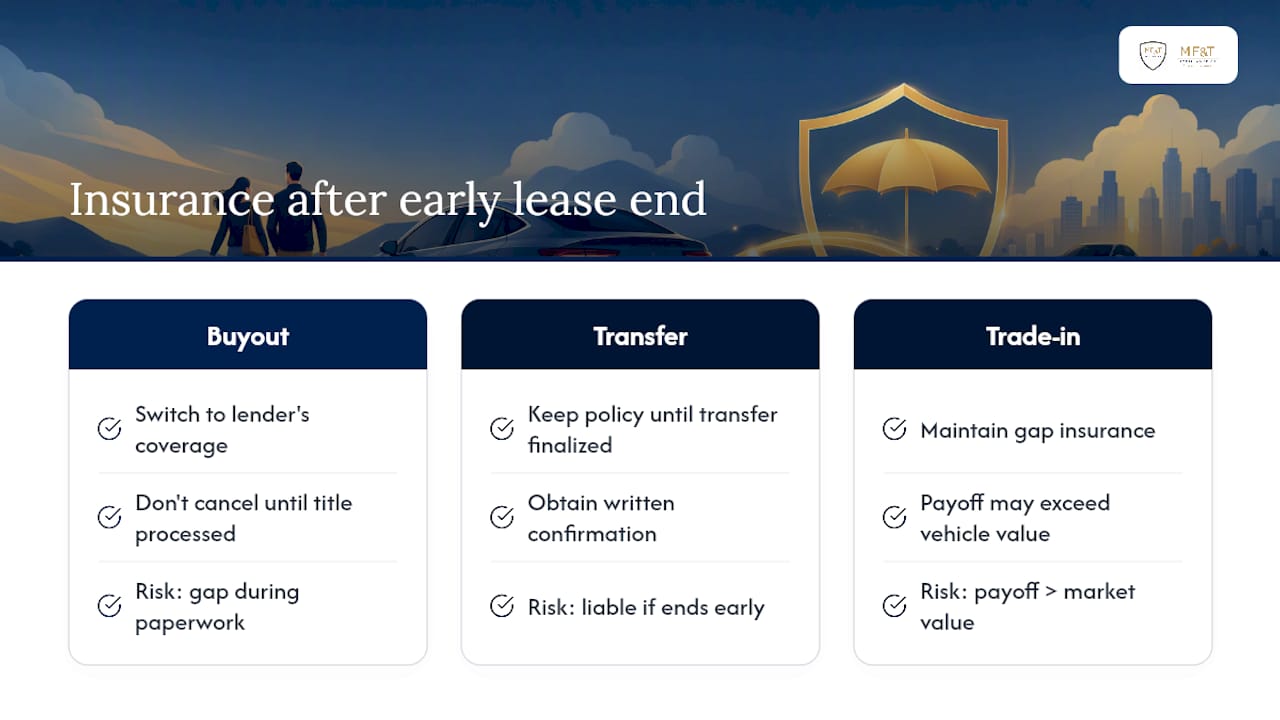
If you're buying out the lease, your insurance requirements typically shift from the lessor's minimums to whatever your new lender requires, which may be lower, but don't cancel or downgrade coverage until the title and loan paperwork are fully processed. A gap in timing here can leave you technically uninsured on a car that's still legally financed.
If you're transferring the lease to another person, your insurance obligation ends when the transfer is finalized and the new lessee's policy is confirmed active, not before. Keep your own coverage in force until you have that confirmation in writing.
If you're trading the car in early toward a new lease or purchase, gap insurance becomes especially important, since early termination often triggers a payoff calculation that can exceed the vehicle's value by more than a standard total-loss scenario would.
In every early-termination scenario, notify your insurer of the date coverage should change, and don't let a lapse open up between the old lease's insurance requirement and whatever comes next. A short gap during a transition is exactly the kind of moment force-placed insurance or a compliance dispute tends to appear.
The pitfalls lessees don't see coming
The mistakes we see most aren't about ignorance. They're about timing and precision: shopping for insurance the day before delivery, picking a deductible that feels smart but breaks the lease cap, or a COI that lists the wrong entity name and bounces back from the dealer. An independent agent can quote multiple carriers against your exact lease terms at once, catch the mismatch before it costs you, and get the paperwork right the first time.
— Mike
Get compliant leased car insurance without the runaround
Meeting your lease's exact coverage terms while still finding a fair rate takes more than one quote from one carrier. M F and T North America compares multiple insurers against your lease's specific liability limits and deductible caps, so you're not guessing whether a policy actually satisfies your contract.
We handle the certificate of insurance directly, naming your leasing company as loss payee and additional insured, and we send it where it needs to go before your delivery date. If you're leasing a motorcycle alongside a car, or adding a second driver to the policy, we sort out those endorsements at the same time instead of leaving you to track down separate paperwork later.
Have your lease agreement handy, along with your driver's license and current insurance information if you're switching carriers, and get a free auto insurance quote built around what your lease actually requires. If you'd rather talk it through first, our auto insurance page has direct contact options to reach an agent the same day.
This article is general information, not a substitute for advice from a qualified financial advisor. Consult a qualified financial professional about your own circumstances before acting on anything here.
Sources
- Insuring a leased vehicle — MoneyGeek
- Understanding car leases — Consumer Reports
- What are the requirements for insurance on a leased car? — MarketWatch