
There is no universal legal new car grace period in the United States. Insurers decide whether to offer one, how long it lasts, and what conditions apply. Most states do not mandate a coverage window for newly purchased vehicles, so your protection depends entirely on your existing policy and your carrier's specific terms.
A few things to know right away:
- No existing policy means no grace period. If you don't currently carry an active auto insurance policy, you must secure coverage before driving off the lot. There is no automatic protection to fall back on.
- Financed or leased vehicles come with lender rules. Your lender may require proof of insurance at the moment of purchase, regardless of any grace window your insurer offers.
- State rules vary. Your state's Department of Insurance (DOI) sets minimum liability requirements and proof-of-insurance standards, but it generally does not mandate a new-car grace period.
Check your policy declarations page and any lender or lease paperwork before you sign anything at the dealership.
Key Takeaways
No universal new car grace period exists in the U.S.; insurers set their own windows, typically 7–30 days, and lenders may require proof of insurance immediately regardless of that window.
| Point | Details |
|---|---|
| No policy, no grace period | You must have an active policy before buying; no existing coverage means no automatic protection. |
| Typical window is 7–30 days | Most insurers offer 7–30 days of automatic coverage, but physical-damage protection may be much shorter without existing collision/comprehensive. |
| Lenders don't wait | Lenders often require a binder naming them as additional interest at the time of purchase, not after the grace period ends. |
| State rules set minimums, not grace periods | Check your state DOI for minimum liability requirements and proof-of-insurance standards for registration. |
| M F and T North America | An independent agent can issue a same-day binder, confirm lender requirements, and advise on coverage gaps in a single call. |
Table of Contents
- How does a new car grace period actually work?
- What grace-period lengths do most insurers offer?
- Steps to take when you buy a new car
- What can go wrong if you rely on a grace period?
- Where state rules matter and how to check yours
- How an independent agent handles adding a new car
- What agents see most often at the dealership
- Get same-day coverage support from M F and T North America
- Sources
How does a new car grace period actually work?
A grace period for a newly purchased vehicle is a contractual policy provision, not a legal right. Your insurer writes the rules, and those rules live in your policy's "newly acquired auto" clause. Grace periods are discretionary policy benefits; some insurers define a clear window, some offer a very short one, and some offer none at all.
What typically extends automatically:
Liability coverage usually carries over to a new vehicle if you already have an active policy. That means the bodily injury and property damage protection you carry on your current car will generally apply to the new one during the grace window. Comprehensive and collision coverage are a different story: if you don't already carry those on at least one vehicle in your policy, automatic physical-damage protection for the new car may last only a few days, not the full 7–30 day window you might expect.

What commonly does not extend:
Higher liability limits required by a lender, gap coverage, and any endorsements specific to your existing vehicle typically do not transfer automatically. If your lender requires $100,000/$300,000 limits and your current policy carries $50,000/$100,000, you are underinsured from the moment you drive off the lot, even within a grace period.
Who qualifies:
The grace period applies only when you have an active, in-force policy. Once a policy has been canceled, coverage ends on the cancellation date and no grace window applies to a new purchase.
Replacement vs. addition:
Insurers treat these differently. Replacing a vehicle you already insure often triggers a broader automatic coverage window. Adding a second or third vehicle to your policy may come with a shorter window or different conditions. Read your declarations page carefully, or call your agent to confirm which scenario applies.
Pro Tip: If you're financing or leasing, ask your lender in writing exactly what coverage levels and effective dates they require. Get that confirmation before you arrive at the dealership so your agent can match those requirements precisely.
What grace-period lengths do most insurers offer?
Most insurers extend coverage automatically for a window that commonly runs 7 to 30 days after you purchase a new vehicle, but the exact length depends on your carrier, your state, and whether you're replacing or adding a car. Understanding auto insurance coverage types helps clarify what actually extends during that window.
| Grace Window | Common Scenario | Coverage Note |
|---|---|---|
| Same day to 3 days | Adding a vehicle with no collision/comprehensive on existing policy | Physical-damage coverage may be very limited or absent |
| 7 days | Adding a vehicle when you carry liability only | Liability typically extends; collision/comprehensive may not |
| — | Replacing an insured vehicle; you already carry collision/comprehensive | Full coverage usually mirrors existing policy |
| 30 days | Replacement vehicle; some carriers extend maximum window | Broadest automatic coverage; confirm with your insurer |
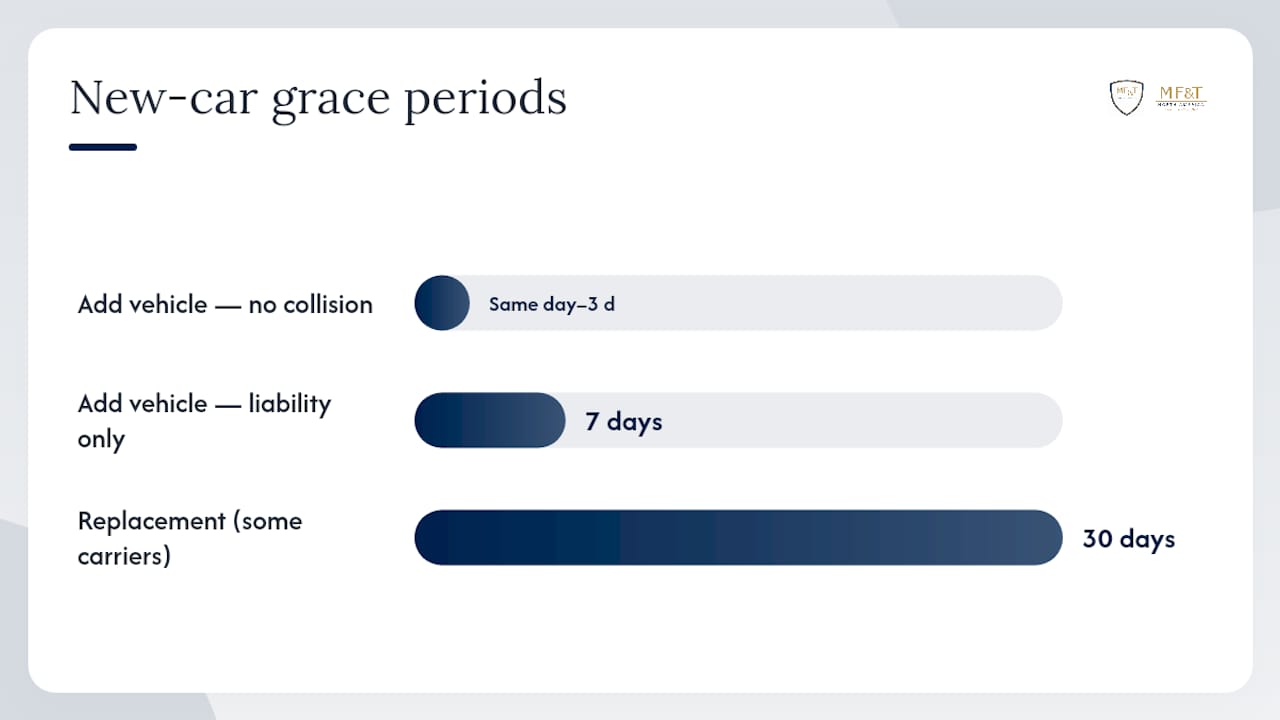
These ranges are representative, not guaranteed. Your insurer's declarations page is the only authoritative source for your specific window. Call your carrier or agent on the day of purchase to confirm the exact number of days and what coverage applies.
Steps to take when you buy a new car
Follow this checklist in order. Skipping steps, especially with a financed vehicle, can leave you exposed.
Before you drive off the lot:
- Pull up your current policy declarations page and note your coverage types, limits, and your insurer's phone number.
- Gather the vehicle's VIN, the purchase date, and your lender's full legal name and address (required for the binder).
- Call your insurer or agent and confirm whether your policy includes a grace period, how long it lasts, and whether it covers the specific vehicle type you're buying.
- If your lender requires immediate proof of insurance, request an emailed binder naming the lender before you sign the purchase agreement.
Same day:
- Add the new vehicle to your policy formally, even if a grace period applies. Provide the VIN, purchase date, and odometer reading.
- Request written or electronic proof of insurance (a binder or ID card) and forward it to the dealer and lender.
- Confirm the effective date on the binder matches the purchase date, not a future date.
Within 48 hours:
- Review your updated declarations page to confirm the correct coverage levels, especially collision and comprehensive if your lender requires them.
- Verify that any lender-required endorsements (such as gap coverage) are in place.
- Save all documentation: the binder, the updated declarations page, and any lender confirmation emails.
Pro Tip: Buying on a Friday evening or over a weekend? Use your insurer's mobile app or website to add the vehicle and set the effective date to the purchase date. Most major carriers can issue an emailed binder within minutes. Getting same-day proof of insurance this way prevents a gap even when your agent's office is closed.
What can go wrong if you rely on a grace period?
Assuming a grace period covers you without verifying the details is one of the more expensive mistakes a new car buyer can make. Here's what's actually at stake:
- Claim denial for physical damage. If your existing policy carries liability only and you assume collision transfers automatically, a crash during the grace window could leave you paying for repairs out of pocket on a vehicle you just financed.
- Lender force-placement. Lenders often require proof of insurance immediately upon purchase. If you can't produce it, the lender can purchase a force-placed policy on your behalf. Force-placed insurance is typically far more expensive than a standard policy and covers only the lender's interest, not yours.
- Fines and registration penalties. Driving without the minimum required liability coverage violates state financial responsibility laws in every state. Penalties range from fines to license suspension, depending on where you live.
- Higher future premiums. A recorded coverage lapse, even a short one, can raise your rates at renewal. In serious cases involving repeated lapses or violations, some states require an SR-22 filing, which signals high-risk status to carriers and raises premiums further.
- Loan default risk. Most auto loan agreements require you to maintain specific coverage levels throughout the loan term. Driving without adequate coverage can technically put you in default, giving the lender grounds to accelerate the loan.
Consider a practical scenario: you finance a $38,000 SUV on a Saturday afternoon. Your existing policy carries liability only. You assume the grace period covers everything. Monday morning, someone rear-ends you at a stoplight and the SUV is totaled. Without collision coverage in place, your insurer pays nothing for the vehicle. You still owe the full loan balance.
Where state rules matter and how to check yours
Most states do not require insurers to offer a new-car grace period. What states do control is the minimum liability coverage required to register and drive a vehicle legally. Those minimums vary significantly, and they affect what your policy must carry before you drive.
State Departments of Insurance and the National Association of Insurance Commissioners (NAIC) are the authoritative sources for state-specific rules. To find your state's requirements:
- Search "[your state] Department of Insurance" or "[your state] insurance commissioner."
- On the DOI site, look for sections labeled "newly acquired vehicle," "minimum liability requirements," or "proof of insurance for registration."
- Check whether your state requires electronic proof of insurance at registration or only a physical card.
- If you're moving to a new state, check the new state's requirements immediately. Moving to another state typically requires updating your policy to meet the new state's minimums, and some states give you only a short window (often 30–90 days) to re-register your vehicle and update your coverage.
Pro Tip: When financing, ask your insurer to email a binder that specifically names the lender as an additional interest. Many lenders won't accept a generic proof-of-insurance card. The binder with the lender's name is what satisfies the loan agreement and prevents force-placement.
How an independent agent handles adding a new car
Calling an independent agent on the day you buy a vehicle is often faster and more reliable than navigating an insurer's app alone, especially when financing is involved or when you have questions about coverage limits. Here's what a qualified agent does in that situation:
- Pulls up your existing policy immediately and confirms your current coverage types, limits, and any grace-period provisions.
- Checks lender requirements against your current limits and flags any gaps, such as insufficient collision/comprehensive or missing gap coverage.
- Issues a same-day binder naming the lender as required, so you can hand it to the dealer or email it to the finance office before signing.
- Advises on endorsements you may need for a financed or leased vehicle, including gap coverage and any lender-mandated minimum limits.
- Submits required documentation to the lender or DMV on your behalf, reducing the back-and-forth that often delays registration.
An agent is especially valuable when you're buying out of state, when the vehicle is leased through a manufacturer's finance arm with specific insurance requirements, or when you have questions about how a new purchase affects your overall premium. The insurer's app handles straightforward additions well. Complex financing, state-specific DMV requirements, or limit adjustments are situations where a real conversation saves time and prevents mistakes.
M F and T North America, an independent agency based in Arlington, MA with over 30 years of experience, handles exactly these situations for buyers across multiple states. Independent agents work with multiple carriers, which means they can also check whether your current carrier's grace-period terms are competitive or whether a policy adjustment makes sense at the time of purchase. You can also compare coverage choices across carriers to make sure your limits match what your lender actually requires.
What agents see most often at the dealership
The most common mistake buyers make is assuming the grace period is longer than it actually is. Most people hear "30 days" and treat it as a guarantee. In practice, that full window applies only when you already carry collision and comprehensive on another vehicle and you're replacing it, not adding to your fleet.
The second most common issue: buyers don't realize their lender requires a binder naming the lender specifically, not just a standard insurance card. A dealer finance office will often let this slide at signing, but the lender's servicing department will flag it within days and initiate force-placement.
The one thing worth telling every buyer: call your agent or insurer before you get to the dealership, not after. Confirm your grace-period window, your current coverage levels, and exactly what the lender needs. That call takes five minutes and prevents problems that can take weeks to untangle.
Get same-day coverage support from M F and T North America
Buying a car is already a full day. Sorting out insurance paperwork on top of it, especially when a lender is waiting on a binder, adds real pressure. M F and T North America makes that part straightforward.
As an independent agency with 30+ years of experience, M F and T North America can pull up your existing policy, confirm your coverage levels against your lender's requirements, and issue a same-day binder naming your lender, all in a single call. The agency serves buyers across multiple states and can advise on state-specific registration steps, minimum liability requirements, and any endorsements your financing agreement demands. Whether you're buying your first car or adding a vehicle to an existing fleet, the process is faster with an agent who already knows your policy.
Request a free quote or reach out to the Boston-area auto insurance team to get same-day proof of insurance before you drive off the lot.
Sources
These are the authoritative places to verify rules for your specific state and situation:
- Buying New Car Insurance with Grace Period
- Carinsurance
- Car Insurance Grace Period: After Cancellation, New Car and Missed Payments
- How to Add a New Car to Insurance: Steps and Costs - LegalClarity
- How Long Do I Have to Insure a New Car?
Save any emailed binders immediately and forward copies to your lender and the dealership's finance office. A binder in your email is proof you can produce in seconds, whether you're at the DMV or on the phone with your loan servicer.
This article is general information, not a substitute for advice from a qualified financial advisor. Consult a qualified financial professional about your own circumstances before acting on anything here.