
Additional insured status adds liability defense and indemnity coverage to a third party. Loss payee status directs property insurance proceeds to a lender or lienholder. They protect different interests on different policies, and mixing them up on a certificate of insurance can leave a lender, landlord, or contractor unprotected. Pull your declarations page now and confirm the endorsement form number matches what your contract or loan actually requires.
TL;DR:
- Additional insured status applies to liability policies and grants defense and indemnity protection, but does not provide direct property claim payments.
- Loss payee status attaches to property or damage policies and ensures claim proceeds go directly to lenders or lienholders up to the loan balance.
- Many certificates mistakenly list the wrong party as either additional insured or loss payee, which can void protections at claim time if not corrected beforehand.
- The appropriate endorsement type depends on the relationship: request additional insured status for liability exposure and loss payee for financial interest in property.
- Confirm endorsement forms and policy limits before signing, and request a corrected certificate if your contract’s requirements are not clearly met.
Table of Contents
- Loss Payee vs Additional Insured: What Each One Actually Does
- What a Loss Payee Actually Gets Paid
- How the Two Endorsements Stack Up Side by Side
- When to Request Each Endorsement
- Getting the Endorsement Right on Your Certificate
- Lender-Specific Protections and the Pitfalls They Prevent
- Certificate Mistakes That Void Protection at Claim Time
- How MF&T North America Verifies Your Endorsements
- One Rule Worth Repeating
- Get Your Endorsements Reviewed Before You Sign
- Sources
- FAQ
Loss Payee vs Additional Insured: What Each One Actually Does
The confusion usually starts because both terms sound like they mean "this person gets covered too." They don't work the same way at all.
Additional insured status attaches to a liability policy, most often a Commercial General Liability (CGL) policy or an umbrella policy. It extends defense and indemnity protection to a party who isn't the named insured, but faces exposure from your work or your premises. If a subcontractor's mistake gets your client sued, an additional insured endorsement can mean your client's own insurer isn't the only one paying legal bills. According to Insureon, additional insureds gain access to defense and indemnity, not a check for property damage.
The common ISO endorsement forms include:
- CG 20 10 — ongoing operations coverage for the additional insured
- CG 20 37 — completed operations coverage, which matters once your work is finished but a claim surfaces later
- CG 20 26 — a broader "additional insured, designated person or organization" form
Pro Tip: Ask specifically for CG 20 10 and CG 20 37 together if you're a contractor. Ongoing operations coverage alone leaves a gap once the job is done.
The catch: additional insured status only covers what the endorsement wording allows. It never pays out property proceeds, and it's only as strong as the exact form attached to the policy.
What a Loss Payee Actually Gets Paid
Loss payee status attaches to property and physical damage policies, not liability policies. Think commercial property insurance, builder's risk insurance, and commercial auto physical damage coverage. A loss payee has an insurable financial interest in the property itself, typically because they lent money against it or lease it to you.
Investopedia describes the loss payable clause as a mechanism that sends claim proceeds to a third party rather than only the policyholder. Here's how it plays out in practice:
- The insurer issues a joint payment naming both you and the lienholder, or pays the lienholder directly up to the loan balance.
- Payment priority typically follows the outstanding loan amount first, with any remainder going to you.
- The loss payee's rights are limited to whatever rights the named insured has under the policy, per Investopedia's explanation of loss payable clauses.
A basic loss payee endorsement is not the same as a lender's loss payable or mortgagee clause, which we'll get to below. If you financed a delivery van and it's totaled, a basic loss payee clause simply routes the check toward your lender first.
How the Two Endorsements Stack Up Side by Side
Once you see them next to each other, the distinction gets easier to hold onto. Additional insured protects against being sued. Loss payee protects a financial stake in physical property. They're not competing options. They're solving two completely different problems.
| Feature | Additional Insured | Loss Payee |
|---|---|---|
| Applies to | Liability policies (CGL, umbrella) | Property/physical damage policies (commercial property, builder's risk, commercial auto) |
| Primary protection | Defense and indemnity against third-party claims | Property insurance proceeds tied to financial interest |
| Payment/claim rights | No direct payment, benefits from insurer's defense | Direct or joint payment, often up to loan balance |
| Notice/cancellation rights | Varies by form, often limited | Can be stronger with lender's loss payable clause |
| Typical use cases | General contractors, property owners, vendors | Lenders, lessors, equipment financiers |
A single certificate can list a party as both additional insured on the liability section and loss payee on the property section. That's normal for a construction loan where the lender wants both protections. Careless COI issuance is genuinely common: brokers sometimes put the property owner in the loss payee field or the lender in the additional insured field, according to GetBusinessCoverage's comparison of the two endorsements, and that mismatch surfaces only when someone tries to file a claim.
When to Request Each Endorsement
Match the endorsement to the relationship, not the paperwork habit of whoever drafted the contract.
- Request additional insured status when a general contractor, property owner, or vendor could be pulled into a liability claim tied to your operations. Contract language often reads "Contractor shall name Owner as an additional insured on a primary and noncontributory basis."
- Request loss payee status when a lender, lessor, or equipment financer has a financial stake in property you're insuring. Look for wording like "Lender shall be named as loss payee as its interest may appear."
- Request both on construction loans and financed commercial property, where the lender needs liability protection during the build and payout rights if the structure is damaged.
- Watch for vague phrasing like "name as insured" with no distinction between liability and property. That ambiguity is exactly what causes claim-time disputes.
Getting the Endorsement Right on Your Certificate
Call your agent before you sign, not after a claim gets denied. Give them the exact named insured, the certificate holder's legal name, and the specific endorsement form your contract or loan requires.
- Check the declarations page for the correct policy type, the endorsement form number, and matching limits.
- Confirm the certificate holder field and the additional insured or loss payee field aren't reversed.
- Ask for the actual endorsement, not just a certificate. Insureon notes that a certificate is evidence of coverage, not the controlling policy language itself.
- Use precise request language: "Add [Lender Name] as loss payee per lender's loss payable clause" rather than "add lender to policy."
Pro Tip: If your insurer issues the wrong endorsement, don't accept a verbal fix. Request a corrected, reissued certificate in writing before your closing date or contract start.
If a lender's guide to commercial real estate insurance requirements applies to your deal, review it alongside whatever your loan officer sends you. For a deeper look at how additional insured wording gets structured for contractors, see this explainer on additional insured status.
Lender-Specific Protections and the Pitfalls They Prevent
Lenders rarely accept a basic loss payee clause on its own. They ask for a lender's loss payable or mortgagee clause, which functions closer to an independent contract between the lender and the insurer.
- These clauses typically survive certain policyholder breaches that would otherwise void coverage, according to Washington State's sample lender loss payable endorsement.
- They usually require the insurer to give the lender advance notice before canceling the policy.
- They can require the lender to pay overdue premiums itself to preserve its rights, a detail many borrowers never see coming.
A lender's loss payable clause exists precisely because a basic loss payee designation isn't strong enough on its own. It gives the lender standing to claim and notice rights that survive situations where the borrower's own coverage might otherwise lapse.
Ask your lender directly whether they require the lender's loss payable form or a standard mortgagee clause, and confirm who's responsible for premium payment if you fall behind. Federman & Steifman's overview of lender requirements notes that mismatched or incomplete endorsements are a routine cause of delayed closings.
Certificate Mistakes That Void Protection at Claim Time
Most COI failures aren't dramatic. They're clerical, and nobody notices until a claim gets filed.
- Wrong field. A lender listed as additional insured when they needed loss payee status, or vice versa.
- Missing endorsement number. A certificate that says "additional insured included" without naming CG 20 10 or CG 20 37 specifically.
- Wrong policy referenced. A loss payee listed against a liability policy instead of the property policy that actually covers the asset.
- Confirm the named insured spelling matches your legal business name exactly.
- Confirm limits on the certificate match the declarations page, not a generic template number.
- Confirm the endorsement form itself, not just the certificate, is attached to the policy file.
Pro Tip: Keep a single shared folder with your current declarations page, all active endorsements, and the last issued COI. When a lender or client asks for proof, you'll have it in one place instead of chasing your agent under deadline.
How MF&T North America Verifies Your Endorsements
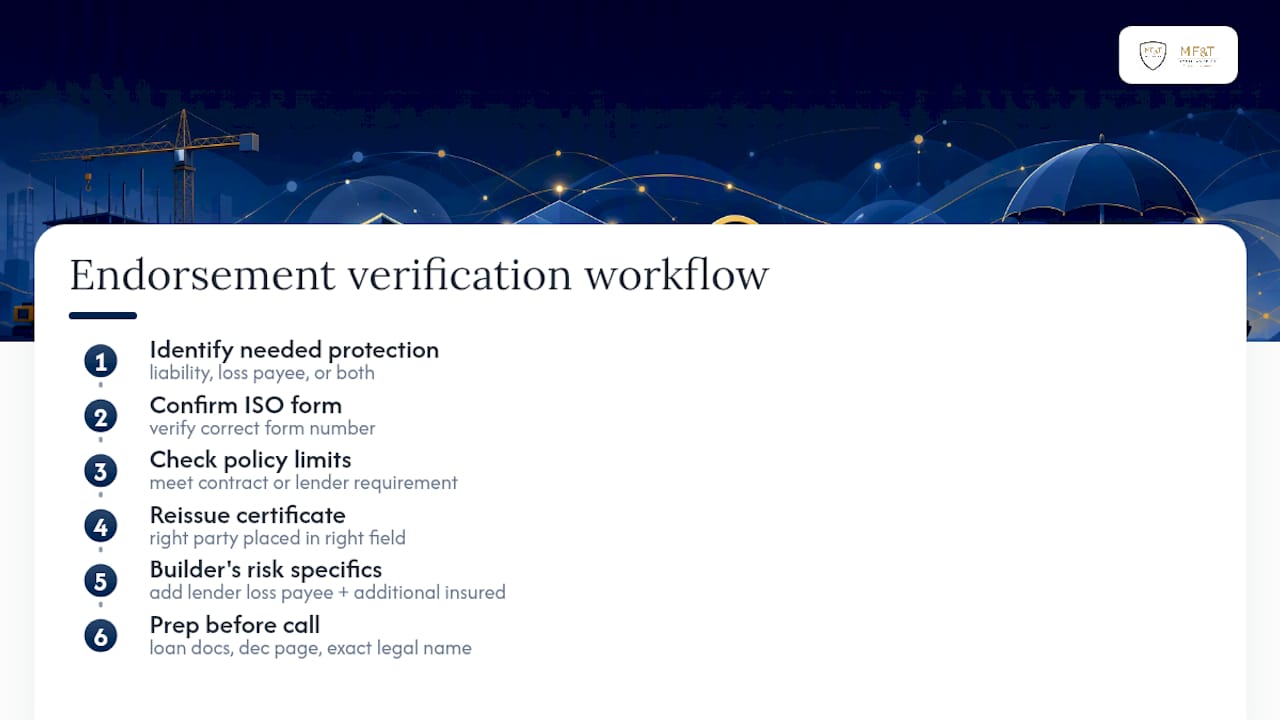
Getting this right usually comes down to workflow, not luck. When a client calls about a contract or loan requirement, the process starts with verifying exactly what the other party needs: liability protection, property proceeds protection, or both.
From there, an agent confirms the correct ISO form number, checks that policy limits satisfy the contract or lender requirement, and reissues the certificate with the right party in the right field. For builder's risk projects with a construction lender attached, that often means adding a lender's loss payable clause alongside additional insured status for the general contractor.
Before you call, have your loan documents or contract insurance clause, your current declarations page, and the certificate holder's exact legal name ready. That single call usually resolves what would otherwise become a closing-day scramble.
One Rule Worth Repeating
Match the endorsement to the actual risk, then verify the form number yourself. That's the whole rule, and most disputes trace back to skipping it.
I've seen contractors hand over a certificate listing a lender as additional insured when the lender actually needed loss payee status for a financed piece of equipment. Nobody caught it until the equipment was damaged and the lender had no standing to claim. I've also seen a builder's risk policy lapse without lender notice because the borrower assumed a basic loss payee clause carried the same cancellation protections as a mortgagee clause. It didn't.
If you're not sure which one your contract or loan actually calls for, ask your agent for a quick endorsement review before you sign anything.
— Mike
Get Your Endorsements Reviewed Before You Sign
M F and T North America reviews your coverage against the actual contract or loan language instead of guessing from a template, and as an independent agency, we shop your policy across multiple carriers rather than pushing one insurer's form.
If you're financing equipment, closing on commercial property, or starting a construction project with a lender attached, request an endorsement review and a certificate reissue before you sign. That means confirming the right ISO form, checking your limits against the lender's or contract's requirement, and correcting the certificate holder field if it's wrong. M F and T North America offers same-day policy binding for builder's risk insurance, which matters when a lender's closing date won't move. If your needs run broader, from general liability to commercial property to workers' compensation, our business insurance services cover the full package small business owners and contractors typically need. Call your agent, hand over the contract language, and get the correct paperwork in hand before the deadline arrives.
Sources
- Lender Loss Payable Endorsement (sample ISO-style form) — Washington State Office of the Insurance Commissioner
- Loss payable clause: What it is, how it works — Investopedia
- Additional insured vs. loss payee requirements — Federman & Steinman
FAQ
Is loss payee the same as additional insured?
No. Additional insured provides liability defense and indemnity on policies like CGL and umbrella coverage, while loss payee directs property insurance proceeds to a lender or lienholder on property or auto physical damage policies.
Is additional interest the same as loss payee?
Not exactly. "Additional interest" is often used informally on certificates for a party with some financial stake, but a true loss payee has a specific contractual right to claim proceeds, which additional interest status doesn't always guarantee.
Who should be listed as a loss payee?
Anyone with a financial interest in the insured property, most commonly a lender financing a vehicle, equipment, or building, or a lessor on leased equipment.
What is a loss payee in insurance?
A loss payee is a third party named on a property or physical damage policy who has the right to receive insurance proceeds, typically up to the balance of a loan or lease, when covered property is damaged or destroyed, as explained in Investopedia's overview of loss payable clauses.
Can M F and T North America help me get the right endorsement added?
Yes. As an independent agency, M F and T North America reviews your contract or lender requirements, confirms the correct endorsement form, and reissues a corrected certificate through our business insurance services.