
A certificate of insurance for contractors is a one-page ACORD 25 form that proves an insurance policy is active. It does not create coverage on its own. Contractors get one from their carrier or agent; hiring parties should verify the endorsements and effective dates before letting anyone step onto a job site.
TL;DR:
- Verify that the policy's effective dates and limits cover the entire project duration and meet contractual requirements before accepting a COI.
- Confirm that endorsements such as additional insured and waiver of subrogation are actually included on the underlying policy, not just listed on the certificate.
- Ensure the certificate holder's name and address match your records exactly, and request the endorsement page for policies over a few hundred thousand dollars.
- Track and store COIs long-term, especially for projects with potential claims years later, and confirm policies are active and unchanged at renewal.
- Coordinate with an experienced insurance agency to draft precise contract clauses, request appropriate endorsements, and prevent common rejections or delays.
Table of Contents
- What Is a Certificate of Insurance and How Do You Read the ACORD 25?
- Who Asks for a COI and When Should You Request One?
- What Do Additional Insured and Waiver of Subrogation Actually Do?
- How Do Contractors Actually Get a COI?
- How Do You Verify a COI in Two Minutes?
- What Does a COI Cost and How Long Does It Take?
- Why Do COIs Need to Be Tracked, Not Just Filed?
- How Does MF&T North America Help With Contractor COIs?
- A Note From the Field on COI Mistakes
- Get Help Getting Your COI Right the First Time
- Where to Verify COI Details and Learn More
- Sources
What Is a Certificate of Insurance and How Do You Read the ACORD 25?
The ACORD 25 is the industry-standard certificate of insurance for contractors, and it's built to be skimmed in under a minute once you know where to look. The form summarizes coverage, but it explicitly confers no rights to the certificate holder. It's a snapshot, not a contract, and it does not itself change what a policy covers.
Here's what actually sits on the page:
- Named insured: the contractor's exact legal business name, matched to their contract
- Insurer and NAIC number: the company actually backing the policy
- Policy numbers and effective dates: proof the coverage was active on the date shown
- Coverage types and limits: usually general liability, commercial auto, umbrella/excess, and workers' compensation
- Certificate holder: the person or company requesting proof, which is not automatically the same as being an additional insured
- Description of operations: free text where endorsement language actually lives
That last field matters more than most people realize. If a general contractor requires additional insured status or a waiver of subrogation, the description box is where it should be spelled out in writing, not just implied by the request.
Who Asks for a COI and When Should You Request One?
General contractors, property owners, landlords, lenders, and municipal permitting offices all ask for certificates of insurance for contractors, usually before they'll let money or access change hands. Each one has a different trigger point.
- General contractors request a COI before adding a sub to a job, often as a condition of the subcontract itself.
- Property owners and developers want one before construction begins, especially on projects tied to builders risk insurance.
- Landlords typically require a current COI at lease signing and again at renewal for any tenant doing buildout work.
- Municipalities may require proof of coverage as part of a permit application, particularly for larger commercial jobs.
- Lenders and equipment financiers often want a COI before releasing funds or leasing machinery.
Someone has to own tracking these documents. On larger projects, that's usually a project manager or the GC's insurance coordinator. On smaller jobs, it falls to whoever signed the contract, which means it falls through the cracks more often than anyone would like to admit.
What Do Additional Insured and Waiver of Subrogation Actually Do?
Being listed as a certificate holder means you received a copy of the COI. It does not mean you have any coverage under that policy. That distinction trips up more property managers and general contractors than any other part of the process.
The endorsements that actually matter are the ones that change how a claim gets paid:
- Additional insured (AI): extends the contractor's liability policy to cover the named party for claims arising from the contractor's work. Look for "ADDL INSD" checked in the relevant coverage line.
- Waiver of subrogation: stops the contractor's insurer from coming after the hiring party to recoup a paid claim. You'll see "SUBR WVD" marked on the certificate.
- Primary and noncontributory: forces the contractor's policy to pay first and forbids their insurer from splitting the cost with the hiring party's own policy.
These three endorsements show up so often in construction contracts that Procore's own guidance treats them as the baseline expectation, typically referenced by standard ISO form numbers like CG 20 10, CG 20 37, or CG 24 04.
Here's the part that catches people off guard: checking a box on the COI doesn't make an endorsement real. The endorsement has to exist on the actual policy. A certificate holder learns the difference the hard way when a claim comes in and the underlying policy was never actually endorsed, only the certificate said it was.
Pro Tip: Ask your agent for the endorsement page itself, not just the COI, on any contract above a few hundred thousand dollars. It takes one extra email and it's the only way to confirm the endorsement is real.
How Do Contractors Actually Get a COI?
Getting a correct certificate on the first try comes down to give your agent the right information before they start typing.
- Pull the exact insurance clause from your contract. Copy the specific language, not a summary. Giving your agent the verbatim wording is the single fastest way to get the right endorsements attached the first time.
- Get the certificate holder's legal name and address exactly right. A typo here is the most common reason certificates get rejected and resent.
- Check your carrier's self-service portal first. Many carriers let contractors generate a standard COI instantly, no phone call required.
- Call or email your agent for anything beyond the standard form. Additional insured status, waivers of subrogation, and primary and noncontributory language usually need a human to process.
- Set a realistic timeline. Standard certificates are typically issued same-day, often within minutes through a portal. Endorsements can take one to three business days if underwriting has to review the request.
How Do You Verify a COI in Two Minutes?
Hiring parties don't need a compliance department to catch the obvious problems. A two-minute pass through the certificate catches most of them.
- Confirm the named insured matches the actual contractor on your contract, not a similarly named affiliate.
- Check that the policy effective and expiration dates cover your entire project window, not just the bid date.
- Verify the limits meet what your contract requires, line by line, not just the total.
- Look in the description of operations box for the actual endorsement language: "ADDL INSD" and "SUBR WVD" should appear if you required them.
If anything looks off, or the stakes are high enough to justify it, call the issuing agent directly using contact information you find independently, not a phone number printed on the certificate itself. Confirming through an independent verification channel is standard practice on large commercial jobs for exactly this reason. You can also run the insurer's name through your state's NAIC license lookup to confirm the company is actually licensed to write coverage in your state.
Red flags worth escalating: a certificate holder that doesn't match your entity name, a policy that expired last month, or endorsement boxes checked with no corresponding language in the description field. None of those are clerical errors you can wave off.
What Does a COI Cost and How Long Does It Take?
Money rarely changes hands for a plain certificate. Standard COIs are almost always free, issued by the agent or carrier as a routine service to policyholders.
Endorsements are where cost and delay can creep in:
- Standard certificates: usually free, issued in minutes through a portal or same-day by an agent.
- Endorsements like additional insured or waiver of subrogation: often free but can trigger underwriting review, adding one to three business days.
- Blanket endorsements or per-project aggregate changes: sometimes carry an annual fee depending on the carrier and the risk involved.
The fastest way through this: forward your agent the exact insurance clause from your contract as early as possible to avoid delays.
Why Do COIs Need to Be Tracked, Not Just Filed?
A certificate of insurance is only accurate on the date it was issued. Policies get cancelled, lapse, or change limits at renewal, and nothing on the certificate itself forces an update unless your contract requires one.
That gap is exactly why retention and tracking matter more than most people assume:
- Construction defect claims can surface years after a project closes, so keeping COIs on file long after work wraps protects you if a claim comes in late.
- Attach certificates directly to the project file, not a general folder, so they're findable when a claim actually happens.
- For subs you use repeatedly, ask about a blanket additional insured endorsement instead of requesting a fresh certificate every job.
- If uninterrupted coverage is critical, require a notice-of-cancellation endorsement so you're alerted before, not after, a policy lapses.
How Does MF&T North America Help With Contractor COIs?
An insurance agency with extensive experience helps contractors and property owners across the region sort out exactly this kind of paperwork, including handling many COI requests.
Here's where that experience actually helps:
- Reading your contract's insurance clause and translating it into the exact endorsements your agent needs to request
- Requesting additional insured status, waivers of subrogation, and primary and noncontributory language directly with your carrier
- Helping property developers and general contractors set up project-specific insurance requirements before subcontractors are even hired
A quick call is usually enough to figure out whether your current policy can support what a contract is asking for, or whether something needs to change first.
A Note From the Field on COI Mistakes
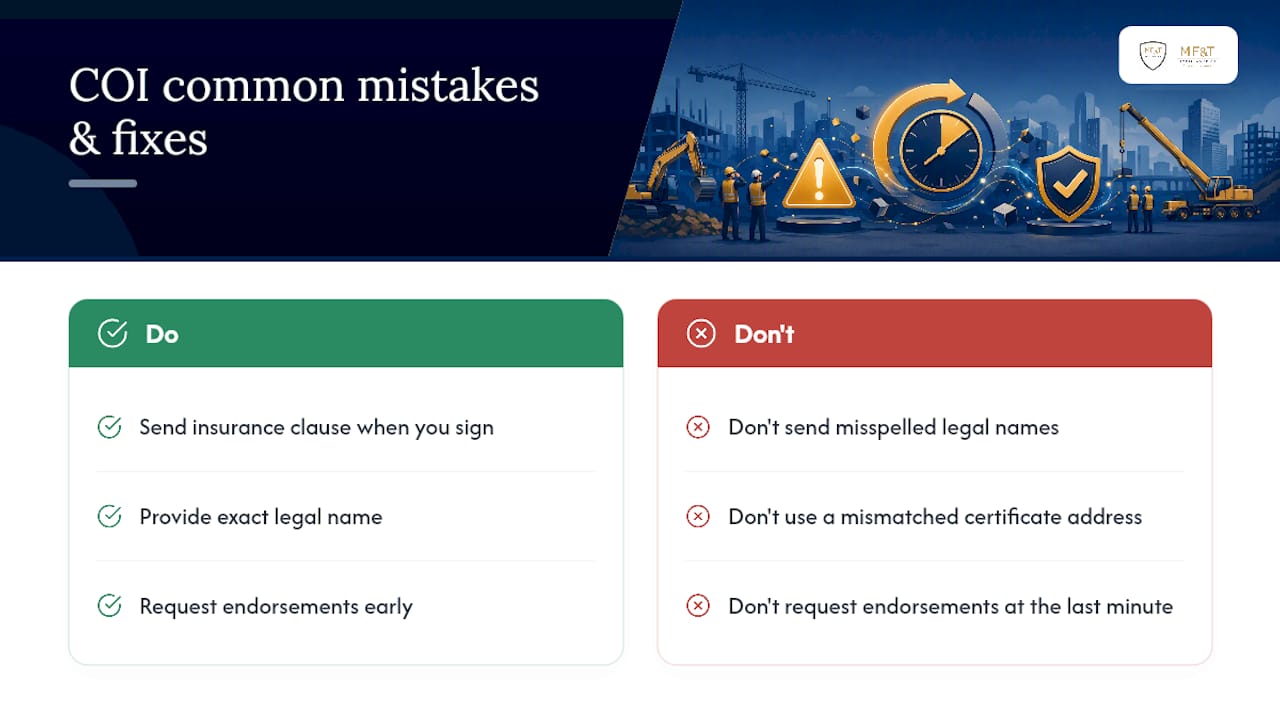
The most common rejection isn't a coverage gap. It's a misspelled legal name or a certificate holder address that doesn't match the contract, sent back and forth two or three times before anyone catches it. The second most common: waiting until the week before a project starts to request an endorsement that needed underwriting review.
Fix both by sending your agent the contract's insurance clause verbatim, the moment you sign, not the day before you need proof.
— Mike
Get Help Getting Your COI Right the First Time
If you've made it this far, you already know a rejected certificate can hold up a bid, a lease signing, or a permit you were counting on. An experienced insurance agency works directly with contractors and property developers across the region to read the contract language, request the right endorsements, and get a clean certificate efficiently.
That's the practical difference between calling a generalist and working with an agency that handles commercial insurance for contractors every week: fewer rejected certificates, faster turnaround on endorsements, and one point of contact instead of chasing three different carriers. If you need a COI request handled correctly or want your current policy reviewed against an upcoming contract, get a free quote from MF&T North America and start with a quick conversation about what your contract actually requires.
Where to Verify COI Details and Learn More
For hands-on verification, ACORD publishes the official ACORD 25 form and guidance directly. State insurance departments and the NAIC license lookup confirm whether an insurer or agent is actually licensed to write coverage. For a homeowner or property manager's side of reviewing contractor certificates, see this step-by-step certificate guide.
Sources
- LegalClarity — How to get a certificate of insurance and what it includes
- NerdWallet — What is a certificate of insurance for business
- Procore — What is a certificate of insurance (COI) for contractors
- TrackMyVendor — How to get a certificate of insurance (step-by-step)