
A workers comp ghost policy is a minimum-premium policy that lists zero payroll and excludes you, the owner, from coverage, so the carrier can issue a Certificate of Insurance without paying you benefits if you get hurt. It works well if you're a sole proprietor with no employees and no plans to hire. It stops working the moment you bring on paid help or uninsured subs. Before you buy one, confirm your state's owner-exclusion rules and keep every subcontractor's COI on file.
TL;DR:
- Ghost policies are suitable only for sole proprietors with no employees, no subcontractors, and no physical work risks, requiring confirmation of state rules first.
- The policy's Certificate of Insurance appears legitimate but offers no coverage for owner injuries, risking substantial out-of-pocket costs if injured on the job.
- Premiums typically range from $400 to $1,500 annually, paid upfront, with audits requiring business tax and subcontractor documentation to verify zero payroll.
- Payments to uninsured subcontractors can lead to reclassification as payroll during audits, dramatically increasing retroactive costs.
- Switching from a ghost policy to full owner coverage is a straightforward endorsement change if the business takes on employees, physical risks increase, or client requirements change.
Table of Contents
- What a Workers Comp Ghost Policy Is and How the Owner Exclusion Works
- Who Actually Buys a Ghost Policy (and Who Shouldn't)
- How the Policy Gets Issued, Priced, and Audited
- What the Policy Doesn't Cover
- What Drives the Price You'll Pay
- Where State Rules Change the Math
- The Audit Mistakes That Cost the Most
- When to Upgrade From a Ghost Policy to Real Coverage
- MF&T North America's Take on Getting This Right
- Why Most Advice on This Topic Misses the Point
- Get a Compliant COI or Convert to Owner-Covered Coverage
- Sources
What a Workers Comp Ghost Policy Is and How the Owner Exclusion Works
The paperwork looks routine. Your agent files an ACORD 130 application, checks a box for the owner exclusion endorsement, and the carrier issues a policy with zero reported payroll. That endorsement is the whole mechanism: it tells the insurer you, the business owner, are opting out of your own coverage while the policy still technically exists.
The Certificate of Insurance that comes out of this is genuinely real. It carries a policy number, effective dates, and a licensed carrier's name, and it looks identical to a COI backing full employee coverage. What it does not carry is any promise to pay you if you're hurt on a job. That distinction is invisible on the document itself, which is exactly why general contractors and permit offices accept it without asking further questions. They're checking a compliance box, not verifying who the coverage actually protects.
Who Actually Buys a Ghost Policy (and Who Shouldn't)
Sole proprietors doing their own labor, single-owner LLCs with no staff, and "paper" general contractors who subcontract every job out are the classic buyers. They need the COI to get on a job site or satisfy a contract clause, not because a state agency is forcing them into coverage.
A few situations make a ghost policy the wrong tool:
- You hire even one paid employee, W2 or otherwise, on a regular basis.
- You routinely use subcontractors who can't produce their own current COI.
- Your trade's licensing board requires proof of owner coverage, not just a business policy.
- You have any physical job risk you can't easily absorb out of pocket if you're hurt.
If none of those apply, run through a quick self-check: no payroll, no subs without insurance, no board mandates on owner coverage, and a genuine need for a COI to land contracts. That's the profile a ghost policy is built for.
How the Policy Gets Issued, Priced, and Audited
Getting one issued follows a predictable sequence:
- Your agent submits an ACORD 130 with the owner exclusion checked and the correct class code assigned to your trade.
- The carrier prices it against minimum premium rules rather than actual payroll, since there's officially none to rate.
- You typically pay the full annual premium upfront rather than in installments.
- The carrier schedules a mandatory annual audit near the policy's renewal date.
Premiums commonly run $400 to $1,500 a year depending on your state and class code, with higher-risk trades like roofing or excavation landing at the top of that range even with zero payroll. At audit, expect to produce your business tax filings, bank statements, and 1099s for any subcontractors you paid, all used to confirm that payroll really stayed at zero.
What the Policy Doesn't Cover
The owner exclusion is the whole point of the discount, and it's also the whole risk. If you fall off a ladder or throw out your back lifting materials, this policy pays nothing toward your medical bills or lost income. You're not covered. Full stop.
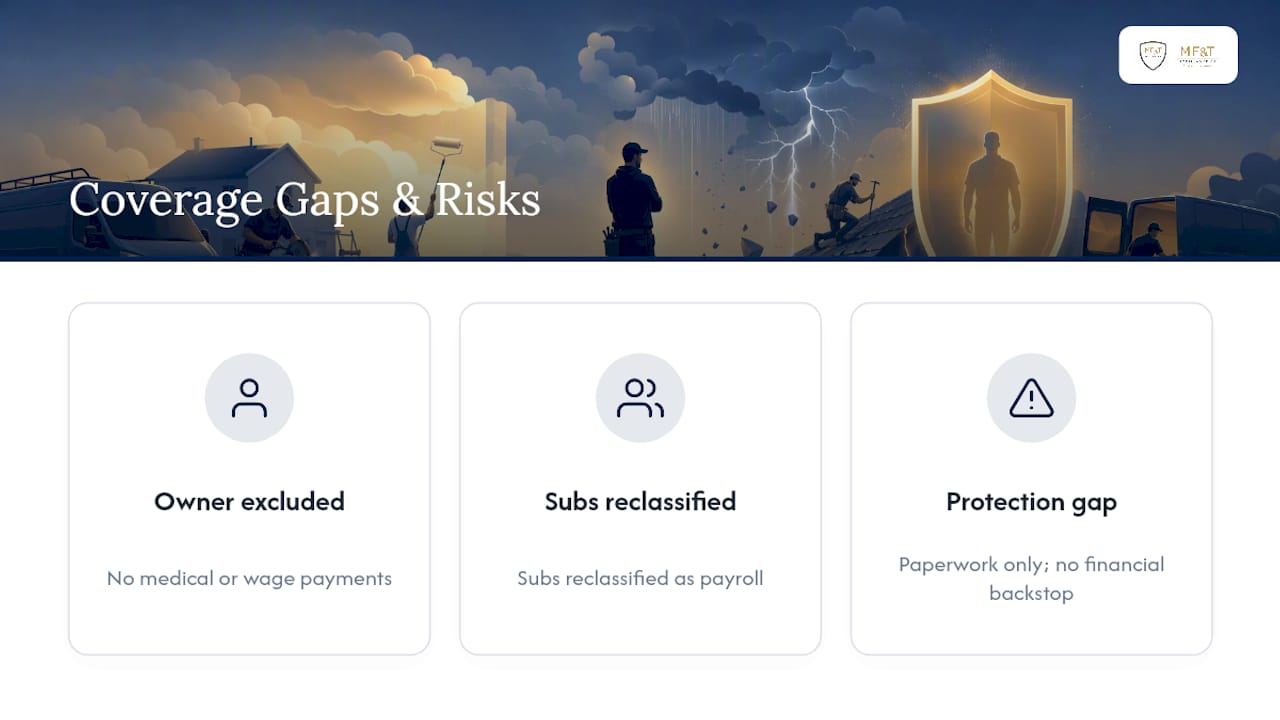
There's a second trap that catches people off guard at audit time: payments to subcontractors who can't produce their own valid workers' comp coverage get reclassified as payroll. That reclassification can turn a $500 minimum-premium policy into a much larger retroactive bill, because the auditor is now rating you as if you employed those subs directly.
Industry practitioners describe this as the protection gap. You're holding a document that satisfies a general contractor's paperwork requirement while carrying zero financial backstop for yourself. An injury serious enough to keep you off a job site for a few months can mean tens of thousands in medical costs and lost income with no policy behind you.
What Drives the Price You'll Pay
A handful of factors move your quote up or down:
- Your class code and trade risk (roofers and electricians pay more than bookkeepers).
- Your state's minimum premium rules and any assigned-risk pool surcharges if you can't find voluntary market coverage.
- How long you need the policy for, since short-term COIs bought for a single job can trigger short-rate cancellation penalties.
Statistic Callout: Ghost policy premiums typically fall between $400 and $1,500 annually, and most carriers require the full amount paid upfront rather than spread across the year.
If you're only buying coverage to satisfy a single contract, ask your agent about pro-rata alternatives before committing to a full annual term. Canceling early on a short-rate policy often costs more per day used than if you'd simply budgeted for the full year.
Where State Rules Change the Math
Four states run monopolistic workers' comp funds, meaning private carriers can't sell workers' comp policies there at all: Ohio, North Dakota, Washington, and Wyoming. If you operate in one of those states, a private-market ghost policy isn't on the table, and you'll need to go through the state fund directly to get any form of coverage or exclusion documentation.
Everywhere else, owner-exclusion rules still vary. Some states, including New York, explicitly exempt sole proprietors with no employees from mandatory coverage but let you voluntarily elect it. Massachusetts requires certain corporate officers to file a formal written exclusion rather than assuming it applies automatically, according to state guidance on corporate officers and sole proprietors. Before you assume a ghost policy is even available to you, check your state's workers' compensation department or ask an agent licensed in your state to confirm the local process.
The Audit Mistakes That Cost the Most
Auditors reviewing a ghost policy at renewal want to see tax returns, 1099 records, and bank statements that confirm payroll actually stayed at zero all year. If those records show payments to workers who look like employees, or to subcontractors without their own coverage, the carrier can retroactively rerate the policy and bill you for the difference.
Fix that one habit and you eliminate most audit surprises.
A few safeguards keep this simple, including a practical contractor insurance checklist for South Florida property managers to evaluate subcontractor coverage:
- Collect a current COI from every subcontractor before you pay them, not after.
- Call your carrier before you hire any paid help, even seasonal or part-time.
- Keep a basic spreadsheet logging every sub's name, COI expiration date, and payment amount.
Pro Tip: Set a calendar reminder 60 days before your subs' COIs expire. Chasing paperwork after you've already paid someone is how misclassified payroll ends up on an audit report.
When to Upgrade From a Ghost Policy to Real Coverage
Run this checklist before your next renewal: How physically risky is your work? How often do you bring on help, even informally? Do your clients or GCs specifically require owner coverage, not just a COI? Does your license depend on proof of owner protection?

If you answered yes to any of those, the math usually favors full workers' comp that covers you as the owner. A few hundred extra dollars a year is nothing next to an uncovered shoulder surgery and three months of lost income. The good news: converting from a ghost policy to owner-covered coverage is a straightforward endorsement change, not a new application, and a licensed agent can usually process it before your next job starts.
MF&T North America's Take on Getting This Right
We've spent more than 30 years placing commercial coverage for contractors and small business owners across Massachusetts and beyond, and ghost policies come up constantly with solo tradespeople who need a COI fast. Our job is verifying your state's exclusion rules, matching your trade to the correct class code, and making sure your paperwork survives an audit without surprises.
Bring your business entity type, a description of your work, and any subcontractor COIs to a quote conversation, and we can usually tell you within a day whether a ghost policy fits or whether you should budget for owner-covered protection instead.
Why Most Advice on This Topic Misses the Point
Most guides treat the ghost policy decision like a pricing question. It isn't. The real decision is a risk tolerance question dressed up as a paperwork question, and that framing gets lost constantly.
Here's what the research actually supports: a ghost policy is a rational, defensible choice for a genuinely solo operator who wants to land contracts without paying for coverage they don't need. It is not a workaround, a loophole, or a trick, despite how it sometimes gets described online. It's a legitimate minimum-premium product built for a specific use case.
Where conventional advice falls short is in treating "I have no employees today" as a permanent condition instead of a snapshot. The contractors who get burned aren't the ones who bought a ghost policy. They're the ones who kept the ghost policy for two years after they started paying a regular helper, because switching felt like a hassle or an unnecessary cost. That's the moment to prioritize: not the initial purchase decision, but the discipline to revisit it the first time your business changes shape. Set a reminder at renewal, ask yourself honestly whether zero payroll is still true, and treat that annual check as the real safeguard, not the policy itself.
— Mike
Get a Compliant COI or Convert to Owner-Covered Coverage
If you need a Certificate of Insurance to satisfy a contract this week, or you've decided your risk profile calls for real owner protection, MF&T North America can move faster than a generic online quote form because we already know which Massachusetts and multi-state carriers write both products cleanly.
To get a quote moving quickly, have your business name and entity type, a short description of the work you do, your estimated annual revenue, and current COIs from any subcontractors you pay. We'll confirm your state's owner-exclusion rules, assign the right class code, and tell you within a day or two whether a ghost policy or full workers' comp coverage makes more sense for where your business stands right now. If you're already juggling other coverage decisions, our small business insurance guidance for owners walks through how workers' comp fits alongside general liability and commercial auto. Ready to start? Request a free quote and we'll walk you through your options directly.
This article is general information, not a substitute for advice from a qualified financial advisor. Consult a qualified financial professional about your own circumstances before acting on anything here.
Sources
- Workers’ Comp Ghost Policy: How It Works and When You Need It - LegalClarity
- North Carolina Department of Insurance - workers' compensation