
Additional insured status adds a person or business to someone else's liability policy, giving them a direct claim on that insurer for defense and payouts tied to the named insured's work. The catch: it almost never covers accidents caused by the additional insured's own independent negligence, only liability arising from the named insured's operations.
- Who benefits: landlords, general contractors, property developers, and vendors added to a subcontractor's or tenant's policy.
- What creates it: a written endorsement attached to a Commercial General Liability (CGL) policy, not the contract by itself.
- What to do first: request the actual endorsement form, not just a certificate of insurance.
Key Takeaways
Additional insured status grants a third party direct access to another company's liability policy, but only for claims tied to the named insured's covered operations, and only when a proper endorsement, not a certificate, backs it up.
| Point | Details |
|---|---|
| Endorsement, not contract, controls | Coverage exists only once a carrier issues the actual endorsement, regardless of what the contract promises. |
| COI is not proof of coverage | A certificate of insurance shows a policy exists but carries none of the endorsement's actual terms. |
| Match endorsement to project phase | Confirm whether coverage includes ongoing operations, completed operations, or both before work begins. |
| Claims affect future premiums | Adding an endorsement costs little upfront, but paid claims raise your loss history and renewal costs. |
| Get expert verification | M F and T North America reviews endorsements and coordinates with carriers to confirm real coverage before contracts are signed. |
Table of Contents
- How additional insured status explained through a policy actually works
- Additional insured vs. named insured vs. certificate holder
- Common endorsement types and what they actually trigger
- Where additional insured coverage falls short
- Why landlords and contractors demand additional insured status
- How to request and verify additional insured coverage
- Does adding an additional insured raise your premium?
- When additional insured disputes end up in court
- An agent's take on getting additional insured status right
- Let M F and T North America Review Your Coverage
- Frequently Asked Questions
- Sources
How additional insured status explained through a policy actually works
Getting added as an additional insured is not a formality that happens by mentioning it in a contract. It requires an endorsement, a physical amendment to the named insured's CGL policy, and that endorsement's wording controls everything about the scope of protection you receive.
The mechanics follow a predictable sequence. First, the named insured's carrier issues an endorsement naming the additional insured. Second, a claim arises out of the named insured's operations. Third, the endorsement is checked to confirm the claim falls within its trigger language. If it does, the insurer generally owes a defense and possibly indemnity to the additional insured, subject to the endorsement's specific terms.
From the claimant's side, here's what typically happens:
- The additional insured can tender a claim directly to the named insured's carrier.
- The insurer may owe a defense even before liability is determined.
- Available limits are shared with the named insured, since it is one policy, not two separate pools of money.
These endorsements are legally enforceable against the insurer and stand apart from any contractual indemnity promise between the parties. That distinction matters when a general contractor's indemnity clause gets challenged in court. If the clause itself is unenforceable, a valid additional insured endorsement can still put the insurer on the hook for defense and indemnity.
Pro Tip: Whenever the potential exposure is significant, ask for the endorsement form and the policy declarations page together. A certificate alone tells you insurance exists somewhere. It tells you nothing about whether your specific situation is covered.
Additional insured vs. named insured vs. certificate holder
These three terms get used interchangeably by people who should know better, and the confusion causes real problems on job sites and in landlord disputes. Each status carries different rights, and mixing them up can leave you thinking you have coverage you don't.
- Named insured: the policyholder. Controls the policy, can request changes, and typically has the broadest rights, including full access to policy limits.
- Additional insured: added by endorsement. Can file a claim and may get a defense, but has no control over the policy and no say in cancellation or changes.
- Certificate holder: simply the entity that received a certificate of insurance as proof coverage exists. Has no contractual relationship with the insurer at all.
A certificate holder is often mistaken for an additional insured, but a COI is only evidence that a policy is in force. It doesn't grant any rights, doesn't reflect endorsement wording, and can be issued in error or go stale the moment the underlying policy changes. If your name is only on a certificate and not on an endorsement, you likely have no coverage at all.
Common endorsement types and what they actually trigger
Not every additional insured endorsement covers the same ground, and the differences show up exactly when you need coverage most. Two structural choices matter above all others: how the endorsement is issued, and what phase of work it covers.
Blanket versus project-specific. A blanket endorsement automatically extends additional insured status to any party the named insured is contractually required to add, which cuts down on paperwork for contractors juggling multiple jobs. A project-specific endorsement names one party for one job or period. Blanket forms are convenient, but their scope varies by carrier, and some quietly exclude completed operations.

Ongoing versus completed operations. Ongoing operations coverage applies while work is in progress. Completed operations coverage extends protection after the job wraps, which matters enormously for construction defects that surface months or years later. An endorsement silent on completed operations can leave a property owner exposed the moment the crew packs up.
Beyond those two axes, contracts commonly request:
- Primary and noncontributory language, which forces the named insured's policy to pay first, ahead of the additional insured's own coverage.
- Waiver of subrogation, which stops the insurer from later suing the additional insured to recover what it paid out.
Standard ISO-style forms also carry exclusions, often around professional services or certain types of pollution, so read the fine print rather than assume broad protection.
Where additional insured coverage falls short
Most disputes over additional insured status trace back to a handful of repeat offenders, and they're avoidable once you know what to look for.
- Accepting a certificate of insurance as proof of coverage instead of demanding the endorsement itself.
- Endorsements restricted to "ongoing operations" that leave you unprotected after project completion.
- Other-insurance or "excess" clauses that shift payment obligations in ways nobody expected at signing.
- Limits that look adequate on paper but get exhausted quickly when shared across multiple additional insureds on one policy.
Picture a general contractor added as an additional insured on a subcontractor's CGL policy during a two-year build. The endorsement only covered ongoing operations. Eighteen months after completion, a structural issue tied to the sub's work surfaces, and the general contractor gets named in the lawsuit. Because the endorsement never extended to completed operations, the insurer denies the claim, and the general contractor is left defending itself with no backstop.
Pro Tip: Never accept "we'll add you as additional insured" as a verbal or contract promise. Insist the actual endorsement form number and coverage period appear in writing before work starts, and get a copy before the first day on site.
Why landlords and contractors demand additional insured status
Requiring additional insured status is a deliberate risk-transfer move, not a bureaucratic checkbox. Parties higher up the contract chain want direct access to someone else's insurance money if things go wrong.
- Landlords add tenants' insurers to protect against liability tied to a tenant's business activities or foot traffic, shifting legal defense costs away from the property owner.
- General contractors require it from subcontractors so a sub's mistake doesn't become the GC's sole financial problem.
- Property developers, event venues, and municipalities often mandate it as a condition of any contract or permit.
The underlying logic is that an indemnity clause is only as good as the indemnitor's ability to pay. Additional insured status backstops that promise with an insurance company's balance sheet instead of a subcontractor's bank account. It's why larger, better capitalized parties routinely push this requirement down onto smaller contractors and vendors as standard market practice.
How to request and verify additional insured coverage
Getting this right takes a few concrete steps before a contract gets signed, not after a claim hits.
- Specify requirements in the contract. Name the required endorsement type (ongoing, completed operations, or both), minimum limits, and whether coverage must be primary and noncontributory.
- Ask the counterparty's broker for the actual endorsement, not just a certificate, along with the policy declarations page.
- Confirm effective dates line up with the project timeline, including any completed operations tail period.
- Check limits and any self-insured retention that could affect how quickly a claim gets funded.
Useful contract language to request:
- "Contractor shall name Owner as additional insured on a primary and noncontributory basis, including completed operations, via ISO endorsement CG 20 10 or equivalent."
- "Contractor's carrier shall waive rights of subrogation against Owner."
Pro Tip: Loop in your own broker before you sign anything, and keep a single tracking sheet listing every contract's additional insured obligations, endorsement forms received, and renewal dates. Contractors managing multiple jobs benefit from the same discipline outlined in subcontractor management practices, where paperwork gaps cause the most costly disputes.
Does adding an additional insured raise your premium?
Adding an endorsement typically costs little relative to the base premium, sometimes nothing at all depending on the carrier. The real financial exposure shows up later: any claim paid out under that endorsement counts against your loss history, which carriers weigh heavily at renewal.
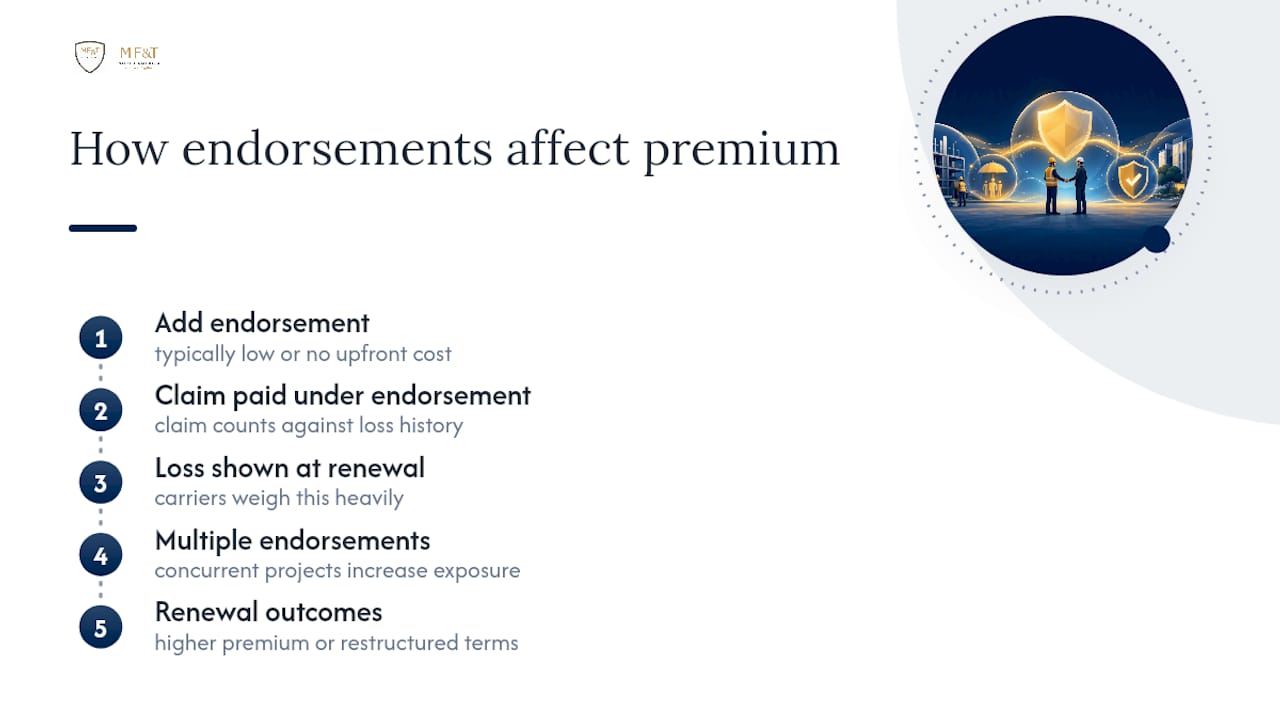
A contractor with several additional insureds and a large completed-operations claim may see their premium rise or face tighter underwriting scrutiny across the whole account. Carriers writing policies with many additional insured exposures sometimes require higher limits or restructured coverage terms before renewal, particularly for contractors juggling multiple concurrent projects and endorsements.
When additional insured disputes end up in court
Coverage fights over additional insured status usually trace back to the same friction points, and outcomes shift depending on which state's courts are interpreting the language.
- Ambiguous endorsement wording that could reasonably support two different readings.
- Other-insurance clauses that conflict between the named insured's and additional insured's own policies.
- A mismatch between what the contract's indemnity clause promises and what the insurance endorsement actually delivers.
Courts across different states read policy and contract language with real variation, so an endorsement that clearly covers a claim in one jurisdiction might get a narrower reading in another. When wording is ambiguous or the dollar exposure is material, get coverage counsel or your broker involved before a dispute escalates, not after.
An agent's take on getting additional insured status right
After decades in this business, the pattern is consistent: the contractors and property owners who avoid coverage disputes are the ones who never accept a promise on paper without the endorsement behind it. Three habits separate smooth renewals from painful claim denials. Always require the actual endorsement copy, never a certificate alone. Centralize every additional insured obligation in one place so nothing falls through when a policy renews or a carrier changes. And bring your broker into contract negotiations before signatures happen, not after a claim forces the conversation.
Pro Tip: Set up a simple internal log, spreadsheet or otherwise, that tracks every contract requiring additional insured status alongside its endorsement form, effective dates, and renewal deadline. Review it every time a carrier changes.
Let M F and T North America Review Your Coverage
Getting additional insured language right on paper is one thing. Confirming the actual endorsement matches what your contract requires is another, and it's where most contractors get caught off guard.
M F and T North America has spent more than 30 years helping contractors, property developers, and small business owners in Arlington and across multiple states get this right the first time. We review commercial liability policies, verify that endorsement forms actually match contract requirements, and coordinate directly with carriers and brokers on your behalf so you're not left guessing whether a certificate is worth the paper it's printed on. If you're negotiating a contract that requires additional insured status, or you need to confirm coverage before work starts, request a policy review and quote and send us your contract or endorsement paperwork. We'll tell you exactly what's covered, what's missing, and what to ask for next.
Frequently Asked Questions
What does additional insured status explained in plain terms actually mean? It means an insurer has agreed, through a written endorsement, to extend certain liability protections from someone else's policy to you, but only for claims arising from that named insured's covered work.
Is a certificate of insurance the same as being an additional insured? No. A certificate only shows that a policy exists at a point in time. Only the endorsement itself creates additional insured rights.
Who typically pays for an additional insured endorsement? The named insured's policy absorbs the cost, and it's usually minor relative to the overall premium, though claims paid later can raise future renewal rates.
Does additional insured status cover work completed months ago? Only if the endorsement specifically includes completed operations coverage. Many forms limit protection to ongoing operations only, leaving a gap after project completion.
How do I verify additional insured coverage before signing a contract? Request the actual endorsement form and policy declarations page, confirm effective dates and limits, and check whether coverage is primary and noncontributory.
This article is general information, not a substitute for advice from a qualified financial advisor. Consult a qualified financial professional about your own circumstances before acting on anything here.
Sources
- additional insured (AI)
- Navigating additional insured requirements in commercial contracts: a practical guide for businesses
- What Is an Additional Insured? Coverage, Benefits & Costs Explained