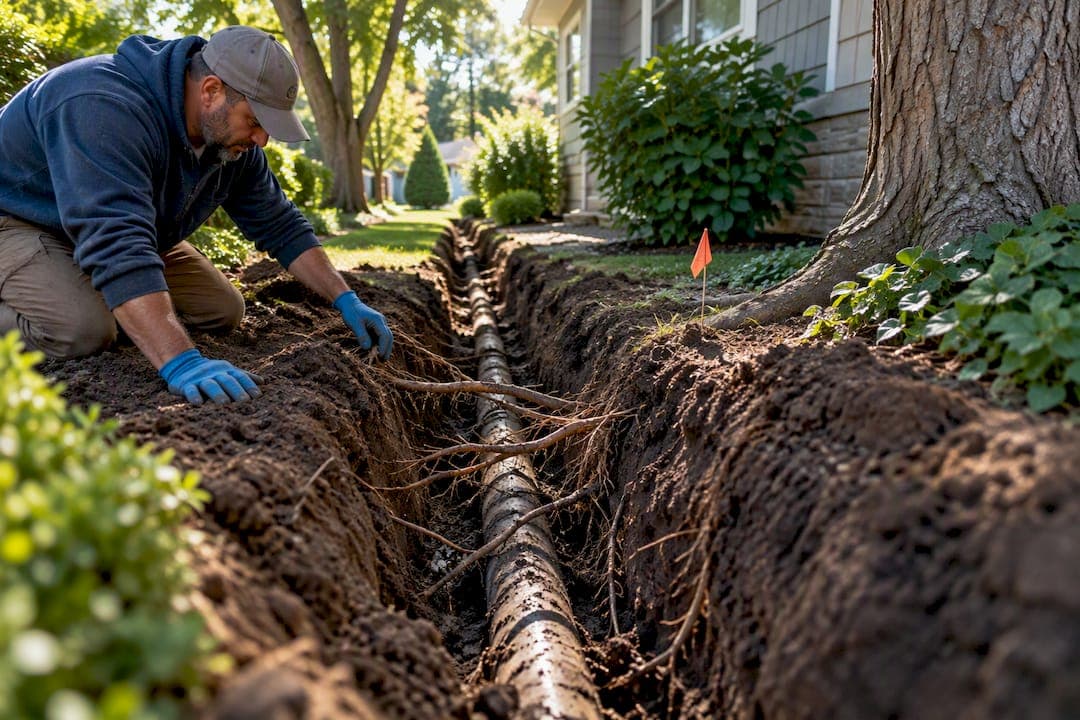
Service line coverage is an optional homeowners insurance endorsement that helps pay to excavate, repair, or replace broken underground pipes and cables running to your house. It matters most if you own an older home, live where tree roots or frequent digging threaten buried lines, or don't have much set aside for a surprise five-figure repair. If any of that sounds like you, it's worth comparing an insurer endorsement against third-party repair plans and your own emergency fund before you decide.
TL;DR:
- Service line coverage is best for homeowners with older pipes, nearby trees, or limited emergency funds, but may be unnecessary for newer homes with recent line replacements.
- Coverage typically includes damage from burst pipes, roots, or external force, but excludes routine blockages or gradual deterioration, with excavation and permit costs often included.
- It works alongside your homeowners policy and can be more advantageous than private repair plans due to state oversight, clearer claim standards, and appeal rights.
- Costs vary but tend to be significantly lower annually than home warranties, with limits around $10,000 to $50,000 and deductibles affecting out-of-pocket expenses.
- Confirm municipal responsibility boundaries and ask your insurer about specific line coverage, especially for lines under hardscaping or under pools, to avoid coverage gaps.
Table of Contents
- What service line coverage typically includes: covered lines and perils
- How service line endorsements differ from service contracts and home warranties
- Typical costs, limits, and deductibles: how to compare value
- Do you need service line coverage? A short decision checklist
- How to buy service line coverage and questions to ask your insurer
- What happens when you file a claim: excavation, repair, and permits
- How this coverage interacts with your homeowners policy
- Common exclusions and how to fill the gaps
- Does your location change what you need?
- Local codes and permit rules you should know about
- MF&T North America's take on when this coverage makes sense
- Get a policy review and a service line quote from MF&T
- Sources
- FAQ
What service line coverage typically includes: covered lines and perils
A service line endorsement is built to fill a specific gap: the buried pipes and cables that run from your house to the street, which standard homeowners policies usually leave out. ISO created a homeowners endorsement that covers damage to a broad range of exterior underground service lines, and insurers have offered it as a formal policy add-on since the filing process began state by state in June 2020.
Most endorsements apply to:
- Water supply lines running from the street or well to your home
- Sewer and drain lines connecting your house to the municipal system or septic tank
- Natural gas lines feeding your furnace, water heater, or stove
- Underground electrical lines and communication or data lines
- Well and septic system components in some policies
Coverage isn't tied to the material failing on its own. It's tied to how the damage happened. Insurers typically pay for lines damaged by bursting, root intrusion, external force such as accidental excavation, material failure, collapse, or electrical arcing. Covered causes commonly include wear and tear, bursting, and root damage, which are broader than what a standard homeowners policy allows. A simple clog with no physical damage to the pipe, on the other hand, is usually excluded, since that's considered routine maintenance rather than a covered loss.
Beyond the pipe or cable itself, a good endorsement also picks up the costs that make these repairs so expensive in the first place: excavation to reach the line, the repair or replacement work, permit fees, and sometimes expediting costs if you need the job done fast. Some policies include limited additional living expenses if the damage forces you out of your home temporarily.
Picture two scenarios. A tree root cracks your sewer line and sewage backs up into your basement: likely covered, since it's physical damage from an identifiable cause. Now picture a slow-draining kitchen sink that turns out to be years of grease buildup: not covered, because there's no line failure, just a maintenance issue you let go too long. That distinction between sudden damage and gradual neglect runs through almost every claim decision.
How service line endorsements differ from service contracts and home warranties
This is where a lot of homeowners get confused, and where some marketing takes advantage of that confusion. A service line endorsement is regulated insurance, added to your homeowners policy and subject to your state's insurance rules as explained in HVAC service agreement terms. A service contract or home warranty is a different animal entirely: a private repair agreement, not insurance, often sold through utility bill inserts or door-to-door marketing.
Consumer Reports has flagged that some third-party repair plans can mislead homeowners and sometimes cost more than the repairs they're likely to need, prompting scrutiny from state attorneys general and utility commissions in places like Massachusetts and Illinois. The concern usually centers on plans marketed to look like an extension of your utility service, when they're actually a separate paid contract with its own rules.
That structural difference has real consequences:
- Service contracts often limit which contractor can do the work, while an insurance endorsement generally lets you choose
- Contracts carry annual benefit caps that reset each year, while endorsement limits apply per loss under your policy
- Home warranties are service contracts that commonly deny claims tied to preexisting conditions or lack of maintenance, a standard that's harder to dispute than a regulated insurance denial
- Insurance claim denials can be appealed through your state's insurance department, while a service contract dispute is a private contract matter
A regulated insurance endorsement gives you avenues a private repair contract usually doesn't: state oversight, a formal appeals process, and clearer claim standards.
A warranty can still make sense if you want predictable annual costs and don't mind a limited contractor list, particularly for older systems already showing wear. For most homeowners who want broader protection and the right to choose their own plumber or electrician, an insurer endorsement is the stronger fit.
Typical costs, limits, and deductibles: how to compare value
Pricing varies by carrier, location, and the limit you choose, but the shape of the decision is fairly consistent. ISO's endorsement structure uses a common base limit for coverage per loss, with optional higher coverage limits available. Home warranty contracts, by comparison, typically run around $400 to $500 a year plus a service-call fee each time you use them.
Here's how to think about the math instead of just the sticker price:
- Add up what you'd pay in premiums over five or ten years at your chosen limit
- Compare that total against the realistic cost of a single sewer or water line repair in your area
- Weigh the size of your emergency fund against your comfort with a large, unplanned expense
- Factor in the deductible, since a higher deductible usually lowers your premium but raises your out-of-pocket cost per claim
Say your endorsement costs $40 a year with a $500 deductible and a $10,000 limit. Over ten years that's $400 in premium. If you never file a claim, you've paid $400 for peace of mind. If a root intrusion cracks your sewer line in year six and the repair runs into the thousands once excavation and permits are added, the endorsement pays the difference above your deductible, and you come out well ahead.
A $10,000 to $50,000 endorsement limit typically costs far less annually than a home warranty's flat yearly fee, which is worth weighing when you compare the two side by side.

Do you need service line coverage? A short decision checklist
Not every homeowner needs this coverage, but a few factors push the answer toward yes.
- Check your home's age and line materials. Homes built before the 1980s often have older clay, cast iron, or galvanized lines more prone to failure.
- Look at your property's risk factors. Mature trees near sewer or water lines, recent construction or excavation nearby, and a history of shifting soil all raise your odds of a claim.
- Be honest about your emergency fund. If a $5,000 to $15,000 repair would strain your finances, coverage or a warranty starts to look more attractive.
- Confirm what your municipality and utility already cover. Some cities maintain the line from the street to the meter, while everything past that point is the homeowner's responsibility.
- Decide on your approach. Buy an endorsement if you want broad, regulated protection; consider a warranty only if you value predictable annual costs and accept the contractor limits; self-insure only if your emergency fund can comfortably absorb a major repair.
Pro Tip: Pull up your municipal water department's website before you buy anything. Many post a map showing exactly where your responsibility for the line begins, which tells you how much exposure you're actually covered against.
How to buy service line coverage and questions to ask your insurer
Adding this coverage is usually simple: you ask your agent to attach the endorsement to your existing homeowners policy, and it shows up as a line item on your declarations page with its own limit and deductible. There's no separate contract to sign in most cases, since it becomes part of your existing policy documentation.
Before you add it, ask your insurer or agent:
- What exact lines count as a "covered service line" under this endorsement?
- What's the per-loss limit, and can I raise it?
- What deductible applies, and is it separate from my main homeowners deductible?
- Does this cover excavation and permit costs, or just the pipe itself?
- Am I free to choose my own contractor, or must I use one from a network?
- How fast are claims typically processed once a line fails?
Watch for vague language around "sudden and accidental" damage versus "wear and tear," since insurers draw that line differently. If a policy excludes damage to lines under structures like a driveway or patio, ask specifically how that affects your situation, since excavation under hardscaping tends to be the most expensive scenario. An independent agent can pull quotes from multiple carriers and walk through this language with you line by line rather than leaving you to decode it alone.
What happens when you file a claim: excavation, repair, and permits
A typical service line claim starts the way most property claims do: you report the failure, and an adjuster reviews the cause of loss to confirm it's covered, such as a burst pipe or root intrusion rather than a simple blockage. Once approved, the process usually moves through three phases.
First comes excavation, where a contractor digs to reach and diagnose the damaged section. Second is the repair or replacement itself, which can take anywhere from a day to over a week depending on the extent of the damage and whether the line runs under a driveway, patio, or foundation. Third, and often overlooked, is the municipal permitting step: many cities require a permit before you can dig into a public right-of-way or connect to a municipal sewer or water main, which can add days to the timeline while the paperwork clears.

Ask your insurer upfront how claims are typically processed and how permit delays factor into their turnaround expectations, since that timeline affects how long you might be without water, sewer, or gas service. Keeping photos of the damage and copies of any permit applications helps if you need to follow up on the claim's status.
How this coverage interacts with your homeowners policy
A service line endorsement doesn't replace your homeowners policy, it works alongside it. Your base policy generally excludes underground utility lines and gradual damage like wear and tear, so the endorsement exists specifically to cover the gap your main policy leaves open.
Filing a service line claim is treated separately from a typical homeowner claim in terms of the specific coverage and limit involved, but it's still tied to your overall policy and claims history with that carrier. A pattern of frequent claims, service line or otherwise, can affect your premium at renewal or your insurer's willingness to renew at all. It's worth asking your agent whether service line claims are counted the same way as other homeowners claims for underwriting purposes, since carriers can differ on this.
If your home also has separate coverage for interior systems like electrical panels or HVAC equipment, it helps to understand where that coverage ends and where service line protection for exterior lines begins, since the two are often confused but apply to different parts of your home.
Common exclusions and how to fill the gaps
Even a solid service line endorsement has boundaries. Most policies exclude simple blockages that don't involve physical damage to the pipe, since that falls under routine maintenance rather than an insurable loss. Damage that existed before you bought the endorsement is also typically excluded, along with gradual deterioration that an inspection would have caught earlier.
Lines running under a swimming pool, detached structure, or extensive hardscaping can also be treated differently, since excavation in those areas is more complex and expensive. Some endorsements cap coverage lower for these scenarios or exclude them outright.
If your policy excludes something that matters for your property, ask about riders or higher-limit options that specifically address it. A homeowner with an in-ground pool near their sewer line, for example, might want to confirm exactly how excavation near the pool is handled before a problem arises rather than after. Reviewing your homeowners policy line by line for this kind of language is worth the time it takes.
Does your location change what you need?
Where you live changes both your risk and your options. Urban and older suburban homes often have more mature trees near sewer lines, more densely packed underground infrastructure, and older clay or cast iron pipes, all of which raise the odds of root intrusion or material failure. Frequent street work and utility upgrades in cities can also mean a higher chance of accidental damage to your lines from outside contractors.
Rural homes come with different exposures. Well and septic systems aren't always included in standard service line endorsements, so if your property relies on either, confirm specifically whether they're covered or need a separate rider. Longer line runs from the street to a rural home can also mean higher excavation costs if something does fail, since there's simply more ground to dig through.
Availability itself can vary by carrier and state too, since not every insurer offers the ISO endorsement or an equivalent in every market. If your current carrier doesn't offer it, that's a reason to shop around rather than assume you're out of luck.
Local codes and permit rules you should know about
Service line repairs almost always intersect with local building and public works codes, since digging into a street, sidewalk, or utility easement typically requires a permit from your city or town. Skipping this step isn't just a compliance issue, it can also complicate an insurance claim if the repair wasn't done to code or without proper authorization.
Municipalities also draw the line differently on who's responsible for what. In many cities, the water department maintains the line up to the meter or the property line, while everything from there to your house is yours. Sewer responsibility often splits similarly at the property line or a cleanout point. These boundaries directly affect what your service line endorsement needs to cover, since insuring a section the city already maintains would be redundant.
Before assuming you need broad coverage, check your municipal water or sewer department's website for a responsibility map, and ask your insurer how their endorsement handles the specific split in your town.
MF&T North America's take on when this coverage makes sense
After reviewing homeowners' policies across different towns and home ages, a general rule is straightforward: if your home is more than 25 years old, has mature trees near its sewer or water lines, or you'd struggle to cover a $10,000 repair without financial strain, a service line endorsement is usually worth the modest annual cost. If your home is newer, your lines have been recently replaced, and you have a solid emergency fund, self-funding often makes more sense than paying for coverage you're unlikely to use.
An independent agency can shop your policy across multiple carriers rather than pushing one insurer's version of this endorsement, and can walk through your declarations page to show you exactly what's already excluded. If you've had a claim denied or you're unsure whether your current policy even has this coverage, you can have it reviewed and get help filing or appealing a claim if needed.
If you want a second opinion on your policy, consider contacting an independent insurance professional for a review.
— Mike
Get a policy review and a service line quote from MF&T
If you're not sure whether your current homeowners policy covers your service lines, an independent agent can answer that question faster than digging through your declarations page alone. Independent agents can compare service line endorsement options side by side and explain which one fits your home and your budget.
To get started, bring:
- Your current homeowners policy declarations page
- Photos of any known plumbing, sewer, or electrical line issues
- Recent water or gas utility invoices if you've had past line problems
Request a homeowners insurance quote and we'll walk you through your options, including whether a service line endorsement makes sense for your specific property.
This article is general information, not a substitute for advice from a qualified financial advisor. Consult a qualified financial professional about your own circumstances before acting on anything here.
Sources
- Covering the buried peril of underground utility lines | Verisk
- Putting money in a fund for a rainy day is smarter than paying for a service-line repair plan | Consumer Reports
FAQ
Do you really need service line coverage?
It depends on your home's age, your line materials, and how much of an unplanned repair your budget can absorb. Homes with older pipes, mature trees near sewer lines, or a thin emergency fund tend to benefit most, while newer homes with recently replaced lines and strong savings may be fine self-funding instead.
Is a third-party home warranty plan worth it for service lines?
Home warranties are service contracts, not insurance, and Consumer Reports has noted they often limit your choice of contractor and deny claims tied to preexisting conditions or poor maintenance. For most homeowners, a regulated insurance endorsement offers broader protection and a clearer appeals process than a private repair contract.
What issues tend to lower homeowners insurance satisfaction ratings?
Homeowners insurance satisfaction tends to suffer most from slow claim turnaround, unclear policy language, and unexpected denials rather than from any single company across the board. Comparing an insurer's claims process and communication before you buy, rather than after a loss, is the more useful way to avoid frustration.
What isn't covered by service line coverage?
Simple blockages without physical damage to the pipe are typically excluded, since insurers treat that as routine maintenance rather than an insurable loss. Preexisting damage, gradual deterioration, and in some cases lines running under pools or detached structures are also commonly excluded or capped differently, so it's worth checking your specific policy language.