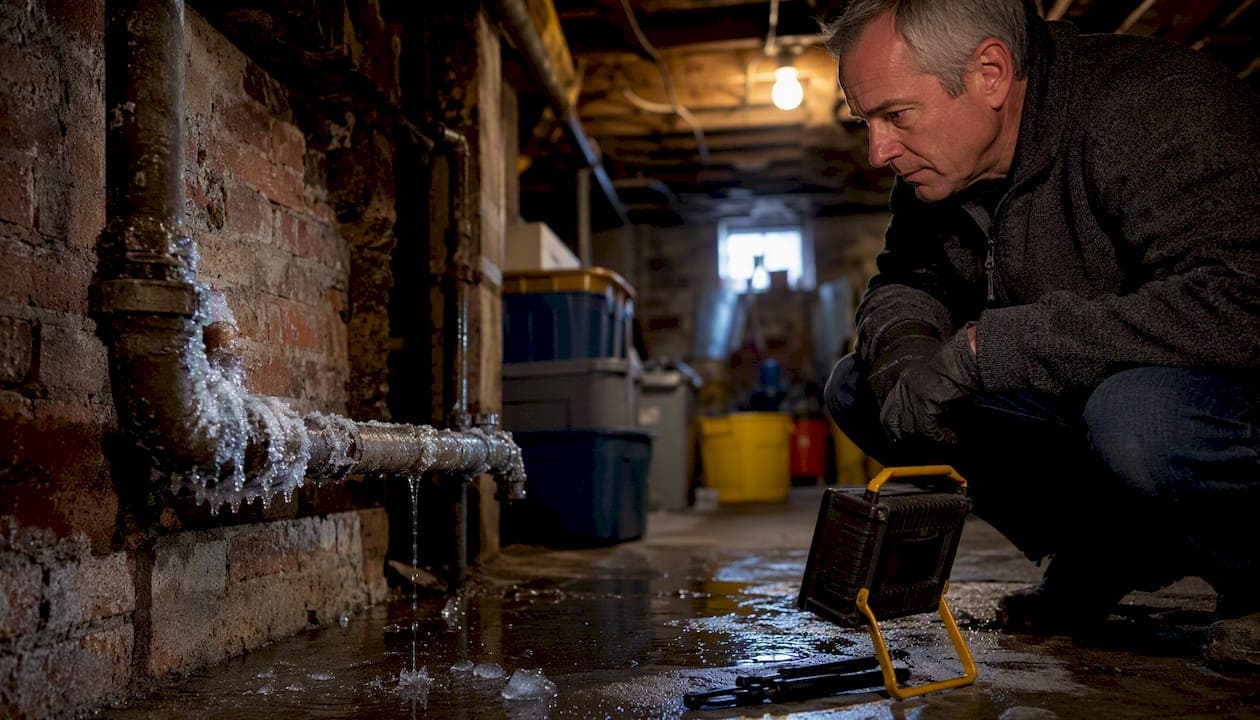
Standard homeowners insurance usually covers water damage caused by a frozen pipe that bursts suddenly and accidentally — but not always. According to NAIC consumer guidance, coverage depends heavily on whether you took "reasonable precautions" before the freeze. If you left the heat off in a vacant home or ignored a known plumbing problem, your insurer may deny the claim entirely.
Here is what to do right now if a pipe has already burst:
- Shut off the main water supply immediately to stop the flow.
- Document everything with photos and video before cleanup begins.
- Call your insurer to report the loss and get a claim number.
- Begin mitigation (drying, extraction) to prevent secondary mold damage.
Pro Tip: Keep your thermostat set to at least a commonly recommended minimum temperature even when you travel. Many carriers cite a temperature threshold in their reasonable-precautions guidance, and your utility records can confirm you met it.
Key Takeaways
Standard homeowners insurance covers sudden, accidental water damage from frozen pipes — but only when you maintained reasonable precautions, and never the cost of the pipe repair itself.
| Point | Details |
|---|---|
| Sudden and accidental standard | Coverage applies to water damage from a burst pipe, not gradual leaks or maintenance failures. |
| Pipe repair is excluded | Carriers pay for ensuing water damage; the broken pipe itself is a maintenance cost you cover. |
| Reasonable precautions matter | Maintain interior heat (commonly cited at around 55°F) and winterize vacant properties to preserve coverage. |
| Document before you clean up | Photos, separate plumber invoices, and thermostat records materially strengthen your claim. |
| M F and T North America | An independent agency review can identify endorsement gaps and support your claim documentation process. |
Table of Contents
- What does your homeowners policy actually pay for after frozen pipe damage?
- What your standard policy will not cover
- Why insurers deny frozen-pipe claims and what "reasonable precautions" means
- Endorsements that fill the gaps your standard policy leaves open
- Should you file a claim for frozen-pipe damage?
- How to document and submit a strong frozen-pipe claim
- A winter prevention checklist to protect your home and your coverage
- An agent's perspective on frozen-pipe risk
- How M F and T North America can help you close coverage gaps
- Sources
What does your homeowners policy actually pay for after frozen pipe damage?
Most standard policies cover the ensuing loss, meaning the water damage that results from the burst, not the pipe itself. Per MoneyGeek's consumer guide, policies generally pay for the following:
Dwelling repairs (Coverage A): Drywall, framing, flooring, built-in cabinets, and similar structural elements damaged by the water. Carriers also commonly pay tear-out costs — opening walls or ceilings to reach a broken pipe tied to a covered water loss.
Personal property (Coverage C): Furniture, electronics, clothing, and other belongings. Your payout depends on whether your policy uses replacement cost value (RCV) or actual cash value (ACV). RCV pays what it costs to buy a comparable new item; ACV deducts depreciation. A five-year-old sofa worth $800 new might settle at $300 under ACV.
Additional living expenses (ALE/Coverage D): If the damage makes your home temporarily uninhabitable, ALE covers hotel stays, meals, and comparable housing costs while repairs are underway.
A quick example: a contractor estimates water damage repairs well above common deductible levels. Your insurer pays the repair cost minus your deductible on an RCV policy, assuming no depreciation disputes. On an ACV policy, the net payout could be meaningfully lower depending on the age of your finishes.
Frozen-pipe water damage claims are among the most common winter homeowners claims in cold-weather states, making documentation and prompt reporting especially important for a smooth settlement.
What your standard policy will not cover
Knowing the gaps is just as useful as knowing what is covered. The MoneyGeek guide and state-level guidance consistently point to the same exclusions:
- The pipe itself: Repairing or replacing the burst pipe is treated as a maintenance expense, not a covered loss.
- Gradual or slow leaks: The "sudden and accidental" standard is strict. A pipe that dripped for weeks before failing is likely excluded.
- Exterior and underground service lines: The water main running from the street to your foundation is typically outside standard policy scope.
- Flooding from frozen ground: Ground-thaw flooding is a flood event, covered only by a separate NFIP flood policy, not your homeowners policy.
- Sewer or drain backup: A separate endorsement is required; standard policies exclude it.
- Vacancy-related voids: Leaving a property without heat or winterization can void coverage entirely. Many policies define vacancy as a certain period and require either maintained heat or a formal shutoff-and-drain procedure. See why insurance requires home maintenance for more on how upkeep affects coverage.
Pro Tip: When you submit your claim, ask your plumber to issue two separate invoices: one for the pipe repair and one for the water-damage remediation. Mixing them on a single bill can cause your adjuster to question which costs are covered.
Why insurers deny frozen-pipe claims and what "reasonable precautions" means
Denial is more common than most homeowners expect. The New Hampshire Insurance Department is direct about this: coverage depends on whether the loss was sudden and accidental and whether the homeowner maintained reasonable precautions. Failure on either point is grounds for denial.
The most common denial triggers are:
- Failure to maintain adequate interior heat
- Leaving a property vacant without winterizing the plumbing
- Known plumbing defects that were not repaired
- Evidence of gradual damage predating the freeze event
When investigating a claim, adjusters often pull thermostat records, utility bills, and prior maintenance history. Visible signs of long-term moisture damage near the pipe location can shift the loss from "sudden" to "gradual" in the adjuster's report.
"Reasonable precautions" in most policy language means maintaining a minimum interior temperature — consumer guidance commonly cites around 55°F — or shutting off and draining all water lines if the property will be vacant for an extended period.
State insurance departments, including New Hampshire's, report seasonal spikes in frozen-pipe inquiries each winter. The pattern is consistent: claims filed without evidence of precautions face the highest denial rates. Keeping a simple log of your thermostat settings and utility bills costs nothing and can be decisive.
Endorsements that fill the gaps your standard policy leaves open
Three add-ons are worth asking your agent about, per MoneyGeek's endorsement guidance:
| Endorsement | What it covers | Best for |
|---|---|---|
| Service line coverage | Underground pipes and utility lines from the street to your home | Older homes with aging water mains |
| Water backup / sewer backup | Damage from backed-up drains, sewers, or sump pump overflow | Homes with sump pumps or basement drains |
| Equipment breakdown | Mechanical failure of water heaters, boilers, and HVAC systems | High-value mechanicals or older heating systems |
Questions worth asking your agent: What are the per-occurrence limits? Does the endorsement exclude freeze events specifically? Are there territorial exclusions for your state? Pricing varies by carrier, so comparing policy options before adding endorsements is time well spent.
Should you file a claim for frozen-pipe damage?
Not every loss is worth a claim. Filing when the payout barely clears your deductible can affect your renewal premium or, in some markets, your insurability or policy renewal terms. Use this simple framework:
- Get a contractor estimate first. If the repair cost is close to or below your deductible, pay out of pocket.
- Consider severity. Structural damage, major contents loss, or a home that is temporarily uninhabitable all justify filing.
- Review your recent claim history. A second claim within two or three years raises renewal risk more than a first claim.
Before you file, call your agent — not the claims line — and describe the damage. An experienced agent can tell you how your carrier typically handles similar losses and whether the premium impact is likely to outweigh the payout.
Pro Tip: This conversation with your agent is not a claim. Describing damage to your agent does not trigger a claim report to your insurer, so you can get honest guidance without any record being created.
How to document and submit a strong frozen-pipe claim
Claims adjuster guidance is consistent: prompt mitigation and thorough documentation materially improve outcomes. Homeowners who document well settle faster and dispute less.
Your documentation checklist:
- Photos and video of all affected areas before any cleanup
- Inventory of damaged personal property with purchase dates and estimated values
- Plumber's invoice (pipe repair, separate from water damage)
- Contractor or restoration company estimate for water-damage repairs
- Thermostat records or utility bills showing heat was maintained
- Any prior maintenance records for the plumbing system
Claim timeline:
- Shut off water and begin emergency mitigation (extraction, drying).
- Photograph everything before moving or discarding items.
- Call your insurer to open a claim — do this within 24 to 48 hours.
- Schedule the adjuster inspection; be present if possible.
- Obtain written contractor estimates and submit them with your documentation.
- Review the settlement offer against your estimates before signing a release.
When you call your insurer, keep it factual: "I'm reporting water damage from a frozen pipe that burst on [date]. The water has been shut off and mitigation has started. I have photos and a plumber's invoice ready." FGC Attorneys note that documenting your mitigation timeline is one of the strongest defenses against a denial based on alleged negligence.
A winter prevention checklist to protect your home and your coverage
Prevention is the cleanest path. These steps reduce freeze risk and preserve your coverage eligibility:
- Maintain interior heat at or above 55°F in all areas of the home, including basement and crawlspace zones.
- Insulate exposed pipes in unheated spaces: attics, garages, and exterior walls.
- Seal drafts around foundation sills, rim joists, and utility penetrations.
- Drain and shut off exterior hose bibs before the first freeze.
- Winterize vacant properties by shutting off the main supply and draining all lines, or arranging for a house-sitter to maintain heat.
- Service your boiler or furnace before winter. A heating failure during a cold snap is a common precursor to a freeze event.
- Install a smart thermostat with remote monitoring so you can verify heat levels from anywhere.
Pro Tip: Take dated photos of your thermostat settings and any pipe insulation you install. Store them in a cloud folder labeled by year. If a claim is ever questioned, that folder is your first line of defense.
An agent's perspective on frozen-pipe risk
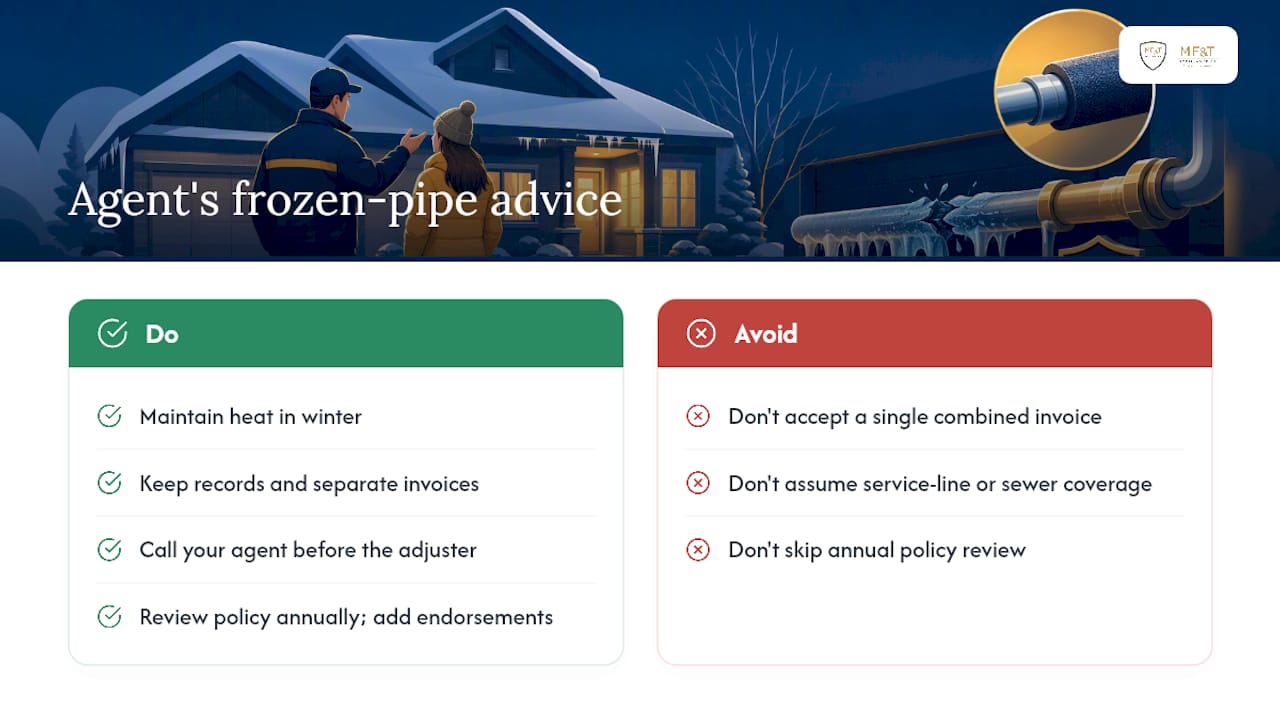
Most homeowners find out what their policy actually covers at the worst possible moment: standing in a flooded basement at midnight in January. After 30-plus years of helping families in Massachusetts and across multiple states, the pattern is clear. The claims that go smoothly are the ones where the homeowner maintained heat, kept records, and called their agent before the adjuster.
What surprises people most is the dual-invoice issue. Carriers will pay for the water damage but not the pipe. When a plumber hands you a single bill for everything, the adjuster has to sort it out, and that sorting rarely favors the homeowner. Separate invoices from the start.
The other underestimated risk is the endorsement gap. Service-line failures and sewer backups are not exotic events. They happen every winter, and a standard policy leaves you fully exposed to both. A service-line endorsement typically adds a modest amount to your annual premium. The cost of an uninsured underground pipe repair is not modest.
The homeowners who come out of a freeze event with the least stress are the ones who treated their policy as a living document — reviewed it annually, added endorsements when their home's risk profile changed, and kept their agent in the loop. That is the habit worth building.
How M F and T North America can help you close coverage gaps
Frozen-pipe losses are preventable on the coverage side, and M F and T North America makes that review straightforward. As an independent agency with over 30 years of experience, M F and T North America compares options across multiple carriers to find the homeowners policy that fits your home's actual risk profile — not a generic template.
A free coverage review with M F and T North America takes less than 30 minutes and covers your current dwelling limits, deductible, ACV vs. RCV basis, and which endorsements make sense for your property. If you have already experienced a freeze loss, the team can help you organize your documentation and connect you with vetted restoration contractors.
Request a homeowners insurance quote or visit the homeowners insurance page to start a coverage review today.
Sources
- Will my homeowners insurance policy cover water damage from a burst pipe?
- Does Homeowners Insurance Cover Water Damage from a Burst or Frozen Pipe? | New Hampshire Insurance Department
- Does Home Insurance Cover Frozen Pipes? a 2026 Guide
- Frozen Pipes to Filed Claims: A Clear Guide for Homeowners
This article is general information, not a substitute for advice from a qualified financial advisor. Consult a qualified financial professional about your own circumstances before acting on anything here.