
Contractual risk transfer in construction is the practice of shifting legal and financial responsibility for a job-site risk (injury, property damage, delay) from one contracting party to another through specific written provisions, moving that exposure from an owner to a general contractor, or from a GC down to a subcontractor. The immediate takeaway matters more than the definition: a clause that transfers risk on paper does not automatically transfer it in practice.
Here's what that means for your next contract review:
- Risk transfer works only when the party receiving the obligation actually has insurance that covers it.
- The typical flow runs owner to GC to subcontractor, with each layer pushing exposure downstream.
- Never assume a signed indemnity clause equals real protection. Confirm the language with your broker before you sign.
Key Takeaways
Contractual risk transfer only protects a contractor when the indemnity language, endorsements, and policy limits actually align, verified in writing before the contract is signed.
| Point | Details |
|---|---|
| Verify before you sign | Have a broker compare indemnity wording to your actual policy terms and limits, not just the certificate of insurance. |
| Match endorsements to obligations | Require additional insured primary/non-contributory status and waiver of subrogation in the actual endorsement form. |
| Know the limits of transfer | Uninsurable risks, anti-indemnity statutes, and insolvent counterparties can all make contractual transfer fail. |
| Document allocation decisions | Keep a risk register that records which risks were transferred, retained, or mitigated, and update it as scope changes. |
| Get a written coverage opinion | M F and T North America can review contract language against current policies and recommend specific endorsements or limit increases. |
Table of Contents
- What Is Risk Transfer Construction and How Does It Work?
- Where Risk Transfer Fits in Construction Risk Mitigation Strategies
- How to Verify Risk Transfer Actually Protects You
- What to Ask Your Insurance Broker About Contractual Liability
- Legal Enforceability of Risk Transfer Clauses Across States
- How Risk Transfer Shapes Project Risk Management Outcomes
- Risk Transfer in Construction vs. Other Industries
- Negotiating Risk Transfer Clauses Without Losing the Job
- Emerging Trends in Construction Risk Transfer Practices
- Why Fair Risk Allocation Beats Blanket Risk Transfer
- How M F and T North America Helps You Verify Contractual Coverage
- Sources
What Is Risk Transfer Construction and How Does It Work?
Risk transfer construction relies on a handful of contract and insurance mechanisms working together, not any single clause. Each one shifts a different slice of exposure, and each has a failure point contractors routinely miss.
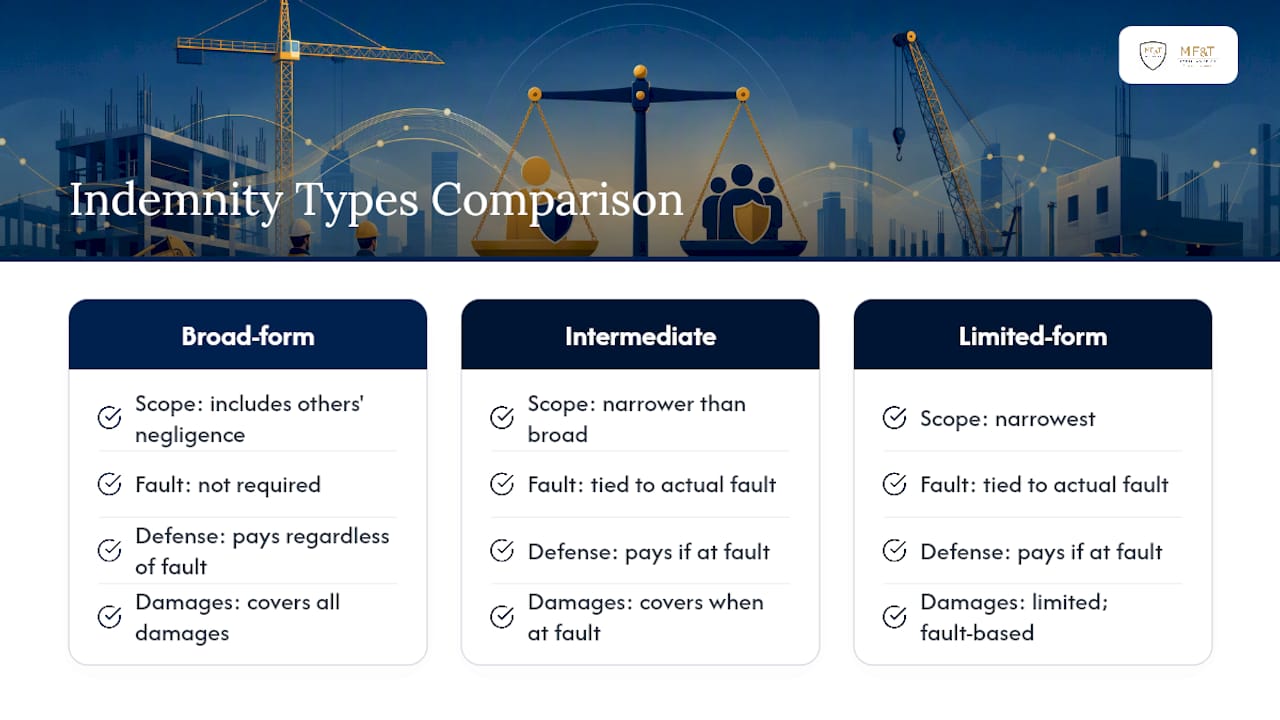
Indemnity, or hold-harmless, provisions require one party to cover another's losses, but the wording decides how far that obligation reaches. Broad-form indemnity can force a subcontractor to cover losses caused entirely by someone else's negligence, while intermediate or limited-form language ties responsibility to actual fault. The difference changes who pays for a defense the moment a claim gets filed.
Additional insured endorsements add a second party to your liability policy, but the scope varies widely. Some endorsements cover ongoing operations only; others extend to completed operations, which matters if a defect surfaces after you've left the job site. The Hartford's guidance on these mechanisms notes that the endorsement's actual language, not the certificate referencing it, controls what's covered.
Waivers of subrogation stop your insurer from pursuing a claim against an upstream party after paying a loss. Without one, your carrier can turn around and sue the GC or owner even though you never intended that.
Primary and non-contributory language decides which policy pays first when two policies could respond to the same claim. A certificate of insurance (COI) only shows that a policy exists on the date it was issued. It does not confirm the endorsement itself was ever added, which is why the certificate and the policy need separate verification.
Performance and payment bonds work differently. Instead of shifting liability through insurance, a surety guarantees financial performance if a contractor defaults, giving owners a backstop that indemnity language alone can't provide.
Pro Tip: Request the actual endorsement form, not just the certificate. A COI can list coverage that was promised but never issued.
Where Risk Transfer Fits in Construction Risk Mitigation Strategies
Risk transfer is one of four standard responses to project risk, alongside avoiding it, mitigating it, and accepting it outright. Procore's framework for construction risk management recommends identifying which response fits each risk during preconstruction, before contract language locks in an allocation nobody actually evaluated.
Transfer makes sense when the receiving party has both the operational control and the insurance capacity to handle the risk. It stops making sense fast when either condition is missing.
Some risks resist transfer altogether. Reputational damage, regulatory penalties, political risk, and certain emerging technological exposures are largely uninsurable, so contract language assigning them to a subcontractor doesn't actually protect anyone. Layered protection strategies become necessary on large projects precisely because standard insurance markets won't absorb every exposure.
Contractual transfer also fails in predictable ways:
- Underinsured or insolvent parties. A subcontractor who accepted broad indemnity but carries minimal limits leaves the GC exposed anyway.
- Anti-indemnity statutes. Many states restrict how far indemnity obligations can reach, and broad-form clauses may simply be unenforceable depending on jurisdiction.
- Ambiguous drafting. Vague language can boomerang liability back to the party who thought they'd transferred it away.
- Poor tender of defense. Missing notice deadlines or procedural steps can void coverage that should have applied.
How to Verify Risk Transfer Actually Protects You
Confirming that a contract clause functions the way it reads on paper takes five concrete steps, not a signature and a hope.
- Map every contract obligation to a real loss scenario. Read each indemnity and insurance requirement against the actual work you're performing, and flag anything that assumes risk you don't control.
- Require specific endorsements and verify the actual wording. Additional insured primary/non-contributory status and a waiver of subrogation should appear on the endorsement form itself, matched against what the upstream party's general liability policy requires.
- Add bonds or holdbacks where the counterparty's financial strength is uncertain, and log every risk allocation decision in a written risk register so nothing gets assumed by default.
- Negotiate compensation for onerous obligations, or refuse them. If a clause pushes an uninsurable risk downstream, that's a negotiating point, not a formality to accept.
Pro Tip: Keep the risk register updated through the life of the project. Allocations made at bid time often need revisiting once change orders shift the scope of work.
What to Ask Your Insurance Broker About Contractual Liability
Your broker can catch mismatches between contract language and actual coverage before they turn into an uncovered claim. Ask for a written coverage opinion that walks through the indemnity language line by line against your policy terms and limits, not a verbal assurance that "it should be fine."
Request sample endorsement wording and COI language the upstream party will actually accept. Vague assurances create disputes later; specific language settles them before the ink dries.
- Ask for a gap analysis comparing your current limits to the exposure the contract creates.
- Request recommendations on policy limit increases or riders where a gap shows up.
- Confirm whether your situation calls for coverage counsel rather than a broker's opinion alone. Complex indemnity language or a jurisdiction with strict anti-indemnity rules often justifies the extra step.
A contractual liability policy built to match your actual contract obligations closes the gap between what you signed and what your insurance will pay.
Legal Enforceability of Risk Transfer Clauses Across States
Indemnity language that works in one state can be partially void in another. Roughly most US states have some form of anti-indemnity statute limiting how far a downstream party can be forced to indemnify an upstream one, particularly for the upstream party's own negligence.
These statutes generally target broad-form indemnity, the version that makes a subcontractor responsible for losses regardless of who caused them. Some states void broad-form language entirely. Others allow intermediate-form indemnity, where the subcontractor covers losses except those caused solely by the indemnitee's own negligence. A handful of states permit broader language but still scrutinize it closely if a dispute reaches court.
The practical problem is that construction contracts frequently get drafted once and reused across projects in different states without adjustment. A clause that survives review in Texas may be unenforceable in California. Since enforceability turns on the specific statute governing the project's location, treating any indemnity clause as automatically valid is a mistake regardless of how standard the language looks.
This is also where anti-indemnity rules intersect with insurance. Even where an indemnity clause is enforceable, an additional insured endorsement can still fail to respond if its own terms are narrower than the contract assumes. Legal enforceability and insurance coverage are two separate questions, and a contract can pass one test while failing the other. Coverage counsel review, not a general read of the contract, resolves that gap when the stakes on a project are high enough to warrant it.
How Risk Transfer Shapes Project Risk Management Outcomes
Contractual risk transfer functions as one lever inside a larger risk management structure, and the projects that manage it well tend to look different from the start. Formal risk identification during preconstruction surfaces exposures before contracts get signed, giving teams a chance to decide deliberately which risks to transfer, retain, or mitigate rather than defaulting to whatever boilerplate language a template happens to include.
Projects that skip this step tend to discover their risk allocation only after something goes wrong, at which point the contract language becomes evidence in a dispute rather than a planning tool. That's the difference between risk transfer as a strategy and risk transfer as an afterthought.
The impact shows up in claims data and project economics both. Proactive allocation strategies correlate with fewer insurance claims and more predictable premiums, largely because responsibility sits with the party positioned to prevent the loss in the first place. A GC who transfers scaffolding risk to a scaffolding subcontractor with proper coverage sees fewer disputes than one who transfers it to a sub who never had the right policy limits.
Risk transfer also affects project outcomes beyond the balance sheet. Clear allocation reduces the friction that slows down claim resolution, since insurers spend less time arguing over which policy responds. On multi-party projects with tight schedules, that speed matters as much as the dollar amount at stake.
Risk Transfer in Construction vs. Other Industries
Construction's approach to risk transfer looks different from manufacturing, retail, or professional services for a specific reason: the risks themselves are less predictable and more physically dangerous. A manufacturing plant can model defect rates with years of production data. A construction site changes shape daily, with new subcontractors, new equipment, and new exposures introduced every week of the schedule.
That volatility is why construction relies so heavily on layered contractual tools, indemnity, additional insured status, waivers of subrogation, and bonds, stacked together rather than a single liability policy. Other industries often transfer risk through one dominant mechanism, like a product liability policy or a service agreement's limitation-of-liability clause. Construction needs several tools working in combination because a single project involves so many independent parties performing physically hazardous work on the same site at the same time.
The multi-party structure itself creates unique complexity. An owner, GC, and a dozen subcontractors can each carry separate policies, each with different limits and different exclusions, all responding to the same job site. Structured, layered financial programs that combine surety instruments with alternative coverage triggers have become more common on large projects specifically because standard insurance markets weren't built to handle that many moving parts at once.

Performance and payment bonds also set construction apart. Few other industries rely on a surety guarantee as a standard risk transfer tool, largely because few other industries see contractor default cause the kind of cascading project failure a mid-project walkoff creates.
Negotiating Risk Transfer Clauses Without Losing the Job
Negotiating indemnity and insurance language works best when you treat it as a business conversation, not a legal standoff. Come to the table having already identified which clauses your current policy can actually support and which ones would require new coverage or higher limits.
Push back on broad-form indemnity specifically. Ask whether intermediate-form language, which limits your responsibility to losses your own work actually caused, would satisfy the owner's or GC's risk appetite just as well. Many upstream parties default to the broadest language available simply because it's the template, not because they need that scope.
If a clause requires coverage you don't currently carry, quote the cost of adding it and factor that into your bid or your negotiated price. Equitable contracts compensate the party assuming risk rather than expecting risk absorption for free, and raising that point early reframes the conversation from "sign or walk" to "here's what this obligation costs."
Get specific about endorsement wording before you sign, not after a claim arrives. A GC willing to negotiate primary/non-contributory language or waiver of subrogation terms in writing, rather than leaving it to a certificate that may not match the actual policy, signals a counterparty who understands the mechanics. One who won't discuss it at all is worth a harder look before you commit.
Emerging Trends in Construction Risk Transfer Practices
Construction risk transfer is shifting toward more structured financial thinking rather than boilerplate contract language. Leading firms now treat risk allocation as a financial discipline, designing layered protections with alternative coverage triggers and financing arrangements aligned to a project's actual cash flow timing, not just its insurance calendar.
That shift responds to a real problem: on large projects, financial stress from a loss event can accumulate well before a formal insurance trigger activates, leaving a liquidity gap even when coverage eventually pays out. Structured programs that combine surety, alternative triggers, and financing address that timing mismatch directly.
Tighter scrutiny of indemnity drafting is showing up too. Owners and GCs increasingly expect tailored clause language rather than copied boilerplate, partly because generic 'copy and paste' indemnity clauses tend to create obligations nobody actually intended and nobody can insure. Expect more contracts to specify exact endorsement forms by name rather than leaving coverage to a generic reference.
Market pricing pressure is also changing negotiating leverage. As insurance evaluation for complex projects becomes more sophisticated, subcontractors with strong loss histories and verified coverage have more room to push back on broad-form indemnity than they did when carriers priced risk more uniformly. Contractors who can document a clean claims record and appropriate limits increasingly negotiate from a position of strength rather than accepting whatever the template says.
Why Fair Risk Allocation Beats Blanket Risk Transfer
Risk transfer only works when it follows control and insurance capacity, not leverage. Pushing a risk downstream to whoever has the least negotiating power, rather than whoever can actually manage or insure it, just relocates the failure point.
Bringing your broker and, when the stakes justify it, coverage counsel into contract review before signature costs far less than untangling a boomerang claim after a loss. And if a clause asks you to assume real risk, negotiate compensation for it. An equitable contract prices risk. A one-sided one just hides it.
— Mike
How M F and T North America Helps You Verify Contractual Coverage
M F and T North America gives contractors something a generic policy comparison can't: a direct line to reviewing your actual contract language against your actual coverage, before you sign, not after a claim exposes the gap.
That review typically produces a few concrete deliverables. M F and T North America can walk your indemnity and insurance clauses against your current general liability and contractual liability policies, flag where endorsements are missing, and recommend the specific additional insured or waiver of subrogation language an upstream party will accept. For active project work, a builders risk policy tailored to the job site's actual exposure often fills the gap that a standard commercial policy leaves open.
If you're preparing to sign a contract with indemnity language you haven't had reviewed, request a coverage quote from M F and T North America and get a written answer on where your current policy stands before the job starts.
Sources
- What is Contractual Risk Transfer? - NASBP
- Risk transfer mechanisms webinar — The Hartford (2025)
- Construction risk management — Procore
- Different Market Methods for Transferring Financial Risks in Construction — IntechOpen (2019)