
Most U.S. contractors need a license bond before they can legally work, and the fastest way to confirm your specific contractor license bond requirements is to check your state's licensing board directly. A license bond is a surety contract, not insurance, and it protects the public and the licensing authority, not your business. If you are already licensed in your state, you almost certainly posted one. If you are applying for the first time, here is what to do right now.
Three immediate actions:
- Go to your state licensing board's website and search for "contractor bond requirements" or "surety bond" in the licensing section.
- Confirm the required bond amount, the exact bond form your state accepts, and whether the bond must be filed by the licensee or a qualifying individual.
- Contact a licensed surety producer or independent agency like M F and T North America to get a quote and start the application.
Who almost always needs a contractor license bond:
- General contractors in most states
- Specialty trade contractors (electrical, plumbing, HVAC, roofing) in states with trade-specific licensing
- Home improvement contractors in states with consumer protection licensing laws
- Any contractor whose license is issued by a state or local board that mandates bonding as a condition of licensure
Your state board is the only authoritative source for your exact requirement. Rules vary significantly, and what applies in California does not apply in Texas.
Pro Tip: Save your state licensing board's URL and your surety producer's contact information in the same place. Bond lapses are one of the most common reasons for license suspension, and a quick renewal reminder from your producer can prevent a costly gap.
Key Takeaways
Most contractors in the U.S. need a license bond to get or renew their contractor's license, and the premium you pay is a small percentage of the bond face amount, not the full amount.
| Point | Details |
|---|---|
| Verify your state requirement | Check your state licensing board's website for the exact bond amount, required form, and filing deadline before purchasing. |
| Premiums range from 0.5% to 5% | Your annual cost is a percentage of the bond face value; credit score is the biggest factor in where you land in that range. |
| Organize documentation early | Two to three years of financials, your EIN, and clean business entity paperwork speed underwriting and often lower your rate. |
| Renew on time to avoid suspension | Most bonds renew annually; a lapse can trigger license suspension, so set a reminder 60 days before expiration. |
| M F and T North America | M F and T North America helps contractors get bonded and package bonds with the liability and commercial coverage licensing boards require. |
Table of Contents
- What is a contractor license bond and how does it differ from insurance?
- How contractor license bonds work: underwriting, claims, and consequences
- Who needs a contractor license bond and how state rules vary
- How much does a contractor license bond cost?
- Step-by-step: how to apply for a contractor license bond
- Other surety bonds contractors commonly need
- How to check your bond and license status and stay compliant
- Proven steps to lower your bond premium and improve approval odds
- What happens if a claim is filed against your bond and how to respond
- Why the right bond setup matters more than most contractors realize
- M F and T North America helps contractors get bonded and stay covered
- Official resources to verify your state's bond rules
- Sources
What is a contractor license bond and how does it differ from insurance?
A contractor license bond is a three-party surety agreement. The three parties are the principal (you, the contractor), the obligee (the state or local licensing authority), and the surety (the bonding company that issues the bond). When you purchase a license bond, the surety guarantees to the obligee that you will comply with the licensing laws and regulations governing your work. If you violate those rules and a valid claim is paid, you must repay the surety. Contractor license bonds are required by many state and local licensing authorities and follow the contractor across jobs.
This is the fundamental difference from insurance. General liability insurance pays claims on your behalf and does not require you to reimburse the insurer for covered losses. A license bond is a credit instrument. The surety steps in to pay a valid claim, but you remain personally liable for that amount.
A contractor license bond does not protect your business from financial loss. It protects the public and the licensing authority from your failure to comply with the law. Any payout the surety makes must be repaid by you, the contractor, in full.
Here is a quick breakdown of how license bonds compare to the other bond and insurance types you will encounter:
- License bond: Guarantees compliance with licensing rules. Filed with the state or local board. Protects consumers and the licensing authority.
- General liability insurance: Covers third-party bodily injury and property damage claims arising from your work. Protects your business. Does not require repayment.
- Performance bond: Guarantees you will complete a specific project according to contract terms. Required by project owners or public agencies on larger contracts.
- Payment bond: Guarantees subcontractors and suppliers will be paid. Often paired with performance bonds on public work.
Pro Tip: A license bond and general liability insurance are not interchangeable. Most licensing boards require the bond; most project owners and general contractors require the general liability insurance for contractors. You need both.
How contractor license bonds work: underwriting, claims, and consequences
The underwriting process
Before a surety issues your bond, an underwriter reviews your application using what the industry calls the Three Cs: character, capital, and capacity.
- Character refers to your credit history. A low personal credit score signals risk to the surety and will raise your premium or, in severe cases, limit your access to bonding.
- Capital means your financial strength, including business assets, liabilities, and cash flow. Sureties want to see that you can repay a claim if one is paid on your behalf.
- Capacity covers your experience and track record in your trade. Years in business, contract backlog, and references all factor in.
Sureties commonly weigh these factors across states. Improving your credit score and presenting a stable revenue history are the most effective levers you control before applying. Poor credit or a recent bankruptcy can raise premiums significantly or require collateral.
How a claim works
- A consumer, subcontractor, or licensing authority files a claim against your bond, citing a specific violation of licensing law or a covered obligation.
- The surety investigates the claim, reviewing documentation from both the claimant and you.
- If the surety determines the claim is valid, it pays the claimant up to the bond's penal sum (the face amount of the bond).
- The surety then demands reimbursement from you for the full amount paid.
The penal sum is not your premium. It is the maximum the surety will pay on any single claim or in aggregate, depending on the bond form. Your premium is a fraction of that amount.
Consequences of an unpaid reimbursement
- The surety can sue you to recover the payout.
- Your license may be suspended or revoked by the licensing board.
- Future bonding capacity shrinks, and premiums rise sharply.
- A judgment against you affects your personal and business credit.
Most state boards require the bond form to be executed on their specific form, signed by the surety's attorney-in-fact, and submitted before license issuance or renewal. Failing to maintain a current, properly filed bond is grounds for license denial or suspension in most jurisdictions.
Who needs a contractor license bond and how state rules vary
The short answer: if your state or local jurisdiction issues a contractor's license, it almost certainly requires a bond as a condition of that license. The bond amount, who must post it, and how it is filed differ by state, trade classification, and sometimes by the dollar volume of work you perform.
General rules of thumb:
- Most states require the bond at initial license application and at every renewal.
- Some states require the qualifying individual (the person whose license the company operates under) to post the bond personally, not just the business entity.
- Bond amounts are set by the licensing authority, not by the surety or the agency selling the bond.
Representative state examples
California: The Contractors State License Board (CSLB) requires a $25,000 contractor license bond for all licensed contractors. This is one of the most widely cited state requirements and applies to both the contractor of record and, in some cases, a separate qualifying individual bond.

Washington: Washington L&I requires a continuous contractor surety bond of $30,000 for general contractors and $15,000 for specialty contractors, plus minimum liability insurance coverage. The bond must remain in force continuously throughout the registration period.
Nevada: The Nevada State Contractors Board sets the bond amount at the time of license approval. Amounts range from $1,000 to $500,000 depending on the license classification and scope of work. Nevada also allows a cash deposit in lieu of a surety bond in some cases, though that option ties up capital for years.
Arizona: Arizona statute requires a surety bond or cash deposit for contractor licensing. Bond amounts are set on a schedule tied to estimated annual construction volume and classification, starting at a $5,000 minimum and rising with volume.
| State | Typical bond amount or rule | Who posts it | Renewal |
|---|---|---|---|
| California | $25,000 | Licensee (and qualifying individual separately in some cases) | Annual |
| Washington | $30,000 general / $15,000 specialty | Licensee | Continuous |
| Nevada | $1,000–$500,000 (board-set at approval) | Licensee | Per license term |
| Arizona | Schedule-based, starting at $5,000 | Licensee | Annual |
How to find your state's exact requirement:
- Go to your state licensing board's official website and search for "surety bond" or "bond requirements."
- Download the state's required bond form. Many states will not accept a generic bond form.
- Confirm whether the bond must be filed by the licensee, the qualifying individual, or both.
- Check whether your state accepts a cash deposit as an alternative and what the retention rules are.
How much does a contractor license bond cost?
Your premium is what you actually pay. The bond face amount (the penal sum) is what the surety guarantees to pay on a valid claim. Bond premiums typically range from about 0.5% to 5% of the bond face value, depending on your risk profile.
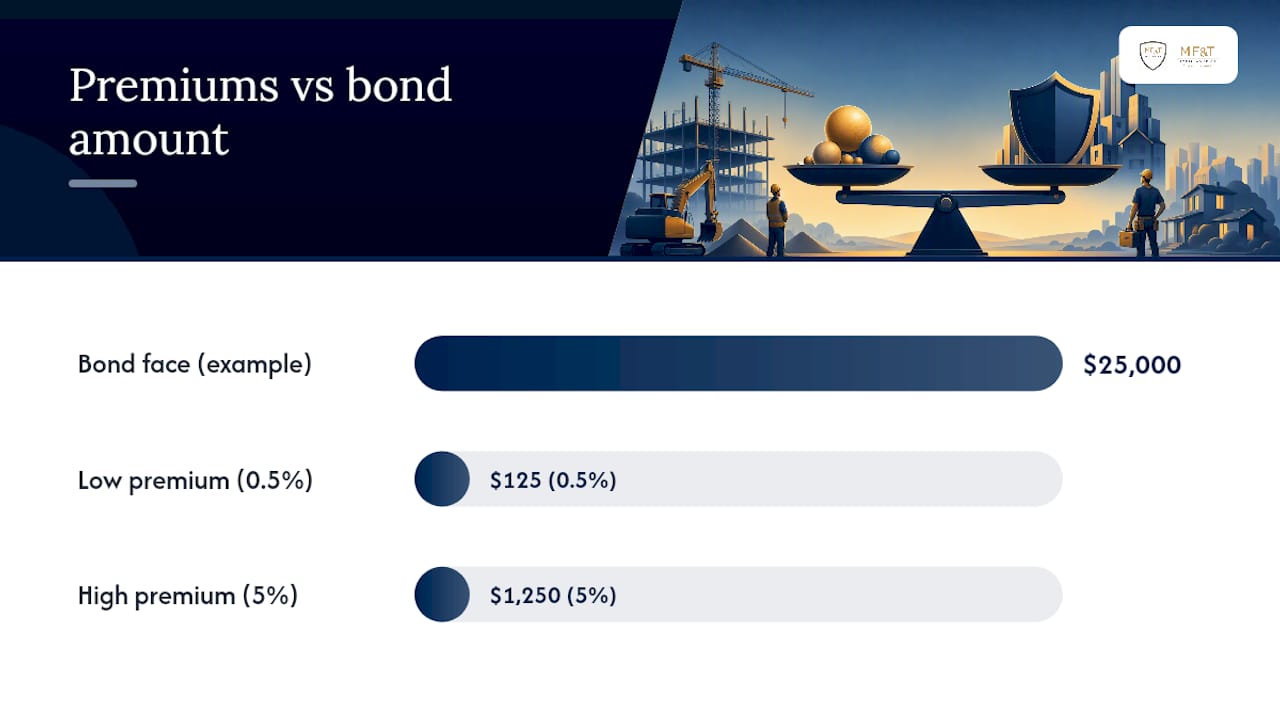
On a $25,000 California contractor bond, that means an annual premium of roughly $125 to $1,250. A contractor with strong credit and several years in business will land near the low end. A contractor with a recent bankruptcy or prior claims history will pay more, or may need to post collateral.
Factors that set your premium:
- Personal credit score: The single biggest driver for most small-to-mid-size bond amounts.
- Business financials: Revenue stability, assets, and liabilities.
- Years in business: Newer businesses are higher risk in the surety's view.
- Prior claims: Any paid claims on previous bonds will raise your rate.
- Bond amount: Larger bonds carry more exposure and often higher rates.
- Trade classification: Some trades (roofing, demolition) are considered higher risk than others.
Pro Tip: Pull your personal credit report before applying for a bond. Dispute any errors and pay down revolving balances if possible. Even a modest credit score improvement can move you into a lower premium tier. Organizing two to three years of business financials before you apply also speeds up underwriting and signals stability to the surety.
Because bond amounts are set by the licensing authority, the agency selling the bond cannot change the penal sum. You can only influence your premium, not the face amount of the bond.
Step-by-step: how to apply for a contractor license bond
Getting bonded is straightforward when you know what to gather. Here is the sequence most contractors follow:
- Confirm the requirement. Check your state licensing board for the exact bond amount, required form, and filing deadline.
- Choose a licensed surety producer. Work with a licensed independent agency or direct surety writer who is authorized in your state.
- Gather your documentation. Most applications require:
- Legal business name and entity type (LLC, sole proprietor, corporation)
- Employer Identification Number (EIN) or Social Security Number
- Two to three years of business financial statements or tax returns
- Personal financial statement
- Prior claims history on any previous bonds
- License application number or existing license number
- Complete the application and sign a credit authorization. The surety will pull your credit as part of underwriting.
- Pay your premium. Once approved, you pay the annual premium and receive the bond.
- File the bond with the licensing board. Submit the executed bond form, including the surety's power of attorney, to the board before or with your license application.
Timeline: Most standard contractor license bonds are approved and issued within one to three business days for applicants with clean credit. Complex applications (poor credit, large bond amounts, prior claims) can take a week or more. Filing with the state board adds another few days in most jurisdictions.
Common hurdles and how to handle them:
- Poor credit: Ask your producer about collateral-backed bonds or co-signer options. Some sureties specialize in high-risk applicants.
- Prior claims: Be upfront. Hiding a prior claim and having it discovered during underwriting is worse than disclosing it.
- New business: Lean on personal credit and financials. A strong personal balance sheet can offset a short business history.
Proactive preparation, including organized financials and clear business entity documentation, speeds approval and often reduces premium rates.
Other surety bonds contractors commonly need
A license bond is not the only bond you may encounter. Here is a quick reference for the most common additional surety bonds in contracting:
- Performance bond: Guarantees you will complete a project per contract terms. Required on most public construction projects and many large private contracts. The project owner or general contractor is the obligee.
- Payment bond: Guarantees subcontractors and material suppliers will be paid. Often required alongside a performance bond on public work under the Miller Act (federal) or state Little Miller Acts.
- Bid bond: Guarantees you will honor your bid price and execute the contract if awarded. Required on many public bids.
- Maintenance or warranty bond: Covers defects in workmanship for a defined period after project completion. Some owners require these on larger projects.
- Consumer protection bond: Some states require a separate bond specifically to protect homeowners from contractor fraud or abandonment, distinct from the standard license bond.
These bonds are project-specific or contract-specific, unlike a license bond, which is tied to your license and follows you across all jobs. Public work almost always triggers performance and payment bond requirements. Private owners may require them by contract. Your license bond does not substitute for any of these.
How to check your bond and license status and stay compliant
Letting your bond lapse is one of the fastest ways to lose your license. Here is how to stay on top of it.
Checking your status:
- Go to your state licensing board's website and use the license lookup tool. Most boards show whether a current, active bond is on file.
- Confirm the bond form on file matches the state's current required form. Forms change occasionally, and an outdated form can trigger a compliance issue.
- Verify the power of attorney attached to the bond is current and has not expired.
Renewal mechanics:
- Most contractor license bonds renew annually, though some states use continuous bonds that remain in force until canceled.
- Sureties typically provide 30 days' written notice before canceling a bond for non-payment or other reasons. That window is your safety net, but do not rely on it.
- Set a calendar reminder 60 days before your bond's expiration or renewal date.
Compliance checklist:
- Keep your bond current and confirm the state board shows it as active.
- Notify your surety and the licensing board promptly if you change your business name, entity structure, or ownership.
- Maintain copies of your bond form, power of attorney, and all correspondence with the board.
- If you add a qualifying individual or change the person whose license the company operates under, confirm whether a new bond or bond rider is required.
Proven steps to lower your bond premium and improve approval odds
Underwriting is not a black box. Sureties evaluate the same factors across states, and you can move the needle on most of them before you apply.
- Separate personal and business credit. Open a dedicated business checking account and business credit card. Keep them clean. Sureties look at both, and mixing them makes your financial picture harder to read.
- Correct your business entity paperwork. Make sure your legal business name, EIN, and entity type are consistent across your license application, bond application, and tax filings. Discrepancies slow underwriting.
- Organize two to three years of financials. Profit and loss statements, balance sheets, and tax returns. If your books are a mess, a bookkeeper's cleanup before you apply is money well spent.
- Highlight long-term contracts and references. A backlog of signed contracts and a list of satisfied clients or general contractors signals capacity and stability to the underwriter.
- Address credit issues before applying. Pay down revolving balances, dispute errors, and avoid new hard inquiries in the months before your bond application.
- Consider collateral if your credit is weak. Some sureties accept cash collateral or a letter of credit to offset credit risk. This can unlock bonding capacity that would otherwise be unavailable.
Working with a surety producer:
A specialist producer who works with contractors regularly knows which sureties are most competitive for your trade, your state, and your credit profile. Ask your producer: Which surety is most competitive for my trade and bond amount? What can I do before I apply to get a better rate? Will you help me file the bond with the state board?
Pro Tip: Strengthening your capital position before applying for a bond also improves your profile for construction financing. If you are exploring how construction loans work, lenders and sureties look at many of the same financial signals, so the preparation overlaps.
What happens if a claim is filed against your bond and how to respond
A claim against your license bond is serious. Here is the sequence and what you should do at each step.
Claim flow:
- Notice: The claimant (a consumer, subcontractor, or licensing authority) files a written claim with the surety, citing the specific violation or loss.
- Investigation: The surety notifies you and requests documentation. You have the right to respond and provide evidence that the claim is invalid or overstated.
- Determination: The surety reviews both sides and decides whether the claim is valid and, if so, how much to pay.
- Payout: If the claim is valid, the surety pays the claimant up to the bond's penal sum.
- Reimbursement demand: The surety immediately demands full repayment from you.
Consequences of a paid claim:
- Your licensing board will likely be notified. Depending on the violation, your license may be suspended or placed on probation.
- Future bond premiums will rise, sometimes substantially.
- If you do not repay the surety, it can file a civil suit against you and pursue your personal assets.
- A judgment on your record affects your ability to get bonded at any price.
What to do if a claim is filed:
- Engage a construction attorney promptly. Do not respond to the surety or the claimant without legal guidance.
- Cooperate fully with the surety's investigation and provide all requested documentation.
- If the underlying dispute is with a homeowner or subcontractor, explore whether a negotiated settlement resolves the issue before the surety pays.
- Document every corrective step you take and communicate those steps to the licensing board proactively. Boards respond better to contractors who get ahead of the problem.
Why the right bond setup matters more than most contractors realize
Most contractors treat bonding as a checkbox. Get the bond, file it, move on. That approach works until it doesn't, and when it fails, it usually fails at the worst possible moment: mid-project, mid-license-renewal, or right after a dispute with a client.
The contractors who navigate bonding well treat it the way they treat their license itself: as something that requires active management. They know their renewal date, they know their surety's cancellation notice window, and they have a producer they can call when something changes in their business. That relationship pays off when a claim is filed, when they need a larger bond for a bigger project, or when a state board changes its required form and they need to refile quickly.
There is also a cost dimension that most contractors underestimate. A contractor who improves their credit score from the mid-600s to the low-700s before applying for a bond can cut their annual premium by a meaningful amount over the life of their license. Over five years, that is real money, and it compounds if you eventually need a larger bond for public work or higher-volume contracts.
The bond protects the public. Your job is to make sure it never gets used.
M F and T North America helps contractors get bonded and stay covered
Sorting out contractor bonding requirements across states takes time you probably do not have. M F and T North America is an independent insurance agency with over 30 years of experience helping contractors, property developers, and small businesses get the coverage and bonding support they need, without the runaround.
For contractors, that means practical help: guidance on what your state licensing board requires, assistance coordinating bond filing, and honest advice on how to present your application to get a competitive premium. M F and T North America also helps contractors package their bond with the general liability and commercial insurance that project owners and licensing boards expect to see alongside it. State availability varies, and bond placement is subject to surety underwriting approval.
Ready to get a quote or talk through your bonding situation? Request a free quote and have your license application details, EIN, and two to three years of financials ready. The conversation is free, and it usually takes less than 15 minutes to identify the right path forward.
Official resources to verify your state's bond rules
Before you purchase a bond, confirm the requirement directly with the authoritative source for your state. Here are the most useful official references:
- California Contractors State License Board (CSLB): Cslb — search "bond" to find the current $25,000 requirement, the required bond form, and filing instructions.
- Washington Labor and Industries (L&I): Lni — confirms continuous bond amounts and insurance minimums for general and specialty contractors.
- Nevada State Contractors Board: Nvcontractorsboard — shows board-set bond amounts, the cash-deposit alternative, and required bond form details.
- Arizona Revised Statutes, Section 32-1152: Azleg — the statutory schedule for bond amounts tied to annual construction volume and classification.
- Procore's contractor license bond overview: Procore — a practical industry-level explainer useful for understanding how license bonds work across states.
Use these pages to locate the exact bond form your state requires and to confirm whether the bond must be filed online or submitted with a paper power of attorney. Always confirm current requirements directly with your state board before purchasing a bond, since amounts and forms do change.
This article is general information, not a substitute for advice from a qualified lawyer. Consult a qualified legal professional about your own circumstances before acting on anything here.
Sources
- Contractor License Bonds: Everything You Need to Know | Procore
- Contractor License Bonds: Complete Guide & Requirements
- Bonds – Nevada State Contractors Board
- Register as a Contractor
- 32-1152 - Bonds