
A performance bond is a three-party surety instrument in which a surety company guarantees a project owner (the obligee) that a contractor (the principal) will complete a construction contract
its terms. IRMI defines it as a bond that protects the owner up to the bond's penal sum if the contractor defaults. Here is what that means in practice:- Three parties: The obligee (owner or client) requires the bond; the principal (contractor) purchases it; the surety (a licensed insurance or bonding company) issues it and backs the guarantee.
- What the surety guarantees: If the contractor fails to perform, the surety steps in to arrange completion, fund a replacement contractor, or pay damages up to the penal sum.
- Indemnity obligation: The contractor is not off the hook. If the surety pays a claim, the contractor must repay the surety for every dollar spent, plus legal and administrative costs, typically through a signed indemnity agreement.
A quick numeric example: on a $1,000,000 construction contract with a 100% performance bond, the surety's maximum exposure is $1,000,000. Investopedia confirms that premiums on such a bond typically run 1%–4% of contract value, so the contractor's cost to secure that bond would likely fall between $10,000 and $40,000.
Key Takeaways
A performance bond is a three-party surety instrument that guarantees contract completion, protects the owner up to the penal sum, and holds the contractor financially responsible through indemnity if the surety pays a claim.
| Point | Details |
|---|---|
| Definition and parties | A surety guarantees the owner that the contractor will complete the contract; three parties: obligee, principal, surety. |
| Typical cost | Premiums generally run 1%–4% of contract value; a $1,000,000 bond costs roughly $10,000–$40,000. |
| Indemnity obligation | The contractor must repay the surety for any claim paid, including legal costs, often backed by personal guarantees. |
| Not the same as insurance | Bonds guarantee performance; builders risk and general liability cover physical loss and third-party claims. |
| M F and T North America | Can advise on builders risk and contractor insurance and refer you to reputable surety producers for bonding needs. |
Table of Contents
- What does a performance bond actually do on a construction job?
- Who are the three parties and what does each one do?
- How do performance, payment, and bid bonds differ?
- How much does a performance bond cost?
- How do you get a performance bond?
- What happens when a contractor defaults?
- When do owners require performance bonds?
- What performance bonds don't cover
- How performance bonds relate to your insurance program
- What experienced practitioners know that most guides skip
- How M F and T North America can help with your construction risk
- Sources
What does a performance bond actually do on a construction job?
A performance bond shifts the financial risk of contractor default from the owner to the surety. Without one, an owner who discovers their contractor has walked off the job faces the full cost of finding a replacement, paying higher prices mid-project, and absorbing schedule delays. With a bond in place, the surety absorbs that exposure up to the penal sum.
Procore's construction guidance explains that sureties typically respond to a valid default in one of three ways: they arrange for a replacement contractor to finish the work, they fund the original contractor's completion efforts, or they pay the owner damages. The owner does not have to chase the defaulting contractor in court to recover losses, at least not initially.
The owner declares default, notifies the surety, and the surety investigates. Within weeks, the surety engages a replacement GC to finish the remaining scope. The owner's out-of-pocket exposure for completion costs above the original contract price is covered by the bond, up to the $2,000,000 penal sum.
Pro Tip: Before signing a contract, check three things in the bond wording: the penal sum (it should match 100% of the contract value on most public projects), the notice requirements (how and when you must notify the surety of a default), and the performance period (the bond must remain in force through final completion and any warranty period the contract specifies).

Who are the three parties and what does each one do?
Every performance bond involves exactly three parties, each with distinct duties.
- Obligee (the owner or project client): The party requiring the bond and the one protected by it. The obligee sets the bond amount, receives the bond as part of the contract package, and has the right to make a claim against the surety if the principal defaults.
- Principal (the contractor): The party purchasing the bond and the one whose performance it guarantees. The principal pays the premium, signs the indemnity agreement, and remains financially liable to the surety if a claim is paid.
- Surety (the bond issuer): A licensed surety company that underwrites and issues the bond. The surety vets the contractor before issuing, and if a valid claim arises, it investigates and responds with one of the remedies described above.
The flow works like this: during procurement, the owner requires the bond as a contract condition; the contractor applies to a surety and, if approved, delivers the executed bond to the owner before work begins. During performance, the bond sits in the background. If the contractor defaults, the owner triggers the claim process, the surety investigates, and the indemnity obligation kicks in on the back end.
How do performance, payment, and bid bonds differ?
Construction contracts often require more than one type of surety bond. Understanding which bond does what helps you know what protection you actually have.
| Bond Type | What It Guarantees | Who It Protects | Typical Penal Sum | When It's Required |
|---|---|---|---|---|
| Bid bond | That the bidder will enter the contract and provide required bonds if awarded | Owner (during bidding) | 5%–10% of bid amount | At bid submission |
| Performance bond | That the contractor will complete the work per contract terms | Owner (during construction) | 100% of contract value (public); varies privately | At contract award |
| Payment bond | That subcontractors, laborers, and suppliers will be paid | Subs, suppliers, laborers | 100% of contract value (public); varies privately | At contract award, often paired with performance bond |
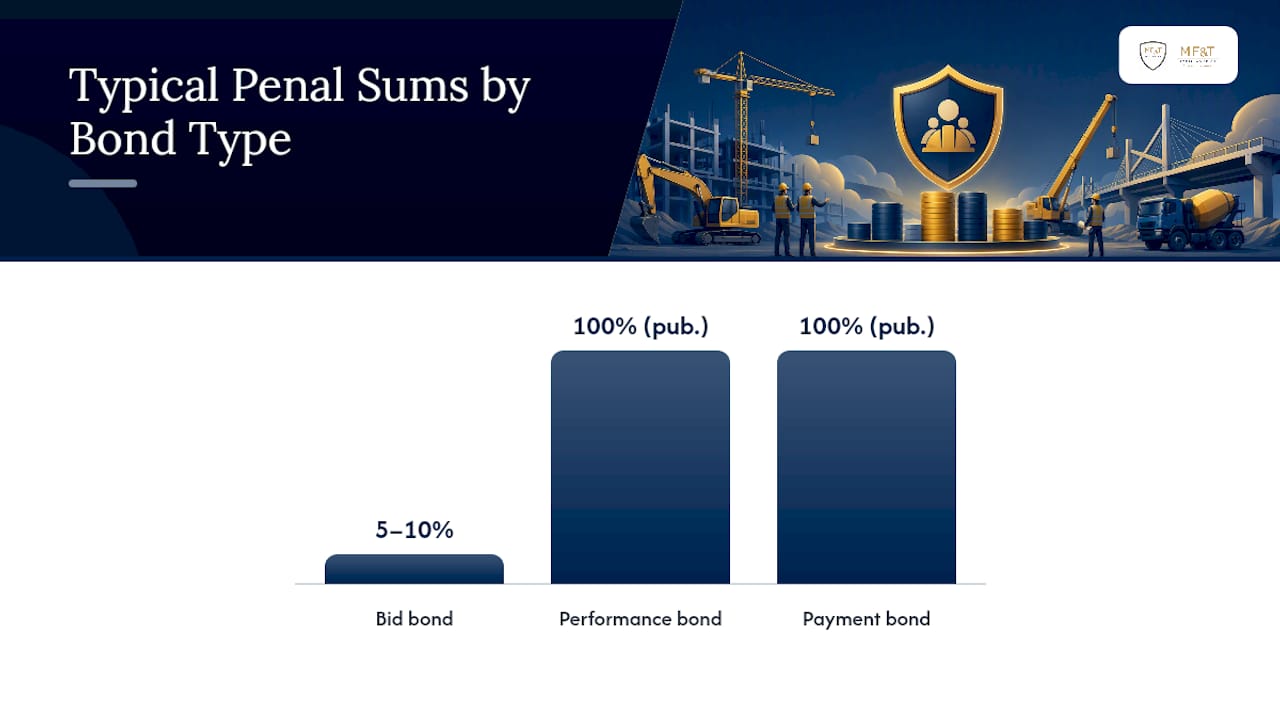
AIA Contract Documents notes that owners frequently require both a performance bond and a payment bond together, often called a "Performance and Payment Bond" package. The performance bond protects the owner's completion interest; the payment bond protects the downstream parties who might otherwise file mechanics' liens.
On penal-sum variants: Wikipedia's performance bond entry notes that a 10% penal sum equals 10% of the total contract price. Some private contracts and certain jurisdictions allow fractional penal sums, but most U.S. The lower penal sum reduces the contractor's premium cost, but leaves the owner exposed to losses above that threshold.
How much does a performance bond cost?
On a $500,000 contract, that translates to a premium somewhere between $5,000 and $20,000. On a $10,000 contract, the premium might be as low as $100–$400, though many sureties set minimum premiums that make very small bonds proportionally more expensive.
What underwriters look at
Sureties evaluate the contractor's full financial picture before quoting a rate. The primary factors are:
- Financial statements: Audited or reviewed financials showing working capital, net worth, and liquidity.
- Backlog: How much work the contractor already has under contract versus their capacity to take on more.
- Work history: Track record of completed projects, including size, complexity, and any prior defaults or claims.
- Project type and complexity: A straightforward residential build carries less risk than a complex mechanical or specialty trade project.
- Credit profile: Both business and personal credit scores factor in, especially for smaller contractors.
Pro Tip: Premium quotes are not standardized across sureties. Working with a surety broker who has relationships with multiple carriers often produces better rates than going directly to a single company. Contact a licensed surety producer for exact pricing on your specific project.
How do you get a performance bond?
Securing a performance bond follows a defined sequence. Rushing any step typically delays issuance and can hold up contract execution.
- Request a prequalification letter. Before bidding on a bonded project, ask a surety or surety broker to assess your bonding capacity. This letter tells you the maximum contract size you can bond and signals to owners that you are bondable.
- Submit financial statements. Provide CPA-prepared financials (reviewed or audited, depending on bond size) for the past two to three years. Sureties want to see working capital, net worth, and cash flow.
- Provide a work-in-progress schedule. This document shows all current contracts, percent complete, estimated cost to complete, and projected profit. It tells the surety whether you have capacity for the new project.
- Supply references and project history. Bank references, owner references, and a list of completed projects with contract values demonstrate your track record.
- Sign the indemnity agreement. Before any bond is issued, the surety requires a General Indemnity Agreement (GIA) signed by the company and, typically, the principals personally. This is the surety's protection if they pay a claim.
- Receive and deliver the bond. Once approved, the surety issues the executed bond. You deliver it to the owner as a condition of contract execution.
Documents to have ready
- Two to three years of CPA-prepared financial statements
- Current work-in-progress schedule
- Bank reference letter
- Certificate of insurance (general liability and workers compensation)
- Completed project list with contract values and owner contacts
- Personal financial statements for owners or principals
AIA's contractor guide notes that incomplete financial schedules, unreported claims history, or a thin backlog are the most common reasons sureties slow down or decline applications. Having clean, complete documents ready before you apply cuts the typical timeline from several weeks to a few days.
What happens when a contractor defaults?
When a contractor fails to perform, the claim process follows a specific sequence. Knowing the steps protects your rights as an owner and helps contractors understand the consequences.
- Step 1: Declare default and provide notice. The owner must formally declare the contractor in default and notify the surety in writing, following the notice requirements in the bond form. Missing or late notice can jeopardize the claim.
- Step 2: Surety investigation. The surety investigates the default, reviews the contract, and assesses the contractor's position. This typically takes 30–60 days, though complex situations take longer.
- Step 3: Surety selects a remedy. The surety has several options: arrange for a replacement contractor to complete the work, finance the defaulting contractor's completion efforts, pay the owner the cost to complete up to the penal sum, or deny the claim if the default is disputed.
- Step 4: Completion or settlement. If the surety arranges completion, the project moves forward with a new contractor. If the surety pays damages, the owner uses those funds to hire a replacement independently.
- Step 5: Surety seeks indemnity. After paying any claim, the surety pursues the contractor (and personal indemnitors) for full repayment, including legal costs.
For federal public projects, FAR 28.102-1 establishes specific performance-bond requirements, and the Miller Act imposes statutory payment and performance security obligations on federal construction contracts above certain thresholds. State "Little Miller Acts" extend similar requirements to state and local public projects.
Litigation is always possible if the surety disputes the claim or the parties disagree on the cost to complete. Owners should document every default-related communication carefully.
When do owners require performance bonds?
Performance bonds are mandatory on many public projects and increasingly common on large private ones. Here is when you are most likely to encounter them:
- Federal construction contracts: FAR 28.102-1 requires performance bonds on most federal construction contracts above the applicable threshold. The Miller Act is the underlying statute.
- State and local public projects: Most states have "Little Miller Acts" requiring performance and payment bonds on public construction above a set dollar threshold.
- Large private projects: Sophisticated private owners, lenders, and developers routinely require bonds on projects above $500,000 or $1,000,000 as a condition of financing or contract award.
- Owner risk management: Even when not legally required, owners may require bonds when the contractor is new, the project is complex, or the owner's exposure to a default is high.
Contract language that matters most
The AIA A312 Performance Bond form is the industry standard for private construction projects and is widely accepted on public work. When reviewing bond language, check for:
- Penal sum: Should match 100% of the contract value for full protection.
- Claim procedures: Specific steps and timelines the obligee must follow to preserve claim rights.
- Notice deadlines: How quickly you must notify the surety after discovering a default.
- Performance period: The bond must cover the full construction period through final completion.
- Obligee rights: Language confirming the owner's right to select the completion remedy.
For contract drafting patterns and how penal-sum choices appear in real agreements, Formable's contract playbook offers practical examples worth reviewing.
What performance bonds don't cover
Performance bonds are not insurance policies, and confusing the two leads to real problems. Here are the most common misconceptions:
- Myth: The bond covers defective design. A performance bond guarantees the contractor's work, not the architect's or engineer's design. If a design defect causes a failure and the contractor built exactly what was specified, the bond typically does not respond.
- Myth: The contractor walks away clean after a claim. The indemnity agreement means the contractor owes the surety every dollar it pays, plus costs. Personal guarantees from company owners are standard, so the contractor's personal assets can be at risk.
- Myth: The bond covers all project costs. The bond only covers losses up to the penal sum. If completion costs exceed the bond amount, the owner absorbs the difference.
- Myth: The surety pays immediately. Sureties investigate before paying. The process takes time, and disputed claims can take months or years to resolve.
Pro Tip: Ask your surety or attorney to confirm whether the bond form includes a "dual obligee" rider if a lender is financing the project. Without it, the lender may not have direct claim rights under the bond, leaving a gap in their protection.
The contractor's indemnity obligation deserves special emphasis. A performance bond is a fully indemnified instrument. If the surety pays out on a claim, it seeks full repayment from the principal and any personal indemnitors named in the General Indemnity Agreement. This is not optional and not negotiable after the fact.
How performance bonds relate to your insurance program
Performance bonds and insurance policies serve different purposes, and understanding where one ends and the other begins helps you build a complete risk program.
A builders risk insurance policy covers physical loss or damage to the project under construction from perils like fire, theft, or weather. General liability insurance for contractors covers third-party bodily injury and property damage claims. A performance bond, by contrast, guarantees contract completion. None of these products substitutes for the others.
Here is how to think about who to call:
- Call your insurance agent when you need builders risk, general liability, workers compensation, or contractual liability coverage. These are insurance products your agent can quote and bind.
- Call a surety broker when you need a bid bond, performance bond, or payment bond. Surety underwriting is a separate discipline from insurance underwriting, and a licensed surety producer has the carrier relationships to get you bonded.
- Coordinate both early. Many contract packages require both insurance certificates and bond forms at execution. Starting both processes at the same time prevents delays.
For a complete picture of how insurance and surety fit together on a construction project, NASBP is the leading trade association for surety bond producers and publishes guidance for both owners and contractors on bonding capacity and best practices.
What experienced practitioners know that most guides skip
Most articles on performance bonds stop at the definition. Here is where the practical judgment actually lives.
The biggest mistake owners make is treating the bond as a passive safety net. A bond is only as useful as the claim process you follow. Miss a notice deadline, fail to formally declare default in writing, or skip the required cure period, and you may lose your right to collect. The AIA A312 form has specific procedural requirements for a reason. Read them before you need them, not after.
For contractors, the indemnity agreement is the document that deserves the most attention before signing, not the bond itself. Most contractors focus on the premium and the bond amount. The GIA is where the real exposure lives: it typically gives the surety broad rights to settle claims, control the defense, and pursue repayment from both the company and the individual owners personally. Signing it without legal review is a significant risk.
There is also a market-signal dimension that rarely gets discussed. Being bondable is not just a contract requirement. It is a credentialing signal. Sureties that approve a contractor are effectively vouching for that contractor's financial health and track record. Contractors who cannot get bonded face a shrinking pool of available work, and persistent denials often push them toward subcontractor roles or joint-venture arrangements to stay competitive. If bonding is difficult, the right response is to treat it as a financial health diagnostic, not just a procurement obstacle.
How M F and T North America can help with your construction risk
Securing a performance bond and the right insurance coverage are two separate steps, but they belong in the same conversation. M F and T North America is an independent insurance agency with over 30 years of experience helping contractors, developers, and property owners in Massachusetts and across multiple states build complete risk programs. The agency advises on builders risk insurance, general liability, workers compensation, and contractual liability coverage, and can refer you to reputable, licensed surety bond producers when bonding is part of your contract requirements.
M F and T North America does not underwrite surety bonds, but the agency coordinates the insurance side of your project and connects you with trusted bonding partners so you are not managing two separate processes with two separate contacts. If you are starting a new project, reviewing a contract that requires a performance bond, or simply want to understand what coverage you need before signing, request a free quote and get straightforward answers from an experienced local team.
This article is general information, not a substitute for advice from a qualified lawyer. Consult a qualified legal professional about your own circumstances before acting on anything here.
Sources
These primary sources and industry references support the guidance in this article and are worth bookmarking for deeper research:
- Performance Bonds 101: A Contractor's Complete Guide | AIA Contract Documents / Learn
- NASBP — National Association of Surety Bond Producers
- Performance bond — IRMI