
Every subcontractor you hire needs, at minimum, commercial general liability (CGL), workers' compensation, and commercial auto if vehicles are involved. Beyond that baseline, most general contractors require three specific endorsements: additional insured, primary and non-contributory, and waiver of subrogation, all verified through an ACORD 25 certificate. A certificate alone doesn't prove endorsements exist. You need the endorsement pages, and you need the carrier rated by AM Best at a level strong enough to actually pay a claim.
TL;DR:
- Subcontractors must carry both occurrence-form commercial general liability and workers' compensation policies, with additional endorsements like primary non-contributory coverage and waiver of subrogation verified through endorsed pages, not just certificates.
- Proper proof of insurance requires endorsement pages, a strong AM Best-rated carrier, and confirmation that policies are active with appropriate cancellation notice language, to prevent coverage gaps during the project.
- Occupation-specific limits typically start at $1 million per occurrence and $2 million aggregate for general liability, with umbrella coverage often required for high-exposure projects, and carrier strength matters more than policy limits on paper.
- Lacking required insurance typically results in work stoppages, potential claims on the GC's policy, and negative impacts on future bonding capacity if coverage lapses or gaps remain unaddressed.
- Tiered insurance requirements based on trade hazard, proactive endorsement verification, and early broker engagement are critical for maintaining compliance and avoiding costly claim disputes.
Table of Contents
- Essential Insurance Types Subcontractors Should Carry
- What Do Additional Insured Endorsements Actually Cover?
- Is Workers' Comp Legally Required for Subcontractors?
- How Much Insurance Should a Subcontractor Carry?
- What Happens When a Subcontractor Lacks Required Insurance?
- How Should GCs Set and Verify Insurance Requirements?
- Underwriting Realities: What Drives Subcontractor Insurance Costs
- What Contractors Get Wrong About Insurance Compliance
- Get Help Placing and Verifying Subcontractor Coverage
- Sources
- FAQ
Essential Insurance Types Subcontractors Should Carry
Subcontractor liability insurance starts with commercial general liability, but which version of CGL matters more than people realize. Occurrence-form policies cover claims from incidents that happened during the policy period, even if the claim surfaces years later. Claims-made policies only respond if the claim is filed while the policy is active, which creates a coverage gap the moment a sub switches carriers or lets a policy lapse. For construction work, occurrence form is the standard, and completed operations coverage inside that CGL policy is what protects against defects or damage discovered after the job wraps. A roofer whose work leaks two years later needs that completed operations language intact, not expired.
Workers' compensation is the second pillar, and it's non-negotiable in nearly every state once a subcontractor has employees. Employer's liability, which typically rides alongside workers' comp, covers claims that fall outside the statutory system, like a spouse suing over loss of consortium. These required insurance types aren't optional add ons. They're baseline.
Commercial auto liability matters the moment a subcontractor's crew drives a company truck to a job site. The distinction that trips people up is owned versus hired versus non-owned auto. A sub who rents a truck for one job or has employees driving personal vehicles for work errands needs hired and non-owned auto coverage, not just a policy on the company's owned fleet.
Depending on the trade, you'll also see:
- Inland marine or tools and equipment coverage for subs who own expensive mobile equipment
- Builders' risk insurance for the property itself during construction, often carried by the GC or owner but sometimes required from specialty trades
- Umbrella or excess liability, which sits above the CGL, auto, and employer's liability limits and follows the same terms as the underlying policy
General contractors ask for umbrella coverage because a single serious injury claim can blow through a $1 million CGL limit fast. A general liability policy built for contractors needs to work in concert with these other layers, not in isolation.
What Do Additional Insured Endorsements Actually Cover?
An additional insured endorsement adds another party, usually the GC or property owner, onto the subcontractor's CGL policy so that party gets defense and coverage for claims arising from the sub's work. Being named a "certificate holder" on an ACORD 25 does nothing of the sort. It just means the insurer will notify that party if the policy cancels. Contractable's review of subcontract insurance language confirms that only a properly issued endorsement creates coverage, not a certificate-holder listing.
Two form numbers do almost all the work in construction contracts. CG 20 10 adds the GC as an additional insured for ongoing operations. CG 20 37 extends that same protection to completed operations, which matters once the sub has left the site. Some contracts also reference CG 20 01, which addresses primary and non-contributory language directly on the endorsement, and CG 24 04 for waiver of subrogation. Ask for both CG 20 10 and CG 20 37 whenever a project has any tail risk, which is most construction work.
Primary and non-contributory language forces the subcontractor's policy to pay first, before the GC's own insurance gets touched, and it can't ask the GC's policy to share the loss. Waiver of subrogation blocks the sub's insurer from turning around and suing the GC after paying a claim. Both typically live in the subcontract itself before they show up on a policy.
Here's a short verification process that catches most problems before they become claims:
- Request the ACORD 25 with the correct project name and address listed
- Ask for the actual endorsement pages, not just a COI that lists form numbers in a description box
- Confirm the carrier's AM Best rating meets your floor, often A- VIII or better
- Check the cancellation notice language, since most standard ACORD 25 forms only promise "endeavor to notify" rather than a guaranteed 30-day notice
- File the endorsement pages, not just the certificate, in your compliance records
Pro Tip: If a subcontractor's insurance broker pushes back on providing endorsement pages, that's a signal, not an inconvenience. Legitimate additional insured endorsements take a broker minutes to pull once the policy is active.
Watch for these certificate of insurance red flags: form numbers typed into a description box instead of appearing as attached endorsements, a carrier you can't find rated on AM Best's site, and a COI that lists a project address different from the one you're actually working on. A quick two-minute COI check catches most of these before a sub ever mobilizes.
Is Workers' Comp Legally Required for Subcontractors?
Workers' compensation is mandated by statute in nearly every state once a business has employees, and it isn't something a GC can waive through contract language. It exists independent of what any subcontract says.
Texas stands out as the major exception. It's the only state that doesn't require most private employers to carry workers' comp at all, allowing "non-subscriber" status instead. That creates a real gap: a Texas subcontractor with no employees, working as a true sole proprietor, is often exempt from carrying the policy, but the moment that sub hires even one W-2 employee, the calculus changes and many GCs will require coverage anyway as a contract condition regardless of the state exemption.
Employer's liability limits typically pair with workers' comp, often at $500,000 or $1,000,000, and GCs require both together because employer's liability picks up claims workers' comp's exclusive remedy provisions don't reach.
A few practical checks matter more than most contractors realize:
- Confirm the state policy number matches the state where work is actually performed, not just the sub's home office
- Verify payroll classification codes match the actual trade. Misclassifying a roofer as a general laborer understates the real premium and can void coverage in a claim
- On public or federal projects, expect additional bonding thresholds and sometimes Davis Bacon wage compliance tied to the insurance package
- Confirm the workers' comp filing is active in your state's monitoring system, not just listed on a certificate
How Much Insurance Should a Subcontractor Carry?
Common minimum limits contractors require: CGL at $1,000,000 per occurrence / $2,000,000 aggregate, commercial auto at $1,000,000 combined single limit, employer's liability between $500,000 and $1,000,000, and umbrella coverage layered from $1,000,000 up to $5,000,000 depending on project size, according to SubDoc's subcontractor compliance guidance.
Larger commercial or public projects routinely push those umbrella numbers higher, sometimes to $10 million or more when the GC is managing significant schedule or safety exposure. The aggregate limit deserves particular attention for trades with long-tail risk. Waterproofing, structural, and electrical subs can face claims years after project completion, so a per-project aggregate (rather than a shared annual aggregate across all the sub's jobs) protects against one bad year wiping out coverage for every other project.
Carrier financial strength closes the loop on limits. A policy from a carrier rated below AM Best's typical A- VIII floor is only as good as that carrier's ability to actually pay, no matter how high the stated limit reads on paper.
What Happens When a Subcontractor Lacks Required Insurance?
The immediate contract consequence is usually a stop-work order. Most subcontracts treat missing or lapsed insurance as a material breach, which gives the GC the right to halt work, withhold payment, or remove the sub from the project entirely, as Contractable's review of subcontract insurance clauses lays out.
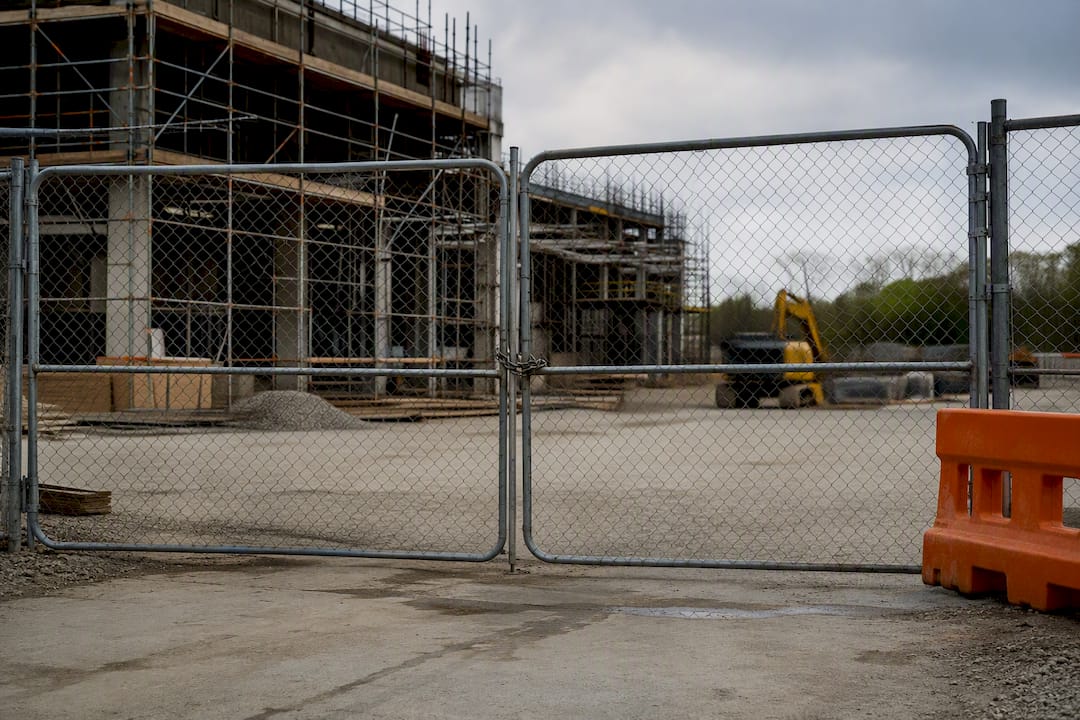
The claim-level exposure runs deeper. Without valid coverage, an injured worker or damaged-property claim can land directly on the GC's own policy, triggering an indemnity demand against the sub personally and a subrogation action once the GC's carrier pays out.
A few failure modes show up again and again:
- A COI that expired mid-project because nobody set a renewal reminder
- An additional insured endorsement that was requested but never actually issued
- A carrier that quietly went insolvent or lost its AM Best rating between bid and mobilization
- A sub who let workers' comp lapse after a slow month and didn't tell anyone
Repeated claims and coverage gaps also follow a subcontractor into future bids. Bonding companies and larger GCs pull loss run histories, and a pattern of coverage lapses can shrink a sub's bonding capacity for years.
How Should GCs Set and Verify Insurance Requirements?
Tiering by trade hazard keeps requirements realistic instead of one-size-fits-all. A low-voltage electrician doesn't need the same limits as a structural steel erector, and SubDoc's compliance framework recommends matching limits and endorsement scope to actual project risk rather than applying a flat requirement across every trade on the job.
A workable subcontract insurance checklist includes:
- Named policy types required: CGL, workers' comp, commercial auto, umbrella, and inland marine where relevant
- Specific limits for each, scaled to project size and trade hazard
- Endorsement form numbers required by name (CG 20 10, CG 20 37, and waiver of subrogation language)
- An AM Best rating floor stated explicitly in the contract, not just assumed
- Cancellation notice language spelling out how much notice you require, since standard ACORD 25 forms don't guarantee 30 days automatically
Verification is a workflow, not a one time event: request the ACORD plus endorsement pages before mobilization, confirm the AM Best rating, store both documents together, and set a renewal reminder 30 days ahead of expiration so a lapse doesn't surface mid-project.
Pro Tip: Negotiate the scope of additional insured language before signing, not after a claim. "Ongoing and completed operations" is a fair, standard ask. A GC demanding blanket additional insured status on every policy a sub carries, unrelated to the actual project, is overreaching and worth pushing back on.
For readers building a broader safety onboarding process alongside insurance verification, a subcontractor safety compliance checklist pairs well with the insurance side of vendor management.
Underwriting Realities: What Drives Subcontractor Insurance Costs
Payroll classification mistakes are the single biggest premium driver MF&T North America sees. A sub coded as general labor instead of the actual trade often pays the wrong rate, and it can complicate a claim later. Prior loss history and whether tools and equipment are scheduled separately also swing pricing significantly. Getting endorsements issued fast matters just as much as price. A broker with an active carrier relationship can often turn around a CG 20 10 or CG 20 37 endorsement within the same business day when engaged early in the bid process, rather than after the subcontract is already signed and the clock is running.
What Contractors Get Wrong About Insurance Compliance
The conventional advice on subcontractor insurance treats the certificate of insurance as the finish line. It isn't. A COI is a snapshot of what a broker claims exists on a given day, not proof that endorsements were ever issued. The gap between those two things is where most claim disputes actually happen, usually discovered at the worst possible moment, after an injury or a property loss, when it's too late to fix.
What gets underrated is how much leverage the request for endorsement pages actually carries. Most subs and their brokers can produce them in minutes if the policy is legitimate. Asking for them isn't adversarial. It's the fastest filter available.
If you take one thing from this article, prioritize the AM Best check before the limit negotiation. A subcontractor carrying a $2 million CGL limit from a carrier rated B+ is often worse off than one carrying $1 million from an A- VIII carrier, because the second one can actually pay. Limits on paper mean nothing if the carrier behind them can't honor a claim.
— Mike
Get Help Placing and Verifying Subcontractor Coverage
Chasing down endorsement pages and checking AM Best ratings on every sub eats hours you'd rather spend running your projects. An independent insurance agency can handle that legwork directly, working with contractors and subcontractors across multiple states to place commercial general liability, workers' compensation, commercial auto, and umbrella coverage through carriers vetted for financial strength.
As an independent agency, an agency shops multiple carriers rather than pushing one company's paper, which matters when you need a policy that actually satisfies a specific contract's endorsement language rather than a generic package. For project-specific coverage, including single-project and reporting-form builders risk policies, the agency can bind same-day in many cases. For the broader commercial package a subcontractor needs to stay compliant across multiple GCs, business insurance options cover general liability, commercial property, workers' comp, and commercial auto under one roof. Reach out for a coverage review or a same-day quote before your next bid deadline.
Sources
Endorsement mechanics, carrier rating floors, and tiered limit guidance in this article draw on RiskCube's subcontractor insurance guide, SubDoc's compliance framework, and TrackMyVendor's COI verification guide. For project-specific coverage setup, see M F and T North America's construction insurance overview.
- GC's Guide to Subcontractor Compliance (2026) | SubDoc
- Subcontractor Agreement: Insurance & Payment Terms | Contractable
FAQ
What Are Subcontractor Insurance Requirements?
They typically include commercial general liability, workers' compensation, commercial auto (when vehicles are used), and often an umbrella policy, plus endorsements for additional insured, primary and non-contributory, and waiver of subrogation.
What Type of Insurance Do You Need to Subcontract People?
At minimum, you need workers' compensation for any employees, commercial general liability for injury and property damage claims, and commercial auto if crew members drive for work; most GCs also require specific endorsements on top of these base policies.
How Much Does $1,000,000 in Contractor Insurance Cost?
Cost varies widely by trade, payroll size, and claims history, so there's no single published figure. Getting an accurate number requires a broker to quote your specific trade classification and loss history. M F and T North America can run that quote directly.
What Happens if My Subcontractor Does Not Have Insurance?
Most subcontracts treat missing insurance as a material breach, giving the GC grounds to issue a stop-work order, withhold payment, or remove the sub, and any resulting claim can fall back on the GC's own policy through an indemnity demand.