
If you already carry full coverage on your own car with a deductible of $500 or less, or your credit card offers primary collision coverage, you can usually decline the rental counter's collision waiver. If your policy is liability-only, your deductible sits at $1,000 or more, or you're renting abroad, buying counter protection is often the smarter move. Either way, pull your declarations page and call your card's benefits line before you sign anything.
TL;DR:
- If your auto policy has a deductible of $500 or less, or your credit card offers primary collision coverage, you can usually decline rental counter protection.
- Checking your declarations page and calling your card benefits line before rental pickup can help you avoid unnecessary costs or gaps in coverage.
- Buy counter insurance if you have liability-only coverage, a deductible of $1,000 or more, or are renting internationally, but skip it if you already have full coverage with a low deductible and credit card protection.
- Personal auto policies extend collision, comprehensive, and liability coverage to rentals, but may not cover loss-of-use fees or rentals in some states or for certain vehicle types.
- Third-party rental insurance can be a cheaper alternative if purchased at least 24 hours before pickup, especially for longer trips or excluded vehicle classes.
Table of Contents
- What Should You Verify Before Rental Car Pickup?
- What Do CDW, SLI, PAI, and Loss-of-Use Actually Cover?
- Does Your Personal Auto Policy Cover a Rental Car?
- When Does Buying Counter Insurance Actually Pay Off?
- How Do You Confirm Coverage Before You Drive Off?
- Is Third-Party Rental Insurance Worth Buying Instead?
- What Would an MF&T North America Agent Check First?
- A Practical Take on Rental Coverage Decisions
- Get Your Coverage Reviewed Before Your Next Trip
- Sources
What Should You Verify Before Rental Car Pickup?
A few minutes of prep saves you from either overpaying at the counter or discovering a gap after an accident. Before you book, or at the latest before you drive off the lot, run through this list:
- Find your auto policy's declarations page and confirm your liability limits, plus whether it extends to non-owned vehicles.
- Check your collision and comprehensive status and note your exact deductible.
- Call the number on the back of your credit card to confirm whether its collision damage waiver is primary or secondary, and check for territory exclusions.
- Ask whether you have an umbrella policy or a non-owner policy that could apply to the rental.
None of this takes more than fifteen minutes, and it's the difference between an informed decision and a guess made under pressure at a rental counter.
What Do CDW, SLI, PAI, and Loss-of-Use Actually Cover?
Rental companies bundle several distinct products under the umbrella of "protection," and each one covers a different risk. Knowing the difference matters more than the sales pitch you'll hear at the counter.
Collision Damage Waiver (CDW) / Loss Damage Waiver (LDW): This isn't technically insurance. It's a contractual waiver where the rental company agrees not to hold you financially responsible for damage to or theft of the vehicle. Buy it, and repairs on a dinged bumper become the rental company's problem instead of yours.
Supplemental Liability Insurance (SLI/SLP): This raises your liability protection, often up to $1 million, in case you injure someone or damage property with the rental car. It typically runs $10 to $16 per day and does nothing for damage to the rental car itself. It's worth considering because rental companies frequently carry only state-minimum liability, which in some states starts as low as $15,000 per injured person.
Personal Accident Insurance (PAI) and Personal Effects Coverage (PEC): PAI covers medical costs for you and passengers after an accident; PEC covers stolen belongings. Both frequently duplicate coverage you already have through health insurance or homeowners and renters policies.
Loss-of-use fees: If the rental car gets damaged and taken out of service for repairs, the rental company can bill you for the income it lost while that car sat in the shop. These charges aren't typically covered by personal auto policies or credit card benefits and can add up to hundreds of dollars, which is exactly why CDW still has value even when your own collision coverage would otherwise handle the repair bill.
Does Your Personal Auto Policy Cover a Rental Car?
For most personal trips, yes. Most standard personal auto policies extend collision, comprehensive, and liability coverage to a rental car, using the same limits and deductible as your own vehicle. That's good news if you carry solid limits, but it also means any weakness in your existing policy travels with you into the rental.
Here's how the major coverage sources map onto a rental car:
- Personal auto policy: Extends your existing collision, comprehensive, and liability limits and deductible to the rental, as long as the trip is personal rather than business use.
- Umbrella policy: Often extends liability protection beyond your auto policy's limits, but many umbrella policies require an underlying auto policy to be in force to trigger coverage.
- Non-owner policy: Provides liability protection for people who don't own a car, which matters if you rent frequently but have no personal auto policy to lean on.
- Credit card benefits: Commonly cover collision and theft damage to the rental vehicle, but rarely include liability protection for injuries or property damage you cause to others.
That last gap catches a lot of renters off guard. Card benefits feel comprehensive because they handle the vehicle damage question, but a renter who assumes the card also covers a lawsuit after an at-fault accident is exposed in a way they didn't expect. Premium travel cards sometimes offer primary coverage, meaning you can file a claim without touching your own policy first; standard cards are usually secondary, paying only after your personal insurance has processed the claim.
When Does Buying Counter Insurance Actually Pay Off?
Whether counter insurance makes financial sense comes down to your existing coverage, your deductible, and how long you're renting. Run through these profiles to see where you land.
- Buy counter coverage if: you carry liability-only insurance with no collision or comprehensive, your deductible is $1,000 or higher, you have no umbrella policy, or you're renting frequently without a non-owner policy backing you up.
- Skip counter coverage if: you already carry full coverage with a deductible of $500 or less and your credit card provides primary CDW. Repeated daily CDW fees, running $15 to $30 per day, often exceed the deductible you'd actually pay out on a rare claim.
- Do the math yourself: multiply the daily CDW rate by your rental length, then compare that total against your deductible plus potential loss-of-use exposure. A five-day rental at $25 per day in CDW costs $125. If your deductible is $250 and the odds of a claim are low, declining often wins financially over a single trip, but the calculation shifts fast on longer rentals or in cities with heavier traffic risk.
- Treat specialty rentals differently. Cargo vans, exotic cars, and rentals in states with low liability minimums often carry higher exposure than the math above assumes, so leaning toward SLI or full CDW makes more sense there.
How Do You Confirm Coverage Before You Drive Off?
Your declarations page is the one document that settles most of these questions in under a minute. Look for the liability limits section, the collision and comprehensive deductible amounts, and any language about coverage extending to "non-owned" or "temporary substitute" vehicles.
- Call your credit card's benefits line and ask directly: "Is my collision coverage primary or secondary, and are there territory or vehicle-class exclusions?"
- Call your auto insurer and confirm whether business use, extended rentals, or international travel change your coverage.
- Photograph every angle of the vehicle, including the dashboard mileage and fuel gauge, before you leave the lot, with timestamps enabled.
- Add every driver to the rental agreement. An unlisted driver behind the wheel during an accident can void CDW and any other waiver entirely.
Pro Tip: Save the pickup photos to a cloud folder labeled with the rental confirmation number. If a damage dispute comes up weeks later, you'll have dated proof instead of a fuzzy memory of "it was already scratched."
Is Third-Party Rental Insurance Worth Buying Instead?
Standalone policies from insurers or travel-protection companies frequently undercut the rental counter's CDW pricing while covering similar vehicle damage risk. The catch is timing: buy third-party coverage at least 24 hours before pickup to make sure it's active and to give yourself time to gather any documentation the provider requires.
- Third-party vehicle protection is often cheaper per day than counter CDW for equivalent coverage.
- Watch for territory restrictions, excluded vehicle classes (trucks, vans, luxury models), and how the policy handles loss-of-use billing, since not all third-party plans match the counter's terms.
- Third-party coverage tends to deliver the best value on longer trips, where the daily savings compound, or when you're renting a vehicle class the counter waiver excludes.
For a quick comparison of how these policies stack up against counter waivers on price and terms, Roman Insurance's rental coverage breakdown walks through the decision rules in plain language.
What Would an MF&T North America Agent Check First?
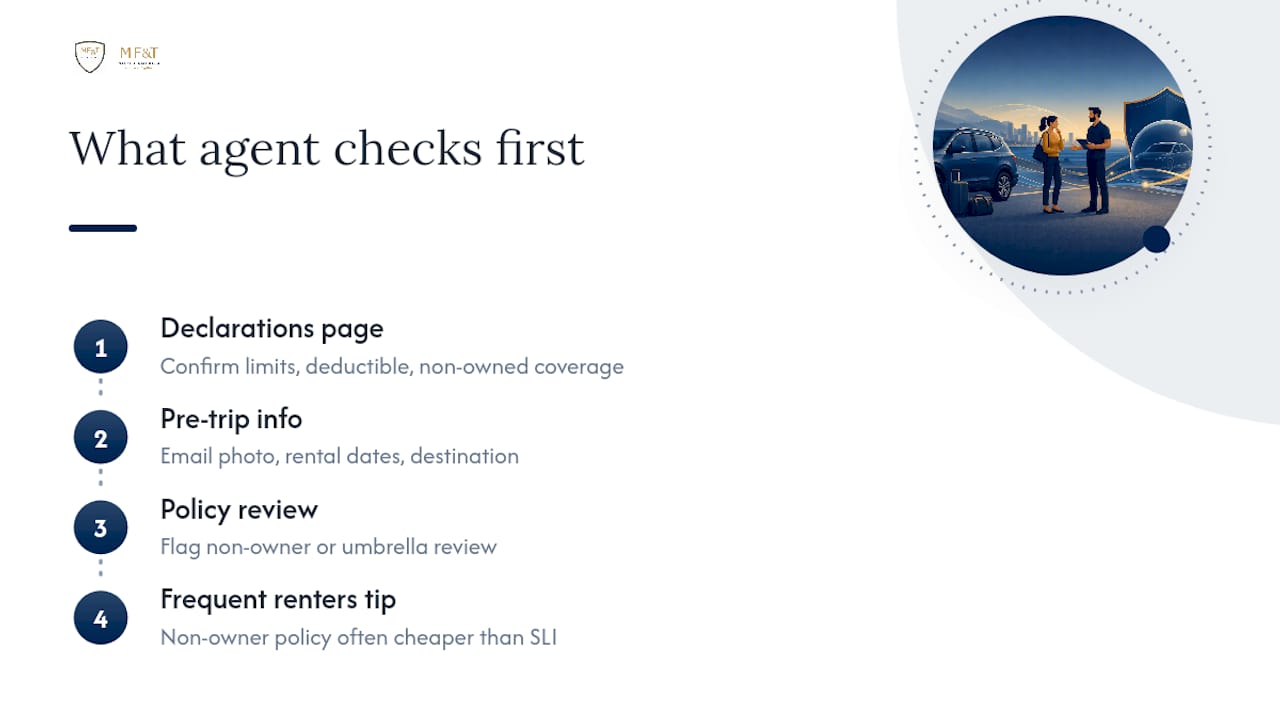
Every agent conversation about rental coverage starts in the same place: your declarations page. It's the fastest way to confirm your actual liability limits, your deductible, and whether non-owned vehicles are covered, rather than guessing based on what you remember signing up for.
If you want a fast pre-trip check, email your agent a photo of your declarations page along with your rental dates and destination. MF&T North America will flag whether a non-owner policy or umbrella review makes sense based on how often you rent and what your current limits actually cover.
Pro Tip: If you rent more than a few times a year and don't own a car, a non-owner policy usually costs less annually than paying for SLI on every single trip.
A Practical Take on Rental Coverage Decisions
Most drivers overthink the vehicle damage question and underthink liability. Full coverage with a low deductible makes CDW an easy skip, but too many renters assume that also means they're covered if they hurt someone else. Check your declarations page, call your card's benefits line, and when your liability limits look thin, buy the SLI. It's the cheapest insurance you'll ever regret not buying.
— Mike
Get Your Coverage Reviewed Before Your Next Trip
Reading your declarations page answers most rental coverage questions, but confirming what it actually means for your next trip takes a second set of eyes. MF&T North America reviews personal auto policies for Massachusetts drivers and surrounding states, checking your liability limits, deductible, and whether a non-owner or umbrella policy would close any gaps a rental exposes.
If your policy is liability-only, your deductible runs high, or you rent often without owning a car, a quick conversation can settle whether counter insurance, a non-owner policy, or an umbrella add-on fits your situation best. Request a free insurance quote from MF&T North America and get your auto coverage checked before your next rental, not after a claim forces the question.
Sources
- Do credit cards cover rental car insurance? — SoFi Learn
- Do I Need Supplemental Liability Insurance When Renting a Car? — LegalClarity
- Do My Car Insurance Cover Rental Cars? — Forbes Advisor (source excerpt)