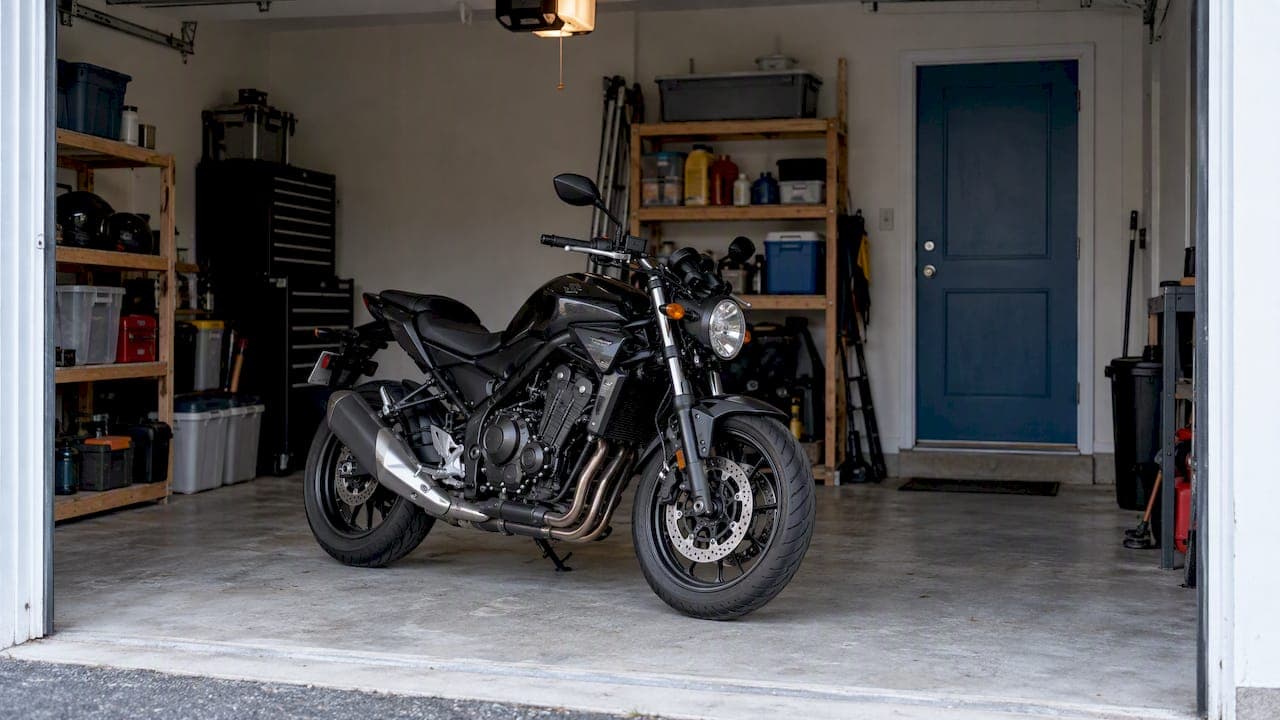
Motorcycle lay-up coverage is a temporary change to your policy for the months your bike is parked. You pause the coverages tied to riding, mainly liability and collision, and keep comprehensive in place for theft, fire, vandalism and other non-crash losses. It is not the same as canceling, and it only makes sense if the bike truly stays off the road until you restore full coverage in spring.
Below, we walk through what stays on, what comes off, the Massachusetts-specific traps, and a simple spring restart plan.
TL;DR
- Lay-up (or seasonal) coverage usually keeps comprehensive and suspends liability and collision, so it is only for a bike that is not being ridden, according to the Insurance Information Institute.
- Canceling outright leaves a parked bike exposed to theft, fire and storm damage, and can create a coverage gap or a registration problem.
- Not every carrier offers a formal lay-up policy. Some let you reduce coverages on the existing policy instead, so ask before you assume.
- In Massachusetts, a winter lay-up is a change to your insurance policy, not a state deregistration process.
- Before your first spring ride, restore full coverage, then check tires, battery, fluids and seals.
Table of Contents
- What motorcycle lay-up coverage actually is
- What stays on and what comes off
- Why not just cancel for the winter?
- Massachusetts: what to know before you pause anything
- Is lay-up coverage worth it for you?
- Your lay-up checklist
- Our perspective: ask the question before the first snowfall
- Get a second opinion on your motorcycle policy
- FAQ
- Sources
What motorcycle lay-up coverage actually is
Think of your motorcycle policy as a bundle of separate coverages. Each one answers a different question:
- Liability pays for injury or damage you cause to others while operating the bike.
- Collision pays for damage to your bike from a crash.
- Comprehensive pays for non-collision damage such as theft, fire, vandalism or a falling object, minus your deductible.
- Uninsured/underinsured motorist can respond when the other driver has too little insurance.
The Triple-I (Insurance Information Institute) explains that these coverages protect against different risks, and most states require only a minimum of liability. A lay-up keeps the coverage that protects the parked bike and pauses the ones built around riding.
That is why the idea works. Your bike is still worth something in the garage, so it still needs protection. What disappears while it sits is the risk of you causing or being in a crash.
What stays on and what comes off
The exact setup depends on your carrier and state. This table shows the usual pattern.
| Coverage | Typical lay-up status | Why |
|---|---|---|
| Comprehensive | Stays on | Parked bikes still face theft, fire, vandalism, storm damage |
| Liability | Usually suspended | Covers harm caused through operating the bike |
| Collision | Usually suspended | Tied to crash damage |
| Medical payments / injury coverage | Usually suspended | Tied to riding and passengers |
| Accessory / custom parts coverage | Often kept, confirm in writing | Chrome, paint and aftermarket parts can be limited unless covered separately |
Two cautions matter here. First, the III warns that customized parts may be limited unless you address them separately, so if you have added chrome, custom paint or a trailer, ask whether those stay covered during lay-up. Second, don't assume your homeowners policy picks up the slack. A home policy is not a substitute for motorcycle insurance, and its treatment of vehicles and parts is limited. If your bike lives in a garage or shed, your home and motorcycle policies should be reviewed together. Our home insurance page explains what we look at on the property side.
Why not just cancel for the winter?
It is a fair question, especially in New England, where many riders park their bikes from late fall until spring. Canceling feels logical. The trouble is what you give up.
- No protection against non-crash losses. A garage fire or a break-in does not wait for riding season.
- A lapse on your record. Gaps in coverage can affect how carriers price you later. Ask your agent how your carrier treats a lapse.
- A temptation to ride. A warm December Saturday can pull a bike out of storage. If your coverage is canceled, so is your protection on that ride.
- Financing rules. Massachusetts notes that a financed motorcycle will likely require comprehensive and collision. A lender will not be happy to hear the bike is uninsured.
- Possible registration consequences. In Massachusetts, insurance and plates are linked. If liability disappears from a bike whose plate is still active, the registry can be notified. Ask us or the RMV how to handle the plate before you drop anything.
Savings can also be smaller than you expect. Some carriers charge the same annual rate regardless of seasonal changes, which is one reason a comparison matters. Different carriers treat lay-up very differently, and that is where an independent agency helps. We shop multiple carriers, so we can check which ones offer a true lay-up or seasonal option for your bike.
Massachusetts: what to know before you pause anything
Massachusetts is a compulsory-insurance state. Per Mass.gov (June 17, 2025), motorcycle operators must carry bodily injury and property damage liability at the required minimum limits. Unlike private passenger auto, motorcycle personal injury protection (PIP) is not treated the same way, and the state advises riders to consider medical payments coverage (MedPay).
The state's motorcycle insurance regulation, 211 CMR 3.00, covers policy forms and exemptions from personal injury coverage. It does not set up a universal seasonal suspension program. In practice, a winter lay-up in Massachusetts is something you arrange with your insurer, not a form you file with the state.
That has two consequences:
- Ask your agent in writing which coverages are suspended, from what date, and what you must do to restart.
- Do not remove liability on a bike with an active plate without first asking how the registry will see it.
Riders in other states should check with their own state insurance department, because rules on required coverage and on registration differ.
MedPay, PIP and why the gap matters in spring
Because motorcycle PIP works differently from car PIP, many riders discover only after a crash that their auto policy never covered them on the bike. When you restore riding coverage in spring, it is a good moment to revisit medical payments. A Florida law office's explainer on MedPay versus PIP shows how the two kinds of first-party medical coverage differ and why subrogation can matter after a claim. It is written from a Florida perspective, so use it for the concept and ask your agent how it applies in your state.
For the car side of the same question, our guides on personal injury protection in Massachusetts and the $8,000 PIP limit are good background.
Is lay-up coverage worth it for you?
Use these questions to decide.
- Will the bike truly stay parked? If there is any chance you will ride in a mild spell, keep full coverage or pick a carrier that lets you restart in minutes.
- Is the bike financed? If so, check the lender's insurance requirements first.
- How valuable is the bike and its custom parts? The more you have invested, the more comprehensive matters.
- Where is it stored? A locked garage lowers risk but does not remove fire or theft exposure. A shared storage unit or an open carport raises it.
- What will you actually save? Ask for two quotes: your current policy and a lay-up or reduced version. If the difference is small, a higher comprehensive deductible may be an easier route.
If the numbers are close, the simplest option is often to keep the policy as it is and tune the deductible. If the savings are meaningful, a lay-up is a sound, low-risk move. The key is that you decide with real quotes, not guesses.
Your lay-up checklist
Before storage
- Call your agent and ask whether your carrier offers a lay-up or seasonal option, and what exactly it suspends.
- Confirm that comprehensive stays on, and that custom parts and accessories are still covered.
- Get the start date, end date and restart steps in writing.
- Store the bike following your owner's manual. Harley-Davidson, for example, notes that proper storage is important and that improper procedures can damage equipment. Check the manual for your own make.
- Keep the title, registration and policy documents somewhere safe.
Before the first ride
- Restore full coverage first. Do not ride on a lay-up policy. Get written confirmation that liability and collision are active again.
- Inspect the bike. Motorcycle News recommends checking tire condition, battery, fluids and seals before heading out. Look at tire pressure, battery condition, oil and coolant levels, and fork or shock seals.
- Start it and watch for leaks. Let it warm up as the manual says.
- Check your registration. Make sure your plate is valid and your documents are in order.
- Take a short first ride. Stay close to home while you re-learn the bike's feel and check that everything works.
A lay-up is not finished when the engine starts. It is finished when the bike is roadworthy and your coverage is back in force.
Our perspective: ask the question before the first snowfall
We have been helping riders, drivers and homeowners around Arlington, Lexington, Somerville and Waltham for over 30 years, and the same pattern repeats each fall. A rider calls in December wanting to "turn off" the bike. We slow things down and ask three questions. Is it financed? Is it going to sit in a locked garage? Will you be tempted to ride on a nice day?

Because we are an independent agency, we can compare carriers instead of offering one company's rule as if it applied everywhere. Some carriers have a clear lay-up option. Others simply let you raise a deductible or reduce certain coverages. A few treat a seasonal change as a cancellation with consequences. The right answer depends on your bike, your carrier and your plate status, which is why we would rather check than guess.
Our advice is simple. Keep comprehensive on. Get any change in writing. Never ride on a paused policy. And book your restart before the first warm weekend, not after.
— Mike
Get a second opinion on your motorcycle policy
If you are weighing a lay-up, the quickest way to see your real options is to ask us to review your current policy and compare carriers. We write motorcycle coverage for riders across the Boston area, and you can see how we approach it on our Lexington motorcycle insurance page or our checklist to avoid gaps in motorcycle coverage. When you are ready, request a quote and tell us the bike, where it is stored and when you expect to ride again.
FAQ
Is lay-up insurance the same as seasonal motorcycle insurance?
In everyday use, yes. Both terms describe coverage that keeps protection for a parked bike, usually comprehensive, while pausing riding-related coverage. Carriers use different names and rules, so ask yours how it defines the option.
Can I ride my motorcycle while it is on lay-up coverage?
No. Lay-up coverage is designed for a bike that is not being ridden, and liability and collision are typically suspended. Restore full coverage and get written confirmation before you ride, even for a short trip.
Do I need comprehensive on a motorcycle in storage?
It is the coverage that protects a parked bike from theft, fire, vandalism and similar losses, which is why the III describes it as separate from collision and liability. If your bike is financed, your lender will likely require it. If you own it outright, keeping it is still the safer choice for a bike you value.
Will pausing coverage in Massachusetts affect my plate?
It can. Massachusetts requires liability coverage when a motorcycle is operated, and insurance is tied to registration. Before you remove any coverage on a bike with an active plate, ask your agent and the RMV how the change will be handled.
Sources
- Motorcycle insurance, Triple-I (Insurance Information Institute)
- Get Your Motor Runnin', but first get your insurance needs sorted, Mass.gov
- 211 CMR 3.00: Motorcycle insurance, Mass.gov
- How to get your motorbike back on the road after a lay-up, Motorcycle News
- Harley-Davidson service information on storage
- MedPay vs PIP and subrogation, The Law Office of John Vernon Moore, P.A.