
Yes, but not through a standard policy in most cases. Your realistic paths are a surplus or excess-and-surplus (E&S) carrier, your state's FAIR plan, an HO-8 policy, or a conditional policy that locks you into a rewire deadline. Licensed-electrician inspection and clean documentation open more doors than you'd expect, but full rewiring remains the only route back to normal coverage and normal premiums.
TL;DR:
- Surplus and excess-and-surplus carriers can provide coverage quickly but often at higher premiums and with time-limited rewire requirements.
- State FAIR plans serve as a last-resort option with narrower coverage and are intended as temporary solutions, not permanent.
- Insurance eligibility improves significantly after completing a rewire, with standard HO-3 policies offering lower premiums and broader protection.
- Insurers generally refuse coverage for active knob and tube wiring due to fire risks from lack of grounding, degraded insulation, and amateur modifications.
- A detailed electric inspection and proper documentation are essential to qualify for full coverage and to meet rewire deadlines, especially when closing on a home.
Table of Contents
- Knob and Tube Insurance: Your Realistic Options Right Now
- Why Do Insurers Decline Knob and Tube Wiring?
- How Do You Get Insured With Knob and Tube Wiring?
- What Does It Cost to Fix or Insure Knob and Tube Wiring?
- Does Knob and Tube Wiring Affect Your Mortgage Closing?
- Why Work With an Independent Agent on Knob and Tube Coverage?
- The Real Priority Isn't the History Lesson. It's the Deadline.
- Get Help Insuring a Home With Knob and Tube Wiring
- Where to Check Next on Knob and Tube Coverage
- Sources
Knob and Tube Insurance: Your Realistic Options Right Now
If you're staring down a closing date or a nonrenewal notice, you don't have time for theory. You need to know what's actually available today. Here's the honest rundown of knob and tube coverage paths, ranked roughly by how fast you can get each one in place.
- E&S/specialty carriers: These "excess and surplus" insurers write policies that standard, admitted carriers won't touch. You'll usually get full coverage faster than through a standard company, but expect higher premiums, higher deductibles, and often a time limit before you need to rewire or requalify.
- State FAIR plans: Every state runs some version of a Fair Access to Insurance Requirements plan as a last-resort option. It satisfies a lender's minimum coverage requirement, but the protection is narrower than a standard homeowner's policy, and it's meant as a stopgap, not a permanent home.
- HO-8 policies: Written by admitted carriers specifically for older homes, HO-8 pays actual cash value or functional replacement cost rather than full replacement cost. It's a real option, just a more limited one.
- Conditional policies: Some admitted carriers will bind coverage if you sign off on a rewire within a set window, often 30 to 90 days. Miss that window and the policy can lapse.
An electrician's inspection report showing no insulation contact and no amateur splices can occasionally unlock a specialty program that would otherwise pass on the risk. It's not common, but it's worth requesting before you assume you're stuck with a FAIR plan.
Why Do Insurers Decline Knob and Tube Wiring?
Underwriters aren't being difficult for the sake of it. Knob and tube wiring, installed roughly between 1880 and 1940, lacks a grounding wire, and its rubber or cloth insulation degrades over decades. That combination raises fire risk substantially, especially where the wiring has been buried in modern blown-in insulation or spliced by a previous owner without a permit.
By the numbers: most standard admitted carriers simply won't write a policy on a home with active knob and tube wiring still in service, pushing homeowners toward surplus lines, specialty programs, or FAIR plans as the default alternatives.
A few specific triggers make underwriters especially nervous:
- Insulation contact: Modern attic insulation packed around old wiring traps heat and is a leading fire-risk flag.
- No grounding: Knob and tube circuits can't safely support grounded three-prong outlets or many modern appliances.
- Amateur splices: Decades of DIY additions, tape joints, and unpermitted extensions compound the risk far beyond the original installation.
- Occupancy and load: A home running space heaters, window units, and modern electronics on century-old circuits carries more risk than a lightly used vacation cottage.
Regional coverage isn't uniform, either. Reporting out of the Bay Area documented homeowners getting denied or canceled specifically over outdated wiring, a reminder that underwriting decisions can shift by carrier and by market.
How Do You Get Insured With Knob and Tube Wiring?
Getting from "no coverage" to "insured and closing on schedule" follows a fairly predictable sequence. Skip a step and you'll likely lose time you don't have.
- Order an insurance-focused electrical inspection. Ask the electrician specifically for photos of splices and panels, a statement on insulation contact, and a load assessment. A generic home inspection report usually isn't detailed enough for an underwriter.
- Disclose the wiring on every application. Never let a knob-and-tube system slide past an insurer unmentioned. Nondisclosure is grounds for a denied claim later, which is a far worse outcome than a higher premium now.
- Secure bridge coverage. An E&S policy or FAIR plan gets you to the closing table while you sort out a permanent fix.
- Get multiple rewire bids. Prices and timelines vary more than most homeowners expect, so shop at least three licensed electricians.
- Pull the permit and schedule the municipal final inspection. Skipping the permit to save money defeats the purpose. Insurers want to see the paper trail, not just the work.
- Collect your documentation package. Completion certificate, approved permit, final inspection sign-off, and dated photos are what convince an underwriter to re-evaluate you for standard coverage.
- Re-shop your policy with an independent agent. A comparing insurance quotes approach, run by someone with access to multiple carriers, usually beats calling one company directly.
Pro Tip: Ask your electrician to explicitly write "no insulation contact, no amateur splices, no overloaded circuits" in the inspection report if it's true. That exact language is what a handful of specialty programs look for before they'll even consider the file.
What Does It Cost to Fix or Insure Knob and Tube Wiring?
Budgeting starts with the inspection. An insurance-focused electrical inspection typically runs $100 to $500 and takes two to four hours, depending on the size of the home and how accessible the wiring is.
A full rewire costs considerably more and swings widely based on square footage, wall access, and finish repair after the electricians close everything back up. Partial rewires exist, but most carriers still want the whole system replaced before they'll write a standard policy. A house rewired room by room can end up costing more overall than doing it in one project.
- Inspection: $100–$500, same-day to a few days for the report
- Full rewire: wide range depending on home size, often a five-figure project
- Deadlines: conditional policies commonly require completion in 30–90 days
- Reward: many homes qualify for standard HO-3 coverage and a real premium drop after the rewire is documented
Does Knob and Tube Wiring Affect Your Mortgage Closing?
Lenders won't fund a purchase without proof of insurance, and that's where knob and tube wiring creates a genuine bind. You need coverage to close, but you might not qualify for standard coverage until the wiring is replaced, which you can't finish before closing either.
Buyers typically break that cycle with a bridge policy, an E&S plan, FAIR plan, or conditional binder that satisfies the lender's minimum coverage requirement on closing day.
- FHA and conventional appraisals may flag minimum service amperage and note wiring condition, which can slow approval
- Some buyers negotiate a seller credit tied to a signed rewire contract, then convert to standard coverage after the work is certified
- Missing a conditional policy's rewire deadline risks cancellation, lender notification, and complications at resale or refinance
Why Work With an Independent Agent on Knob and Tube Coverage?
Direct-to-consumer insurance shopping tends to hit a wall fast with knob and tube wiring, because most call centers only quote a handful of admitted carriers. An independent agent represents multiple carriers, including specialty and E&S markets that never show up in an online quote tool.
An experienced independent insurance agency with access to multiple states regularly navigates knob-and-tube homes scenarios for homeowners and buyers under closing deadlines.
Before you call an agent, bring:
- The licensed electrician's inspection report
- Any permit or municipal inspection documents already on file
- Dated photos of the panel, splices, and visible wiring
- Your closing date or lender's insurance deadline, if applicable
The Real Priority Isn't the History Lesson. It's the Deadline.
Most articles on knob and tube wiring spend paragraphs on when it was installed and why it was once considered adequate. None of that helps you close on a house next month. What actually matters is sequencing: get the inspection first, disclose everything, secure bridge coverage second, and start collecting rewire bids in parallel rather than waiting for a denial letter to force your hand.
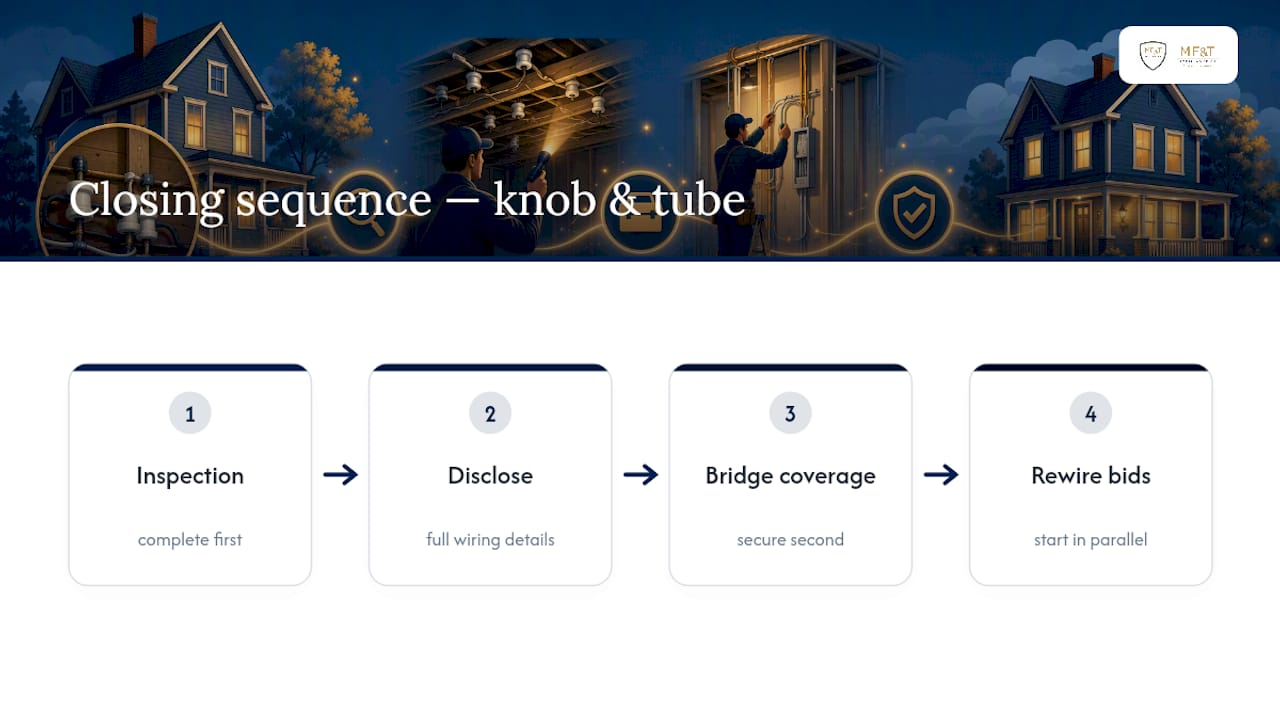
The conventional advice to "just rewire it" undersells how much lead time that takes, from bids to permits to a municipal final inspection. Homeowners who treat the electrician's report as a checkbox rather than a negotiating tool leave money and options on the table. A report that explicitly rules out insulation contact and amateur splices can occasionally get you into a specialty program most people assume doesn't exist.
If there's one habit worth adopting, it's re-shopping the policy the moment the rewire is certified. Too many homeowners stay on an expensive E&S plan for years past the point they qualified for something cheaper.
— Mike
Get Help Insuring a Home With Knob and Tube Wiring
Sorting through E&S carriers, FAIR plans, and conditional binders on your own eats time you probably don't have, especially with a closing date on the calendar. An independent agency can work these cases directly, shopping your risk across admitted, specialty, and surplus markets instead of quoting you from a single carrier's rate sheet.
Before you call, have your electrician's inspection report, any permit or final inspection paperwork, dated photos of the wiring, and your closing timeline ready. That package is what lets an agent move fast instead of starting from scratch. Request a no-obligation homeowners insurance quote and find out which carriers will actually write your home today, while you plan the rewire that gets you back to standard coverage.
Where to Check Next on Knob and Tube Coverage
- Your state FAIR plan website, to confirm last-resort coverage availability in your area
- Insure.com's guide to insuring older homes, for a plain explanation of carrier behavior
- A NACHI-certified inspector or NFPA guidance, for safety and inspection standards on aging wiring systems
This article is general information, not a substitute for advice from a qualified financial advisor. Consult a qualified financial professional about your own circumstances before acting on anything here.
Sources
- Insure
- Does Homeowners Insurance Cover Knob and Tube Wiring? - LegalClarity
- Insuring a Home With Knob and Tube Wiring