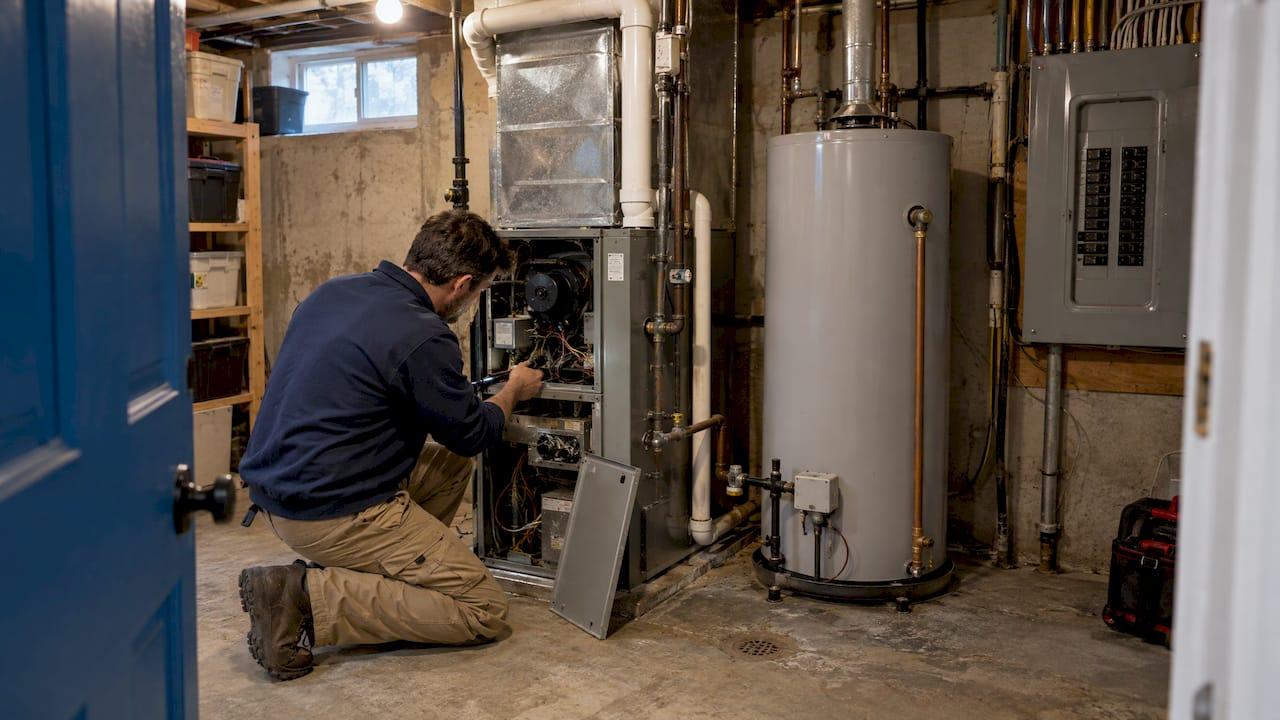
Equipment breakdown insurance pays to repair or replace equipment that fails suddenly because of a mechanical, electrical or pressure-system problem. It also pays for related losses such as spoiled food or lost business income. A standard property policy usually leaves most of that out. If you own a home, a building, or a business that depends on heating, cooling, refrigeration or computers, this is the coverage that fills the gap. As an independent agency in Arlington, MA, we review how your current home, business or builders risk policy handles equipment failure and shop carriers for options that fit.
TL;DR
- Equipment breakdown insurance (the modern name for boiler and machinery insurance) covers sudden, accidental failure of equipment, such as a power surge, a burned-out motor or a pressure vessel failure.
- Standard property policies and warranties often miss these causes, and they rarely pay for spoilage, lost income or extra restoration costs.
- Homeowners usually add it to an existing policy. Businesses and developers often need it for HVAC, elevators, refrigeration and production equipment.
- Wear and tear is not covered. Read the exclusions, limits and deductibles before you decide.
- Contractors and developers should check testing and equipment breakdown wording on any project with an elevator or central HVAC.
Table of Contents
- What equipment breakdown insurance is
- What counts as a breakdown
- Equipment breakdown coverage examples
- What the policy pays beyond the repair bill
- Why your current policies may not cover it
- Do you need it? A quick check for homeowners
- Do you need it? A quick check for businesses
- What equipment breakdown insurance usually excludes
- Contractors and developers: equipment breakdown on a project
- How to buy it well
- Our perspective
- Let us review your coverage
- FAQ
- Sources
What equipment breakdown insurance is
The term covers loss from the mechanical or electrical breakdown of nearly any type of equipment, from photocopiers to computers. It pays to repair or replace the equipment and any other property it damages. Business income and extra expense losses are often covered too.
If you searched for boiler and machinery insurance, you are in the right place. It is the same idea under an older name. Traditional boiler and machinery policies covered "accidents" to insured "objects" and relied on long technical definitions. Modern equipment breakdown policies use everyday words like "breakdown" and "equipment" and typically cover nearly all kinds of equipment. Insurers have been moving from the old name to the new one, and the new policies tend to be slightly broader.
The Washington State Department of Enterprise Services explains that the coverage handles physical and financial damage from accidental breakdown. Equipment is insured on a replacement value basis. The policy can also pay business income losses, expediting expenses to speed up restoration, and spoilage of perishable goods.
What counts as a breakdown
The word "sudden" matters. These policies respond to a failure that happens suddenly and accidentally, not to equipment that slowly wears out. The Washington DES FAQ lists the covered causes: short circuits and electrical arcing, power surges, mechanical breakdown, explosion, boiler breakdown, and bursting, cracking or splitting of covered machinery.
In plain terms, there are three families of breakdown:
- Electrical: a power surge fries a control board, or a short circuit burns out a motor.
- Mechanical: a part seizes, a belt or bearing fails, or centrifugal force tears a rotating component apart.
- Pressure system: a boiler, pressure vessel or similar equipment fails under pressure.
Normal wear and tear is not covered. A compressor that dies of old age is a maintenance problem. A compressor that fails because of a sudden electrical fault is a claim.
Equipment breakdown coverage examples
Examples show the coverage better than definitions do. These come from published insurance guidance.
Homes
One homeowners program reported a real loss in which a power surge damaged an insured's boiler and water heater controls, security system and media equipment. The loss came to $18,341. The same source lists covered household property including wine coolers, heat pumps, pool equipment, air conditioning systems, electrical panels, televisions and other appliances.
Another home program groups covered items by type. Air conditioners, furnaces, refrigerators, water heaters, security systems, smart home monitoring devices, pool equipment, personal computers and well pumps all appear on its list.
Think of a summer storm near Newton or Arlington. The grid flickers, a surge runs through the house, and the furnace control board, the refrigerator and the home office computer all fail in the same minute. Without breakdown coverage, you may be sorting out which item is covered under which policy. With it, one loss can be handled as a single event.
Businesses
Published small business examples follow the same logic:
- A manufacturing machine stops after a motor failure. Repair costs are covered, and lost income can be covered while the machine is fixed.
- A power surge damages a technology company's computer system.
- The air conditioning fails in a food distribution warehouse. Lost business income and spoiled stock can be covered.
The Washington DES FAQ lists the covered equipment categories: electrical systems, production and mechanical equipment, air conditioning and refrigeration, boilers and pressure vessels, business equipment, computers and other electronics, and communication systems.
What the policy pays beyond the repair bill
The repair or replacement bill is often the smaller part of a breakdown loss. For a business, the cost of sitting idle usually grows faster. Equipment breakdown policies can include:
| Cost | What it means for you |
|---|---|
| Repair or replacement | Fixing or replacing the failed equipment, and other property it damaged |
| Business income | Income lost while operations are slowed or stopped |
| Extra expense / expediting | The cost of rush shipping, temporary equipment or overtime to get running sooner |
| Spoilage | Food, medicine or materials lost when refrigeration or climate control fails |
| Additional living expenses (home policies) | Costs of living elsewhere when a home system failure makes the house unlivable, where the policy includes it |
Coverage also reaches beyond your own equipment. If a leased machine breaks or a vendor outage halts your operations, you still lose productivity and customers. Check whether your policy responds to these situations.
Why your current policies may not cover it
Most people assume a homeowners, commercial property or all-risk policy handles this. Often it does not.
Commercial property. Standard commercial property policies contain exclusions for mechanical breakdown, electrical injury to electrical devices (other than lightning damage), and steam and hot water equipment explosion. Those exclusions also remove coverage for the resulting loss of income and extra expense.
Homeowners. Basic homeowners policies contain specific exclusions for mechanical and pressure systems breakdown and typically limit electrical breakdown coverage. An equipment breakdown endorsement (an add-on to the policy) closes that gap.
Warranties and service contracts. The Washington DES FAQ notes these may miss common causes of breakdown. They do not pay for business interruption, spoilage, damage to surrounding property or extra restoration expense. A home warranty plan also usually covers only limited pieces of equipment, while home equipment breakdown coverage applies to all real and personal property in the home.
If you are also unsure how your belongings are covered, our guide to what personal property coverage means is a good companion read.

Do you need it? A quick check for homeowners
Count the systems you could not live without for a week. For most families that is the furnace or boiler, central air, water heater, refrigerator and freezer, and the electronics that run the house. In a New England winter, a heating failure is not an inconvenience. It can mean frozen pipes and a hotel stay.
Ask yourself:
- Do I have costly mechanicals, such as a heat pump, a boiler, a pool system or a well pump?
- Is there a lot of electronics in the house, including a home office?
- Would a surge or control-board failure strain my budget?
- Does my homeowners or condo policy say anything about mechanical or electrical breakdown?
If you answered yes to the first three, or you are not sure about the fourth, have a licensed agent read your policy with you. Our home insurance page covers homeowners, condo (HO-6), renters and valuable belongings coverage.
Do you need it? A quick check for businesses
An organization that depends on equipment to earn revenue likely needs this coverage. The Washington DES FAQ says businesses that heat, cool or refrigerate their premises, run communication networks, or use equipment to sell or deliver a service should consider it.
Organizations with steam boilers usually recognize the need on their own. Governments generally require such equipment to be inspected regularly, and insurance company boiler inspectors often perform those inspections. Some buyers purchase the coverage as much for the inspection as for the protection.
Typical candidates include restaurants and grocers with walk-in coolers, medical and dental offices, small manufacturers, offices with servers and phone systems, and property owners with elevators and central HVAC.
What equipment breakdown insurance usually excludes
Exclusions vary by policy, so read the list. The Washington DES FAQ shows what a typical program leaves out: structural portions of buildings, foundations, cabinets and compartments, insulating material, buried vessels or piping, waste and sewer piping, sprinkler and fire-suppression piping, vehicles and mounted equipment, satellites, excavation and construction equipment, equipment made by the insured for sale, and data. Deductibles and limits vary by equipment type, location and loss type.
Before you sign, confirm these points:
- Limit: is it enough to replace your most expensive system and cover a spoilage or income loss?
- Deductible: is there one amount for everything, or does it change by equipment or loss type?
- Valuation: is equipment replaced at replacement value?
- Spoilage and income: are they included, and at what limit?
- Leased equipment and outside vendors: does the policy respond?
- Wear and tear: how does the policy define a sudden breakdown?
Vehicles and mounted equipment fall outside this coverage. Your auto and commercial auto policies handle those, and our auto insurance page and business insurance page cover them.
Contractors and developers: equipment breakdown on a project
For builders, the question is different. Your own tools and machinery are one issue. The building's systems during construction and testing are another.
Lenders and investors often write this requirement into project insurance rules. One national housing investor's July 7, 2024 requirements for projects under construction call for equipment breakdown coverage on all properties with an elevator or central HVAC system. It must be provided for the total building value and include equipment (cold) testing. The deductible or self-insured retention must not exceed $25,000. These sit alongside builder's risk at 100% replacement cost.
Cold testing means running the building's systems before occupancy to confirm they work. A failure during testing is exactly the kind of loss that falls between policies if the wording is thin.

The Associated General Contractors of America advises owners and contractors reviewing an owner-placed builder's risk policy to check for full coverage for testing and equipment breakdown with no time limit or restriction. They should also review all exclusions, see whether catastrophe perils are sub-limited, and confirm adequate limits for delay costs.
A short checklist for a project:
- Read the loan or contract insurance requirements before you buy the builder's risk policy.
- Confirm equipment breakdown and testing coverage are in the policy, with no time cap.
- Match the deductible to the lender's maximum.
- Check that delay costs are covered for both owner and contractor.
- Make sure the coverage lines up with what happens at turnover, when the permanent property policy takes over.
Our builders risk insurance page covers single-project policies and term and reporting-form policies. Builders risk is our specialty, and we offer same-day binding on it. For your own machinery, read our guide on equipment coverage for US contractors.
How to buy it well
- List your equipment. Group it by value and by how long you could operate without it.
- Pull your current policies. Look for mechanical, electrical and pressure exclusions, and any equipment breakdown endorsement.
- Put a number on downtime. For a business, estimate a day of lost income and the stock that would spoil.
- Set limits and deductibles to match. Aim for a limit that covers your biggest single failure plus income and spoilage.
- Compare carriers. Wording differs, so compare what is actually included.
- Review at renewal. New equipment, a new cooler or an added HVAC unit changes the picture.
On a home policy, this coverage is usually an endorsement, so it is added to a policy you already have rather than bought on its own. Timing can matter too, as some programs add it only at new business or renewal. Ask your agent when it can take effect.
Our perspective
Most of the equipment breakdown claims people worry about come down to a gap nobody noticed. The homeowner thinks the policy covers a fried furnace board. The restaurant owner thinks property insurance covers a dead walk-in cooler. The developer assumes the builder's risk policy covers a failed system during testing. Then a loss happens and the exclusions get read for the first time.
That is why we start with the policy, not the price. As an independent agency, we are not tied to one carrier, so we can compare how different carriers word mechanical and electrical breakdown and recommend what fits your situation. For builders risk, we bind same day, so a project is not waiting on paper.
If you are a homeowner, bring your declarations page and a list of your big systems. If you build or own property, bring your lender requirements and your project schedule. We will go through it with you in plain language.
Mike
Let us review your coverage
MF&T North America is an independent insurance agency in Arlington, MA with over 30 years of experience. We help homeowners, families, contractors, property developers and small businesses across multiple states, with licensed agents who work directly with you. Whether you want to understand what your home policy does about a power surge, or you need a builders risk policy that fits a lender's requirements, we compare carriers and recommend coverage built around you.
Start with the page that matches your situation: builders risk insurance for projects, business insurance for commercial property and liability, or home insurance for your house or condo. You can also reach us through mfandtna.com.
FAQ
Is boiler and machinery insurance the same as equipment breakdown insurance?
In practice, yes. Boiler and machinery is the older name, and equipment breakdown is the modern one. Traditional policies relied on technical definitions of "accidents" to "objects," while current policies use plain terms and typically cover nearly all kinds of equipment. Ask your agent to explain the exact wording of any policy you are offered.
Does homeowners insurance cover a broken furnace or a power surge?
Not always. Basic homeowners policies often exclude mechanical and pressure system breakdown and limit electrical breakdown. An equipment breakdown endorsement is designed to cover that gap and can apply to the home's real and personal property. Review your policy, or ask a licensed agent to do it with you.
Does equipment breakdown insurance cover wear and tear?
No. It covers sudden and accidental breakdown, not normal wear and tear, so routine maintenance remains your job. Policies also exclude items such as structural parts of buildings, buried piping, vehicles and data, so check the exclusions list.
Does a warranty make equipment breakdown coverage unnecessary?
Not usually. Warranties and service contracts may miss common causes of breakdown, and they do not pay for business interruption, spoilage, surrounding property damage or extra restoration expense. Equipment breakdown coverage is designed to pay those costs.
Do contractors and developers need it on a project?
Often, yes. Lenders and investors commonly require it on projects with an elevator or central HVAC, including coverage for testing, within a set deductible limit. Confirm the requirement before the builder's risk policy is placed.
Sources
- Equipment breakdown insurance (IRMI definitions)
- Go Beyond the Basics with Equipment Breakdown Coverage (IRMI)
- Boiler and Machinery (Equipment Breakdown) FAQ, Washington State Department of Enterprise Services
- Homeowners Equipment Breakdown Coverage FAQ
- Home Equipment Breakdown fact sheet
- Minimum acceptable insurance requirements for projects under construction, July 7, 2024
- Owner-Placed Builder's Risk Insurance, Associated General Contractors of America, March 16, 2025