
Personal property coverage is the part of your homeowners, renters, condo, or manufactured-home policy that pays to repair or replace your belongings after a covered loss, up to your policy limit and minus your deductible. Insurers label it Coverage C in standard policy language. Your first move right now: pull out your declarations page, find the Coverage C limit, note any sublimits for valuables, and start a quick room-by-room inventory to see whether that number actually covers what you own.
A few things to know before you read further:
- Coverage C appears on homeowners, renters, condo, and manufactured-home policies. Renters choose their own limit; many homeowners policies set it automatically as a percentage of dwelling coverage.
- Valuation matters. Your policy pays either replacement cost value (RCV) or actual cash value (ACV). The difference can be hundreds of dollars on a single claim.
- Sublimits are real gaps. Jewelry, cash, and fine art often have separate, lower limits even when the overall Coverage C limit looks generous.
- Mfandtna offers free policy reviews to help you spot those gaps before a loss happens.
Pro Tip: Before your next renewal, photograph every room in your home and upload the images to a secure cloud folder. That five-minute task can save hours of paperwork after a claim.
Table of Contents
- How does personal property coverage work inside your policy?
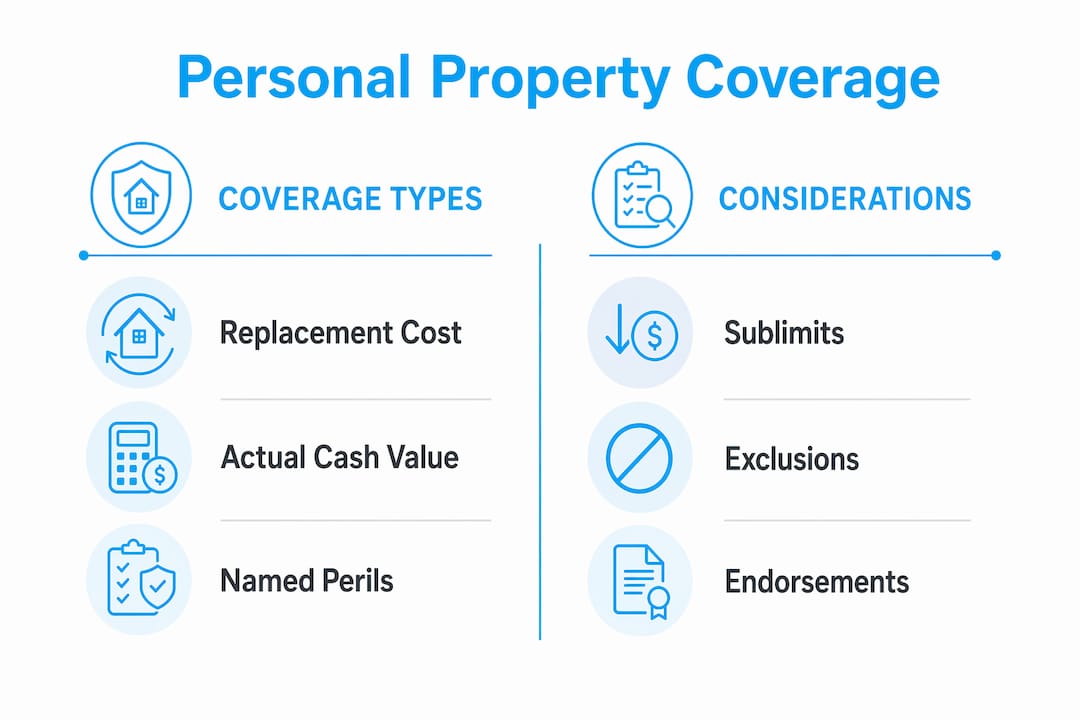
- What does personal property coverage actually cover?
- RCV vs. ACV: which valuation type does your policy use?
- What exclusions and sublimits should you watch for?
- When should you schedule personal property or add an endorsement?
- How much personal property coverage do you actually need?
- How do you file a personal property claim and what affects your payout?
- Named perils vs. open perils: what renters often get wrong
- Key Takeaways
- The coverage detail most people overlook
- Ready for a free policy review from Mfandtna?
- Useful sources
How does personal property coverage work inside your policy?
Coverage C sits alongside dwelling coverage (Coverage A) and liability (Coverage E) in a standard homeowners or renters policy. It is not a standalone product; it is one section of a broader contract, and understanding how it triggers a payout helps you avoid surprises.

Coverage triggers. Your insurer pays only when a loss is caused by a covered peril. Most standard policies use a named-perils approach, meaning coverage applies only for events explicitly listed: fire, theft, vandalism, windstorm, and a handful of others. If the peril is not on the list, the loss is not covered. Open-perils (all-risk) policies flip that logic and cover everything except what the policy explicitly excludes. Open-perils is broader but typically costs more.
Limits and deductibles interact directly. If your Coverage C limit is $50,000 and your deductible is $1,000, a $1,200 covered loss yields a $200 check. That math makes small claims economically questionable. Raising your deductible lowers your premium, but it also means more losses fall entirely on you. Learning how to read a homeowners insurance policy is the fastest way to find these numbers in your own documents.
"Personal property coverage pays to repair or replace belongings after covered events, up to policy limits and minus any deductible." — Progressive
Pro Tip: Open your policy and find two sections: the named-perils list and the exclusions section. Those two pages tell you more about your real coverage than the declarations page does.
What does personal property coverage actually cover?
The short answer: most things you own and use daily. The longer answer involves a few important caveats around where items are located and how much the policy will pay for specific categories.
Typical covered items include:
- Furniture, sofas, beds, and dining sets
- Clothing, shoes, and accessories
- Electronics: laptops, TVs, tablets, gaming consoles
- Kitchen appliances not built into the home
- Sports equipment, bicycles, and outdoor gear
- Children's toys and baby equipment
- Books, musical instruments, and hobby supplies
Away-from-home coverage is one of the most underused features in a standard policy. Your belongings are often covered away from home, so a laptop stolen at a coffee shop or luggage damaged during travel may qualify for a claim. Coverage can even extend worldwide in some policies. That said, insurers frequently cap away-from-home recoveries or apply separate limits for property in storage or carried by travelers, so check your policy's off-premises provision before assuming full protection applies.
Two quick scenarios:
- Stolen laptop at a coffee shop: Usually covered under theft, subject to your Coverage C limit and deductible, and any sublimit for electronics your policy carries.
- Flood-damaged furniture: Almost always excluded from a standard policy. Flood losses require a separate flood insurance policy, typically through the National Flood Insurance Program or a private carrier.
Sublimits are where coverage for personal belongings quietly shrinks. Jewelry, cash, fine art, and business equipment commonly carry their own lower dollar caps even when your overall Coverage C limit is high. A $50,000 Coverage C limit with a $1,500 jewelry sublimit means a stolen engagement ring worth $8,000 pays out $1,500 before the deductible. See real-life examples of how these limits play out in renters insurance claims.
RCV vs. ACV: which valuation type does your policy use?
The valuation method your policy uses determines how large your claim check actually is. This single detail can mean the difference between replacing an item and receiving a fraction of its cost.

Replacement cost value (RCV) and actual cash value (ACV) work very differently:
| Feature | Replacement Cost Value (RCV) | Actual Cash Value (ACV) |
|---|---|---|
| How it pays | Replaces item with a similar one at current prices | Pays replacement cost minus depreciation |
| Depreciation deducted? | No | Yes |
| Payout on a 5-year-old $1,200 TV | ~$1,200 (current price) | Potentially hundreds of dollars after depreciation |
| Premium impact | Higher premium | Lower premium |
| Best for | Maximizing recovery after a loss | Keeping monthly costs down |
RCV policies often require you to actually replace the item before releasing the full payment. The insurer may issue an initial ACV check, then pay the remaining "recoverable depreciation" once you submit a receipt for the replacement. Read your policy's claims payment section carefully to understand this two-step process.
Pro Tip: Search your policy for the words "replacement cost" or "actual cash value." If neither phrase appears clearly in the personal property section, call your agent and ask directly — the answer changes your entire claims strategy.
What exclusions and sublimits should you watch for?
Standard personal property coverage has real gaps. Knowing them ahead of time lets you close them before a loss, not after.
Common exclusions that apply to most standard policies:
- Flood damage: Requires a separate flood policy. Standard homeowners and renters policies do not cover rising water. For a full breakdown of what storms and floods do and don't cover, see floods, fires, and storms coverage explained.
- Earthquake damage: Also excluded from standard policies; a separate earthquake endorsement or policy is needed.
- Wear and tear: Gradual deterioration, rust, mold, and mechanical breakdown are not covered events.
- Intentional loss: Damage you cause on purpose is never covered.
- War and nuclear hazard: Standard exclusions in virtually every policy.
Typical sublimits to check in your policy's Schedule of Limits or Special Limits of Liability:
- Jewelry, watches, and furs: often $1,500–$2,500
- Cash and gift cards: commonly $200–$500
- Silverware and goldware: frequently $2,500
- Business property kept at home: often $2,500 or less
- Fine art and collectibles: varies widely
The fix for most sublimit gaps is straightforward. A scheduled property endorsement, a personal articles floater, or a separate policy for high-value collectibles raises your effective limit for those items. For a detailed look at what a standard homeowners policy excludes, the home insurance exclusions list covers 14 common gaps worth reviewing.
Pro Tip: Pull your policy's "Special Limits of Liability" table and compare each category to what you actually own. If any single item exceeds the sublimit, you have a coverage gap today.
When should you schedule personal property or add an endorsement?
Scheduling an item means listing it individually on your policy with its own specified limit, usually based on a recent appraisal. It removes the sublimit constraint for that item and often provides broader coverage, including mysterious disappearance (loss without a known cause), which standard policies typically exclude.
When scheduling makes sense:
- A piece of jewelry exceeds the policy's sublimit (commonly $1,500–$2,000)
- You own collectibles, fine art, or musical instruments with significant market value
- You carry expensive camera or photography equipment regularly
- You have a coin, stamp, or sports memorabilia collection
What you need to schedule an item:
- A recent appraisal from a certified appraiser (required for most jewelry and art)
- Original receipts or purchase records
- Serial numbers for electronics and instruments
- Photographs showing condition
The trade-off is straightforward: you pay a higher premium, and you provide documentation upfront. In exchange, you get a higher payout ceiling and fewer coverage surprises at claim time. A personal articles floater works similarly and can cover multiple items under one endorsement rather than scheduling each piece separately.
How much personal property coverage do you actually need?
The right Coverage C limit is the one that matches the total replacement value of everything you own. Getting there takes a home inventory, not a guess.
- Go room by room. Start with the most valuable rooms (living room, bedroom, kitchen) and list every item you would need to replace if the home were destroyed.
- Record purchase dates and estimated replacement costs. Use current retail prices, not what you paid years ago.
- Photograph or video each room. Walk slowly and capture serial numbers on electronics and appliances.
- Add up the totals. Most people are surprised how quickly furniture, clothing, and electronics accumulate past $30,000–$50,000.
- Compare to your Coverage C limit. If your inventory total exceeds the limit, you are underinsured. If it is well below, you may be overpaying for coverage you do not need.
- Check sublimits separately. Even if your total Coverage C limit is adequate, a single high-value item can exceed its category sublimit.
- Update annually and after any major purchase: new appliances, furniture, jewelry, or electronics.
Many homeowners policies set personal property at 50%–70% of dwelling coverage as a default. If your dwelling is insured for $300,000, your Coverage C might default to $150,000–$210,000. That may be more than enough, or it may fall short if you own high-value items concentrated in a few categories. Renters pick their own limit entirely, so the inventory step is especially important for tenants. The Insurance Information Institute provides a home inventory guide with templates to make this process faster.
How do you file a personal property claim and what affects your payout?
Acting quickly and documenting thoroughly after a loss directly affects how much you recover. Here is what to do.
Immediately after a loss:
- Confirm everyone is safe and call emergency services if needed.
- Stop further damage when you can safely do so (cover a broken window, move items away from water).
- Photograph and video the damage before touching or moving anything.
Documentation to collect:
- Police report for any theft or vandalism
- Receipts, serial numbers, and model numbers for damaged or stolen items
- Appraisals for jewelry, art, or collectibles
- A written itemized list of every damaged or missing item with estimated values
How deductibles affect your payout. The formula is simple: insurer payout equals the covered loss amount (RCV or ACV) minus your deductible, minus any applicable sublimit. If your laptop is stolen and valued at $1,800 RCV, your deductible is $500, and there is no electronics sublimit, you receive $1,300. If a jewelry sublimit of $1,500 applies to a $3,000 ring, the insurer pays $1,500 minus the deductible. Raising your deductible reduces your premium but increases your out-of-pocket exposure on every claim.
Pro Tip: Keep digital copies of receipts, serial numbers, and appraisals in a cloud storage account separate from your home network. If your home is destroyed, those records survive.
Named perils vs. open perils: what renters often get wrong
Two distinctions trip up homeowners and renters more than almost any other policy detail.
Named perils vs. open perils:
- Named-perils policies cover only the events explicitly listed: fire, lightning, windstorm, hail, theft, vandalism, and a few others. If the cause of loss is not on the list, the claim is denied.
- Open-perils (all-risk) policies cover every cause of loss except those the policy explicitly excludes. The burden shifts: instead of proving the peril is listed, the insurer must prove an exclusion applies.
- Open-perils coverage is broader but usually costs more and is often recommended for homeowners with higher-value belongings who want fewer coverage surprises.
The renter misconception that costs people real money:
Many renters assume their landlord's policy covers their personal belongings. It does not. A landlord's policy covers the building structure and common areas only. If a pipe bursts and destroys your furniture, your landlord's insurer has no obligation to pay you a cent. You need your own renters insurance policy to protect your belongings, and the cost is typically very affordable relative to the coverage provided.
Pro Tip: If you rent, ask your landlord what their policy covers and get your own renters policy regardless of the answer. The two policies serve completely different purposes and do not overlap.
Key Takeaways
Personal property coverage (Coverage C) pays to replace your belongings after a covered loss, and the valuation type, sublimits, and deductible in your policy determine how much you actually receive.
| Point | Details |
|---|---|
| Coverage C definition | Pays to repair or replace belongings after covered perils, up to your policy limit minus your deductible. |
| RCV vs. ACV | RCV replaces at current prices; ACV subtracts depreciation and pays less for older items. |
| Sublimits create gaps | Jewelry, cash, and fine art often have separate lower limits even when your overall Coverage C limit is high. |
| Home inventory is the baseline | A room-by-room inventory is the only reliable way to set the right Coverage C limit. |
| Mfandtna policy review | Mfandtna reviews your Coverage C limits, sublimits, and endorsement gaps to help you close coverage holes before a loss. |
The coverage detail most people overlook
Most conversations about personal property coverage focus on the limit. The number on the declarations page feels concrete and reassuring. What gets less attention is the combination of valuation type, sublimits, and named-perils restrictions that quietly shape what you actually receive after a loss.
A $100,000 Coverage C limit sounds like strong protection. But if the policy pays ACV on a home full of furniture and electronics that are five to ten years old, the depreciated payout on a total loss could be a fraction of what replacement actually costs. Add a $1,500 jewelry sublimit on a household with several thousand dollars in rings and watches, and the gap widens further. The limit is the ceiling; the valuation method and sublimits determine the floor.
The named-perils vs. open-perils distinction deserves more attention than it typically gets. Most standard policies are named-perils for personal property, which means a water damage scenario that falls outside the listed perils (say, a slow leak rather than a sudden burst) may be denied even when the damage is obvious. Reading the perils list once, carefully, is worth more than any amount of premium comparison.
The renter misconception is the most consequential misunderstanding in personal property insurance. Renters who believe their landlord's policy protects their belongings are entirely uninsured for personal property losses. A fire, a theft, a burst pipe — none of those events trigger a payout from the building owner's policy for the tenant's possessions. Renters insurance is inexpensive relative to the risk it covers, and the homeowners insurance basics framework applies directly to renters policies as well.
Ready for a free policy review from Mfandtna?
If reading this article made you realize you are not sure what your Coverage C limit is, whether you have RCV or ACV, or whether your jewelry and electronics are adequately covered, that is exactly the conversation Mfandtna is built for.
Mfandtna is an independent insurance agency with over 30 years of experience helping homeowners and renters across multiple states find coverage that actually fits their lives. Because Mfandtna works with multiple carriers, the agency compares options on your behalf rather than steering you toward a single insurer. A policy review costs you nothing and takes less than an hour.
Before you reach out, have these ready:
- Your current declarations page (the one-page summary of your policy limits)
- A rough home inventory total or a list of high-value items
- Receipts or appraisals for any jewelry, art, or collectibles you own
- A list of major purchases made since your last policy renewal
Request a free quote or visit the homeowners insurance page to start a policy review today. Your information stays confidential, and there is no obligation to switch.
Useful sources
The following authoritative resources informed this guide and are worth bookmarking for your own policy research:
- Personal Property Insurance for Homeowners and Renters — NerdWallet's consumer explainer covering Coverage C, named vs. open perils, sublimits, and away-from-home coverage.
- What Is Personal Property Coverage? — Progressive's plain-language overview of how covered losses, limits, and deductibles interact.
- How to Create a Home Inventory — Insurance Information Institute guide with templates for documenting belongings room by room.
- Homeowners Insurance Basics — Insurance Information Institute overview of policy structure, Coverage C placement, and standard exclusions.
- What Is Personal Property Insurance? — U.S. News consumer breakdown of coverage types, valuation methods, and endorsement options.
- Home Insurance Policy Exclusions List — Mfandtna's guide to 14 common exclusions in standard homeowners policies.
- Renters Insurance Coverage Examples — Partner resource illustrating how renters coverage applies to tenant belongings and common claim scenarios.