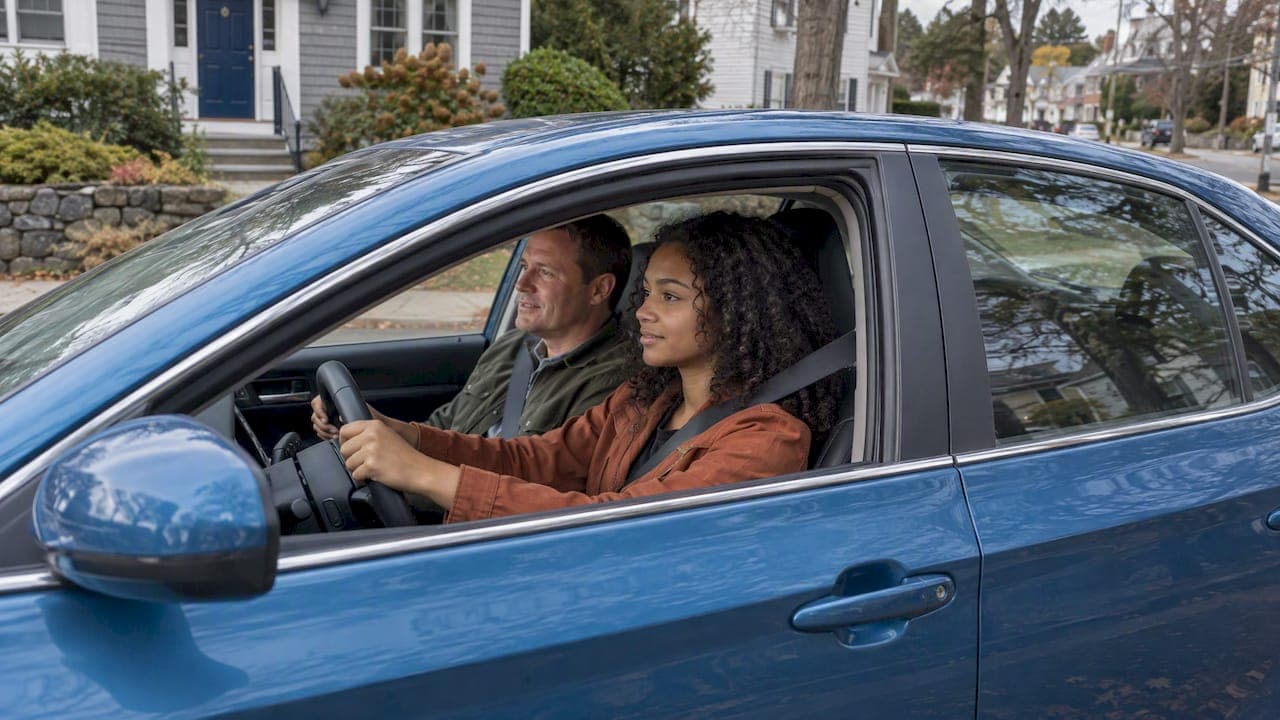
When your teen gets a license, your auto insurance bill goes up, often by a lot. In most cases the cheapest route is to add your teen to your own policy instead of buying a separate one. Then you review your coverage limits, ask for every discount you qualify for, and compare quotes that match line for line. This guide walks through each step, with Massachusetts rules where they apply.
TL;DR
- Adding a teen to a parent's policy usually costs less than a separate policy for the teen.
- Teens carry the highest crash risk of any age group, which is why the young driver surcharge exists.
- In Massachusetts, you must tell your insurer within 60 days of your teen getting licensed.
- Good-student, multi-car, student-away-at-school and telematics discounts can help, but insurers choose whether to offer them, so ask.
- Compare quotes with identical limits, and review your coverage before your teen starts driving alone.
Table of Contents
- Why teen driver insurance costs so much
- How much does it cost to insure a teen driver?
- Add your teen to your policy or buy a separate one?
- What the law requires in Massachusetts
- Coverage to review before your teen drives
- Discounts that can lower the bill
- How to compare teen insurance quotes
- Our perspective: what we see families miss
- Get a teen driver quote with MF&T North America
- Habits that keep teen rates from climbing
- FAQ
- Sources
Why teen driver insurance costs so much
Insurance is priced on risk. New drivers are the riskiest group. The Washington State Office of the Insurance Commissioner says new teen drivers are expensive to insure because they have the highest crash risk of any age category and very little driving experience.
That is the idea behind what readers call the young driver surcharge. It is not usually a separate line item. It is built into the rate your insurer calculates once a young, inexperienced driver is on the policy. The New York Department of Financial Services explains that young drivers have historically had poorer loss experience, and higher rates make them pay their fair share so older drivers are not asked to subsidize them.
So the increase is not a penalty for anything you did. It reflects how often drivers your teen's age file claims. If you want to understand the kinds of situations behind those numbers, this look at the common causes of teen car accidents shows why inexperience matters so much on the road.
Two things can soften the blow. Rates tend to ease as your teen builds a clean record, and the discounts and coverage choices below can narrow the gap now.
How much does it cost to insure a teen driver?
The honest answer is a range. Your price depends on your teen's age and gender, your ZIP code, the car, your coverage limits, your household's claims history and the insurer. Published averages give you a sense of scale, not a quote.
| What is being measured | Figure | Source |
|---|---|---|
| Teen added to a parent's full-coverage policy (the increase in premium, nationwide) | $4,515 a year | Insurance.com, updated August 2026 |
| A 16-year-old on their own full-coverage policy | $10,387 a year | Insurance.com, updated August 2026 |
| Average for teens ages 16 to 19 in Massachusetts | $5,299 a year | Insure.com |
A few takeaways from those numbers:
- A separate policy is the expensive option. The gap between the first two rows is more than double.
- Those are averages. Plenty of families pay less, and some pay more, especially with a sports car, a poor driving record or a high-claim ZIP code.
- Massachusetts is not cheap for teens. The state average sits well above $5,000 a year in that estimate.
If $200 a month feels like a lot for car insurance, the useful question is what it covers and what it would cost after you shop. A teen on the policy can easily push a household past that number. Whether it is reasonable depends on your limits, deductibles, vehicles and drivers, not on one figure.
What moves the price most
- Age and experience. A 16-year-old usually costs more than an 18-year-old, and an 18-year-old more than a 21-year-old.
- The car. A car's age, make and model affect premiums. The Washington insurance commissioner notes that an older, cheaper car is not necessarily safer or cheaper to insure.
- Coverage you choose. Higher limits cost more. Collision and comprehensive on a car worth little may not be worth the price.
- Driving record. One ticket on a new driver's record can matter more than several on a veteran's.
- Discounts. These can offset part of the increase. More on those below.
Add your teen to your policy or buy a separate one?
For most families, adding the teen is the better deal. Consumer Reports reports that it usually costs less to add a teenager to an existing policy than for the teen to have their own.
There are practical reasons as well:
- You keep your multi-car and bundling discounts.
- Your teen gets the benefit of your higher liability limits.
- You see exactly what is covered and can fix gaps.
- You keep control of the policy while your teen is still learning.
A separate policy can make sense for an older young adult who lives independently and owns their own car. For a teen living at home, it rarely does.
What if your teen only has a learner's permit?
Policies and rules vary by insurer, so do not assume anything. Call your agent when your teen gets a permit, not after the license arrives. Ask how a permit holder is treated and what changes the day the license is issued.
What the law requires in Massachusetts
If you live in Massachusetts, the state sets rules that touch both licensing and insurance.
Tell your insurer within 60 days
Mass.gov states that when a teen gets a license, you or your parents must notify your insurance company within 60 days. All licensed household members, and other licensed people who customarily operate your vehicle, must be listed on the policy. Do not wait and hope it does not come up. An unlisted driver is a problem if there is a claim.
Minimum limits
As of July 1, 2025, the mandatory minimums in Massachusetts are:
| Coverage | Minimum |
|---|---|
| Bodily injury to others | $25,000 per person, $50,000 per accident |
| Uninsured auto | $25,000 per person, $50,000 per accident |
| Property damage | $30,000 per accident |
| Personal Injury Protection (PIP) | $8,000 |
Minimums are a legal floor, not a recommendation. If you want to see how those numbers play out at renewal, our guide to 25/50/30 minimums in Massachusetts covers what to check.
Junior Operator restrictions
Massachusetts drivers under 18 fall under the Junior Operator Law. According to the Massachusetts Driver's Manual:
- Night driving: not allowed from 12:30 a.m. to 5:00 a.m. unless a parent or guardian is in the vehicle.
- Passengers: for the first six months, no one under 18 in the vehicle, unless they are an immediate family member, unless a supervisor who is 21 or older is also in the vehicle.
- Penalties: a first violation of the passenger or night restrictions brings a 60-day license suspension, 180 days for a second and one year after that.
A suspension is a bigger insurance problem than a ticket. Talk through these rules with your teen before the first solo drive.
Coverage to review before your teen drives
The Washington commissioner's guidance is to review your limits and consider increasing them before a teen starts driving. The reasoning is simple: a new driver is more likely to be in a crash, and a crash can cost more than a minimum policy pays.
Here is what each main coverage does, in plain terms:
- Liability pays for injury and damage you or your teen cause to other people. This is the coverage that protects your savings and your future income.
- Collision pays to repair or replace the car your teen drives after a crash, minus your deductible.
- Comprehensive covers things like theft, fire or a tree falling on the car.
- Uninsured and underinsured motorist coverage protects you when the other driver cannot pay.
- Personal Injury Protection (PIP) helps with medical bills and certain lost wages for you and your passengers, whoever is at fault.
Think about an umbrella policy
If your family has a home, savings or a growing income, a serious teen-at-fault crash could exceed your auto liability limit. A personal umbrella policy adds liability protection on top of your auto and home policies. Ask your agent whether it makes sense for your household before your teen starts driving alone. You can read more on our auto insurance page, and our auto coverage types guide explains each coverage in more depth.

Choose the car carefully
Parents often assume the cheapest, oldest car is the smart pick. That is not always true. An older car may lack modern safety features, and it is not automatically cheaper to insure. Before you buy, ask your agent to price two or three vehicles for your teen. It takes minutes and can save you real money.
Discounts that can lower the bill
Mass.gov points out that Massachusetts insurers are permitted, but not required, to offer a range of discounts: multi-car, bundling with home or renters insurance, good student, student away at school, and usage-based or telematics programs. Because insurers decide whether to offer each one, the lesson is to ask, and to shop around.
Here is a checklist to take to your agent:
- Good student. Bring your teen's latest report card or transcript.
- Student away at school. If your teen goes to college without a car, tell your insurer.
- Multi-car. Ask what changes if the teen's car goes on the same policy.
- Bundling. Ask about pairing auto with home, condo or renters coverage. Our home insurance page lists those options.
- Usage-based programs. A telematics app tracks braking, speed and phone use. A careful teen may earn a discount. A careless one may not, so talk to your teen first.
- Driver training. Some insurers give a discount for a completed driver education or defensive driving course. Ask whether yours does.
- Higher deductible. This lowers your premium, but only choose a deductible you could pay tomorrow without strain.
For more ideas, see our guide to reducing car insurance for young drivers, and our overview of what affordable auto insurance really means.
How to compare teen insurance quotes
A low price means little if the coverage underneath is thinner. Mass.gov advises comparing quotes by making sure each one reflects exactly the same coverage limits, so you get an apples-to-apples comparison. It also suggests weighing the insurer's reputation for handling claims, the agent's location and the company's financial health, not only the premium.
A simple process:
- Write down your current limits and deductibles. Use them as the baseline.
- Decide on any changes first. If you plan to raise liability limits for your teen, request that figure from every insurer.
- Give everyone the same information. Mass.gov recommends consistent details across insurers, including vehicle VINs and driver license details.
- List every discount you expect. Then check each quote shows it.
- Look beyond price. A cheaper quote that comes from a company with a poor claims record is not a bargain.
- Ask who you will call after a crash. Having a licensed agent who knows your policy matters when you are standing on the roadside.
Our perspective: what we see families miss
We work with Massachusetts families as an independent agency, which means we are not tied to one insurance company. That lets us shop your household across several carriers and show you the differences side by side, instead of handing you one company's number.

When a teen gets a license, three things tend to go wrong. First, families wait too long to report the new driver. Second, they focus entirely on price and never look at liability limits. Third, they treat the quote as fixed, when changing the car, the deductible or the discounts can change the total a great deal.
Our advice is to call before the license test, not after it. Bring the teen's school report, the car you are considering and your current declarations page. We will help you compare options with the same limits so you can see what you are really paying for. There is no pressure to buy. The goal is that you understand your choices and feel confident in the one you make.
— Mike
Get a teen driver quote with MF&T North America
If you are adding a new driver, we can review your current policy, price different cars and limits, and check which discounts apply. Our licensed agents handle auto coverage along with home, condo and renters insurance, so bundling is easy to evaluate.
Start on our auto insurance page, or request a free quote and tell us about your teen, your vehicles and your current coverage.
Habits that keep teen rates from climbing
The premium is not fixed once the teen is on the policy. What happens next matters.
- Set a family driving agreement. Cover phone use, seat belts, passengers, and night driving, including the legal limits for Massachusetts Junior Operators.
- Review each year. Rates tend to ease as your teen builds a clean record, so ask your agent to reprice at every renewal.
- Keep the grades up. The good-student discount can follow a teen through school, if your insurer offers it.
- Report changes. A teen heading to college, a new car or a move to a different address can all change the rate.
- Avoid small claims when you can. Talk to your agent before filing something that costs barely more than your deductible.
FAQ
What is the cheapest way to insure a 17-year-old?
Usually, add them to your existing policy instead of buying a separate one, because that tends to cost less. Then choose a modest, safe car, ask for good-student and other discounts, and compare quotes with identical limits. An independent agent can run that comparison across several carriers.
Is a young driver surcharge a separate fee?
Not normally. It is the higher rate insurers charge because young drivers have historically had worse loss experience than older drivers. It shows up as a larger premium once the teen is added. Rates typically ease with age and a clean record.
Why is insurance for 18-year-olds still so expensive?
An 18-year-old is still a new driver with limited experience, and that group has the highest crash risk of any age category. Insurers price that risk even when the teen's own record is spotless. A clean record, discounts and a sensible car are your best tools.
How soon do I have to add my teen after they get a license in Massachusetts?
Mass.gov says you or your parents must notify your insurer within 60 days of getting licensed. Licensed household members and others who regularly drive your vehicle must be listed. Many families call earlier, so the rate is settled before the first solo drive.
What car is cheapest to insure for a new driver?
There is no single answer, because a car's age, make and model all affect premiums, and an older, cheaper car is not necessarily cheaper to insure. Ask your agent to price two or three candidates before you buy. Safety features matter as much as sticker price.
Sources
- Everything You Need to Know About Teen Car Insurance, Consumer Reports
- Auto coverage for teen drivers, Washington Office of the Insurance Commissioner
- Why are auto insurance rates higher for younger drivers?, New York Department of Financial Services
- Teenage car insurance average cost calculator, Insurance.com
- Estimate Teen Car Insurance Costs in Massachusetts, Insure.com
- Tips For Teen Driving, Mass.gov
- Massachusetts Consumer Bill of Rights for Automobile Insurance, Mass.gov
- Massachusetts Driver's Manual, Mass.gov
- Auto Insurance: How Asking about Discounts Might Help Save You Money, Mass.gov
- Basics of Auto Insurance, Mass.gov
- Common Causes of Teen Car Accidents