
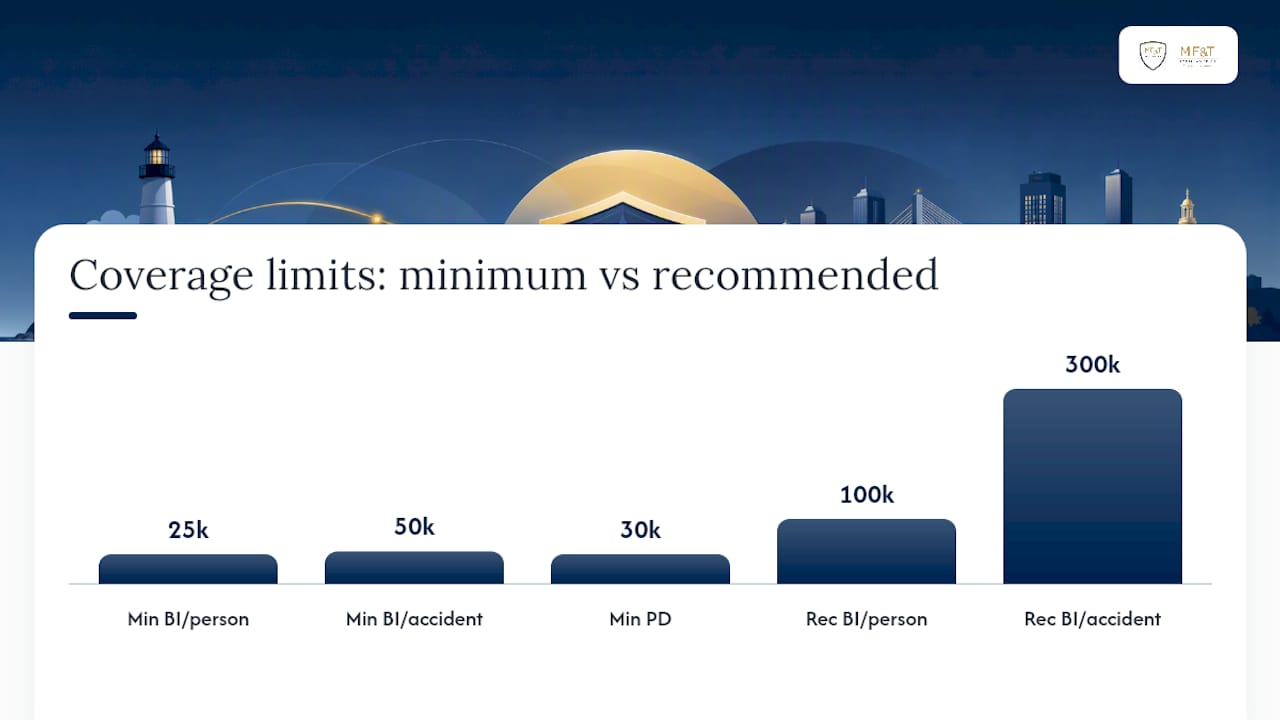
Massachusetts requires 25/50/30 liability coverage plus $8,000 PIP and 25/50 uninsured motorist protection for any policy written or renewed on or after July 1, 2025. That breaks down to $25,000 in bodily injury coverage per person, $50,000 per accident, and $30,000 in property damage per accident. These numbers replace the old, much thinner 20/40/5 minimums. They're the legal floor, not a safety net, and plenty of Massachusetts drivers are still underinsured even after meeting them.
TL;DR:
- Drivers with policies renewing after July 1, 2025, must meet the new minimums of 25/50/30 liability coverage, replacing the previous 20/40/5 limits.
- Property damage liability increased from $5,000 to $30,000, and bodily injury coverage rose from 20/40 to 25/50, with uninsured motorist limits now matching bodily injury limits.
- Failing to update or maintain the required coverage can result in fines up to $5,000 and license suspension, especially for drivers without insurance or on canceled policies.
- Minimum coverage limits are often insufficient for expensive vehicles or assets, so upgrading to higher limits or adding umbrella policies is advisable for better financial protection.
- Confirm your current policy's limits before renewal, especially for policies renewed close to or after July 1, 2025, to ensure compliance and avoid unexpected gaps.
Table of Contents
- What Are the Minimum Required Coverages in Massachusetts?
- What Changed and When: the July 1, 2025 Law and Regulatory Guidance
- How Do PIP, Bodily Injury, and Uninsured Motorist Coverage Actually Work?
- What Happens If You Drive Without Insurance in Massachusetts?
- Do You Need More Than the Minimum Coverage?
- How Do You Confirm and Update Your Massachusetts Policy?
- MF&T North America's Take on the New Minimums
- Get Help Confirming Your Massachusetts Coverage
- Sources
What Are the Minimum Required Coverages in Massachusetts?
Every registered vehicle in the state needs four coverages before it can legally hit the road. You'll sometimes hear this bundle shorthanded as "25/50/30 plus PIP and UM," and once you know what each number means, reading your declarations page gets a lot less confusing.
Here's what the state actually requires, per Mass:
| Coverage | Minimum Limit | What It Pays |
|---|---|---|
| Bodily Injury to Others | $25,000/$50,000 | Injuries you cause to other people |
| Uninsured Motorist | $25,000/$50,000 | Your injuries if the at-fault driver has no insurance |
| Property Damage Liability | $30,000 per accident | Damage you cause to someone else's car or property |
| Personal Injury Protection (PIP) | $8,000 | Your own medical bills and lost wages, regardless of fault |
The "25/50" format means $25,000 covers one injured person, and $50,000 caps the total payout if multiple people are hurt in the same accident. Property damage is a flat per-accident number rather than a split figure.
A few things trip people up here:
- Bodily Injury to Others protects other people, not you or your own passengers unless you've added expanded coverage.
- PIP kicks in no matter who caused the crash, which is the backbone of Massachusetts's no-fault system.
- Uninsured motorist coverage only pays for bodily injury under the state minimum. It does not automatically include uninsured property damage.
- None of these limits guarantee coverage outside Massachusetts without an optional add-on, covered further down.
What Changed and When: the July 1, 2025 Law and Regulatory Guidance
The increase comes from Chapter 275 of the Acts of 2024, which raised the state's mandatory coverage floor for the first time in decades. The Massachusetts Division of Insurance followed up with filing guidance instructing carriers on how to adjust policy forms and rates to reflect the new numbers.
The rule hinges on timing: the higher limits apply to policies written or renewing on or after July 1, 2025. If your policy renewed before that date, you may still be sitting on the old minimums until your next renewal cycle. The Division of Insurance's guidance also addressed midterm policy changes, meaning some drivers saw administrative adjustments show up mid-cycle rather than waiting for a full renewal.
Compared with the prior limits, the jump is substantial:
- Property damage liability rose from $5,000 to $30,000 per accident, a sixfold increase.
- Bodily injury minimums moved from 20/40 to 25/50.
- Uninsured motorist bodily injury now matches the new 25/50 bodily injury limit.
- PIP stayed at $8,000, unchanged by the law.
If you haven't checked your renewal notice lately, now's a good time.
How Do PIP, Bodily Injury, and Uninsured Motorist Coverage Actually Work?
Each required coverage handles a different piece of the aftermath when something goes wrong on the road, and knowing which is which saves you a confusing call with your adjuster later.
Personal Injury Protection (PIP) is the coverage that makes Massachusetts a no-fault state. It pays up to $8,000 for your medical expenses, replaces up to 75% of lost wages, and covers replacement services like child care if you're too injured to handle them yourself. PIP applies to you, household members, passengers, and even pedestrians you strike, regardless of who caused the crash.
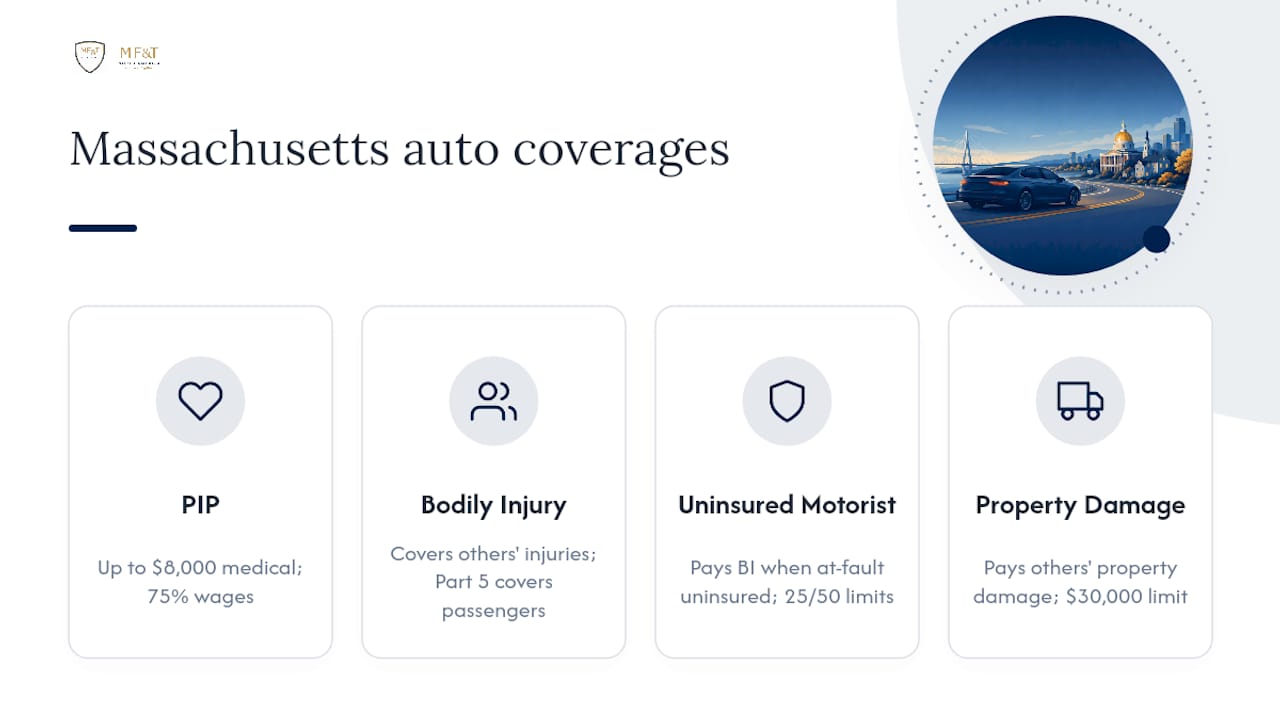
Bodily Injury to Others (Part 1) covers injuries you cause to people outside your vehicle, including other drivers and pedestrians. It generally doesn't cover your own passengers unless you've purchased optional Part 5 coverage, which extends bodily injury protection to riders in your car and to accidents that happen outside Massachusetts.
Uninsured Motorist Coverage steps in when the at-fault driver has no insurance at all, paying your bodily injury claims up to the same 25/50 limit.
Property Damage Liability pays for the other driver's car or property, up to $30,000 per accident, as required under Chapter 90, Section 34O.
One catch worth flagging: Part 1 bodily injury liability generally applies only within Massachusetts. Drivers who commute to New Hampshire or road-trip to New York regularly should look at optional Part 5 coverage to avoid a gap.
Pro Tip: If you drive across state lines even occasionally, ask your agent whether Part 5 makes sense. It's often a modest premium increase for coverage that follows you outside Massachusetts.
What Happens If You Drive Without Insurance in Massachusetts?
Skipping insurance in Massachusetts isn't a minor risk. Under M.G.L. c. 90, § 34J, driving without the required coverage can trigger fines ranging from $500 to $5,000, with first-time offenders typically facing the $500 minimum. License suspension is also on the table, and the financial hit doesn't stop at the fine.
An uninsured driving finding can also lead to an administrative penalty equal to at least one year's premium at the state's highest set rate, a bigger long-term cost than simply keeping your policy current.
If your insurer cancels your policy for nonpayment or another reason, you generally have appeal rights before the cancellation takes full effect, so don't assume a cancellation notice is final without checking.
- Fines: $500 to $5,000 depending on circumstances and history.
- License suspension is possible even for a first offense.
- Cancelled policies can sometimes be reinstated or appealed.
- If no insurer will write you a policy on the standard market, the Massachusetts Automobile Insurance Plan (MAIP) assigns you to a carrier required to cover you for up to three years.
An agent can often walk you through a MAIP application faster than trying to navigate it solo.
Do You Need More Than the Minimum Coverage?
Minimum limits keep you legal. They don't keep you financially whole after a serious crash, and that gap catches a lot of drivers off guard.
- You drive a newer or more expensive vehicle. A $30,000 property damage limit disappears fast against the cost of today's SUVs and trucks.
- You have assets to protect. If you own a home or have savings, a lawsuit from a serious accident could reach beyond your policy limits and into your personal assets.
- You spend a lot of time on highways. Higher speeds mean higher-severity crashes, and severity is exactly what minimum limits struggle to cover.
- You want passenger protection. Standard Bodily Injury to Others doesn't cover your own riders, so families who carpool often benefit from expanded BI.
Common upgrades worth considering include collision and comprehensive coverage (which the mandatory minimums don't require at all), higher bodily injury limits like 100/300, and underinsured motorist coverage that protects you when the other driver has insurance but not enough of it.
Pro Tip: A rough rule of thumb: if your net worth exceeds your current liability limits, it's worth pricing out higher coverage or an umbrella policy. The premium difference is usually smaller than people expect.
How Do You Confirm and Update Your Massachusetts Policy?
Checking compliance takes about ten minutes if you know where to look.
- Pull out your declarations page and find the limits listed next to Bodily Injury, Property Damage, PIP, and Uninsured Motorist.
- Check your policy's effective or renewal date. If it falls on or after July 1, 2025, the new minimums should already apply.
- Gather your vehicle registration, driver's license, and any prior insurance history before contacting an agent.
- Ask your agent directly whether your limits meet the updated state minimums or whether you're still on an older policy version.
When you're ready to make a change, here's what typically happens:
- Requesting higher limits usually takes effect within a few business days once you approve the updated quote.
- Adding optional coverage like Part 5 or expanded BI is a straightforward endorsement, not a full policy rewrite.
- If a carrier declines to write you a policy, an independent agent can shop multiple insurers or help you apply to MAIP.
Bring your VIN, mileage estimate, and driving history when you call. It speeds things up considerably.
MF&T North America's Take on the New Minimums
We've watched plenty of Massachusetts drivers get caught off guard by this change, mostly at renewal time. The most common mistake we see: someone renews in August 2025, assumes their old $5,000 property damage limit carried over, and doesn't realize their carrier already bumped it to $30,000, often with a rate adjustment they didn't expect.
The second pattern involves uninsured motorist coverage. Drivers who've carried the same policy for years sometimes never added UM protection at all, not realizing it's now a mandatory piece of the puzzle.
As an independent agency in Arlington with more than 30 years in the Massachusetts market, our advice is simple: don't wait for your renewal notice to find out where you stand. Pull your declarations page now, and if the numbers look off, call someone who can walk through it with you line by line.
— Mike
Get Help Confirming Your Massachusetts Coverage
Reading a declarations page and cross checking it against the new 25/50/30 minimums isn't complicated, but it's easy to put off until a renewal notice forces the issue. We provide Massachusetts drivers a faster route: a licensed agent looks at your actual policy, tells you plainly whether you meet the July 2025 minimums, and shops multiple carriers if your current limits or rate need adjusting.
That matters most for two groups: drivers whose renewal already crossed the July 1, 2025 line without a policy review, and drivers who've been quoted a MAIP assignment and want a second opinion before accepting it. An agent can usually tell you within a day whether the voluntary market has a better option.
If you're ready to see where your current policy stands, request free Massachusetts insurance quotes and get a straight answer on your limits before your next renewal date arrives.
This article is general information, not a substitute for advice from a qualified financial advisor. Consult a qualified financial professional about your own circumstances before acting on anything here.