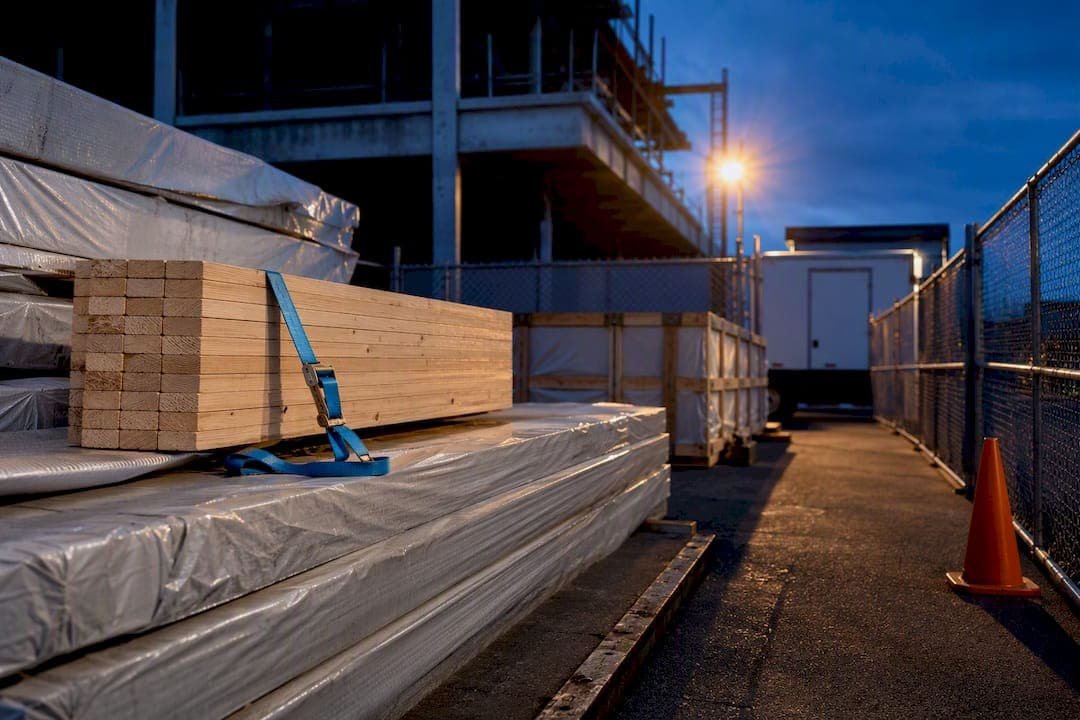
An installation floater is inland marine coverage that protects materials, fixtures, and equipment you're installing while they're in transit, in storage, or sitting on the job site before the owner or general contractor accepts the work. If you're a subcontractor who takes ownership of expensive materials before they're permanently installed, you need this coverage in place before those materials leave the supplier or arrive on site. Check your contract first: many GCs require it as a condition of the job.
TL;DR:
- The policy limits include a per-job cap and an annual aggregate, with transit sub-limits often significantly lower than the overall limit.
- Replacement cost valuation generally provides higher payouts by including labor and overhead, unlike ACV which accounts for depreciation.
- Proper documentation, security measures, and timely reporting are essential to prevent underinsurance and expedite claims settlement.
- The installation floater covers materials in transit, storage, and on-site exposure until official acceptance, after which coverage shifts to owners or GCs.
- Contractors should verify coverage details—including transit sub-limits and exclusions—before purchasing and coordinate coverage with GCs to avoid gaps.
Table of Contents
- What Does Installation Floater Insurance Cover?
- Who Actually Needs an Installation Floater?
- Policy Mechanics: Limits, Valuation, and Reporting Forms
- Installation Floater vs. Builder's Risk vs. Equipment Insurance
- How to Get Quoted: Documents and Timing
- What Claims Actually Look Like on the Job
- MF&T North America: Practitioner Guidance for Contractors
- How the Claims Process Works Under an Installation Floater
- Reducing Your Risk Before It Becomes a Claim
- Legal and Regulatory Factors That Affect Your Coverage
- The Real Gap in How Contractors Buy This Coverage
- Get Your Installation Floater Quote Started
- Sources
What Does Installation Floater Insurance Cover?
An installation floater follows your materials through three distinct phases: the truck ride from supplier to warehouse, the weeks they might sit in storage, and the final stretch on the job site before the owner signs off. Coverage typically applies to property you intend to permanently install, whether that's copper wiring, HVAC condensers, solar panels, or custom cabinetry. The IRMI definition makes clear the policy tracks the property, not the location, which is why it works across multiple job sites rather than a single fixed address.
Coverage generally includes:
- Materials and equipment in transit from supplier to warehouse or job site
- Temporary storage before installation begins
- On-site exposure until the owner or general contractor formally accepts the work
- Common perils like theft, fire, windstorm, hail, and transit accidents
Coverage stops once the owner or GC accepts the installation and any required testing wraps up. After that point, the property becomes part of the building and typically falls under the owner's property policy or builder's risk coverage instead. That handoff moment matters more than most contractors realize, and it's worth nailing down in writing before a loss happens.
Who Actually Needs an Installation Floater?
Certain trades face this exposure constantly, and if you fall into one of these categories, buying the policy isn't optional in any practical sense.
- Electrical contractors installing panels, switchgear, or bulk wire that sits exposed on site for weeks.
- HVAC installers handling rooftop units and condensers that arrive by freight and often wait in a yard before a crane sets them.
- Plumbing contractors managing fixtures and specialty piping that get staged in unlocked storage trailers.
- Solar installers transporting panels and inverters across long distances with real breakage risk.
- Glazing and curtain wall contractors moving fragile, high-value glass units that are expensive to replace on short notice.
Beyond trade type, watch for specific triggers: material values climbing above what your general liability policy would ever touch, contract language that names installation floater coverage explicitly, off-site storage arrangements, or long transit routes with multiple handoffs. Zurich notes that installation floaters are purchased nationwide by subcontractors and specialty trades, distinct from builder's risk policies that owners or GCs typically buy. Never assume a certificate of insurance from someone else on the job covers your materials. Read the actual policy language, not just the COI summary.
Policy Mechanics: Limits, Valuation, and Reporting Forms
This is where quotes start looking different from one carrier to the next, and where a contractor who skims the declarations page ends up underinsured on the job that matters most.
Limits work two ways. Most policies set a per-job limit for a specific project and an annual aggregate limit across all jobs during the policy term. Transit often carries its own sub-limit, meaning your $250,000 job limit might only extend $50,000 of protection while materials are on a truck. Confirm both numbers before you rely on either.
Valuation changes your payout. Replacement cost valuation typically includes labor and overhead needed to source and reinstall materials, which keeps a damaged job moving instead of stalling while you eat the labor cost out of pocket. Actual cash value (ACV) subtracts depreciation and usually pays less, which can leave a real gap on a delayed schedule.
- Reporting forms require periodic reporting of on-hand values, with premium adjusting to actual exposure
- Non-reporting forms lock in a fixed limit regardless of fluctuation
- Optional endorsements like earthquake, flood, and equipment breakdown add coverage for perils excluded by default
- Debris removal and soft costs endorsements address expenses that pile up fast after a loss
Pro Tip: If your job volume swings month to month, ask specifically about a reporting form. Contractors with unpredictable material values often overpay on a fixed non-reporting limit sized for their busiest month.
Great American's underwriting guidance notes that reporting versus non-reporting comes down to how much your exposure varies. A contractor running one large, predictable job might prefer the simplicity of a fixed limit, while one juggling multiple smaller jobs benefits from a form that flexes with reality.
Installation Floater vs. Builder's Risk vs. Equipment Insurance
These three policies get confused constantly, and the confusion causes real coverage gaps.
- Installation floater: covers materials you're installing, purchased by the subcontractor or trade doing the work
- Builder's risk: covers the entire structure under construction, typically purchased by the owner or general contractor
- Contractor's equipment insurance: covers the tools and machinery you own and use, not the materials being installed
Overlap creates the danger zone. A GC's builder's risk policy might name you as an additional insured, but that doesn't automatically extend to materials you're storing off-site before delivery. If you're relying solely on the GC's policy, ask for the actual endorsement language, not just verbal assurance. Coordinating coverage with the GC or owner early, and getting written confirmation of who insures what during each phase, closes gaps before they become disputes. If your business also owns compressors, generators, or specialty tools, a separate contractor's equipment coverage fills that gap rather than an installation floater trying to stretch to cover it.
How to Get Quoted: Documents and Timing
Carriers move faster when you hand them a complete submission the first time, especially when leveraging AI for Insurance Agencies to streamline quote, bind, and renewal automation processes. Gather these before you call:
- The signed contract showing your scope, project value, and any insurance requirements the GC or owner specified.
- A schedule of values or materials list breaking out what you're installing and its dollar value.
- Delivery and storage details, including addresses, security measures, and how long materials sit before installation.
- Transit information, such as carrier names, routes, and distance if materials travel a long way.
- Loss history for the past three to five years, since a clean record helps your rate.
Underwriters price higher for jobsites in high-crime areas, specialty equipment that's expensive to replace quickly, and extended storage periods where materials sit exposed for months. Strengthening jobsite security, fencing, lighting, locked storage containers, can measurably improve the terms you're offered. Grouping smaller, similar jobs under one reporting-form policy instead of buying separate one-off floaters also tends to reduce administrative cost and premium friction over a year of work.
Pro Tip: Photograph your storage setup, locked trailers, fencing, lighting, before you submit for a quote. Underwriters respond well to documented security measures, and it can shave real dollars off your premium.
What Claims Actually Look Like on the Job
Real scenarios show where coverage holds and where it doesn't.
- Copper wire theft on an unsecured site: Covered under most floaters, assuming theft isn't excluded. Police reports, photos of the storage area, and a materials inventory speed up the payout.
- Transit damage to a packaged HVAC unit: Covered up to your transit sub-limit. Bills of lading and carrier incident reports establish who's responsible and support your claim.
- Water damage in off-site storage: This is where policies diverge. Some forms exclude flood by default, meaning you'd need the flood endorsement in place before the loss, not after.
| Loss scenario | Typically covered? | Key documentation |
|---|---|---|
| Theft of materials on site | Yes, absent exclusion | Police report, photos, inventory list |
| Transit damage to equipment | Yes, up to sub-limit | Bill of lading, carrier report |
| Flood damage in storage | Only with endorsement | Endorsement copy, storage photos, weather record |
| Faulty workmanship damage | No, standard exclusion | Not applicable |
File a claim quickly: notify your carrier the same day if possible, secure the scene, and collect documentation before materials get moved or cleaned up.
MF&T North America: Practitioner Guidance for Contractors
M F and T North America has spent more than 30 years helping contractors and property developers in Massachusetts and beyond match coverage to what a job actually needs, across builders risk, commercial property, and contractor-specific lines. Mike, who covers construction insurance topics for the M F and T North America equipment coverage guide, built the checklist below from the underwriting patterns that show up on real contractor quotes.
Before you sign anything, walk through this checklist:
- Confirm whether your job's coverage trigger is contract-required or self-initiated
- Choose replacement cost over ACV unless the premium difference is significant
- Verify your transit sub-limit against your highest single shipment value
- Ask what's excluded by default and whether you need an endorsement for it
How the Claims Process Works Under an Installation Floater
Filing a claim starts the moment you discover a loss, not after you've finished the job and calculated the damage at your leisure. Contact your agent or carrier immediately. Most policies set a notice requirement, and delayed reporting can complicate an otherwise straightforward claim.
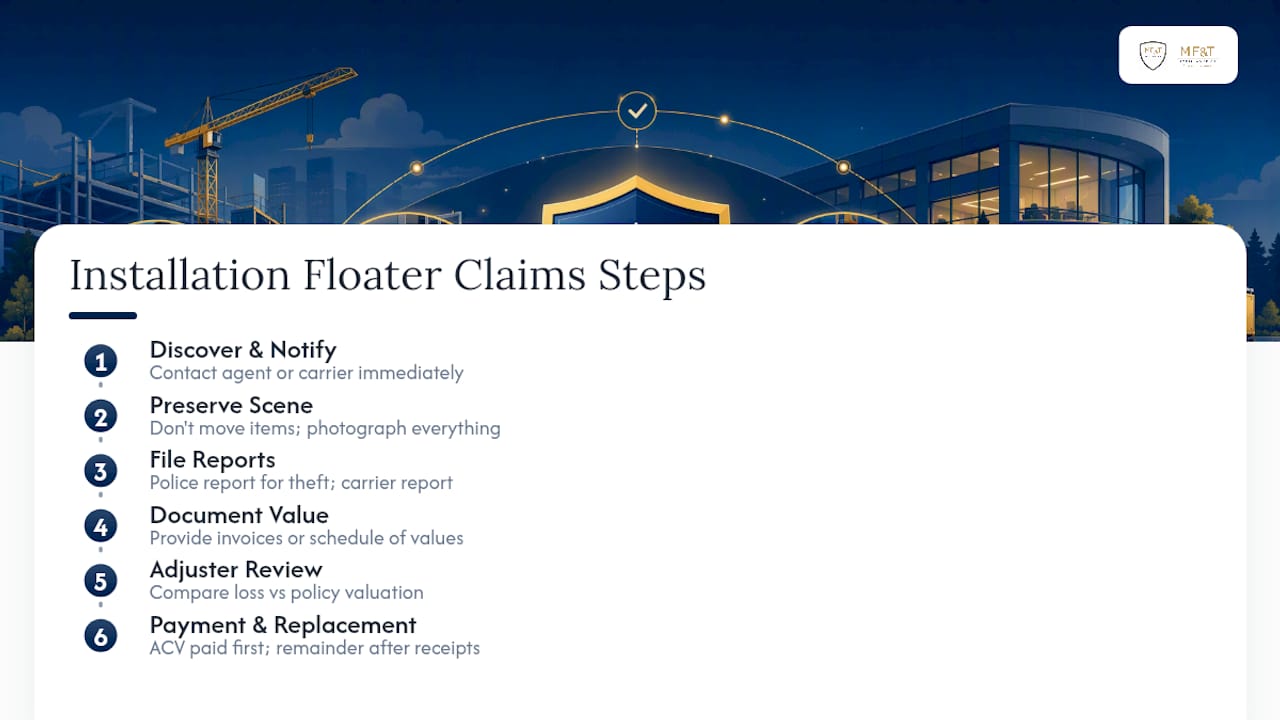
Your adjuster will want to see the loss location, so avoid moving or discarding damaged materials until they've documented the scene, unless safety requires it. Photograph everything: the damaged items, the storage or transit setup, and any surrounding conditions that explain what happened. If theft is involved, file a police report immediately and get a copy for your claim file. If it's transit damage, request the carrier's incident report and hang onto the bill of lading that shows what shipped and when.
The adjuster will compare your documented loss against your policy's valuation method, replacement cost or ACV, and against any applicable sub-limits. Expect them to ask for your original purchase invoices or a schedule of values to confirm the materials' worth. A clean paper trail here is what separates a claim that pays out in weeks from one that drags on for months over valuation disputes.
Once the adjuster approves the claim, payment timing depends on your valuation choice. Replacement cost claims sometimes pay in two stages: an initial ACV payment, followed by the remainder once you show proof you've actually replaced the materials. Keep every receipt from the replacement purchase, since that's your evidence for the second payment.
Reducing Your Risk Before It Becomes a Claim
The cheapest claim is the one that never happens, and most installation losses trace back to a handful of preventable gaps.
Start with physical security. Locked storage containers, fencing around laydown areas, and motion-activated lighting deter the opportunistic theft that accounts for a large share of contractor losses. If materials sit on an unsecured site overnight, that's the window when copper wire and fixtures disappear.
Transit exposure deserves its own attention. Use carriers with a track record of careful handling for fragile or high-value shipments, and require signed delivery confirmations so you have a paper trail showing exactly when custody transferred. For glass, HVAC equipment, and anything else prone to breakage, insist on proper packaging and secure loading, since a poorly strapped load is a claim waiting to happen.
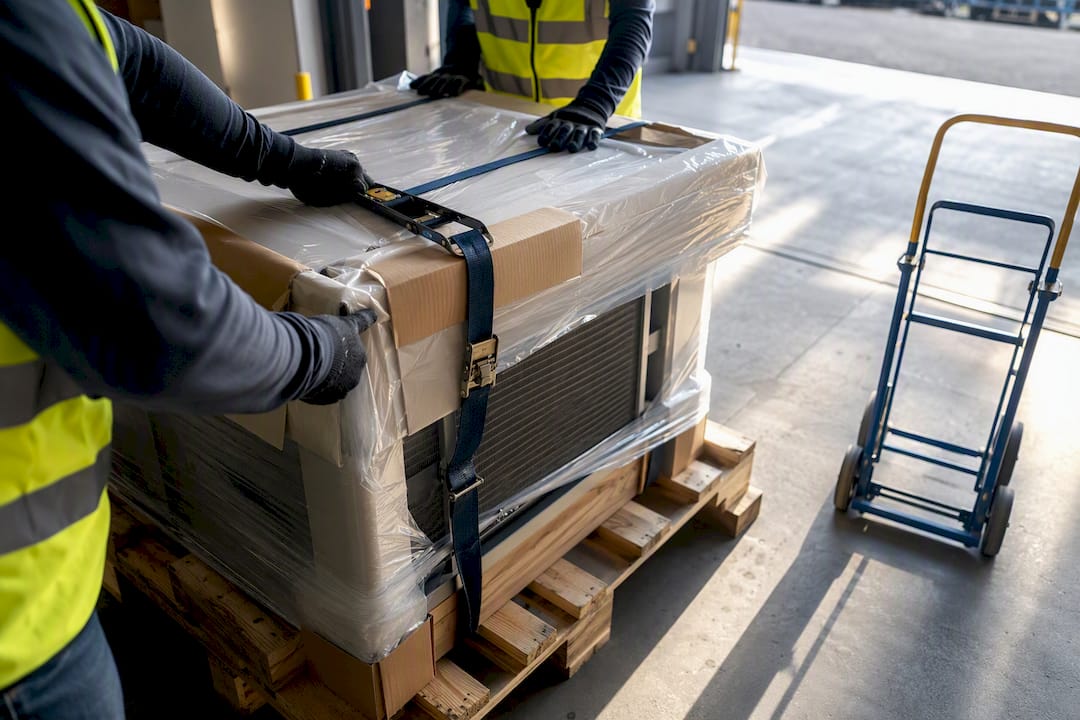
Storage duration matters more than most contractors think. The longer materials sit before installation, the longer they're exposed to weather, theft, and simple misplacement. Where possible, time deliveries to arrive closer to the installation date rather than staging everything weeks in advance.
Finally, document as you go. Take photos of materials on delivery, note their condition, and keep an updated inventory of what's on site at any given time. That habit costs you five minutes a week and turns into the exact evidence your carrier needs if something goes wrong.
Legal and Regulatory Factors That Affect Your Coverage
Contract language drives more coverage disputes than actual policy wording does. Many general contractors specify insurance requirements directly in the subcontract, including minimum installation floater limits, named additional insureds, and waiver of subrogation clauses. Read this language before you sign, not after a loss forces you to.
Insurable interest is the legal concept that determines who can actually collect on a claim, and it shifts as a project moves forward. Coordinating coverage and confirming which party holds the insurable interest at each phase avoids the kind of dispute where two parties both assumed the other was covering the same materials, and the loss falls into an uninsured gap.
State insurance regulations govern how carriers must handle claims, including prompt-payment rules and required disclosures, though these vary and a licensed agent in your state can confirm the specifics that apply to your policy. Lien laws also intersect with insurance in practical ways: if materials are damaged before installation, your ability to file a mechanic's lien for unpaid work can depend on whether the materials were ever incorporated into the structure. That's a conversation worth having with your attorney on any large job, not something to guess at after a loss.
The Real Gap in How Contractors Buy This Coverage
Most contractors treat installation floater insurance as a checkbox item, something they buy because a GC's contract demands it, then forget about until a loss happens. That's backwards. The valuation clause and the transit sub-limit matter more than the headline coverage limit, and they're the two details contractors skip past fastest when reviewing a quote.
The conventional advice, "just get a floater," ignores that a non-reporting form sized wrong for your business either overcharges you every month or leaves you short on your biggest job. Reporting forms deserve more attention than they get, particularly from subcontractors whose material values swing hard between a slow month and a big install.
If you take one thing from this guide, verify your transit sub-limit against your largest single shipment before you bind the policy, not after a truck rolls over with your equipment on it. That's the detail that separates a policy that actually protects your business from one that just satisfies a contract requirement on paper.
— Mike
Get Your Installation Floater Quote Started
M F and T North America is the practical alternative to piecing together coverage on your own or hoping a GC's policy stretches to cover your materials. With more than 30 years serving contractors, property developers, and small businesses across multiple states, the agency bundles builders risk insurance with installation floaters and other contractor lines so you're not juggling separate carriers for related exposures.
Before you call, pull together your job values, your signed contract, and a rough materials list. That's enough for M F and T North America to start shaping a quote around your actual exposure instead of a generic template. If you're also weighing how installation coverage fits alongside your broader construction insurance program, the construction project insurance setup guide is worth a look before your next job breaks ground. Request your free insurance quote today and get a policy that matches the materials you're actually installing.
Sources
- IRMI — installation floater definition
- Great American Insurance Group — installation floater form and options (PDF)
- Zurich — Installation floater insurance program