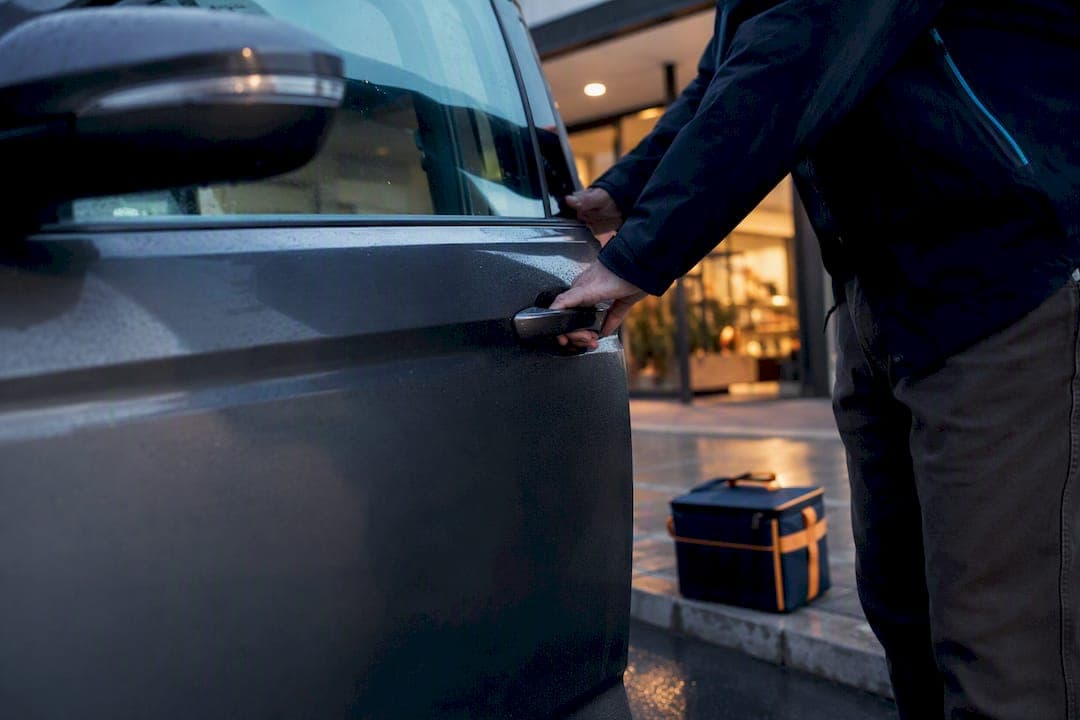
Hired and non-owned auto (HNOA) is a liability endorsement that protects your business when employees drive personal cars for work or when you rent vehicles for company use. If anyone at your business ever drives a personal car on the clock or you rent a vehicle for a work trip, you should have it. Its whole job is covering third-party liability, not damage to the vehicle itself.
TL;DR:
- HNOA primarily covers third-party liability claims arising from employees' personal vehicles or rented vehicles used for business tasks, not vehicle damage.
- The coverage responds as an excess layer after an employee’s personal auto policy exhausts its limits or denies a claim due to commercial-use exclusions.
- Costs vary based on business size, number of drivers, and risk factors, often starting in the tens of dollars annually for low-exposure companies.
- Many small businesses underestimate how often employees' personal policies exclude commercial use, increasing the risk of uncovered liabilities.
- HNOA should be paired with vehicle-specific protections like collision damage waivers if your business rents vehicles regularly.
Table of Contents
- What Does Hired Non Owned Auto Coverage Actually Pay For?
- Hired Vs Non-Owned: What's the Real Difference?
- Does Your Employee's Personal Insurance Pay First?
- What HNOA Won't Cover (and the Gaps That Catch Owners Off Guard)
- How Much Does HNOA Cost, and What Sets the Price?
- Does Your Business Actually Need This Coverage?
- How Do You Actually Buy HNOA Coverage?
- Why Trust This Guidance
- How Do You File a Claim Under an HNOA Policy?
- What Do Real HNOA Claims Actually Look Like?
- Does HNOA Work the Same Way in Every State?
- How Does HNOA Compare to Full Commercial Auto Insurance?
- What the Conventional Advice on HNOA Gets Wrong
- Ready to Review Your HNOA Coverage?
- Sources
What Does Hired Non Owned Auto Coverage Actually Pay For?
HNOA is built around one job: protecting your business when someone gets hurt or something gets damaged because of a vehicle your company doesn't own. That's the core of hired non owned auto coverage, and it's worth understanding before you look at price tags or endorsement forms.
Specifically, HNOA responds to third-party bodily injury and property damage claims, plus the legal defense costs that come with them. If your delivery driver rear-ends someone in her own car while running a company errand, HNOA is what keeps that lawsuit from landing directly on your business's balance sheet.
What it typically won't touch is damage to the vehicle in question. That's a separate conversation, one we'll get to shortly.
Common triggers include:
- An employee uses her own car to pick up supplies or drop off paperwork.
- Your team rents a van for a trade show or sales trip.
- A manager borrows a coworker's truck to haul equipment to a job site.
- A contractor rents a car while traveling for a client visit.
Each scenario shares the same thread: a vehicle you don't own, being used for your business, with real liability exposure if something goes wrong.
Hired Vs Non-Owned: What's the Real Difference?
These two terms get lumped together constantly, and for good reason: they're almost always sold as one endorsement. But they cover different exposures.
- Hired auto covers vehicles your business rents, leases, or borrows, such as a moving truck for a job or a rental car for a business trip.
- Non-owned auto covers vehicles your business doesn't own or rent at all, most commonly an employee's personal car used for work tasks.
- Insurers bundle them into a single HNOA endorsement because most small businesses face both risks at once, sometimes in the same week.
Why the distinction matters practically: if you rent vehicles often, hired-auto exposure deserves more attention. If you have several employees running errands in their own cars, non-owned exposure is your bigger concern. Count your rental frequency and your driving employees before deciding how much weight each half deserves.
Does Your Employee's Personal Insurance Pay First?
Generally, yes. When an employee causes an accident while driving her own car for work, her personal auto policy is expected to respond first. HNOA is designed to work as an excess layer that kicks in after her personal limits are exhausted, or after her insurer denies the claim outright.
That denial scenario happens more than business owners expect. Many personal auto policies contain a commercial-use exclusion, and if the claims adjuster decides the trip counted as business use, the employee's own carrier can walk away from the claim entirely. Suddenly your business is the only party standing between the injured third party and an uninsured loss.
This is where respondeat superior matters. Under this legal doctrine, an employer can be held liable for an employee's actions performed within the scope of employment, which includes routine driving errands. You don't need to have been in the car. You just need to have sent the employee on that errand.
Two things worth flagging:
- A "low limits" personal policy (say, state minimums) can exhaust in a serious accident within seconds of the settlement math starting.
- Employees rarely disclose commercial use to their personal insurer, which increases the odds of a denial you didn't see coming.
What HNOA Won't Cover (and the Gaps That Catch Owners Off Guard)
HNOA is a liability tool, not a repair fund. It generally doesn't cover physical damage to the hired or non-owned vehicle itself, meaning if your employee's car gets totaled or the rental van gets scraped up, that repair bill isn't automatically handled.
Other common exclusions and blind spots include:
- Employee injuries, which fall under workers' compensation, not HNOA.
- Personal errands unrelated to business, even if they happen during work hours.
- Rideshare or food-delivery driving, which many HNOA endorsements exclude outright given the different risk profile.
- Missing paperwork, like no documented list of approved drivers or no proof that employees carry adequate personal limits.
That last gap is the one agencies see most often. A business assumes HNOA has them covered, then discovers during a claim that they never confirmed their employees carried anything beyond state-minimum personal limits.
Pro Tip: If your business rents vehicles regularly, don't rely on HNOA alone for the vehicle itself. A rental collision damage waiver or a hired-auto physical-damage endorsement fills that specific gap, and it's often cheaper than paying out of pocket for a dented rental.
How Much Does HNOA Cost, and What Sets the Price?
For most small businesses, HNOA is one of the more affordable endorsements you'll add to a commercial policy. Premiums vary based on payroll, employee headcount, industry, claims history, and territory, and market benchmarks suggest incremental costs can start in the tens of dollars annually for low-exposure businesses and climb into the hundreds for companies with more drivers or a rougher claims record.
Limits typically run in tiers, commonly mirroring the liability limits on your commercial auto or general liability policy, with several standard options available.
- A five-person consulting firm with occasional errands might carry a $500,000 limit at a modest annual cost.
- A contracting company with a dozen field employees driving personal trucks daily will likely need higher limits and should expect a higher premium.
Match your HNOA limit to your other liability coverage. A $1 million general liability policy paired with a $300,000 HNOA limit creates a mismatch that shows up exactly when you don't want it to, mid-claim.
Does Your Business Actually Need This Coverage?
If any of the following describe your operation, HNOA belongs on your radar:
- Restaurants and retail shops that send employees on delivery runs or supply pickups.
- Contractors and tradespeople who send crews between job sites in personal vehicles.
- Sales teams that rent cars for client visits or trade shows.
- Event staffing companies that rent vans or trucks for setup and teardown.
- Any business where a client contract specifically requires proof of HNOA coverage.
Quick internal check before you call an agent: count your driving employees, estimate how often your business rents vehicles in a typical year, and pull any client contracts that mention insurance requirements. If those numbers are all near zero and no contract requires it, HNOA might be optional for now. For most operations with even occasional employee driving, it isn't.
How Do You Actually Buy HNOA Coverage?
HNOA usually shows up as an endorsement attached to a commercial auto policy, a business owner's policy, or general liability, rather than as a standalone product. Check your declarations page for the endorsement listed by name; if you don't see it, ask your agent directly rather than assuming it's included.
Before that conversation, gather:
- A roster of employees who drive for work, even occasionally.
- Your current policy declarations pages.
- A rough estimate of annual rental expenses, if you rent vehicles.
Pro Tip: Bring three questions to your agent: What limit matches my other liability coverage? Do I need hired-auto physical damage on top of HNOA? Does the certificate wording exclude rideshare or delivery driving? Getting clear answers up front avoids the kind of vague policy language that causes coverage disputes during an actual claim.
If you're also weighing how HNOA fits into your broader vehicle program, commercial auto insurance for contractors is a useful next read.
Why Trust This Guidance
M F and T North America is an independent insurance agency based in Arlington, Massachusetts, with over 30 years of experience writing commercial auto and small business policies across multiple states. This guide reflects practitioner-level familiarity with how HNOA claims actually play out, not just how the endorsement reads on paper. The agency reviews endorsement wording daily, which is exactly the kind of granular detail that determines whether a claim gets paid cleanly or gets stuck in a dispute.
How Do You File a Claim Under an HNOA Policy?
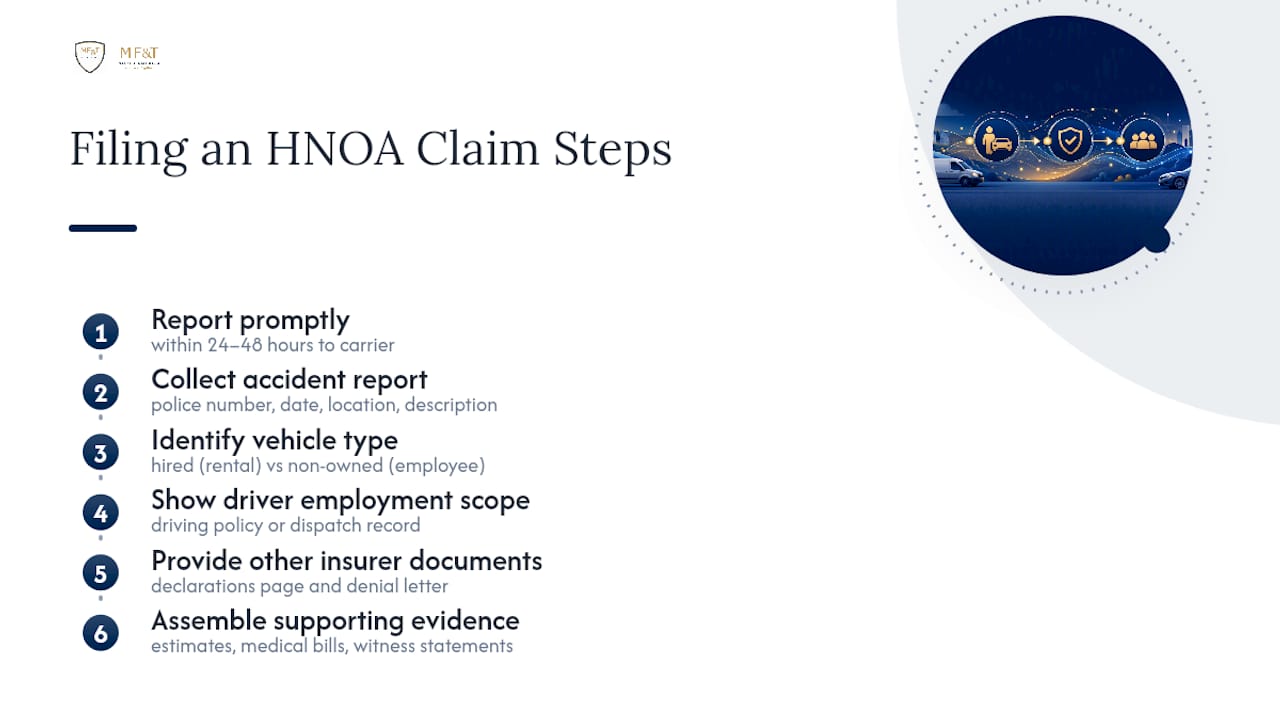
Filing an HNOA claim starts the same way any commercial auto claim does: report it to your carrier immediately, ideally within 24 to 48 hours of the incident. Delay creates its own problems, since insurers can question a late report during the investigation.
You'll need to document a few things clearly. First, get the basic accident report: police report number, date, location, and a description of what happened. Second, identify whose vehicle was involved and confirm whether it falls under the hired half of the endorsement (a rental) or the non-owned half (an employee's personal car). That distinction affects which part of the policy responds and how the claim gets processed.
Third, gather proof that the driver was acting within the scope of employment at the time. This is where a documented driving policy or dispatch record helps enormously. If your employee was running an approved errand and you can show it, the claim moves faster. If there's no record and the employee's activity is ambiguous, expect more questions from the adjuster.
Fourth, if the employee's personal auto insurer is involved, your carrier will typically want to see that policy's declarations page and any denial letter, since HNOA usually pays as excess only after that policy responds or denies. Keep copies of everything: repair estimates, medical bills for injured third parties, correspondence with the other driver's insurer, and any witness statements. The more complete the file you hand your carrier, the less back-and-forth the claim requires.
What Do Real HNOA Claims Actually Look Like?
A sales rep for a small distribution company rents a car for a multi-city trip and sideswipes a parked vehicle in a hotel lot. The rental company's own collision coverage handles the rental car's damage, but the parked car's owner files a liability claim against the business. HNOA responds to that third-party claim, covering the property damage and the legal costs of resolving it.
A different scenario: a landscaping company's crew leader uses his own truck to grab replacement parts mid-shift and rear-ends another driver at a stoplight. His personal auto insurer initially processes the claim, but the injured driver's medical bills exceed his policy's $50,000 bodily injury limit. The business's HNOA coverage steps in as excess, paying the remaining medical costs above that limit, exactly the scenario the excess-layer structure is designed for.
A trickier case involves a restaurant employee using her own car for food delivery. Her personal insurer denies the claim outright, citing a commercial-use exclusion because food delivery counts as business use in her policy's fine print. Without HNOA, the restaurant would have faced that claim with no insurance backing at all. With it, the endorsement absorbed the liability exposure that the personal carrier refused to touch.
Each case illustrates the same pattern: HNOA rarely activates for minor fender-benders. It earns its premium in the higher-stakes claims, where personal limits run out or personal insurers find a reason to deny coverage.
Does HNOA Work the Same Way in Every State?
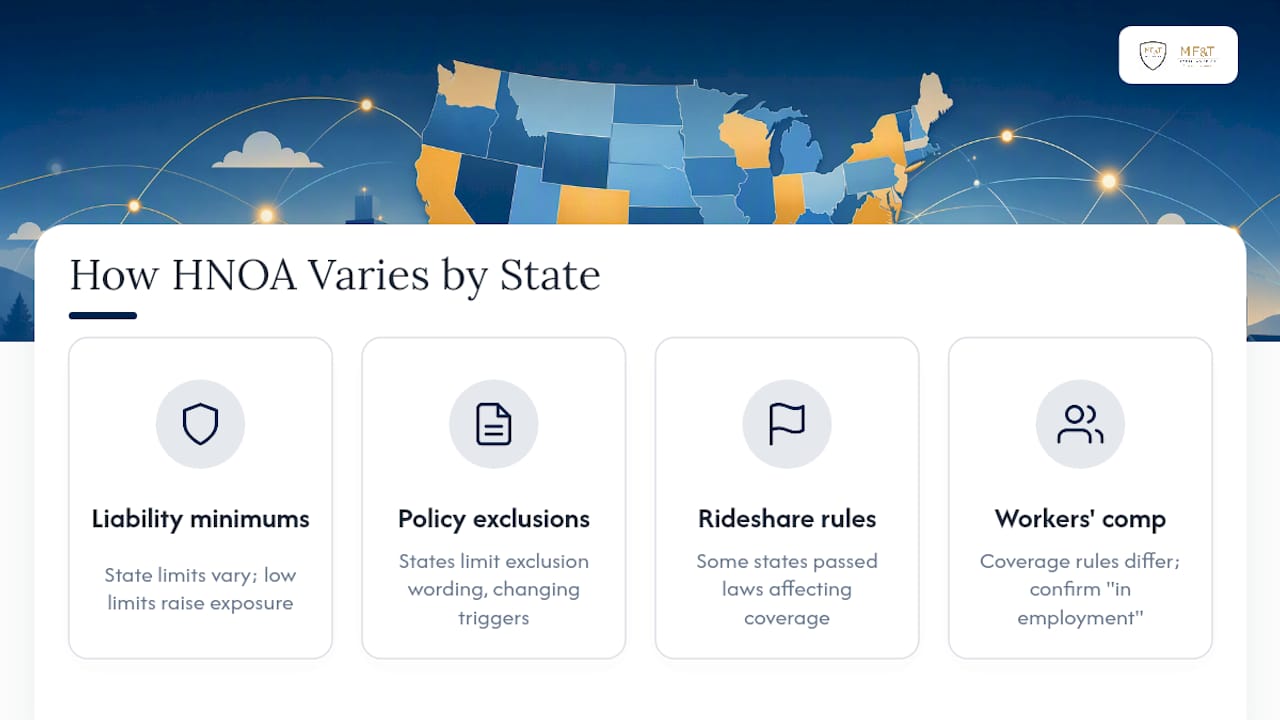
HNOA itself is a fairly standardized commercial endorsement, but the details around it shift by state in ways worth knowing. State minimum liability limits for personal auto policies vary widely, and since HNOA often works as excess above those personal limits, a state with low minimums creates more exposure for your business before HNOA ever kicks in.
Some states also regulate how insurers can word commercial-use exclusions in personal auto policies, which affects how often those exclusions actually get triggered during a delivery or rideshare-related claim. A few states have seen legislative attention specifically around rideshare and delivery driving, given how often those activities blur the line between personal and commercial use.
Workers' compensation rules also vary by state and interact with HNOA indirectly. If an employee is injured while driving for work, workers' comp typically handles the employee's own injury regardless of state, but the rules for what counts as "in the course of employment" differ enough that it's worth confirming with a licensed agent in your state rather than assuming your situation mirrors another business's.
None of this changes the fundamental structure of HNOA, but it does change how much exposure your business carries before that coverage becomes relevant. A conversation with an agent licensed in your state is the fastest way to confirm the specifics that apply to you.
How Does HNOA Compare to Full Commercial Auto Insurance?
Commercial auto insurance covers vehicles your business actually owns, titles, and insures directly, things like a company van, a fleet of delivery trucks, or a contractor's owned pickup. HNOA covers the vehicles your business doesn't own: rentals, leases, and employees' personal cars used for work.
The overlap between the two is liability protection. Both are built to respond when someone gets hurt or property gets damaged because of a vehicle tied to your business. The gap is ownership. If your business has zero owned vehicles but employees occasionally drive their own cars for errands, commercial auto coverage alone won't help you; HNOA is the piece that closes that gap.
Many small businesses need both. A landscaping company might own three trucks (commercial auto) while also having office staff occasionally use personal cars for supply runs (HNOA). Buying only commercial auto and assuming it extends to employee-owned vehicles is one of the more expensive misunderstandings a business owner can make. For a deeper look at where the two programs separate, commercial auto insurance and personal auto policies lay out the practical differences in more detail.
What the Conventional Advice on HNOA Gets Wrong
Most guides treat HNOA like a checkbox: get it, forget it, move on. That's backwards. The coverage itself is straightforward, but the exposure behind it changes constantly as you hire new employees, add delivery routes, or start renting vehicles for a new contract. A policy written for your business two years ago may not reflect who's driving for you today.
The bigger mistake I see is business owners assuming their employees carry adequate personal auto limits without ever checking. That assumption is where claims fall apart. A documented driving policy and proof of personal coverage cost you almost nothing to collect, yet risk control steps like these often matter more than shaving a few dollars off your premium.
If you take one thing from this guide, make it this: HNOA is not a substitute for knowing who drives for your business and what they're driving. The endorsement handles the liability transfer. It doesn't replace the internal discipline of tracking drivers, confirming limits, and updating your policy when your operation changes. Get the paperwork right first. The coverage works far better when it does.
— Mike
Ready to Review Your HNOA Coverage?
If you've read this far and you're not sure whether your current policy actually includes HNOA, or whether your limits match your real exposure, that uncertainty is worth resolving before a claim forces the question. An agency with over 30 years of experience has spent that time helping small businesses across Massachusetts and beyond sort out exactly this kind of gap, matching coverage to how a business actually operates rather than how it looked on paper five years ago.
To get started, pull together your current policy declarations, a rough count of employees who drive for work, and an estimate of how often your business rents vehicles. Bring that to a policy review and you'll walk away knowing exactly where your coverage stands. You can request a quote or policy review directly, or take a look at the agency's commercial auto insurance options if you want to see how HNOA fits alongside the rest of your business insurance program.