
Commercial auto symbols are the numeric codes on your declarations page that tell you exactly which vehicles your policy covers for each type of coverage. Most Business Auto Policies use symbols 1 through 9 plus symbol 19, and the number next to each coverage line, whether it's liability, physical damage, or uninsured motorist, determines whether a specific vehicle is actually protected. Before you do anything else, pull out your declarations page and check the symbol listed beside every coverage you're paying for.
TL;DR:
- Familiarize yourself with the specific symbols listed on your declarations page because coverage varies significantly between symbols and may create gaps.
- Verify that any new vehicles or equipment are correctly added to your policy and covered under the appropriate symbol before use.
- Understand that Hired and Non-Owned Auto coverage usually applies to business use, while Drive Other Car endorsements are for personal use, and mixing them can lead to denial risks.
- Carefully review symbols related to liability, physical damage, and uninsured motorist coverage, as overlaps or gaps can cause denied claims or uncovered damages.
- Regularly update and confirm your fleet and subcontractor coverage symbols with an independent agent, especially after adding new vehicles or changing operations.
Table of Contents
- What Are Commercial Auto Symbols 1 Through 9 and 19?
- How Symbols Determine What Coverage Actually Applies
- Symbols Outside the Standard Business Auto Set
- HNOA vs. DOC: The Distinction That Trips Up Most Policyholders
- Your Declarations Page Review Checklist
- Why This Guidance Holds Up
- The One Mistake I See Most Often
- Get Your Declarations Page Reviewed by M F and T North America
- Sources
What Are Commercial Auto Symbols 1 Through 9 and 19?
Each symbol acts like a filter, narrowing or widening the pool of vehicles a coverage applies to. IRMI's definition of auto coverage symbols lays out the standard set used across nearly every Business Auto Policy written in the United States.
- Symbol 1, Any Auto. The broadest classification available. It covers any vehicle you own, hire, borrow, or don't even own yet, but carriers often restrict Symbol 1 to liability coverage only.
- Symbol 2, Owned Autos Only. Covers vehicles you own as of the policy date. Depending on your policy's wording, newly acquired vehicles may or may not fall under this automatically.
- Symbol 3, Owned Private Passenger Autos Only. Applies to cars and light passenger vehicles you own, not pickup trucks or commercial-grade vehicles. A landscaping company with a company sedan uses this; a construction firm with dump trucks does not.
- Symbol 4, Owned Autos Other Than Private Passenger. The mirror image of Symbol 3. Trucks, vans, and other non-passenger vehicles you own fall here.
- Symbol 5, Owned Autos Subject to No-Fault. Relevant in no-fault states where personal injury protection (PIP) is mandatory. This symbol ties directly to your state's no-fault requirements.
- Symbol 6, Owned Autos Subject to Compulsory Uninsured Motorist Law. Applies where state law requires uninsured motorist coverage on owned vehicles.
- Symbol 7, Specifically Described Autos. The narrowest and most restrictive symbol. Only the exact vehicles listed by VIN on your schedule are covered, which means a vehicle you buy next month isn't protected until you notify your carrier and add it to that schedule.
- Symbol 8, Hired Autos Only. Covers vehicles you rent or lease for business use, like a rental van for a weekend job.
- Symbol 9, Non-Owned Autos Only. Covers vehicles you don't own, rent, or lease, typically an employee's personal car used for company errands.
- Symbol 19, Mobile Equipment. Classifies certain mobile equipment as a covered auto under specific circumstances, distinct from the standard vehicle categories above.
How Symbols Determine What Coverage Actually Applies
Symbols don't apply uniformly across your policy. A single vehicle might be covered for liability under one symbol and completely excluded from physical damage coverage under another.
- Liability coverage commonly runs on Symbol 1, giving the broadest protection against injury or property damage claims you cause.
- Physical damage coverage (comprehensive and collision) usually rides on narrower symbols like 2, 7, or 8, according to InsureTutor's breakdown of commercial auto symbols. That gap means a hired or non-owned vehicle can have full liability protection but zero coverage if it's damaged in a crash.
- PIP and UM/UIM coverage depend on your state's laws and typically attach to Symbols 5 and 6, so the same vehicle might be treated differently depending on where you operate.
- Real-world gap: An employee driving their own car for a delivery run (Symbol 9) usually has liability coverage but no coverage for damage to their own vehicle. A rented box truck (Symbol 8) might have physical damage coverage only if you specifically added it.
Coverage symbols show up next to every line on your declarations page, and reading each line carefully is the only way to catch these gaps before a claim does it for you.
Symbols Outside the Standard Business Auto Set
Not every commercial policy uses the 1 through 9 and 19 framework. Garage policies, which cover auto dealers and repair shops, use symbols 21 through 31 instead, and Symbol 27 belongs to that set, not the standard business auto range. Trucking operations often fall under symbols 41 through 50 and 59, while motor carrier policies use ranges 61 through 71 and 79.
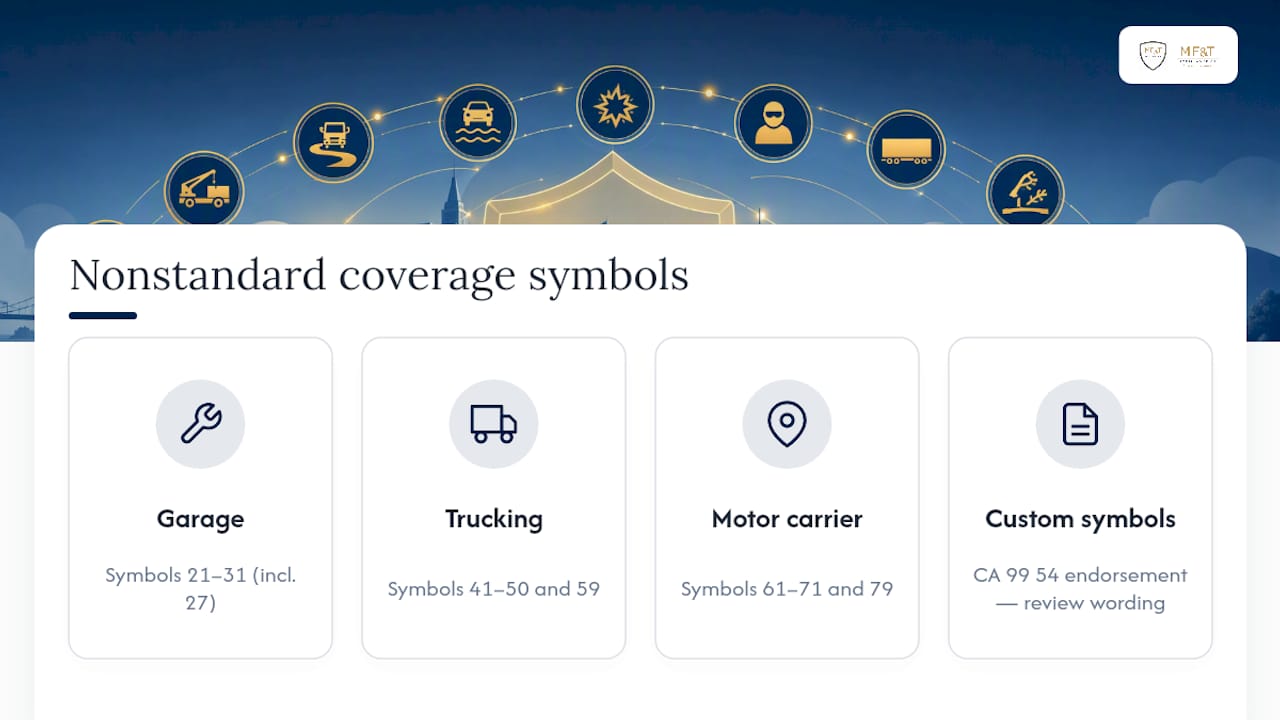
Carriers can also depart from any standard set entirely. The CA 99 54 Covered Autos Designation endorsement lets an insurer and insured agree on custom symbol definitions when a fleet's mix of vehicles doesn't fit neatly into the standard categories. That flexibility helps with complex operations, but custom wording needs careful review, since a poorly defined custom symbol can create the exact coverage gap you were trying to avoid.
HNOA vs. DOC: The Distinction That Trips Up Most Policyholders
Hired and Non-Owned Auto (HNOA) coverage and the Drive Other Car endorsement solve two different problems, and mixing them up is one of the most common, and costly, mistakes business owners make.
- HNOA covers business-use exposures: a rental car for a work trip or an employee's personal vehicle used for company errands.
- Drive Other Car (CA 99 10) provides personal-use coverage for a specifically named individual, often a company executive, who lacks a personal auto policy of their own, according to Independent Agent's guidance on hired, non-owned, and drive other car coverage.
- If that named executive already carries a solid personal auto policy, DOC often becomes an unnecessary, excess layer rather than primary protection.
- The classic failure: an executive borrows a friend's car for a weekend errand, assumes the company policy covers it under HNOA, and gets denied because HNOA only applies to business use.
DOC endorsements frequently operate on an excess basis when a personal auto policy exists, and Insurance & Risk Management Magazine's analysis of when DOC is necessary suggests many companies are paying for overlapping coverage they don't need.
Your Declarations Page Review Checklist
Reviewing symbol accuracy doesn't take long once you know what to look for.
- Read every coverage line on your declarations page and write down the symbol attached to each one, liability, physical damage, PIP, and UM/UIM.
- Check your newly acquired vehicle language. If your policy relies on Symbol 7, that new box truck you bought last month isn't covered until it's added to the schedule.
- Ask your agent directly about HNOA, DOC, and hired/non-owned physical damage. These three items cause more claim denials than almost anything else on a commercial auto policy.
- Keep a current vehicle and driver roster, along with a certificate of insurance (COI) process for any subcontractors who drive on your behalf.
Pro Tip: If any symbol on your declarations page looks ambiguous, ask your carrier for a written explanation in plain language. A five-minute email now beats a denied claim later.
Why This Guidance Holds Up
An independent insurance agency has spent many years helping New England businesses interpret exactly this kind of policy language. For fleets weighing symbol coverage against operational needs, our Commercial Auto Fleet Insurance Setup Guide and Auto Insurance Coverage Types Explained go deeper. The best next step remains simple: ask an independent agent to walk through your declarations page line by line.
The One Mistake I See Most Often
I've reviewed enough declarations pages to know the pattern: a company adds a new truck, assumes it's covered because "the policy is broad," and finds out during a claim that Symbol 7 required them to report it first. The fix isn't complicated according to Arizona Commercial Truck Accident Claims | Tyler Injury Law. Check your symbols against your actual fleet every time something changes, not just at renewal.
— Mike
Get Your Declarations Page Reviewed by M F and T North America
Reading symbol codes on your own is one thing. Knowing whether your specific fleet, subcontractors, and hired vehicles actually line up with those symbols is another, and that gap is where most uncovered claims start. Experienced independent agents review commercial auto policies for New England businesses and can check your declarations page line by line to flag gaps before they turn into denied claims.
If your fleet has grown, added subcontractors, or picked up a rental vehicle in the last year, now is the time to have someone confirm your symbols still match your operation. Request a free coverage quote from M F and T North America and get a straight answer on where your commercial auto policy stands.
Sources
- IRMI — Auto coverage symbols
- Independent Agent — Navigating commercial auto insurance: Hired, Non-Owned, and DOC
- InsureTutor — Commercial Auto Coverage Symbols 1-9