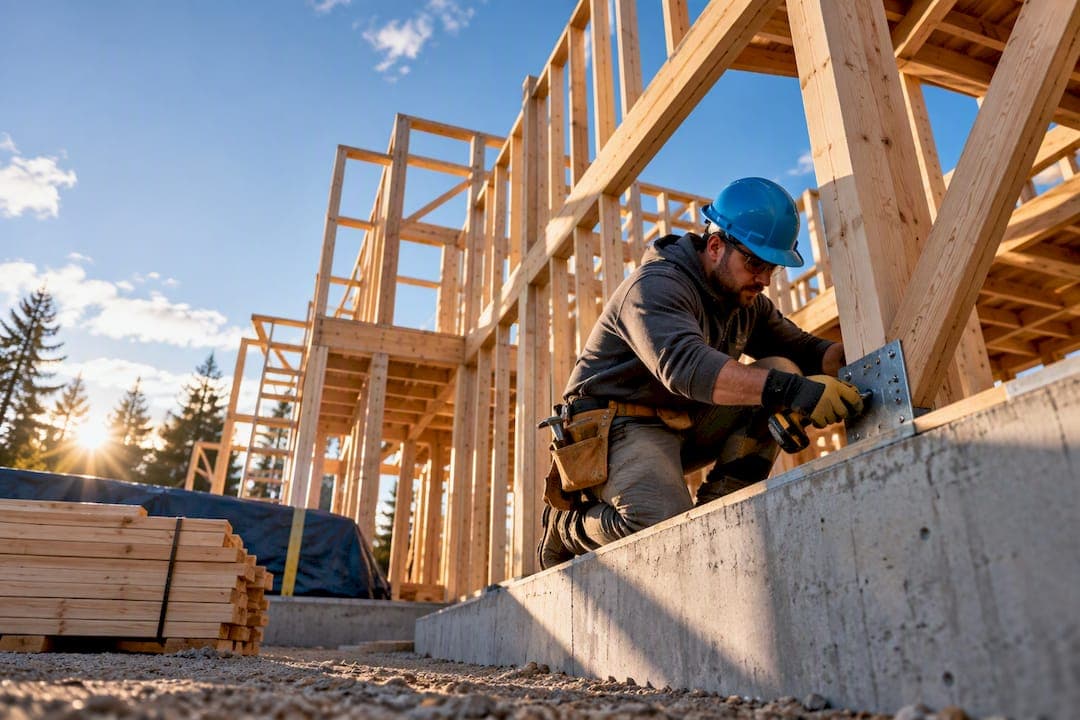
Expect builders risk insurance to run roughly 1% to 4% of your completed project value, with some carriers stretching that range to 5% depending on risk. For most small to midsize projects, that translates to about $100 to $300 per month, or $350 to $7,000 for the full policy term. Your actual number depends on location, materials, and timeline, so treat this as a starting point rather than a quote. A licensed insurance agency can turn these ranges into an exact figure once it knows your project details.
TL;DR:
- Builders risk insurance costs generally range from 1% to 4% of the project value, with high-risk locations and certain materials increasing premiums.
- Shorter projects and those with strong security measures can qualify for lower premiums, especially when proper documentation and high deductibles are used.
- Project type, location hazards, materials, and coverage choices significantly influence rates, and policy valuation approach (completed value vs reporting form) affects premium calculation.
- Premiums are usually paid by the property owner for residential builds and by the contractor for larger commercial projects, with coverage starting before ground break.
- Comparing policy language, valuation approach, and endorsements yields better coverage and cost savings than simply choosing the lowest-priced quote.
Table of Contents
- How Much Does Builders Risk Insurance Cost For Different Project Sizes?
- What Factors Affect Builders Risk Insurance Rates?
- How Do Insurers Calculate Your Insured Value During Construction?
- What Does Builders Risk Insurance Cover?
- How Can You Lower Your Builders Risk Premium?
- Who Pays for Builders Risk Insurance and When Should You Buy It?
- Expert Guidance From M F and T North America
- What the Cost Numbers Actually Tell You
- Get a Builders Risk Quote Built Around Your Project
- Sources
- FAQ
How Much Does Builders Risk Insurance Cost For Different Project Sizes?
The percent-of-project rule works because underwriters price against the value they'd have to replace if the structure burned down or collapsed mid-build. A $350,000 new-construction home at 2% comes closer to $7,000.

Market data backs up the lower end of that range for smaller jobs. Insureon's customer data shows a median builders risk premium of about $105 per month, with many policyholders paying under $100. Annual premiums across that same customer base typically fall between $350 and $7,000, which lines up with the percent-of-project math above once you account for shorter, smaller-scope jobs on one end and larger commercial builds on the other.
A few things shape whether you land near the low end or the high end:
- Project value drives the base number. Bigger completed value means a bigger dollar premium, even at the same percentage rate.
- Minimum premiums exist. Many carriers set a flat floor, often $500 to $1,000, so a tiny renovation might pay more than the percent rule alone suggests.
- Billing structure varies. Some policies bill monthly on actual project value; others charge a lump sum upfront for the entire construction period.
- Short jobs still hit minimums. A three-month kitchen remodel can trigger the same minimum premium as a six-month one, since underwriting costs don't scale down proportionally.
Getting a number that matches your actual project means sharing real project value, not a rough guess, when you request quotes.
What Factors Affect Builders Risk Insurance Rates?
Underwriters build your premium from several inputs, and understanding each one tells you where you have leverage and where you don't.
- Project type. New construction, renovation, and equipment installation each carry different risk profiles. A gut renovation of an occupied structure often costs more to insure than new ground-up construction because occupied space adds liability and damage complexity.
- Location hazards. Flood zones, wildfire-prone counties, coastal wind exposure, and tornado alley all raise rates. Carriers rely on catastrophe modeling for these regions, and NAIC underwriting resources explain how that modeling shapes both pricing and availability in high-risk counties.
- Construction materials. Wood-frame buildings generally cost more to insure than fire-resistive steel or concrete assemblies, since wood burns faster and total-loss risk climbs accordingly.
- Project duration. A 12-month build carries more fire, theft, and weather exposure than a 3-month one, and premiums usually reflect that stretched timeline.
- Coverage choices. Higher limits, lower deductibles, replacement-value settlement, and open-perils wording all push cost up compared to named-perils coverage with a higher deductible.
- Site controls. Security fencing, hot-work permitting, and temporary utility management all factor into how an underwriter prices risk.
Pro Tip: Ask your agent to compare a named-perils quote against an open-perils quote side by side. The premium gap is often smaller than people expect, and open-perils coverage protects against causes of loss the policy doesn't list by name.
How Do Insurers Calculate Your Insured Value During Construction?
Most builders risk policies use one of two valuation approaches, and picking the right one matters as much as the premium itself.
The completed-value basis insures the building at its projected finished value from day one, even though the structure is worth far less early in the build. The Insurance Information Institute describes this as the standard approach for shorter, more predictable projects, since insured value rises steadily as construction progresses toward that final number.
The reporting form works differently. You report actual construction value to the insurer monthly, and premium adjusts to match. This fits longer, multi-phase projects better because it avoids overpaying for coverage on value that doesn't exist yet in month two of a fourteen-month build.
Either basis needs to account for more than the structure itself. Soft costs, materials in transit or storage, and temporary structures on site all add to insured value, and each one needs to show up explicitly in your policy limits or you'll be underinsured exactly when you need coverage most.

What Does Builders Risk Insurance Cover?
A standard builders risk policy protects the structure under construction, along with materials and equipment on site, against causes like fire, wind, theft, and vandalism. Coverage typically follows the project from ground break through substantial completion.
Several endorsements extend that base coverage, and each one adds to your premium:
- Soft costs. Extra interest payments, lost sales income, and real estate taxes from a construction delay. Forbes Advisor notes these delay-related costs can meaningfully raise premium when added, but they also close a real gap most base policies leave open.
- Ordinance or law coverage. Pays for code-upgrade costs triggered by a covered loss.
- Transit and storage. Covers materials and equipment while they're off site or in transport, not just once they reach the job site.
- Flood and earthquake. Excluded from most base policies and priced separately based on location risk.
General liability and workers' compensation stay separate from builders risk entirely. Builders risk protects the property itself, not injury claims or third-party damage, so skipping those other policies leaves a real gap regardless of how strong your builders risk coverage looks.
How Can You Lower Your Builders Risk Premium?
A handful of concrete moves tend to move the number, sometimes significantly:
- Put fire prevention and hot-work permitting in writing. NFPA data shows U.S. fire departments responded to an estimated 4,440 fires in structures under construction annually between 2017 and 2021, with temporary electrical work and hot-work activities as leading causes. Documented prevention programs give underwriters a reason to price you lower.
- Choose your deductible deliberately. A higher deductible lowers premium, and it's often worth it if your project has strong site security and low fire risk.
- Bundle where it makes sense. Contractors running multiple projects may qualify for a master or annual policy instead of insuring each job separately.
- Document contractor experience. Underwriters price experienced general contractors with a clean claims history more favorably than unproven crews.
Pro Tip: If your project sits in a low-hazard area with tight security, a higher deductible paired with a leaner endorsement package usually beats paying for broad coverage you're unlikely to use.
Who Pays for Builders Risk Insurance and When Should You Buy It?
Payment responsibility usually comes down to contract language. Owners on ground-up custom homes often carry the policy themselves, while general contractors typically insure larger commercial and multifamily jobs. Either way, the named insured on the policy matters: whoever holds that designation is who gets paid after a covered loss.
Bind coverage before ground break or demolition begins, never after. Coverage generally runs through substantial completion unless you extend it for delays. If a lender is financing the project, list them as a mortgagee or loss payee on the policy so their interest is protected too.
Expert Guidance From M F and T North America
An experienced insurance agency with multiple decades in the market places insurance for contractors, developers, and property owners across multiple states, with builders risk as a specialty that includes single-project and reporting-form policies.
Getting a fast, accurate quote comes down to having a few things ready: your project budget, construction timeline, contractor information, and a description of site security or hot-work controls. An independent insurance agency shops multiple admitted carriers on your behalf, which helps you compare endorsements and often avoid the added fees that come with non-admitted, surplus-line coverage.
What the Cost Numbers Actually Tell You
The percent-of-project rule is useful, but it hides more than it reveals. Two projects at the same completed value, in the same state, can land tens of thousands of dollars apart in premium once you factor in construction type, deductible choice, and whether the policy uses named-perils or open-perils wording. Most owners fixate on the percentage and skip the policy language, which is backwards. A cheap quote with actual-cash-value settlement and no soft-cost endorsement can cost more in an actual loss than a pricier policy with broader terms.
The conventional advice, get three quotes and pick the lowest, misses the point. The right first move is documenting your project clearly: security measures, contractor history, and realistic timeline. That documentation does more to move your premium than shopping alone ever will. After that, compare policies on valuation basis and perils wording before you compare price. Reader who does both usually ends up with better coverage and a lower number than the one who only chases the cheapest quote.
— Mike
Get a Builders Risk Quote Built Around Your Project
Generic online calculators can provide a range, but they can't account for your specific site, contractor, or coverage needs the way a licensed agent can. Certain insurance agencies specialize in builders risk across multiple states, offering both single-project policies for one-off builds and term or reporting-form policies for contractors running multiple jobs at once, with same-day binding available once your details are in hand.
A typical quote request moves fast when you have your project budget, timeline, and contractor information ready. Some independent agencies shop your project across multiple admitted carriers rather than pushing one insurer's product, which often surfaces better terms and fewer surprises at claim time. If your project involves flood, wildfire, or coastal wind exposure, mention it upfront, since that shapes which carriers make sense from the start. Visit the builders risk insurance page to request a tailored quote for your project.
This article is general information, not a substitute for advice from a qualified financial advisor. Consult a qualified financial professional about your own circumstances before acting on anything here.
Sources
- Construction Contractors | Insurance Information Institute
- Fires in structures under construction (NFPA research)
- Builder’s Risk Insurance – Forbes Advisor
- Builder's Risk Insurance: How It Works, Best Options - NerdWallet
FAQ
How Much Is Builders Risk Insurance on a $400,000 Project?
Projects in low-hazard areas with fire-resistive construction tend to land toward the lower end of that range.
How Do You Calculate the Cost of Builders Risk Insurance?
Start with your completed project value and multiply by 1% to 4%, the common industry rule of thumb, to get a rough estimate. From there, adjust for location hazards, construction type, project duration, and any endorsements like soft costs or flood coverage, since each one moves the final number up or down.
Who Usually Pays for Builders Risk Insurance?
Payment responsibility depends on contract terms: property owners often carry the policy on custom home builds, while general contractors typically insure larger commercial projects. Whoever is listed as the named insured is the party who receives claim payments after a covered loss.
How Much Does $500,000 in Liability Insurance Cost?
General liability coverage is priced separately from builders risk and depends on business type, project scope, and claims history rather than a fixed percentage rule. M F and T North America can quote general liability coverage alongside your builders risk policy so both are priced and bound together.
What's the Difference Between Named Perils and Open Perils Coverage?
Named-perils policies only cover causes of loss explicitly listed in the policy, while open-perils coverage protects against any cause not specifically excluded. Forbes Advisor notes that two quotes with similar limits can offer very different real-world protection depending on which wording applies.