
Mold liability coverage pays third-party claims — bodily injury lawsuits and property damage suits filed against you by tenants, guests, or neighboring property owners — when mold exposure is linked to conditions on your property. It does not pay to clean up mold in your own building; that is a first-party remediation question handled separately. Here is what to check first:
- Trigger matters most. Coverage is far more likely when mold follows a sudden, accidental covered peril (a burst pipe, appliance overflow) than when it stems from a slow leak or deferred maintenance.
- Sublimits are common. Standard homeowners and commercial policies often apply sublimits for fungi-related losses, or exclude mold entirely.
- Act immediately. Document the moisture source, photograph conditions, and notify your insurer in writing before any remediation begins.
Many property owners assume mold is covered by their base policy. Consumer reporting consistently shows that assumption leads to expensive surprises at claim time.
Table of Contents
- What mold liability coverage actually covers and where it lives in your policy
- Common mold liability claim scenarios you should recognize
- How policy wording controls what gets paid: limits, exclusions, and endorsements
- How insurers handle mold liability claims and who bears legal responsibility
- When mold from water damage is covered and when it is not
- Practical steps to reduce your mold liability and protect your coverage
- How M F and T North America helps you close mold liability gaps
- Key Takeaways
- The mistake that costs property owners the most
- Get a mold liability policy review from M F and T North America
- Useful sources and further reading
What mold liability coverage actually covers and where it lives in your policy
Mold liability coverage protects you from third-party claims: a tenant who alleges respiratory illness from mold exposure, a neighboring unit owner whose contents were damaged by mold spreading from your property, or a buyer who sues after discovering undisclosed mold. It covers bodily injury, third-party property damage, and in some forms, the cost of testing and remediation when a third party demands it as part of a lawsuit.
Meaningful mold liability coverage moved out of standard base policies after a wave of litigation in the early 2000s. Today it typically lives in one of these forms:
- Commercial General Liability (CGL) with a buy-back endorsement — the base CGL excludes fungi; you purchase a limited buy-back to restore some coverage.
- Pollution Legal Liability (PLL) or Contractors Pollution Liability (CPL) — broader environmental forms that treat mold as a pollutant and provide dedicated limits.
- Specialty environmental forms — used by larger property portfolios or developers with significant mold exposure history.
- Landlord or apartment endorsements — added to a homeowners or dwelling policy for small residential landlords.
Who is protected under these forms:
- Property owners and managers named as insureds on the policy.
- Contractors, if they are added as additional insureds and the claim falls within their scope of work.
Who is not protected:
- The insured's own first-party mold losses (your building, your contents) unless a separate remediation endorsement is in place.
- Tenants seeking coverage for their own belongings — that is a renters insurance question, not yours.
Common mold liability claim scenarios you should recognize
Understanding mold damage liability is easier with concrete examples. Here are the situations property owners and managers face most often.
-
Tenant respiratory illness after persistent dampness. A tenant reports chronic coughing and headaches, hires an attorney, and files a bodily injury claim alleging mold in the unit caused the illness. The insurer will investigate whether the moisture source was a sudden covered event or a long-standing maintenance failure. If maintenance records show repeated complaints about a slow leak that went unaddressed, coverage is likely denied or limited to a sublimit.
-
Cross-unit mold spread in a multiunit building. Mold originating in one unit migrates through shared walls to a neighboring unit, damaging the neighbor's personal property. The affected tenant sues for contents damage and loss of use. This is a third-party property damage claim. Coverage depends on whether the source event was sudden and whether the policy includes a mold buy-back.
-
Contractor failed remediation leading to recurrence. A remediation contractor removes visible mold but fails to address the moisture source. Mold returns within months, and the tenant files a new claim. Remediation failures that leave the moisture source intact often shift liability to the contractor, but the property owner may still face a direct claim if they selected an unqualified vendor.
Typical damage categories across these scenarios:
- Medical bills and lost wages (bodily injury claims)
- Personal property replacement (contents damage)
- Structural tear-out and repair costs
- Loss-of-use or alternative housing claims from displaced tenants
Professional mold remediation costs vary widely, with whole-building projects potentially costing tens of thousands of dollars. Small sublimits cover only a portion of such exposures.

How policy wording controls what gets paid: limits, exclusions, and endorsements
The declarations page is where mold liability explained in plain language either reassures you or reveals a gap. Here is what to look for.
Sublimits and aggregate caps. Most policies that include any mold coverage apply a separate, lower limit for fungi or bacteria claims. This sublimit is distinct from your main liability limit and often exhausts quickly in a real claim.
ISO endorsements to find by name:
- CG 21 27 (Fungi or Bacteria Exclusion) — removes all coverage for mold-related bodily injury and property damage from the CGL. If you see this on your declarations, you have no base mold liability coverage.
- CG 24 25 (Limited Fungi or Bacteria Coverage) — restores limited coverage under a separate aggregate, typically with a small sublimit.
Anti-concurrent causation language is a major denial driver. Insurers use this clause to deny a claim entirely when mold is listed as an excluded cause, even if a covered water event contributed. The clause says: if an excluded cause and a covered cause both contribute to a loss, the exclusion wins.
Ensuing loss exception. Even with a mold exclusion, your insurer may still owe for tear-out, drying, and structural repairs caused by the underlying covered water event. This varies by state and policy wording, so do not assume a mold exclusion means total denial.
Declarations page checklist:
- Is CG 21 27 listed? If yes, you need a buy-back or a separate environmental form.
- What is the fungi/bacteria sublimit? Is it adequate given your building size?
- Does the policy include a retroactive date (for claims-made environmental forms)?
- Is remediation or ensuing loss explicitly included or excluded?
Pro Tip: When requesting a buy-back endorsement, carriers will ask about your building's maintenance history, prior water losses, and any past remediation work. Gather those records before you call your agent — a clean history can meaningfully reduce the endorsement premium.
How insurers handle mold liability claims and who bears legal responsibility
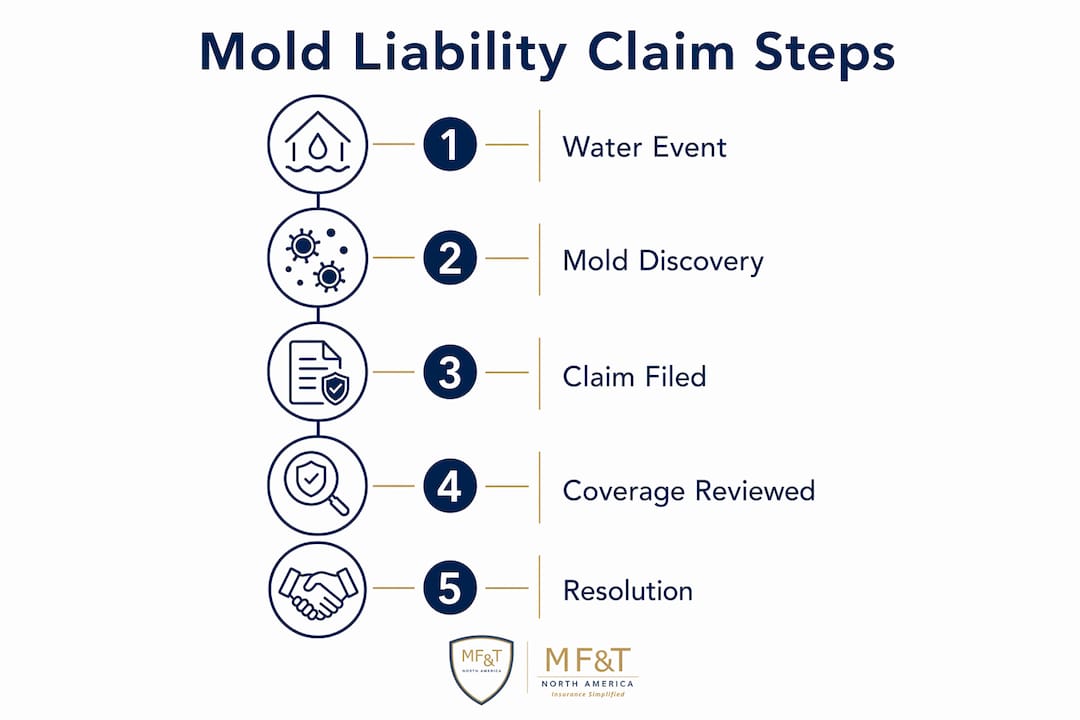
The claims process follows a predictable sequence, and your documentation at each step determines the outcome.
- Initial notice. Report the claim in writing as soon as you learn of a mold complaint or lawsuit. Late notice is a common basis for denial.
- Inspection and testing. The insurer will send an adjuster and typically require professional air sampling, surface testing, and moisture mapping. A successful liability claim requires objective technical evidence linking the moisture source to the mold. Air samples run $50–$300 each; a full professional inspection costs $150–$1,200.
- Technical report and causation analysis. The insurer's expert must connect the mold to a covered peril. Without that link, the claim is denied.
- Coverage decision. The insurer accepts, denies, or reserves rights pending further investigation.
- Remediation and subrogation. If coverage applies, the insurer may fund remediation and then pursue the responsible party (a plumber, roofer, or prior owner) through subrogation.
Evidence you should assemble before the adjuster arrives:
- Maintenance logs showing inspection dates and completed repairs
- Repair invoices for all prior water intrusion work
- Tenant incident reports and written complaints with dates
- Photos of the moisture source, affected areas, and any visible mold
- Vendor remediation contracts and completion certificates
- Professional inspection reports from any prior testing
Legal liability issues. Negligence is the standard in most mold bodily injury claims: the plaintiff must show you knew or should have known about the moisture condition and failed to act. Statutes of limitation vary by state, but the discovery rule often starts the clock when the tenant first noticed symptoms, not when the mold appeared. Contractor liability shifts when a remediation vendor's work fails — but only if that contractor carries its own Contractors Pollution Liability coverage. Hiring an uninsured remediator leaves you holding the bag on recurrence claims.
When mold from water damage is covered and when it is not
The single clearest predictor of coverage is the timeline between the water event and the mold discovery.
| Scenario | Likely insurer framing | Coverage outcome |
|---|---|---|
| Burst pipe discovered same day; mold found within 2 weeks | Sudden, accidental covered peril | Coverage likely (subject to sublimit) |
| Slow roof leak reported by tenant; mold found months later | Long-term neglect, gradual deterioration | Coverage likely denied |
| Appliance overflow; owner mitigates promptly | Sudden event, prompt response | Coverage likely (well-documented) |
| Chronic basement dampness; no maintenance records | Gradual moisture, no covered trigger | Coverage denied |
Mold from flooding is typically excluded under standard homeowners policies — flood coverage requires a separate National Flood Insurance Program policy or private flood endorsement.
What to do immediately after a water event:
- Shut off the source and document the date and time with photos.
- Call a licensed water mitigation company within 24–72 hours. Rapid response is the clearest signal to an insurer that the loss was sudden, not chronic.
- Preserve all wet materials until the adjuster inspects — do not discard damaged items.
- Notify your insurer in writing before remediation begins.
Practical steps to reduce your mold liability and protect your coverage
Prevention and documentation work together. Good records do not just reduce mold risk; they are your best defense if a claim arises.
Day-to-day prevention checklist:
- Maintain indoor humidity below 60% (the CDC recommends 30–50%) using dehumidifiers and HVAC maintenance.
- Inspect roofs, gutters, and plumbing annually and after major storms.
- Service HVAC systems and exhaust fans on a scheduled basis.
- Respond to tenant water complaints in writing within 24 hours and complete repairs within a documented timeframe.
- Keep gutters clear to prevent water intrusion at the foundation.
Documentation practices that preserve coverage:
- Use a structured maintenance log with dates, work performed, and vendor names.
- Require tenants to submit water intrusion reports in writing.
- Keep all repair invoices and remediation certificates in a dedicated property file.
- Record response times to every water complaint.
Responding to a water intrusion within 24–72 hours materially improves the likelihood an insurer treats mold as arising from a covered sudden event rather than chronic neglect.
Pro Tip: When hiring a remediation vendor, require a written contract that specifies the moisture source must be addressed before any surface mold removal begins. Include a warranty clause and verify the vendor carries Contractors Pollution Liability insurance. This protects your subrogation rights and reduces your exposure if mold recurs.
For qualified mold testing and air quality assessments, use a certified environmental professional who can produce a written report suitable for insurance purposes.
How M F and T North America helps you close mold liability gaps
M F and T North America reviews your existing policy for fungi exclusions and sublimits, then works with carriers to obtain buy-back endorsements or place coverage on a dedicated environmental form. Here is what the process looks like in practice.
Agency services for mold liability:
- Policy audit: identifying CG 21 27 exclusions, sublimit amounts, and anti-concurrent causation language on your current declarations.
- Endorsement placement: requesting CG 24 25 buy-backs or pollution legal liability quotes with adequate limits for your building size.
- Submission preparation: assembling maintenance logs, loss history, and remediation records to present a favorable risk profile to underwriters.
- Claims advocacy: helping you organize documentation and communicate with adjusters during an active claim.
- Contractor-vetting guidance: confirming that remediation vendors carry appropriate pollution liability coverage before you sign a contract.
What to bring to your first agency meeting:
- Your current declarations page (homeowners, landlord, or commercial property policy)
- Recent photos of the property, especially any areas with prior water damage
- Maintenance logs and repair invoices for the past three years
- Documentation of any prior mold complaints or remediation work
M F and T North America has helped property owners and managers across multiple states review their homeowners coverage for exactly these gaps for over 30 years. Knowing what your policy says before a claim arrives is always less expensive than finding out during one.
Key Takeaways
Mold liability coverage protects property owners from third-party bodily injury and property damage claims, but standard policies routinely exclude or sublimit it, making a proactive policy review the single most important step you can take.
| Point | Details |
|---|---|
| Standard policies often exclude mold | Most base homeowners and CGL policies apply sublimits or exclude fungi entirely via ISO endorsement CG 21 27. |
| Trigger determines coverage | Mold following a sudden, accidental covered peril is far more likely to be covered than mold from chronic leaks or deferred maintenance. |
| Documentation is your best defense | Maintenance logs, repair invoices, and 24–72 hour response to water events materially improve your claim outcome. |
| Ensuing loss may still be covered | Even with a mold exclusion, tear-out and structural repairs from a covered water event may be owed under the ensuing loss exception. |
| M F and T North America | Offers policy audits, buy-back endorsement placement, and claims advocacy to close mold liability gaps for property owners. |
The mistake that costs property owners the most
Most mold liability claims that end badly share one thing: a small leak that nobody documented. A dripping pipe under a sink, a slow roof seam, a bathroom exhaust fan that stopped working — these are not dramatic events, so owners defer the repair. Months later, a tenant reports symptoms, an attorney sends a demand letter, and the insurer pulls the maintenance log. There is nothing in it. The claim is denied.
The fix is not complicated. A simple written log, a 24-hour response policy for water complaints, and an annual inspection of the roof and plumbing are enough to shift the narrative from "chronic neglect" to "well-maintained property with a sudden event." That shift is the difference between a covered claim and an out-of-pocket loss.
After 30 years of helping property owners navigate exactly these situations, the clearest advice is this: do not wait for a claim to find out what your policy actually says about mold. The endorsement costs far less than the lawsuit.
Get a mold liability policy review from M F and T North America
Knowing you have a mold exclusion on your declarations is worth nothing if you do not act on it. M F and T North America provides a straightforward policy review that identifies fungi sublimits, missing endorsements, and coverage gaps, then helps you place the right buy-back or environmental form at a price that fits your property.

The process is simple. Bring your declarations page, recent property photos, and any maintenance records you have. The team will review your current coverage, identify what needs to change, and submit to carriers on your behalf. No guesswork, no surprises at claim time.
Get a free insurance quote or visit the homeowners insurance page to start your review today.
Useful sources and further reading
- LegalClarity — Does Homeowners Insurance Cover Mold? — Explains standard exclusions, sublimit ranges, and the ensuing loss exception.
- LegalClarity — Mold Remediation Liability — Covers landlord, seller, and contractor liability; includes remediation cost ranges and causation evidence requirements.
- IRMI — Policy Modifications and Endorsements for Mold — Authoritative industry commentary on ISO endorsements CG 21 27 and CG 24 25.
- Goldberg Segalla — Mold Litigation and Insurance Responses — Legal analysis of anti-concurrent causation clauses and claim denial patterns.
- CNBC — How Homeowners Insurance Covers Mold Damage — Consumer-facing overview of carrier practices and common policyholder surprises.
- GetBusinessCoverage — Mold/Fungi Liability Glossary — Plain-language definition and market behavior summary for mold liability coverage.
- CDC — Mold — Authoritative health guidance on mold exposure, recommended humidity levels, and remediation basics.
- MSN Environmental — Mold Remediation Services — Qualified remediation vendor for property owners needing certified mold removal.
- M F and T North America — Home Insurance Exclusions — Detailed guide to the most common homeowners policy exclusions, including fungi and bacteria.
This article is general information, not legal or insurance advice. Confirm your specific coverage with your policy documents and a licensed insurance professional before making coverage decisions.