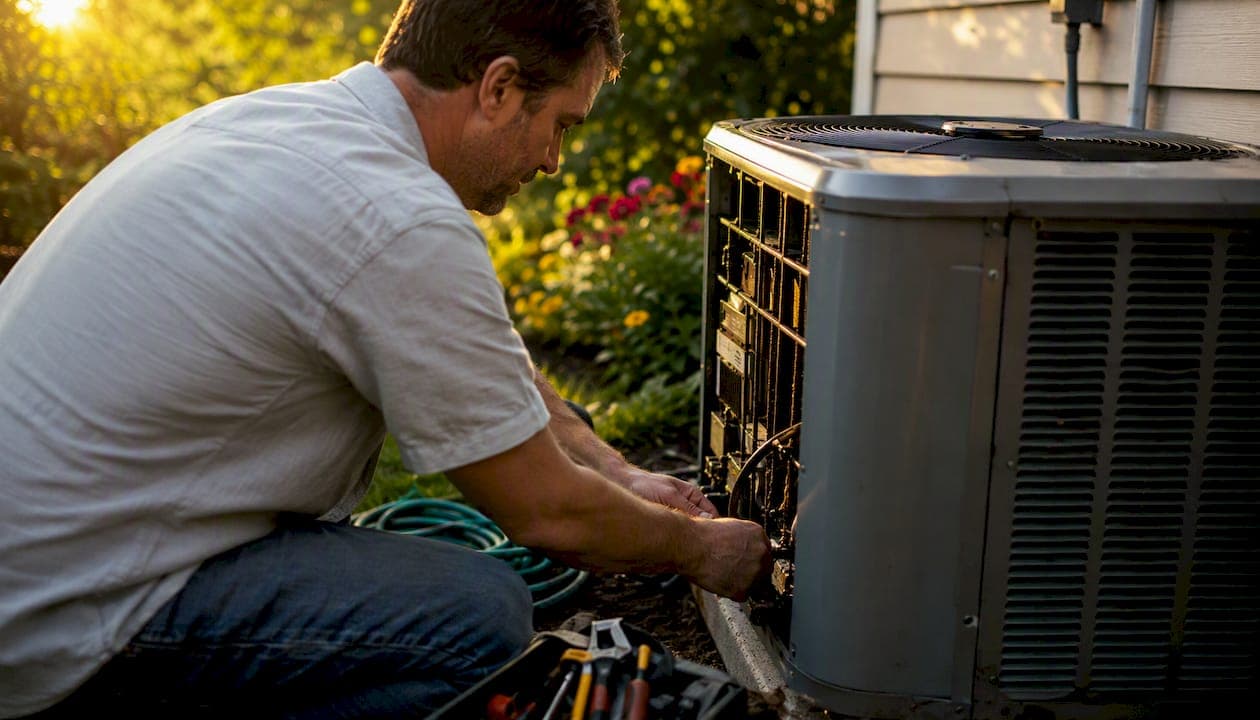
Home systems protection is an optional endorsement you add to your existing homeowners policy to cover the repair or replacement of appliances and permanently installed systems after a sudden mechanical or electrical breakdown. Standard homeowners insurance pays for damage caused by fire, storms, and similar perils. It does not pay when your furnace motor burns out or your AC compressor fails on its own. This endorsement fills that gap, and it does so at a fraction of what an out-of-pocket repair typically costs.
Here is what that means for you right away:
- Broad coverage for your biggest systems: HVAC units, water heaters, built-in appliances, electrical panels, and interior plumbing are all commonly included under home systems protection.
- Low annual cost compared to repair bills: Endorsement pricing often runs in the range of $30–$60 per year added to your homeowners premium, while a single AC compressor replacement can cost several hundred dollars or more.
- Best fit for older homes and tech-heavy households: If your systems are more than 10 years old, or your home runs smart devices and microelectronic controls, ask your agent about adding this endorsement at your next policy review.
Key Takeaways
Home systems protection is an endorsement that fills the gap standard homeowners insurance leaves open — covering sudden mechanical and electrical breakdowns that no base policy pays for.
| Point | Details |
|---|---|
| What it covers | Sudden mechanical or electrical breakdown of HVAC, water heaters, electrical systems, built-in appliances, and more. |
| Top exclusions | Wear and tear, pre-existing damage, manufacturer defects, and improper installation are the most common denial reasons. |
| Typical cost | Endorsement pricing often runs $30–$60 per year, far less than home warranty plans at $450–$900 per year. |
| Who should buy it | Owners of systems 8–15 years old, smart-home households, and anyone who wants predictable repair costs. |
| M F and T North America | An independent agency with 30+ years of experience that can compare endorsement options across multiple carriers for you. |
Table of Contents
- What is home systems protection, exactly?
- What does home systems protection typically cover?
- What home systems protection does not cover
- How does home systems protection differ from a home warranty?
- Who benefits most from this endorsement?
- What does home systems protection cost?
- How to file a home systems protection claim
- Add-ons worth considering
- Questions to ask your agent before adding the endorsement
- How M F and T North America can help you add this coverage
- What most homeowners get wrong about this coverage
- Protect your home systems with M F and T North America
- Sources
What is home systems protection, exactly?
Home systems protection is an optional homeowners-policy endorsement — a rider attached to your existing policy rather than a separate contract you buy from a third party. The endorsement activates when a covered system or appliance suffers a sudden and accidental mechanical or electrical breakdown. That phrase matters at claim time. "Sudden and accidental" means the failure happened without warning and was not the result of gradual deterioration, neglect, or a manufacturer defect.
A practical example: your central air compressor stops working on a July afternoon with no prior symptoms. That qualifies. Your refrigerator's door seal slowly degrades over two years until the unit stops cooling efficiently. That does not qualify, because the failure was gradual, not sudden.
The endorsement sits inside your homeowners policy, which means it shares your policy deductible and follows your insurer's claims process. You do not manage a separate service-contract company or pay a per-visit fee every time something breaks.
What does home systems protection typically cover?
Coverage varies by insurer and endorsement form, but most policies include the following categories, as described in the HSB Home Systems Protection brochure:
- Heating and cooling systems: Central furnaces, heat pumps, central AC units, and boilers.
- Water heaters: Tank and tankless units that are permanently installed.
- Interior plumbing systems: Pipes, pumps, and fixtures inside the home's walls and foundation.
- Electrical systems: Panels, wiring, and circuit breakers.
- Permanently installed appliances: Built-in dishwashers, ovens, ranges, and refrigerators.
- Security and communications equipment: Alarm systems, intercoms, and similar built-in electronics.
- Pool and spa equipment: Pumps, motors, and filtration systems.
- Emergency generators: Standby units permanently connected to your home.
To put dollar amounts in context: a furnace motor replacement can run $400–$600 in parts and labor, and an AC compressor replacement often exceeds $1,000. Without the endorsement, those costs come entirely out of pocket.
Pro Tip: Keep a folder with appliance receipts, installation dates, and annual service records. Insurers may ask for maintenance documentation when you file a breakdown claim, and having those records ready can speed up approval significantly.
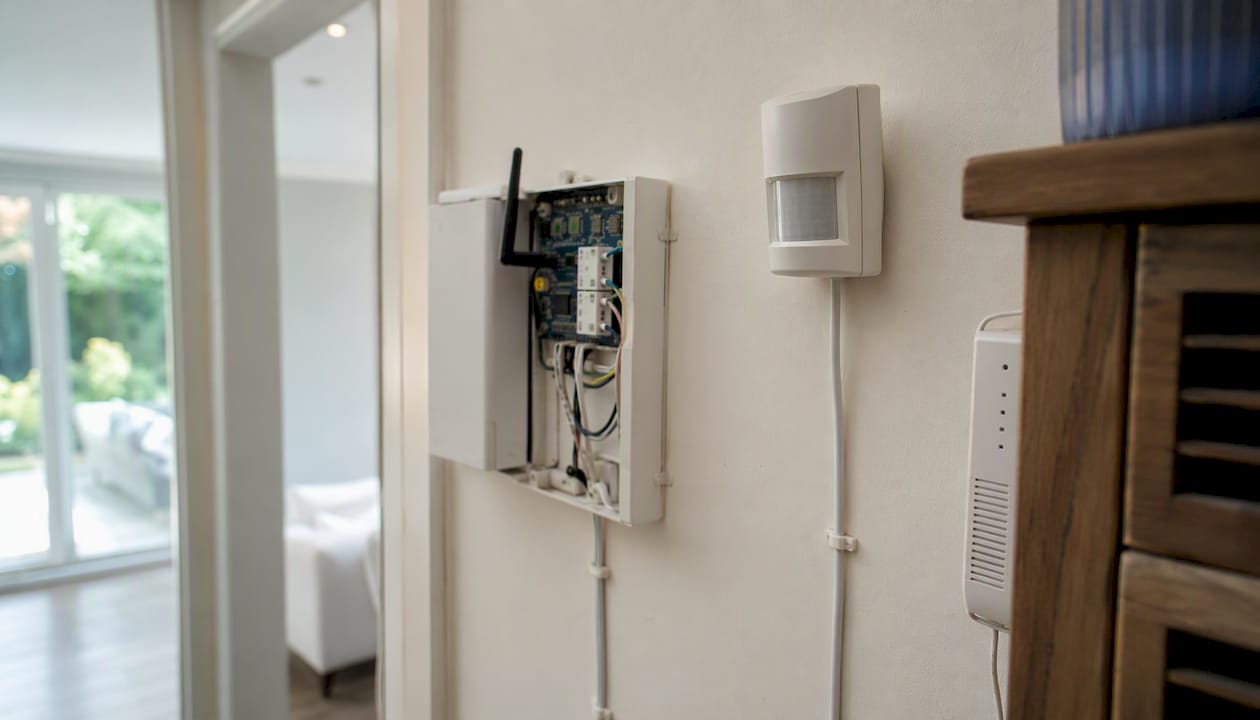
Homes with advanced security installations — including modern security systems wired into the structure — benefit especially from coverage that extends to built-in electronics and communications equipment.
What home systems protection does not cover
Knowing the exclusions is just as important as knowing what is covered. Most endorsements exclude the following:
Wear and tear is the most common exclusion. Equipment that degrades gradually over its normal lifespan does not meet the "sudden and accidental" trigger. If your water heater is 18 years old and slowly loses efficiency before failing, the insurer will likely attribute the failure to age and normal use.
Pre-existing conditions are excluded across virtually all policies. If a system was already malfunctioning before the endorsement took effect, any resulting breakdown is not covered. This is why insurers sometimes require a waiting period before coverage activates.
Manufacturer defects fall outside the scope of breakdown coverage. A factory flaw that causes a unit to fail is the manufacturer's liability, typically addressed through a product warranty rather than an insurance endorsement.
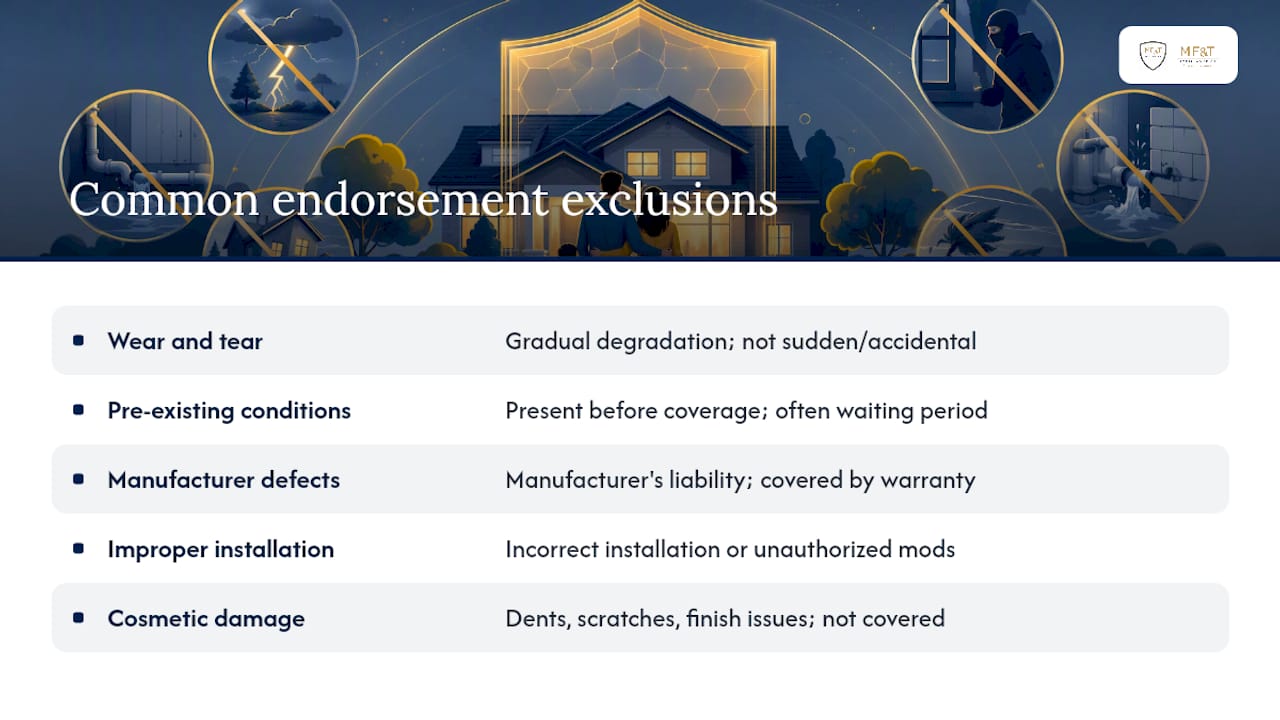
Improper installation is another frequent denial reason. If a contractor installed your HVAC unit incorrectly and that error causes a breakdown, the claim will likely be denied. The same applies to unauthorized modifications.
Cosmetic damage — dents, scratches, or finish deterioration — is not covered. The endorsement pays for functional failure, not appearance.
Common reasons insurers deny equipment breakdown claims:
- The failure resulted from gradual wear and tear, not a sudden event.
- Pre-existing damage was present before the policy or endorsement took effect.
- The item was not properly maintained, and lack of upkeep contributed to the failure.
- The breakdown stemmed from a manufacturer defect covered by a product warranty.
- The equipment was improperly installed or modified.
Most endorsements also carry sublimits — per-item or per-occurrence caps. A policy might cover up to $5,000 for HVAC but only $1,500 for a built-in appliance. If your high-end refrigerator costs $3,000 to replace, a $1,500 sublimit leaves you covering the difference. Always check the per-item limits against the actual replacement cost of your equipment.
How does home systems protection differ from a home warranty?
These two products are frequently confused, and the distinction matters when you are deciding what to buy. They cover different triggers, operate under different contract structures, and handle claims differently.
| Feature | Home Systems Protection | Home Warranty | Standard Homeowners Insurance |
|---|---|---|---|
| Contract type | Insurance endorsement | Service contract | Insurance policy |
| Coverage trigger | Sudden mechanical/electrical breakdown | Normal wear and tear | Physical damage from covered perils (fire, storm, theft) |
| Annual cost | a modest addition to premium | a significant annual fee | Varies by policy |
| Per-claim cost | Policy deductible | Per-visit service fee | Policy deductible |
| Claims handled by | Your insurance carrier | Third-party warranty company | Your insurance carrier |
| Pre-existing conditions | Excluded | Excluded | Not typically relevant |
A home warranty is a service contract that pays for repairs caused by normal wear and tear, the gradual breakdown that happens as systems age. Home systems protection, by contrast, covers sudden failures that are not the result of aging. Standard homeowners insurance covers neither; it responds to physical damage from named perils like fire or wind.
Here is a quick scenario to make it concrete: your dishwasher's pump motor fails suddenly with no prior warning. Home systems protection responds. If the same dishwasher slowly corrodes over years of hard-water use and eventually stops draining, a home warranty is the product designed for that. If a burst pipe floods the kitchen and damages the dishwasher, standard homeowners insurance handles it.
The two products are often complementary rather than competing. Many homeowners carry both.
Who benefits most from this endorsement?
Not every homeowner needs home systems protection equally. The endorsement delivers the most value in specific situations.
- Owners of older systems: Equipment that is 8–15 years old is past its peak reliability but may not yet be due for planned replacement. The risk of a sudden breakdown is highest in this window.
- Homes with high-cost equipment: If your HVAC system, generator, or pool equipment would cost thousands to replace, the endorsement's annual premium is a small hedge against a large, unpredictable expense.
- Smart homes and microelectronic-heavy households: As homes add more sensitive electronics and smart devices, the frequency of electrical and mechanical failures that produce no visible physical damage increases. An endorsement that covers microelectronic circuitry failures is especially relevant here.
- Rural homeowners: Longer service-call distances mean higher labor costs when something breaks. The endorsement can offset those elevated repair bills.
- Homeowners who prefer predictable costs: If you budget carefully and want to avoid surprise four-figure repair bills, the endorsement converts an unpredictable risk into a known annual cost.
When it is probably not worth it: if your home was built or fully renovated within the last five years, most major systems are still under manufacturer warranties and the statistical likelihood of a sudden breakdown is low. In that case, the endorsement may not return its cost until those warranties expire.
What does home systems protection cost?
Endorsement pricing typically runs $30–$60 per year added to your homeowners premium, though the actual figure depends on coverage breadth, the limits you select, your deductible, and whether you add optional riders like service-line coverage.
Compare that to home warranty plan costs, which commonly run $450–$650 per year for a basic plan and $600–$900 per year for a comprehensive plan, plus a per-visit service fee each time a technician is dispatched.
Key factors that move the endorsement price:
- Coverage scope: More systems and appliances covered means a higher premium.
- Per-item limits: Higher sublimits cost more but protect you better on expensive equipment.
- Deductible size: A higher deductible lowers the annual premium but increases your out-of-pocket cost at claim time.
- Add-on riders: Service-line coverage, spoilage coverage, and green-upgrade incentives each add to the cost.
- Equipment age and condition: Some insurers adjust pricing based on the age of your major systems.
A simple cost-effectiveness example: if your AC compressor fails and the repair costs $1,200, and your endorsement cost $50 for the year with a $500 deductible, your net savings on that single claim is $650. One claim in a decade still puts you ahead of paying out of pocket.
How to file a home systems protection claim
The claims process follows your standard homeowners insurance workflow, with a few documentation steps specific to equipment breakdown.
- Document the failure immediately. Take photos or video of the affected equipment showing any visible signs of the breakdown. Note the date, time, and any unusual sounds or behaviors that preceded the failure.
- Contact your insurer or agent. Report the claim as soon as possible. Most carriers allow online filing, phone, or app-based reporting.
- Do not discard the failed equipment. The insurer may send an adjuster or request a technician's inspection before authorizing repair or replacement.
- Gather your documentation. Pull together maintenance records, service invoices, the equipment's serial number and model, and any proof of purchase or installation date.
- Cooperate with the inspection. An adjuster or approved technician will assess whether the failure meets the "sudden and accidental" trigger and confirm the equipment was properly maintained.
- Receive authorization. Once approved, the insurer authorizes repair or replacement up to the applicable sublimit, minus your deductible.
- Complete the repair or replacement. Use an insurer-approved contractor or follow your policy's instructions on contractor selection.
Documentation that speeds up approval:
- Annual HVAC service records or tune-up receipts
- Plumber or electrician invoices for recent inspections
- Appliance purchase receipts and installation records
- Photos showing the sudden nature of the damage
- Serial numbers and model numbers for all affected equipment
Timing varies. Simple claims with clear documentation often resolve within a week. Claims requiring parts that are on back-order or specialist inspections can take two to four weeks. Keeping maintenance records current is the single most effective way to avoid delays.
Add-ons worth considering
The base endorsement covers sudden breakdown of interior systems and appliances. Several optional riders can materially expand that protection.
Service line coverage pays for the repair or replacement of underground utility lines running from the street to your home — water, sewer, electrical, and gas lines. These are not covered by your utility company and not covered by standard homeowners insurance. A single buried pipe failure can cost thousands to excavate and repair.
Microelectronic circuitry coverage addresses failures in sensitive electronic components where no physical damage is visible. Some high-value endorsements specifically include this, recognizing that modern HVAC controls, smart thermostats, and appliance circuit boards fail in ways that leave no obvious mark.
Spoilage coverage reimburses you for food lost due to a covered refrigerator or freezer breakdown.
As noted by PURE Insurance, this incentive can offset the higher upfront cost of an Energy Star-rated replacement.
Add-ons typically carry their own sublimits and sometimes a separate deductible. Service-line coverage, for example, might have a $10,000 per-occurrence limit with a $500 deductible independent of your main policy deductible.
Questions to ask your agent before adding the endorsement
Before you sign off on the endorsement, get clear answers to these questions. They will help you avoid surprises at claim time.
- What is the per-item coverage limit for each system? Knowing the sublimit for HVAC, appliances, and electronics tells you whether the coverage actually matches your replacement costs.
- What deductible applies, and is it the same as my main policy deductible? Some endorsements carry a separate, higher deductible.
- Is there a waiting period before coverage becomes effective? Many endorsements include a 30-day waiting period after the endorsement is added. A breakdown during that window is not covered.
- What proof of maintenance will I need to file a claim? Ask specifically what records the insurer expects so you can start keeping them now.
- How is replacement cost calculated — actual cash value or replacement cost value? Actual cash value accounts for depreciation; replacement cost value pays what a new unit costs. The difference on a 12-year-old furnace can be significant.
- Are green or energy-efficient upgrades covered at a higher limit? If so, what documentation do you need to qualify?
- Which systems and appliances are explicitly excluded from my endorsement? Get the exclusions list in writing, not just a verbal summary.
- Does the endorsement cover equipment I added after the original construction? A generator or pool pump installed after you bought the home may need to be specifically listed.
Comparing coverage terms across insurers before you commit is worth the extra hour. Sublimits and exclusions vary more than the annual premium does.
How M F and T North America can help you add this coverage
M F and T North America has been helping homeowners across multiple states find the right coverage for over 30 years. As an independent agency, the team works with multiple carriers rather than a single insurer, which means you get options rather than a one-size-fits-all answer.
Adding home systems protection to an existing policy is straightforward when you work with an agent who knows the endorsement forms. The process typically involves a policy review, a quick assessment of your current systems and their ages, and a comparison of endorsement options across the carriers M F and T North America represents.
To prepare for that conversation, gather the following:
Your policy declarations page shows your current coverage limits and deductibles. Your equipment age and purchase records help the agent identify which systems are most at risk and which sublimits make sense. Serial numbers for major appliances and systems allow the insurer to confirm eligibility. Recent maintenance records demonstrate that your equipment has been properly serviced, which supports a clean claim if you ever need to file one.
You can reach M F and T North America by phone, online, or by scheduling a policy review appointment. The homeowners insurance FAQ page is a good starting point if you want to review common coverage questions before your call.
What most homeowners get wrong about this coverage
The most common mistake I see is homeowners assuming their standard policy already covers equipment breakdown. It does not. Standard homeowners insurance is built around physical damage from external perils. When a compressor fails from the inside out, there is no fire, no storm, no theft — just a mechanical failure that your base policy was never designed to address.
The second mistake is waiting until after a breakdown to ask about the endorsement. At that point, the damage is pre-existing and the endorsement will not cover it. The time to add this coverage is before something fails, ideally during your annual policy review.
My recommendation: pull out your policy declarations page today. Look at what your current homeowners policy actually covers for equipment failure. If you see nothing, call your agent this week and ask for a quote on a home systems protection endorsement. It takes about 15 minutes and could save you thousands.
Protect your home systems with M F and T North America
A single furnace failure or AC breakdown can cost more than a decade's worth of endorsement premiums. M F and T North America gives you access to home systems protection options from multiple carriers, so you can compare limits, deductibles, and add-ons side by side rather than accepting whatever a single insurer offers.
With over 30 years of independent agency experience, the team at M F and T North America knows which endorsement features matter most for homes in your area and can walk you through the options in plain language. Whether you want to add the endorsement to an existing policy or review your full homeowners insurance coverage from the ground up, the process starts with a free quote.
Request your free quote at Mfandtna or call the Arlington, MA office directly. Bring your declarations page and a rough idea of your major systems' ages, and the team will handle the rest.
Sources
- What Does Home Systems Protection Cover? Exclusions and Cost - LegalClarity
- The Nerds Explain Home Warranties - NerdWallet
- What Is a Home Warranty? - Investopedia
- Home Warranty Service Contracts - Arizona Department of Insurance and Financial Institutions (DIFI)
This article is general information, not a substitute for advice from a qualified financial advisor. Consult a qualified financial professional about your own circumstances before acting on anything here.