
Excess liability coverage is an extra layer of insurance that raises the dollar limit of a specific underlying liability policy and only pays after that underlying policy's limits are fully exhausted. Think of it as a financial backstop: your primary policy handles the first portion of a claim, and your excess policy picks up the remainder, up to its own limit.
Who typically buys it:
- Individuals with significant personal assets, rental properties, teen drivers, or watercraft
- Small businesses and contractors who face contract requirements specifying minimum liability limits.
The main benefit: It raises your financial ceiling without changing what types of claims are covered.
A good starting point is to compare your net worth or your largest contract requirement against your current liability limits. If there's a meaningful gap, an excess layer above your current limits is often where to start the conversation with your agent.
Table of Contents
- What is excess liability coverage and how does it sit above your primary policy?
- What does excess liability cover, and what does it leave out?
- Excess liability vs. umbrella insurance: what's the real difference?
- Who actually needs excess liability coverage?
- How much excess liability coverage should you buy?
- How does excess liability actually pay a claim?
- Real-life examples that show why excess limits matter
- How to buy excess liability: a step-by-step guide
- Why an independent broker makes a difference for excess placements
- Key Takeaways
- What most people get wrong about excess liability
- Get the right excess limits with Mfandtna
- Useful sources for further reading
What is excess liability coverage and how does it sit above your primary policy?
Excess liability insurance increases the limits of an existing liability policy. It does not expand coverage. That distinction matters more than most people realize.
Here's the structure: you carry a primary (underlying) policy, such as a general liability policy, a commercial auto policy, or a homeowners policy. That primary policy has a stated limit, say $1 million per occurrence. If a covered claim exceeds that limit, your excess policy steps in and pays the difference, up to its own stated limit.
Excess coverage can be monoline or multi-policy. A monoline excess policy attaches to just one underlying policy. A multi-policy excess form can be scheduled over several underlying policies at once, which is common for businesses carrying general liability, commercial auto, and employer's liability simultaneously.
Key terms you'll see on a policy:
- Follow form: The excess policy adopts the same terms, conditions, and exclusions as the underlying policy. What the primary covers, the excess covers. What the primary excludes, the excess excludes.
- Per occurrence limit: The maximum the policy pays for a single claim event.
- Aggregate limit: The maximum the policy pays across all claims in a policy period.
- Self-insured retention (SIR): An amount you pay out of pocket before the excess layer responds, similar to a deductible but applied at the excess level.
Stand-alone excess policies also exist. These have their own insuring agreements and exclusions and are not dependent on the underlying policy's language. They are less common but worth knowing about, especially for specialty placements.
What does excess liability cover, and what does it leave out?

Excess liability covers the same claim types as the underlying policy it sits above. It does not create new coverage categories.
Claims excess generally covers (when the underlying policy covers them):
- Bodily injury to a third party
- Third-party property damage
- Personal and advertising injury (libel, slander, wrongful eviction)
- Legal defense costs associated with covered claims
Common exclusions excess typically does not cover:
- Intentional or criminal acts
- Workers' compensation claims
- Professional errors and omissions (unless the underlying professional liability policy is scheduled)
- Cyber liability or standalone data breach claims, unless the underlying policy covers those exposures
Pro Tip: Because excess liability follows the underlying policy's exclusions, a claim denied at the primary level will almost always be denied at the excess level too. Before you buy excess coverage, read your underlying policy's exclusions carefully — those gaps don't disappear just because you added a higher limit.
Excess liability vs. umbrella insurance: what's the real difference?
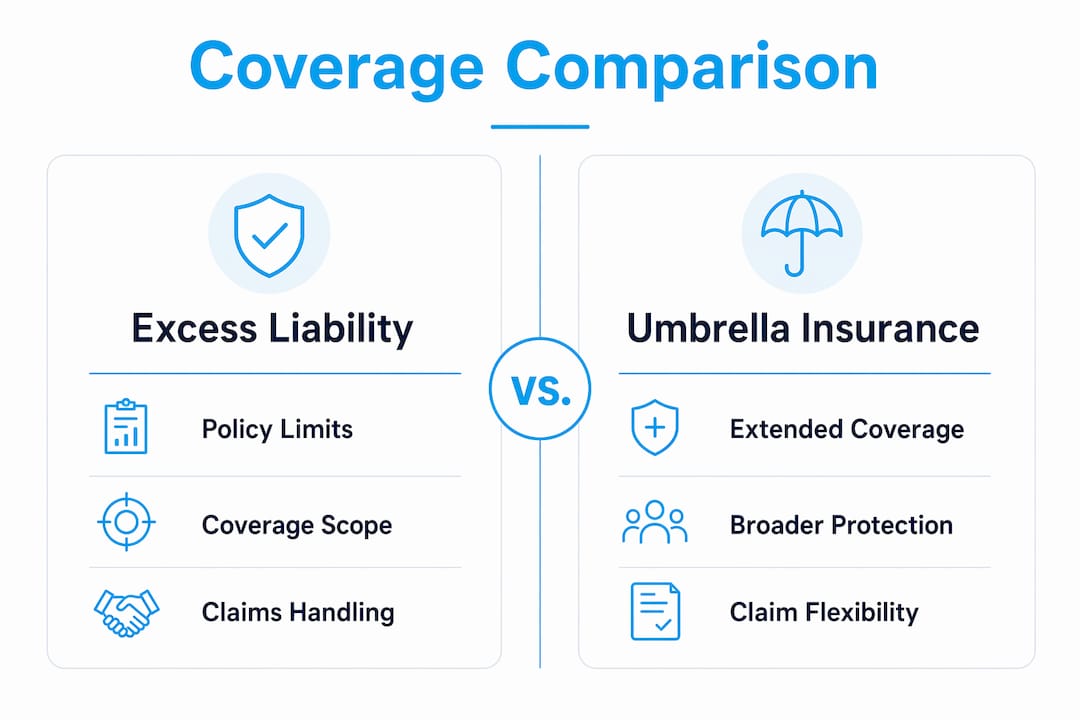
People use these terms interchangeably, but they are not the same product. Umbrella policies are a type of excess liability insurance, but not all excess policies are umbrella policies.
| Dimension | Excess Liability | Umbrella Insurance |
|---|---|---|
| Coverage scope | Mirrors the underlying policy exactly | Can broaden coverage for some claims the underlying policy excludes |
| How payments are made | Strictly follows underlying policy form | May "drop down" to cover gaps when underlying aggregate is exhausted |
| Covered parties and exclusions | Same as underlying policy | May extend to additional parties; has its own exclusions |
| Typical limits | $1M–$25M for commercial; $1M–$5M for personal | $1M–$5M for personal; $1M–$25M for commercial |
| Best fit | Businesses needing higher limits for a specific policy; contract-driven limit requirements | Individuals and families wanting broad personal protection across home, auto, and watercraft |
The core difference comes down to follow form vs. broader coverage. An excess policy follows the underlying form, meaning it inherits both the coverage and the exclusions. An umbrella can sometimes step in for claims the underlying policy would not cover, though often with a self-insured retention requirement.
A few practical points on cost:
- Umbrella policies can be slightly more expensive because of their broader coverage potential
- Excess policies are often more straightforward to price because underwriters know exactly what they're covering
- For a business with a specific contract requirement (say, $5M total liability), a layered excess structure over a primary general liability policy is usually the most direct path
For personal-lines readers, a family excess liability guide can help clarify which product fits your household situation.
Who actually needs excess liability coverage?
Not everyone does. But if you fall into either of the groups below, the question isn't really whether to buy it — it's how much.
Individuals who should take a close look:
- You own significant personal assets (home equity, investment accounts, savings) that a lawsuit could reach
- You have a rental property with tenants or frequent guests
- You have a teen driver on your auto policy
- You own a boat, personal watercraft, or recreational vehicle
- You have a homeowners liability limit that hasn't been reviewed in years
Small businesses and contractors who typically need it:
- Your contracts specify minimum liability limits above what your primary policy provides
- You work in construction, contracting, or any field with significant bodily injury or property damage exposure (see general liability for contractors)
- You operate a fleet of vehicles
- You manufacture or distribute a product
- You want to qualify for larger jobs or reassure lenders and partners about your financial responsibility
Carrying appropriate excess limits signals professional responsibility and can be a direct requirement for winning contracts. Many general contractors and project owners won't sign a subcontractor agreement unless the sub can show a certificate of insurance meeting a specified total limit.
Quick self-assessment checklist:
- My net worth exceeds my current liability limits
- I have a contract requiring $2M, $5M, or more in total liability
- I own property, vehicles, or assets that could be named in a lawsuit
- My business has employees, vehicles, or customer-facing operations
- I haven't reviewed my underlying policy limits in the past two years
If you checked two or more boxes, it's worth getting a quote.
How much excess liability coverage should you buy?
The right limit depends on your specific exposure, not a generic rule. That said, a few practical frameworks help you arrive at a reasonable starting point.
Factors that determine how much you need:
- Your net worth (personal lines) or total assets at risk
- Contractual requirements from clients, lenders, or project owners
- Industry and type of operations (higher-hazard work requires more)
- Number of employees and vehicles
- Claims history
Sample limit ranges:
- Individuals: $1M–$5M is the most common range. If your net worth is under $1M, a $1M excess layer is a reasonable floor. Above $3M in assets, consider $3M–$5M.
- Small businesses: $1M–$5M covers most small commercial accounts. Contractors working on larger projects or in higher-hazard trades often need $5M–$10M. Commercial insurers commonly provide excess capacity up to $25 million for complex placements.
A simple starting method: Add up your net worth (or your largest contract requirement, whichever is higher). Use that figure as your minimum target limit. If your business generates significant revenue or has product exposure, multiply that figure by 1.5 to 2 as a working estimate, then refine it with your broker.
For businesses with multiple vehicles, also review your commercial auto liability limits before deciding on an excess layer, since auto claims are one of the most common triggers for excess coverage.
How does excess liability actually pay a claim?
The payment sequence is straightforward, but the details matter.
Step-by-step claim flow:
- A covered claim is filed against you or your business.
- Your underlying policy (general liability, auto, homeowners, etc.) responds and pays up to its per-occurrence or aggregate limit.
- If the claim amount exceeds that limit, your excess policy steps in and pays the remaining amount, up to its own stated limit.
- If the claim exceeds both layers, you are personally or commercially responsible for the remainder.
Follow form vs. self-contained excess:
A follow-form excess policy adopts the underlying policy's terms completely. If the underlying policy denies a claim, the excess policy denies it too. A self-contained excess policy has its own insuring agreement and may respond differently, but these are less common and require careful review.
A few additional mechanics to know:
- SIRs (self-insured retentions): Some excess placements require you to absorb a set amount before the excess layer responds. This is different from a deductible on the underlying policy and can affect cash flow on large claims.
- Defense costs: Depending on the policy form, defense costs may be inside the limit (reducing the amount available for damages) or outside the limit (paid in addition to the stated limit). Always confirm which applies.
- Stacking layers: Large commercial accounts sometimes carry multiple excess layers, each sitting above the previous one. Each layer must be carefully scheduled to avoid gaps between policies.
Some excess placements also require minimum underlying limits before they will attach. If your primary policy has a $500,000 limit but the excess carrier requires $1M underlying, you'll need to increase your primary limit first.
Real-life examples that show why excess limits matter
Abstract mechanics become clear fast when you look at actual claim scenarios.
Example 1: Auto accident with serious injuries
A driver covered by a personal auto policy with a $300,000 bodily injury limit causes an accident that results in $750,000 in medical bills and legal costs. The auto policy pays $300,000. Without an excess policy, the driver is personally responsible for the remaining $450,000. With a $1M excess policy in place, the excess layer covers the gap, and the driver's personal assets stay protected.
What to check on your own policy: Review your auto liability limits and compare them to your net worth. If the gap is significant, an excess layer is worth pricing.
Example 2: Contractor on a construction defect claim
A subcontractor carries $1M in general liability. The general contractor's contract requires $3M in total liability. A construction defect claim results in $2.2M in damages. The sub's primary policy pays $1M. A $2M excess policy scheduled over the primary covers the remaining $1.2M. Without the excess layer, the sub would have been in breach of contract and personally exposed.

What to check: Read every contract's insurance requirements before you sign. Excess liability construction requirements are common on commercial projects and often specify total limits, not just primary limits.
Example 3: The denied claim that excess couldn't fix
A business owner files a claim for a professional error. The general liability policy excludes professional liability claims. The excess policy, written as follow form over the general liability, also excludes the claim. The business owner assumed the excess policy would fill the gap. It didn't.
An umbrella policy with its own insuring agreement might have responded differently in this scenario — but only if professional liability was not explicitly excluded in the umbrella's own terms. The lesson: excess coverage raises your limit, but it cannot rescue you from an exclusion in the underlying policy. The fix is to schedule the right underlying policies, not to add more excess over a policy that doesn't cover the exposure.
What to check: If you have professional exposure, confirm that a professional liability policy is in place and, if needed, schedule it as an underlying policy for your excess layer.
How to buy excess liability: a step-by-step guide
Getting excess liability coverage in place is a manageable process when you know what to prepare.
Purchase steps:
- Inventory your exposures. List your assets, operations, vehicles, employees, and any contracts that specify minimum limits.
- Gather your underlying policy declarations. You'll need the current limits, carriers, and policy numbers for every policy you want the excess to sit above.
- Determine your target limit. Use the net-worth or contract-requirement method from the "how much" section above.
- Request quotes for that target limit. An independent broker can approach multiple carriers simultaneously.
- Compare exclusions and policy forms. Don't just compare premiums. Check whether each quote is follow form or self-contained, and confirm which underlying policies are scheduled.
- Bind coverage and update your certificates of insurance. Once bound, request updated COIs that reflect the total limits for any contracts that require them.
What underwriters will check:
- Your loss history (prior claims on underlying policies)
- The nature of your operations or personal risk profile
- Current limits on underlying policies (some carriers require minimums)
- Contract requirements or any unusual exposures
Questions to ask your agent or broker:
- Does this excess policy follow form, or does it have its own insuring agreement?
- Which underlying policies are scheduled on this excess?
- Are there any endorsements that restrict coverage beyond the underlying policy?
- Is there a self-insured retention, and if so, how does it apply?
- How are defense costs handled — inside or outside the limit?
Pro Tip: Use an independent broker rather than going directly to a single carrier. Brokers with experience in layered placements can access multiple markets, negotiate follow-form wording, and identify gaps between your underlying policies and the excess layer before they become a problem at claim time. Specialized excess placements, especially for higher-hazard industries, often require experienced broker placement to structure correctly.
Why an independent broker makes a difference for excess placements
Excess liability placements are not one-size-fits-all. The structure of the policy, the underlying policies it attaches to, and the exclusions it carries all require careful coordination. That's where an independent agency earns its value.
Mfandtna is an independent insurance agency based in Arlington, MA, with over 30 years of experience placing commercial and personal lines coverage across multiple states. Working with multiple carriers rather than a single insurer means access to a broader range of excess markets, including specialty carriers for higher-limit or higher-hazard placements.
What Mfandtna brings to an excess liability placement:
- Access to multiple excess and surplus lines markets for competitive pricing
- Structuring of layered placements to avoid gaps between underlying and excess policies
- Negotiation of follow-form wording and review of endorsements that could restrict coverage
- Certificate of insurance management for contractors and businesses with contract-driven limit requirements
- Cross-product expertise across general liability, commercial auto, homeowners, and employer's liability
For small businesses in the Arlington, MA area and beyond, having a single agency manage both the underlying policies and the excess layer eliminates the coordination risk that comes from buying coverage piecemeal from different carriers.
Key Takeaways
Excess liability coverage raises your financial ceiling above a primary policy's limit and only pays after that underlying policy is exhausted — making limit selection and underlying policy review the two most important decisions in the process.
| Point | Details |
|---|---|
| Core function | Excess liability raises limits, not coverage scope; a denied primary claim means a denied excess claim. |
| Follow form matters | Excess policies inherit the underlying policy's exclusions, so review primary policy terms before buying. |
| Limit guidance | Individuals typically start at $1M–$5M; small businesses often need $1M–$25M depending on contracts and operations. Travelers, for example, advertises commercial excess capacity up to $25M. |
| Excess vs. umbrella | Umbrella can broaden coverage beyond the underlying policy; excess strictly follows it — choose based on your gap. |
| Mfandtna | Mfandtna places excess and umbrella coverage across multiple markets and manages COIs for contract-driven clients. |
What most people get wrong about excess liability
Most clients come to me thinking excess coverage is a safety net that catches everything their primary policy misses. It isn't. Excess liability is a limit multiplier, not a coverage expander. The single most expensive mistake I see is someone who buys a $2M excess policy over a general liability policy, then files a professional liability claim and discovers the excess policy won't respond because the underlying policy excluded it.
The second blind spot is low underlying limits. Some carriers won't attach an excess layer unless the underlying policy meets a minimum limit. If your primary general liability is at $500,000 and the excess carrier requires $1M underlying, you have a gap before the excess even starts.
Here's what I'd tell anyone reading this to do right now:
- Pull your declarations pages for every liability policy you carry and check the per-occurrence and aggregate limits.
- Ask your broker specifically whether your excess policy is follow form and which underlying policies are scheduled on it.
- If you're bidding on a new contract, review the insurance requirements before you sign — not after — and schedule a broker review to confirm your total limits meet the spec.
Get the right excess limits with Mfandtna
If you've read this far, you have a clear picture of what excess liability does and whether you need it. The next step is getting actual numbers in front of you.
Mfandtna places excess and umbrella coverage for individuals, families, and businesses across multiple states, with access to a wide range of carriers for both standard and specialty placements. Whether you need a $1M personal excess layer over your homeowners and auto policies or a $10M commercial excess placement to meet a contract requirement, the process starts with a straightforward coverage review. Commercial insurers often provide excess limits up to $25 million for larger or more complex placements.
Prepare your current declarations pages, your largest contract's insurance requirements (if applicable), and a rough estimate of your net worth or total business assets. Then request a free quote from Mfandtna to get a personalized excess liability recommendation built around your actual exposure, not a generic package.
Useful sources for further reading
The following sources were used to build this guide and are worth bookmarking for deeper research:
- PRISM Risk Control — Introduction to Excess Liability Coverage: A government risk-management resource explaining the difference between excess and umbrella policies, COI review, and dependent vs. stand-alone excess forms. Best for understanding policy structure and contract compliance.
- Business.com — Excess Liability Insurance Explained: Covers monoline vs. multi-policy forms, follow-form mechanics, SIRs, and common exclusions. Good starting point for small-business readers.
- NerdWallet — What Is Excess Liability Insurance?: Plain-language explainer with numeric examples showing how excess layers pay after primary limits. Useful for individuals and first-time buyers.
- Chubb — Why Excess Liability Coverage Is Important: Carrier perspective on when excess coverage applies and why appropriate limits matter for contracts and professional credibility.
- IRMI — Insurance Reference: The authoritative industry reference for policy language definitions, including follow form, SIRs, and umbrella vs. excess distinctions. Best for readers who want precise technical definitions.
- RLI — Excess Commercial Liability: Specialty carrier resource on underwriting considerations for complex or high-limit excess placements. Useful for contractors and businesses in higher-hazard industries.
- Travelers — Excess Liability Insurance Coverage: Commercial carrier overview of excess and umbrella capacity, including upper-range limits for large commercial accounts.
- The Root Agency — How an Umbrella Policy Covers Your Liability Gap: A practical explainer on how umbrella policies behave differently from excess policies, with examples useful for personal-lines readers.
This article is general information, not legal or insurance advice. Coverage terms, limits, and exclusions vary by carrier and state. Confirm the specifics of any policy with a licensed insurance professional before making coverage decisions.