
Comprehensive auto coverage is defined as an optional insurance protection that pays for damage to your vehicle caused by non-collision events, including theft, vandalism, natural disasters, falling objects, and animal strikes. According to ConsumerAffairs, this coverage excludes collision damage, mechanical failures, wear and tear, and intentional damage by the policyholder. No state legally requires it, but most lenders and lessors mandate it to protect their financial interest in your vehicle. Understanding what is comprehensive auto coverage, what it costs, and when to carry it gives you real control over your insurance decisions.
What does comprehensive auto coverage include?
Comprehensive coverage pays for a specific set of non-collision damages. Knowing exactly what falls inside and outside that list prevents expensive surprises at claim time.
Covered events include:
- Theft of your vehicle
- Vandalism and malicious mischief
- Weather damage from hail, floods, ice, and wind
- Fire and explosions
- Falling objects such as tree branches or debris
- Animal collisions, including deer strikes
- Civil disturbances and riots
Common exclusions include:
- Collision damage from hitting another vehicle or object
- Mechanical breakdown and engine failure
- Normal wear and tear on tires, brakes, and belts
- Personal belongings stolen from inside the vehicle (those fall under homeowners or renters insurance)
- Custom aftermarket equipment such as upgraded sound systems, unless you add a separate endorsement
- Damage you cause intentionally
Glass and windshield coverage deserves special attention. Some insurers waive the comprehensive deductible entirely for windshield repairs or glass replacement. That makes a cracked windshield one of the most cost-efficient claims you can file under this coverage type. Always check your policy documents or ask your agent before assuming the waiver applies.
Pro Tip: Ask your agent specifically whether your policy includes a glass deductible waiver. Many drivers pay out of pocket for windshield repairs without realizing their policy covers it at no cost.

Comprehensive vs. collision: what is the difference?
The difference between comprehensive and collision is straightforward but frequently misunderstood. Comprehensive covers non-collision events; collision covers damage from accidents with other vehicles or stationary objects, regardless of fault.
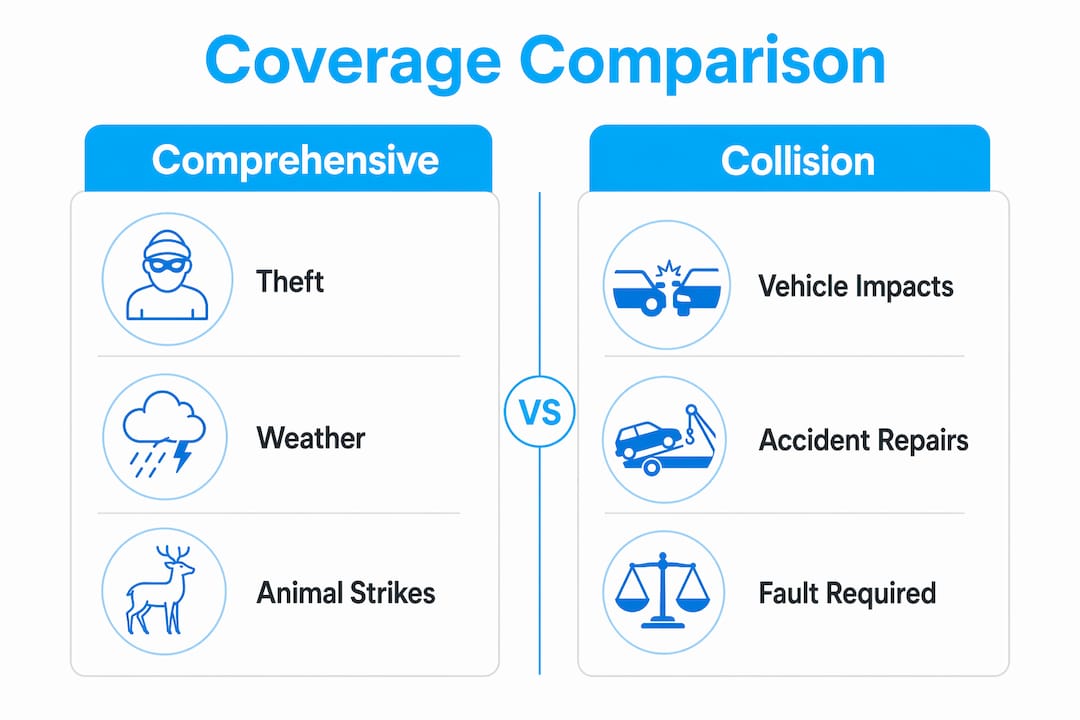
| Coverage Type | What It Covers | Fault Required? | Typical Trigger |
|---|---|---|---|
| Comprehensive | Theft, weather, vandalism, animals, fire | No | Non-collision event |
| Collision | Accidents with vehicles or objects | No | Impact or rollover |
| Liability | Damage or injury you cause others | Yes (you at fault) | At-fault accident |
| Full Coverage | Comprehensive + collision + liability | Varies | Both collision and non-collision |
"Full coverage" is not a single policy type. It refers to carrying comprehensive, collision, and liability together. Liability alone is the legal minimum in most states, but it pays nothing toward your own vehicle's damage. Adding comprehensive and collision fills that gap completely.
Collision coverage pays for repairs after you hit a guardrail, back into a pole, or get rear-ended. Comprehensive pays when a tree falls on your parked car or a thief drives it away. The two coverages are designed to complement each other, not replace one another. Drivers who carry only one of the two leave themselves exposed to a specific category of loss.
A common misunderstanding is that a deer strike is a collision claim. It is not. Hitting an animal is a comprehensive insurance event, which matters because comprehensive and collision deductibles are often set at different amounts.
How much does comprehensive coverage cost?
The typical annual cost for comprehensive coverage runs between $200 and $400, depending on your vehicle's value, your location, and the deductible you choose. That range means comprehensive is usually the less expensive half of a full coverage package, making it a relatively affordable add-on for the protection it provides.
Several factors push your premium up or down:
- Vehicle value. A newer or higher-value car costs more to replace, so the insurer charges more to cover it.
- Location. Areas with high theft rates, frequent hailstorms, or flood risk carry higher premiums. Drivers in Massachusetts can check local auto insurance costs to see how geography affects their rate.
- Deductible amount. A higher deductible lowers your premium but increases your out-of-pocket cost at claim time. MoneyGeek recommends a $500 deductible as the best balance between monthly savings and manageable claim costs.
- Claims history. Prior comprehensive claims can raise your rate at renewal.
- Credit score. In most states, insurers use credit-based insurance scores as a pricing factor.
The 10% rule for deciding coverage value
The 10% rule is the standard financial test for whether comprehensive coverage makes sense on an older vehicle. Here is how to apply it:
- Find your car's actual cash value (ACV) using a source like Kelley Blue Book or NADA Guides.
- Calculate 10% of that ACV. For a car worth $6,000, that figure is $600.
- Compare that number to your annual comprehensive premium.
- If your annual premium exceeds $600 on a $6,000 car, the math favors dropping the coverage and self-insuring.
The rule is a guide, not a rule. Your personal risk tolerance and savings cushion matter too.
Pro Tip: Before dropping comprehensive coverage to save money, check whether your emergency fund can absorb a $5,000 to $10,000 loss from theft or storm damage. If it cannot, keeping the coverage is the smarter financial move.
If your vehicle is financed or leased, the decision is not yours alone. Lenders require you to carry comprehensive coverage to protect their collateral. Dropping it while you still owe money on the car violates your loan agreement and can trigger forced-placed insurance, which is far more expensive than a standard policy.
When should you keep or drop comprehensive coverage?
Deciding whether to carry comprehensive coverage comes down to three factors: your vehicle's value, your financial situation, and your geographic risk. The table below maps out the most common scenarios.
| Your Situation | Recommendation | Reason |
|---|---|---|
| Vehicle is financed or leased | Keep it | Lender requires it; dropping it violates your loan terms |
| Vehicle is worth more than $10,000 | Keep it | Replacement cost justifies the premium |
| You live in a high-theft or storm-prone area | Keep it | Geographic risk increases the likelihood of a claim |
| Vehicle is worth less than $3,000 | Consider dropping | Premium may exceed potential payout after deductible |
| You have strong emergency savings | Consider dropping | You can self-insure against smaller non-collision losses |
Dropping comprehensive coverage should be a calculated decision based on your vehicle's actual cash value and your cumulative premium costs, not an impulse reaction to a high renewal bill. A car worth $4,000 with a $500 deductible only pays out a maximum of $3,500 on a total loss claim. If your annual premium is $350, you are paying roughly 10% of the potential payout every year.
Geographic risk is a factor many drivers underestimate. Living in a region with frequent hailstorms, flooding, or high vehicle theft rates changes the math significantly. Drivers in coastal or storm-prone areas often find that weather-related coverage pays for itself after a single severe weather event.
The peace of mind factor is real too. Comprehensive coverage protects against unpredictable risks that liability and collision do not address. A stolen vehicle or a tree through your windshield can happen to any driver, regardless of how carefully they drive.
Key takeaways
Comprehensive auto coverage is worth carrying when your vehicle's value, location, or loan status makes the premium cost a sound financial trade-off.
| Point | Details |
|---|---|
| Coverage scope | Comprehensive pays for theft, weather, vandalism, fire, and animal strikes, not collision damage. |
| Key exclusions | Personal belongings and custom equipment are not covered without separate endorsements. |
| Cost range | Annual premiums typically run $200–$400; a $500 deductible balances cost and claim value. |
| The 10% rule | Drop coverage if your annual premium exceeds 10% of your car's actual cash value. |
| Lender requirements | Financed or leased vehicles require comprehensive coverage by contract, regardless of car age. |
What i tell every driver who asks about comprehensive coverage
Most drivers treat comprehensive coverage as a checkbox on their policy renewal. That is a mistake I have seen cost people thousands of dollars.
The most overlooked issue is custom equipment. If you added an aftermarket stereo, upgraded wheels, or a lift kit, your standard comprehensive policy likely does not cover those items. You need a separate endorsement, and most agents will not bring it up unless you ask directly. I always tell clients to list every modification they have made to the vehicle before finalizing their policy.
The second thing I push back on is the impulse to drop comprehensive the moment a car gets older. Age alone is not the right trigger. The right trigger is the 10% rule applied to your car's current actual cash value, combined with an honest look at your savings. I have seen drivers drop coverage on a $7,000 car to save $25 a month, then face a $6,500 theft loss six months later with no recourse.
Finally, review your coverage every year at renewal. A car that justified comprehensive coverage at $18,000 may not justify it at $5,000. The math changes as the vehicle depreciates, and your policy should change with it. Staying on top of that review is one of the simplest ways to keep your insurance spending aligned with your actual risk.
— Mike
Get personalized auto coverage help from Mfandtna
Mfandtna has spent over 30 years helping drivers across Massachusetts find auto insurance that fits their vehicle, their budget, and their risk profile. Whether you are deciding between full coverage and liability only, or trying to figure out the right deductible for your situation, the team at Mfandtna gives you straight answers without pressure.
You can get a free insurance quote in minutes and compare options side by side. Mfandtna works with multiple carriers, which means you get real choices instead of a single take-it-or-leave-it offer. If you want coverage tailored to your specific vehicle and location, visit the auto insurance services page to get started today.
FAQ
What is comprehensive auto coverage in simple terms?
Comprehensive auto coverage is insurance that pays for damage to your vehicle caused by non-collision events such as theft, weather, vandalism, fire, and animal strikes. It does not cover accidents with other vehicles or objects.
Is comprehensive coverage required by law?
No state legally requires comprehensive coverage. However, lenders and lessors typically require it on financed or leased vehicles to protect their financial interest until the loan is paid off.
What does comprehensive auto insurance not cover?
Comprehensive coverage excludes collision damage, mechanical breakdowns, normal wear and tear, and personal belongings stolen from inside the vehicle. Items like aftermarket equipment also require a separate endorsement.
How do i know if comprehensive coverage is worth the cost?
Apply the 10% rule: if your annual comprehensive premium exceeds 10% of your car's actual cash value, the coverage may no longer be cost-effective. Also factor in your location's risk level and the strength of your emergency savings.
Does comprehensive coverage pay for a cracked windshield?
Yes, windshield damage is covered under comprehensive insurance. Some insurers waive the deductible entirely for glass repairs, so check your policy details or ask your agent before paying out of pocket.