
A home insurance binder is a temporary, legally binding document that confirms your home is insured before your official policy is issued. Think of it as your proof of coverage on closing day.
- Primary purpose: Provides immediate, enforceable evidence that a homeowners insurance contract is in effect.
- Lender requirement: Mortgage lenders typically require a binder before closing because the home serves as collateral for the loan.
- Temporary nature: A binder is replaced within 30–90 days by your full policy or declarations page — it is not a permanent document.
Table of Contents
- What is a home insurance binder, exactly?
- When do you need a home insurance binder?
- What information does a home insurance binder contain?
- How do you get a home insurance binder before closing?
- How long does a binder last, and what happens when it expires?
- Binder vs. declarations page vs. certificate of insurance
- What does a binder look like? A sample checklist
- How an independent agent makes the binder process easier
- Key Takeaways
- The detail most buyers overlook
- Get your home insurance binder handled the right way
- Useful sources and further reading
What is a home insurance binder, exactly?
Legally, a binder is a temporary insurance contract delivered by the insurer to the insured before a permanent policy is finalized. It binds the insurer to the terms stated in the document, making it enforceable from the moment it is issued. The name itself reflects that act: the insurer is "bound" to provide coverage.
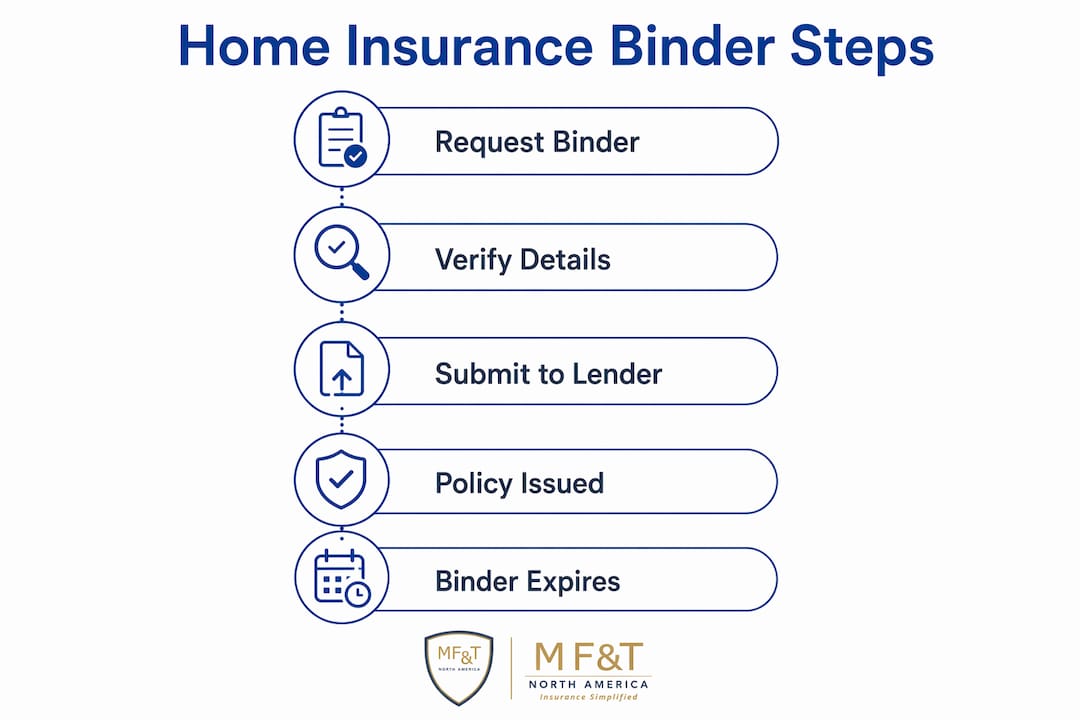
Authorized agents or brokers issue binders on behalf of a carrier, provided the carrier has granted them binding authority. Some carriers allow agents to issue binders instantly; others require underwriting review first. Either way, the binder carries real legal weight during that window.
Format varies. Many insurers use the standardized ACORD binder form, while others produce carrier-specific documents. The layout matters less than the data inside. What you need to verify are the named insured, mortgagee wording, effective date, and coverage limits — those fields are what lenders and title companies actually check.
One practical distinction worth knowing: verbal binders exist in insurance law, but for a mortgage closing, only a written binder counts. A lender will not accept a phone confirmation from your agent.
When do you need a home insurance binder?
Lenders require a binder because they hold a lien on the property. If the home is damaged or destroyed before the policy is formally issued, the lender needs to know the collateral is protected. Without documented proof of coverage, most lenders will not proceed to closing.
Common situations that trigger a binder request:
- Purchase closing: The most frequent scenario. Your lender needs proof of coverage starting on the closing date.
- Refinance: If your current policy is already active, a declarations page often suffices, but some lenders still request a binder.
- Carrier switch before closing: If you change insurers mid-transaction, the new carrier must issue a binder reflecting the new coverage.
- New construction turnover: Builders risk coverage ends at completion; a homeowners binder must be in place before the buyer takes possession.
- Escrow requirements: Some escrow companies independently require a binder as part of their closing checklist.
One thing to confirm with your agent: some carriers can issue a full policy quickly enough that a separate binder becomes unnecessary. Lenders may accept a declarations page from an already-active policy in place of a binder, particularly on refinances. Always ask your lender which document they need before your agent starts the paperwork.
What information does a home insurance binder contain?
A binder typically includes seven to eight key fields. Each one serves a specific purpose, and an error in any of them can cause a lender rejection or a coverage dispute later.
| Field | What to check |
|---|---|
| Named insured | Your full legal name, exactly as it appears on the purchase contract |
| Property address | Full street address, including unit number if applicable |
| Mortgagee / loss payee | Lender's exact legal name, address, and loan number if required |
| Effective date | Must match or precede your closing date |
| Expiration date | Confirms the binder is still active on closing day |
| Coverage limits | Dwelling, personal property, liability — confirm they meet lender minimums |
| Deductible | Stated amount per occurrence |
| Covered perils / policy type | HO-3 open-peril or named-peril designation |
| Insurer and agent details | Carrier name, agent name, contact information |

The mortgagee entry deserves extra attention. Lenders often provide a specific wording template, and even a minor difference — an abbreviated name, a missing suite number — can result in rejection. The binder's terms are binding from the moment it is issued, so errors need to be caught and corrected before closing, not after.
Pro Tip: Ask your lender for their exact mortgagee clause wording in writing before your agent submits the binder request. Copy it character-for-character.
How do you get a home insurance binder before closing?
The process is straightforward when you start early. Here is a step-by-step sequence to follow:
-
Compare carriers and get quotes. Use an agent who can compare homeowners insurance quotes across multiple carriers to find the right fit for your property and budget.
-
Select your carrier and coverage. Confirm that coverage limits meet your lender's requirements. Review coverage types so you understand what the binder will reflect.
-
Request the binder explicitly. Tell your agent you need a binder for closing and provide the closing date, property address, and lender contact details.
-
Provide the mortgagee clause. Give your agent the lender's exact legal name, mailing address, and loan number. A typical format looks like this:
-
Pay the initial premium if required. Some carriers will not issue a binder until the first premium payment is confirmed. Ask your agent upfront.
-
Deliver the binder to your lender and title company. Send it by email with a read receipt, and confirm receipt at least three business days before closing.
-
Follow up. If underwriting is complex, issuance can take from minutes to multiple days. Build in buffer time.
Request the binder at least 7–14 days before your closing date. That window gives you time to catch errors, correct mortgagee wording, and handle any underwriting questions without delaying the transaction.
How long does a binder last, and what happens when it expires?

Binders are temporary by design, typically valid for 30–90 days. That range exists because underwriting timelines vary: a straightforward policy on a standard home may be finalized in days, while a high-value property or one with unusual risk factors can take longer.
The risk of letting a binder expire without a full policy in place is real. If a loss occurs after the binder expires and before the permanent policy is issued, you could face a coverage gap. In some cases, the carrier may decline to renew the binder if underwriting uncovers a problem, leaving you without coverage entirely.
To avoid that outcome:
- Confirm with your agent when the full policy and declarations page will be issued.
- Check the effective date on the declarations page when it arrives — it should match the binder's start date.
- If the binder is approaching expiration and the policy has not arrived, contact your agent immediately to request an extension.
For a broader look at the kinds of gaps that can appear in homeowners coverage, the common coverage gaps guide from M F and T North America is worth reviewing before your policy is finalized.
Binder vs. declarations page vs. certificate of insurance
These three documents are often confused, but they serve different purposes and carry different legal weight.
| Document | What it is | When it is issued | Lender accepted? |
|---|---|---|---|
| Insurance binder | Temporary insurance contract | Before the full policy is finalized | Yes, at closing |
| Declarations page | Summary page of an active policy | After the full policy is issued | Yes, for refinances and renewals |
| Certificate of insurance (COI) | Summary document, not a contract | After a policy is issued | Generally no — not a coverage document |
The key distinction: a COI is a summary produced after a policy exists and does not itself provide coverage. A binder is an active contract. Lenders know the difference and will reject a COI submitted in place of a binder.
Once your full policy is issued, the declarations page replaces the binder entirely. At that point, the declarations page is what you would provide to a lender on a refinance. Learning how to read your homeowners insurance policy makes that transition much easier.
What does a binder look like? A sample checklist
When your binder arrives, run through this checklist before forwarding it to your lender:
- Named insured: Your name matches the purchase contract exactly.
- Property address: Full address, no typos, correct zip code.
- Policy type: HO-3 or the type you selected.
- Dwelling coverage limit: Meets or exceeds lender's required minimum.
- Deductible: Matches what you agreed to.
- Effective date: On or before your closing date.
- Mortgagee / loss payee: Matches the lender's exact wording.
- Insurer name and agent contact: Clearly listed for lender follow-up.
A sample mortgagee entry looks like this:
"ISAOA/ATIMA" stands for "its successors and/or assigns / as their interests may appear" — standard language most lenders require. If your lender gave you a specific clause, use that verbatim.
Audit the binder the moment you receive it. Discrepancies between the binder and the final policy can create claims disputes later, so corrections made now cost nothing; corrections made after a loss can cost everything.
How an independent agent makes the binder process easier
Working with an independent agent changes the experience significantly. Rather than going directly to a single carrier, an independent agency can shop multiple carriers on your behalf, find the one that fits your property and timeline, and issue the binder quickly when authorized.
M F and T North America handles the full workflow: carrier selection, underwriting liaison, binder issuance, and direct delivery to your lender or title company. The agency verifies mortgagee wording against your lender's exact instructions before submitting, which eliminates the most common source of last-minute rejections. With over 30 years of experience placing homeowners coverage across multiple states, the team knows how to move quickly when a closing date is firm.
Independent agents also have a practical advantage that many buyers do not realize: they often carry binding authority on behalf of carriers, meaning they can issue a binder the same day rather than waiting for the carrier's underwriting queue. That speed matters when your closing is a week away.
Key Takeaways
A home insurance binder is a temporary but legally enforceable proof of coverage that lenders require at closing, and it must be replaced by a full policy within a short time to avoid a coverage gap.
| Point | Details |
|---|---|
| Binder = temporary contract | It is legally binding from issuance but expires once the full policy is issued. |
| Lenders require exact wording | The mortgagee clause must match the lender's instructions character-for-character to avoid rejection. |
| Typical duration: temporary period | Confirm your declarations page arrives before the binder expires to prevent a coverage gap. |
| Request it 7–14 days early | Building in lead time protects you if underwriting or corrections cause delays. |
| M F and T North America | The agency handles carrier shopping, binder issuance, and mortgagee verification for homebuyers. |
The detail most buyers overlook
Most closing checklists treat the binder as a box to check. Get insurance, send the binder, move on. What they miss is that the binder is a draft of your permanent policy — and like any draft, it can contain errors that follow you for years.
The mortgagee wording issue is the most common, but it is not the only one. Coverage limits that are too low, a wrong policy type, or an effective date that is one day off can all create problems. The binder's terms govern any claim that occurs during the binder period, so a limit that is too low on the binder is a real limit, not a placeholder.
My advice: treat the binder review as seriously as you treat the home inspection. Read every field. Compare the mortgagee clause to the lender's written instructions. Confirm the effective date. If anything looks wrong, call your agent before you send it to the lender. A correction takes minutes; a coverage dispute takes months.
Get your home insurance binder handled the right way
Closing on a home is stressful enough without last-minute insurance surprises. M F and T North America takes the binder process off your plate: the agency shops carriers to find the right coverage for your property, issues the binder with correct mortgagee wording, and delivers it directly to your lender or title company.
With more than 30 years of experience helping homeowners and buyers across multiple states, M F and T North America knows what lenders expect and how to get it right the first time. The team follows up after closing to confirm your declarations page arrives before the binder expires, so you are never left with a gap.
Ready to get your binder sorted before your closing date? Get a free homeowners insurance quote today, or visit the homeowners insurance service page to learn more about how the agency can help.
Useful sources and further reading
These sources are useful for verifying binder details, lender requirements, and policy specifics:
- LII / Legal Information Institute — Wex: Binder: The authoritative legal definition of an insurance binder under U.S. law. Best for understanding the binder's legal status and enforceability.
- Insurance Training Center — Insurance Binders Explained: Practical agent-level explanation of binder issuance, authority, and error risks. Best for understanding the agent workflow and why errors matter.
- The Balance Money — What Is an Insurance Binder?: Consumer-focused overview covering binder duration, COI differences, and format variability. Good starting point for buyers.
- Insurify — Home Insurance Binder: Covers lender requirements, binder contents, and what to verify. Useful for buyers preparing for closing.
- Rocket Mortgage — What Is a Homeowners Insurance Binder?: Lender perspective on when a binder is required versus when a declarations page suffices. Best for refinance scenarios.
- USA Today Blueprint — Understanding Your Insurance Binder: Accessible consumer explainer on binder purpose and what to expect during the process.