
Your Experience Modification Rate (EMR) is the single multiplier your insurer applies to your base workers' compensation premium. A number below 1.0 lowers your bill; above 1.0 raises it. The industry average is 1.0, and according to SafetyEvolution, values in practice typically range from roughly 0.5 to 2.0. If you've never looked yours up, here's where to start right now:
- Pull your current policy declarations page and look for the "experience modification factor" line.
- Call your carrier or agent and request your last three years of loss runs.
- Ask your agent whether any payroll classifications or prior claims are worth disputing before your next renewal.
Key Takeaways
Your EMR is the most direct lever on your workers' compensation premium, and auditing it annually is the single highest-return action most contractors overlook.
| Point | Details |
|---|---|
| EMR definition | Experience Modification Rate multiplies your base workers' comp premium; 1.0 is the industry average. |
| Dollar impact | EMR variations can significantly increase or decrease your premium costs relative to the base amount. |
| Three-year lag | The most recent policy year is excluded; improvements take about one to two years to reflect in your modifier. |
| Fix errors first | Audit loss runs annually; rating bureaus can revise your modifier when payroll or claims errors are found. |
| M F and T North America | An independent agent can pull your loss runs, dispute errors, and prepare bid-ready documentation before renewal. |
Table of Contents
- What does EMR mean in insurance, and how is it calculated?
- How does your EMR change your workers' comp bill?
- What counts as a good or bad EMR?
- Where can you find your EMR?
- How to lower your EMR: a prioritized plan
- "EMR" means two different things: don't let that trip you up
- An independent agent's perspective on managing your EMR
- How M F and T North America helps contractors control their EMR
- Sources
What does EMR mean in insurance, and how is it calculated?
EMR stands for Experience Modification Rate, and it's calculated by comparing your company's actual incurred losses against the expected losses for a business of your size and industry. As the CNA EMR guide explains, the calculation uses a historical three-year basis and typically excludes the most recent policy year. That exclusion exists because reserves on very recent claims are still maturing; including them would produce an unstable number.
Who does the calculating?
The National Council on Compensation Insurance (NCCI) calculates EMR for most states. A handful of states, including New York, California, and a few others, use their own independent rating bureaus. New York's Compensation Insurance Rating Board (CIRB), for example, publishes a state-specific experience rating plan that can deviate from NCCI rules in technical details. If you operate across multiple states, the bureau that governs your primary state of operations typically issues your modifier.
Why frequency matters more than severity
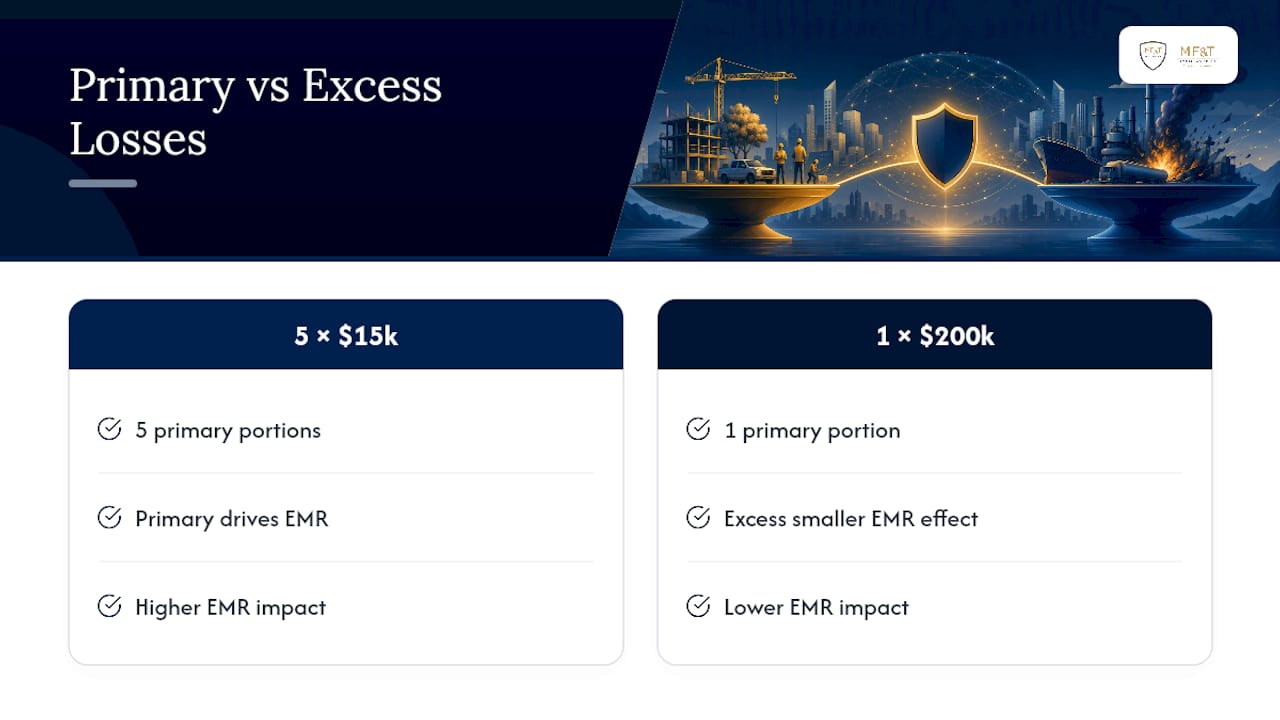
The formula splits losses into two buckets: primary losses (the first portion of each claim, weighted heavily) and excess losses (amounts above that threshold, weighted less). A single $200,000 claim hurts your EMR less than five $15,000 claims, because the formula is deliberately designed to penalize frequent accidents more than one catastrophic event. This means a strong safety culture that prevents small, recurring injuries does more for your modifier than simply hoping to avoid a major incident.
Your audited payroll and the classification codes assigned to each employee also feed directly into the expected-loss calculation. Misclassified workers or understated payroll can distort both sides of the equation, which is why an annual payroll audit matters.
Pro Tip: Ask your agent to confirm that every employee is coded under the correct NCCI classification before your policy renews. A roofer coded as a clerical worker, or vice versa, can quietly skew your EMR for three years.
How does your EMR change your workers' comp bill?
The math is straightforward: Final premium = Base (manual) premium × EMR. What surprises most contractors is how much that multiplier moves the dollar amount at scale.
LegalClarity's worked example illustrates the impact clearly. Take a business with a base premium amount. Depending on the EMR value, the final premium adjusts down or up by thousands compared to the baseline.
That $40,000 swing between an EMR of 0.85 and 1.25 comes entirely from your claims history, not from market conditions or carrier negotiations.
How EMR affects your ability to bid
The dollar impact is only half the story. As HCSS explains, general contractors and project owners routinely use EMR as a prequalification screen. Many public projects and large private contracts set a ceiling of 1.0 or 1.25; some federal and municipal projects require an EMR below 1.0 to even submit a bid. A modifier above that threshold can disqualify you before your price is ever reviewed. For subcontractors, this isn't a soft preference — it's a hard gate.
What counts as a good or bad EMR?
The 1.0 benchmark is the dividing line, but the practical ranges tell a more useful story:
- Values significantly below 1.0 typically indicate a better-than-average safety record with discounted premiums and wider project access.
- Values near 1.0 suggest average experience with premiums close to base rates and general accessibility.
- Values above 1.0 imply surcharges and potential project owner concerns, with higher values leading to limited work opportunities and possible carrier restrictions.
Red flags that push EMR up
If your modifier has risen recently, check these first:
- A spike in claim frequency, even if individual claims are small
- Employees misclassified under lower-risk codes than their actual work
- Open claims with reserves that haven't been challenged or settled
- Missing subrogation recoveries (third-party liability that your carrier never pursued)
- Errors on loss runs: duplicate entries, claims assigned to the wrong policy year, or closed claims still showing open reserves
Where can you find your EMR?
Your EMR appears on your workers' compensation policy declarations page, usually labeled "experience modification factor" or "mod." It also shows up on premium audit documents your carrier sends after each policy period. If you can't locate it there, three quick steps will get you the number:
- Ask your agent. Any licensed agent who writes your workers' comp policy can pull your current modifier and the worksheet behind it.
- Request your loss runs directly from the carrier. Loss runs are a detailed claims history; you're entitled to them, and carriers are generally required to provide them within a set number of days upon request.
- Contact NCCI or your state rating bureau. NCCI's experience rating services page explains how to access your rating worksheet. State bureaus like NY CIRB offer similar lookup tools for their jurisdictions.
Pro Tip: When you call your agent, ask for three things in one request: your current loss runs, the payroll and classification basis used in your last audit, and a copy of your experience rating worksheet. That single call gives you everything you need to spot errors.
How to lower your EMR: a prioritized plan
Reducing your modifier takes time because of the three-year rolling window, but the actions you take today start feeding into future calculations. Here's a practical sequence:
-
Cut claim frequency with targeted safety programs. Frequent small claims damage your modifier more than a single large one. Weekly toolbox talks, OSHA-aligned training, and task-specific hazard reviews reduce the incidents that pile up fastest. The National Safety Council's industry incidence-rate data can help you identify which tasks in your trade carry the highest injury risk so you can focus your training there.
-
Report claims immediately and manage them actively. Delayed reporting inflates reserves. Once a claim is open, stay in contact with the adjuster, push for realistic reserve amounts, and document every return-to-work milestone. A light-duty return-to-work program can cut both the duration and the total cost of a claim.
-
Audit your payroll and classification codes annually. Misclassified employees are one of the most common and fixable sources of EMR inflation. A payroll management review can confirm that each worker is coded correctly and that your reported payroll matches your actual exposure. Corrections can trigger a rating bureau revision that applies retroactively.
-
Review loss runs every year and dispute errors. Per NCCI guidance, rating bureaus can revise experience ratings after discovering misclassified payroll or reporting errors. Look for claims assigned to the wrong year, reserves that were never closed after settlement, and duplicate entries. A formal dispute, submitted through your agent or directly to the bureau, can remove or correct a record that's been dragging your modifier for years.
-
Pursue subrogation on third-party claims. If a worker was injured because of someone else's negligence, your carrier may have the right to recover those losses from the at-fault party. Recovered amounts reduce the net loss charged to your experience period.
How long does it take to see results?
Because the most recent policy year is excluded from the calculation, improvements you make today won't appear in your modifier for roughly 12–24 months. A claim that closes cleanly this year enters the three-year window next year. That lag is frustrating, but it also means the modifier you carry today reflects decisions made two to four years ago — which is exactly why starting now matters.
"EMR" means two different things: don't let that trip you up
In workers' compensation, EMR is your Experience Modification Rate. In healthcare, EMR stands for Electronic Medical Record. The two terms collide most often during workers' comp claims, when your adjuster is talking about your modifier while a medical provider is referencing a patient file.
The confusion is more than semantic. If you ask a clinic to send your "EMR" and they send a medical record instead of your loss-run modifier worksheet, you've lost time and potentially missed a dispute deadline. When speaking with adjusters, always say "experience modification rate" or "experience mod." When speaking with medical providers during a claim, say "electronic medical record" or "patient record." That small habit removes ambiguity from every conversation.
An independent agent's perspective on managing your EMR
Your EMR isn't just a number on a policy page. It's a three-year audit of your business's safety culture, and most business owners don't realize how much leverage they have to challenge it.
The most common mistake I see is treating the modifier as fixed. Owners get the renewal, see the number, and assume it's correct. It often isn't. Loss runs contain errors more frequently than carriers acknowledge: reserves left open on settled claims, claims coded to the wrong policy year, payroll bases that don't reflect a mid-year audit correction. Each one inflates the modifier silently.
An experienced independent agent does more than shop your renewal. They pull your loss runs before the renewal cycle starts, review the experience rating worksheet line by line, flag misclassified payroll codes, and initiate disputes with the rating bureau when the data supports it. They also help you build the bid documentation that general contractors and project owners ask for, so a strong modifier translates directly into more work.

The contractors who manage EMR well tend to do one thing consistently: they treat it as a financial metric, not an insurance formality. They review it annually, the same way they review their P&L. That discipline, more than any single safety initiative, is what keeps the number below 1.0 over time.
How M F and T North America helps contractors control their EMR
Knowing your EMR is one thing. Knowing what to do about it is where M F and T North America makes a real difference. As an independent agency with over 30 years of experience serving contractors and small businesses across multiple states, we go beyond placing your workers' compensation insurance policy. We pull your loss runs, review your experience rating worksheet, flag payroll classification errors, and help you build the case for a rating bureau dispute when the numbers support it.
Before your next renewal, we can review your current modifier, identify fixable errors, and advise on risk-control steps that start moving the number in the right direction. We also prepare the bid-ready documentation that general contractors request during prequalification, so a strong EMR translates into real contract opportunities. If you're ready to take a closer look at your workers' comp costs, request a loss-run review or a quote and we'll get started.
Sources
These are the most reliable places to verify your modifier, pull safety resources, and learn more about the experience rating system:
- NCCI ERPRODSVC
- What Is EMR in Insurance and How Does It Impact Premiums? - LegalClarity
- Experience Modification Rate: EMR Explained - SafetyEvolution
This article is general information, not a substitute for advice from a qualified financial advisor. Consult a qualified financial professional about your own circumstances before acting on anything here.