
Trampoline liability is covered under your existing homeowners policy — not through a separate "trampoline policy," but coverage is never automatic. Insurify confirms that trampolines are treated as endorsements or exclusions within a homeowners policy, and you must disclose ownership to your insurer. Here is what to do right now:
- Don't buy or assemble before you call your agent. Some carriers will non-renew your policy or deny future claims if they discover an undisclosed trampoline.
- Ask specifically about endorsements, exclusions, and your liability limits. A standard policy may cover you, but many carriers attach conditions or exclude trampolines entirely.
- Get coverage confirmation in writing. A verbal "you're fine" from a customer service rep is not a policy endorsement.
Emergency rooms treat approximately 110,000 trampoline injuries each year, a volume well recognized by insurers. Under the legal concept of attractive nuisance, you can be held liable even when an injured child trespasses onto your property. M F and T North America can walk you through exactly where you stand before you set up the equipment.
Table of Contents
- How trampoline liability coverage works inside a homeowners policy
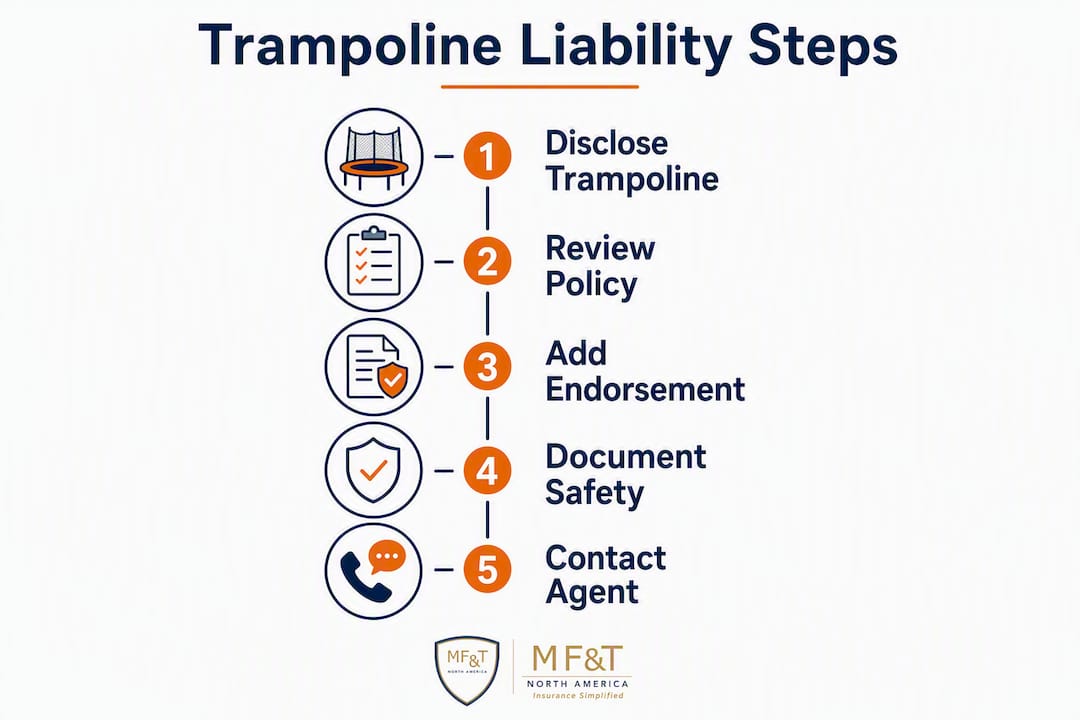
- How to add a trampoline to your policy: a step-by-step checklist
- How a trampoline affects your premiums and when an umbrella policy makes sense
- Practical safety steps that keep your coverage intact
- Questions to ask your insurance agent before the trampoline arrives
- If someone is injured: what to do and how a claim proceeds
- How M F and T North America helps trampoline owners get the right coverage
- Key Takeaways
- The part most homeowners skip — and why it costs them
- Get a trampoline policy review from M F and T North America
- Useful sources for homeowners who want to dig deeper
How trampoline liability coverage works inside a homeowners policy
Your homeowners policy has three parts that matter when a trampoline injury happens.
Personal liability pays for legal defense and damages if a guest sues you after getting hurt. Medical payments coverage (often called "med pay") handles smaller guest medical bills quickly, without a lawsuit. Personal property or dwelling coverage may pay to repair or replace the trampoline itself after a storm or vandalism, though this varies by carrier.
Insurers classify trampolines as an attractive nuisance, which means they apply stricter underwriting than they would for a patio table. Carriers typically fall into three camps:
- Full coverage with no special conditions attached
- Conditional coverage requiring safety features, written proof, or an inspection before the endorsement is issued
- Explicit exclusion — the carrier will not cover any trampoline-related claim, period
One important boundary: homeowners liability generally covers guest injuries, not injuries to you or other household members. If your child is hurt on the trampoline, that claim goes to your health insurance, not your homeowners policy.
Pro Tip: Ask your agent to send you the exact policy language — the endorsement or exclusion wording — in writing. A verbal confirmation is not enforceable at claim time.

How to add a trampoline to your policy: a step-by-step checklist
Timing matters. Notify your insurer before you buy or assemble, not after. Failing to disclose can result in denied claims, policy cancellation, or non-renewal — and carriers sometimes discover trampolines through routine inspections or aerial imagery without you saying a word.
- Call your agent before purchase. Describe the trampoline model, size, and planned location in your yard.
- Gather your documentation. Have the serial/model number, purchase receipt, and photos of your yard and any existing fencing ready.
- Ask about safety requirements. Some carriers require a safety enclosure net, anchoring, and a fenced yard before they will issue an endorsement.
- Submit proof of safety features. Email dated photos of the safety net, anchor kit, and padding. Keep the receipts.
- Request written confirmation. Ask for the policy endorsement, updated declarations page, or a written statement of any exclusion.
- Note the timeline. Endorsements typically process within a few business days, though some carriers require a physical inspection first.
If you already own a trampoline and are approaching renewal, disclose it at renewal and follow the same steps. Do not wait for your carrier to find it on their own.
How a trampoline affects your premiums and when an umbrella policy makes sense
A trampoline almost always changes your premium in one of three ways: a modest surcharge added to your existing policy, a requirement to raise your liability limits before coverage is extended, or a non-renewal notice from a carrier that simply will not insure trampolines at any price.
Industry guidance recommends a minimum of $300,000 in personal liability coverage for trampoline owners, with $500,000 preferred. For many families, that is still not enough. Adding an umbrella policy for $1 million or more in extra liability coverage is also recommended.
A personal umbrella policy typically adds $1 million or more in liability protection and costs a few hundred dollars per year. For a homeowner with meaningful assets — home equity, savings, retirement accounts — that math is straightforward.
Consider an umbrella policy if any of these apply to you. For example, understanding shared pool liability in Spain illustrates how attractive nuisance and shared amenity liability principles can apply in property ownership.
- Neighborhood kids use your trampoline regularly.
- You host birthday parties or playdates with multiple children jumping.
- Your net worth exceeds your standard homeowners liability limit.
- You live in a densely populated area where lawsuit exposure is higher.
One critical caveat: if your homeowners policy explicitly excludes trampoline liability, an umbrella policy will not fill that gap. The umbrella extends your existing coverage — it does not replace an underlying exclusion. Fix the homeowners policy first, then layer the umbrella on top. M F and T North America can help you find carriers that offer both. For a deeper look at how excess liability coverage layers over your base policy, that guide is worth a read.
Practical safety steps that keep your coverage intact
Insurers do not just ask about safety features to be thorough. They may require written proof or conduct a property inspection before issuing an endorsement, and they can use non-compliance to deny a claim after an injury. These steps protect both your family and your coverage:
- Install a safety enclosure net that fully surrounds the jumping surface.
- Use an anchor kit to secure the trampoline against wind and movement.
- Cover all springs and the frame edge with padding.
- Enforce a one-jumper rule — most injuries happen when two or more people jump simultaneously.
- Remove the ladder when the trampoline is not in use to limit unsupervised access.
- Keep an adult present during every session.
- Inspect the equipment seasonally and after any storm.
On the documentation side: photograph every safety feature with your phone so the image carries a date stamp. Keep receipts for the net, anchor kit, and padding in a dedicated folder. Insurers often request this proof after a claim to confirm you met their conditions at the time of the incident.
A quick note on liability waivers: asking neighbors or guests to sign a waiver before jumping is not a bad idea, but waivers do not replace insurance. Courts frequently decline to enforce them, especially when a minor is involved.
Pro Tip: Create a simple folder — digital or paper — labeled "Trampoline File." Store photos, receipts, your policy endorsement, and any insurer correspondence in one place. If a claim ever comes up, you will be glad you did.
Questions to ask your insurance agent before the trampoline arrives
A focused five-minute call covers everything your underwriter needs to know. Use these prompts:
- "I'm planning to purchase a trampoline. Does my current policy cover trampoline-related liability, or is there an exclusion?"
- "What safety features do you require before you'll issue an endorsement?"
- "What are my current personal liability and medical payments limits, and do you recommend raising them?"
- "Will adding a trampoline affect my premium or put my policy at risk of non-renewal?"
- "Can you send me the endorsement or exclusion language in writing after this call?"
Have these ready before or immediately after the call: photos of your yard and fence, the trampoline model and purchase receipt, and receipts for any safety equipment already purchased. If your carrier will not cover trampolines at all, ask for that in writing too. That document is what you bring to M F and T North America when you shop for a trampoline-friendly carrier. For a broader look at what liability coverage actually protects, that resource covers the gaps homeowners most often miss.
If someone is injured: what to do and how a claim proceeds
Stay calm and follow these steps in order.
- Secure the scene and call for medical help. Do not move an injured person unless there is immediate danger.
- Photograph everything. The trampoline, the yard, the injury, and any conditions that may have contributed.
- Collect contact information from the injured person and any witnesses.
- Notify your agent promptly. Do not wait to see how serious the injury is. Early notification protects your claim.
- Do not admit fault. Express concern for the injured person, but let the insurer handle liability determinations.
From there, the claim typically flows like this: med pay coverage can settle smaller medical bills quickly, often without a lawsuit. A serious injury triggers your personal liability coverage, and the insurer assigns a claims adjuster and, if needed, a defense attorney. The insurer handles the lawsuit up to your policy limits.
Remember: injuries to household members are handled by health insurance, not your homeowners liability coverage. That distinction matters when you are deciding how much med pay and liability coverage to carry.
How M F and T North America helps trampoline owners get the right coverage
With over 30 years of experience placing homeowners insurance across multiple states, M F and T North America works with a range of carriers — including those that are trampoline-friendly. Here is what the agency does for homeowners in your situation:
- Reviews your current policy to identify exclusions or gaps before a trampoline arrives.
- Shops multiple carriers to find one that covers trampolines with reasonable conditions and competitive premiums.
- Helps you document safety upgrades in a format insurers accept.
- Quotes personal umbrella policies alongside your homeowners coverage so you see the full protection picture.
When you reach out, have these ready: your current declarations page, photos of the trampoline and yard, and receipts for any safety equipment. That information speeds the review significantly.
Pro Tip: If your current carrier excludes trampolines, do not cancel your policy before you have a replacement in place. M F and T North America can run a parallel quote so there is no gap in coverage.
Key Takeaways
Trampolines are not covered by a separate policy — they are an endorsement or exclusion within your homeowners policy, and disclosure to your insurer is required before you set one up.
| Point | Details |
|---|---|
| No standalone trampoline policy | Coverage comes from your homeowners policy as an endorsement or exclusion, not a separate product. |
| Disclose before you buy | Failing to disclose can result in denied claims, cancellation, or non-renewal. |
| Raise your liability limits | Industry guidance recommends at least $300,000, with $500,000 preferred; add an umbrella for $1 million or more in protection. |
| Document every safety feature | Dated photos and receipts for nets, anchors, and padding protect your claim if an insurer questions compliance. |
| M F and T North America | The agency reviews your current policy, shops trampoline-friendly carriers, and quotes umbrella coverage in one conversation. |
The part most homeowners skip — and why it costs them
Most homeowners call their insurer after the trampoline is already assembled and bouncing. By that point, they have already created a coverage gap, and some carriers use that gap to deny a claim or non-renew the policy at the next cycle.
The attractive nuisance doctrine is not a technicality. It is a well-established legal principle that courts apply regularly, and it means a trespassing child who gets hurt on your trampoline can generate a lawsuit just as easily as an invited guest. Standard liability limits were not designed with that exposure in mind.
The smarter move is to treat the trampoline conversation with your agent the same way you would treat adding a pool or a dog to your property: disclose it, document it, and confirm coverage before the equipment is on the ground. A personal umbrella policy is genuinely affordable relative to the protection it adds, and for most families with home equity and savings, it is the right call. The liability coverage guide for families breaks down exactly how those limits work when a guest injury turns into a lawsuit.
Get a trampoline policy review from M F and T North America
M F and T North America's homeowners insurance team can review your current policy, identify any trampoline exclusions, and shop carriers that offer real coverage with clear conditions. The agency has placed homeowners coverage for over 30 years and knows which carriers work well for trampoline owners and which ones don't.

To get started, send or bring: your current declarations page, photos of the trampoline and yard, and receipts for any safety equipment. Most policy reviews and carrier quotes are completed within 24–72 hours. Request your free quote here and have a clear answer before the trampoline leaves the box.
Useful sources for homeowners who want to dig deeper
These are the primary sources referenced throughout this article:
- NerdWallet — Trampoline Home Insurance: Explains the attractive nuisance doctrine and what insurers typically require before issuing an endorsement.
- Justia — Trampoline Injuries and Homeowners Insurance: Legal perspective on non-disclosure consequences and how claims are evaluated.
- Experian — Does Homeowners Insurance Cover Trampolines?: Clarifies which injuries homeowners liability covers and which fall to health insurance.
Your state insurance department is also worth a visit. Coverage rules, required disclosures, and carrier practices vary by state, and your department's website will have the most current guidance for your specific location.
This article is general information, not legal or insurance advice. Confirm your specific coverage details with a licensed insurance professional or your state insurance department.