If you host guests on Airbnb or Vrbo more than a handful of nights a year, a standard homeowners or landlord policy almost certainly leaves you exposed. Most U.S. short-term rental hosts need a dedicated short-term rental insurance policy, sometimes called a commercial-grade vacation rental policy, because typical homeowner and landlord forms exclude paid guest stays and business use. The fix isn't complicated, but it does require a phone call.
Here's the fastest path to getting this handled correctly:
- Pull your current homeowners or landlord policy's declarations page and check what it actually says about "business use" or "rentals."
- Confirm which platform protections apply to your bookings. Airbnb's AirCover for Hosts and Vrbo's $1M liability program only cover stays booked through their checkout, not every reservation you might take.
- Request a short-term rental insurance quote from an independent agent who can compare commercial-style policies designed for hospitality use.
Before you make that call, gather this information:
- Your current policy's declarations page and renewal date
- Occupancy history: how many nights per year you rent, and average nightly rate
- A rough inventory of contents value and any amenities (pool, hot tub, game room) that add liability exposure
Pro Tip: Don't cancel your existing homeowners policy before your new short-term rental policy is bound and in force. A one-day coverage gap is all it takes for a claim to fall through the cracks.
Key Takeaways
Most U.S. short-term rental hosts need a dedicated commercial-grade policy because standard homeowners and landlord coverage typically excludes paid guest stays and business-use losses.
| Point | Details |
|---|---|
| Standard policies fall short | Homeowners and landlord (DP-3) forms generally exclude business use and guest-caused damage during paid stays. |
| Coverage priorities | Prioritize no guest-damage sublimit, replacement-cost contents, and business income paid on actual loss sustained. |
| Pricing expectations | Comprehensive policies typically run $1,000 to $2,000 per year, with higher-risk properties costing more. |
| Platform protections are supplemental | AirCover and Vrbo's liability program only apply to bookings processed through that platform's checkout. |
| Recommended first step | Contact an independent agent like M F and T North America for a tailored commercial-grade vacation rental quote. |
Table of Contents
- What Is Short Term Rental Insurance, And How Is It Different From Homeowners Coverage?
- What Does Short Term Rental Insurance Cover?
- Homeowner Endorsement, Landlord Policy, Or Commercial Rental Policy: Which Fits?
- How Much Does Short Term Rental Insurance Cost?
- Do Airbnb And Vrbo Protections Replace Private Insurance?
- How Do You Choose The Right Short Term Rental Policy?
- Where Should You Buy Short Term Rental Insurance?
- How Do Short Term Rental Insurance Claims Work?
- How An Independent Agent Evaluates A Short Term Rental Risk
- The Mistake We See Most Often With Rental Hosts
- Get A Short Term Rental Insurance Quote Built For Your Property
- Sources
What Is Short Term Rental Insurance, And How Is It Different From Homeowners Coverage?
Short term rental insurance is property and liability coverage built specifically for homes that host paying guests on a recurring basis, rather than for an owner living in the home full time or a landlord renting to a long-term tenant. That distinction matters more than most first-time hosts realize, and it's the source of nearly every coverage dispute we see.
A typical vacation property gets used three different ways over the course of a year: guest stays, personal owner use, and vacant stretches between bookings. Standard homeowners policies are underwritten around owner-occupancy. Landlord forms, often called DP-3 policies, are built around a single long-term tenant with a lease. Neither one was designed for a property that flips between all three uses, sometimes within the same week, which is exactly why gaps show up when a claim gets filed.
Here's what that looks like in practice:
- Guest-caused damage denial. A guest breaks a window or damages flooring during a paid stay, and the homeowners insurer denies the claim because the loss occurred during commercial use, not owner occupancy.
- Business-use exclusion. Many standard policies contain language excluding losses connected to "business pursuits" conducted on the property, and short-term rental income counts.
- Lost income after a covered loss. Even when the underlying damage is covered, standard forms rarely reimburse the rental income you lose while the property is being repaired.
This is why a comprehensive vacation rental policy, often written on a Commercial General Liability or Commercial Homeowners form, has become the standard recommendation among specialty carriers. It's also why platform-level protections like Airbnb's Host liability insurance, covering up to $1,000,000 per Airbnb stay, exist as a supplement rather than a substitute. They fill a specific gap; they don't replace a named policy with your property on it.
Pro Tip: Ask any agent quoting you a policy whether it's written on a homeowners form with a short-term rental endorsement, or on a true commercial hospitality form. The wording difference determines whether business income and guest liability are actually covered, not just implied.
What Does Short Term Rental Insurance Cover?
The core of a well-built short-term rental policy covers six things: the dwelling itself, your contents, commercial general liability, loss of rental income, guest-caused damage, and amenity-specific liability. Coverage limits and sublimits vary by carrier, so it pays to know what you're comparing before quotes start arriving.
| Coverage Line | What It Typically Includes | Common Limits or Notes |
|---|---|---|
| Dwelling/building | Structure repair or rebuild after covered perils (fire, wind, certain water damage) | Often written at replacement cost rather than actual cash value |
| Contents | Furniture, appliances, linens, and other personal property inside the rental | Replacement-cost valuation is preferable to actual cash value, which factors in depreciation |
| Commercial general liability | Bodily injury or property damage claims from guests on the property | $1,000,000 per occurrence baseline; higher limits available |
| Loss of rental income | Reimburses lost booking revenue while the property is uninhabitable after a covered loss | Look for "actual loss sustained" wording rather than a flat daily cap |
| Guest-caused damage | Damage guests cause during a stay, beyond normal wear | Best policies carry no sublimit on this coverage |
| Amenity liability | Pools, hot tubs, fire pits, game equipment, and similar guest-use features | Frequently requires a specific endorsement; not automatic on every form |
A handful of exclusions show up across nearly every policy, regardless of carrier:
- Wear and tear. A worn mattress or a stained rug from years of guest turnover isn't a covered loss, it's maintenance.
- Intentional damage. Coverage generally excludes damage the insured (you, not the guest) causes deliberately.
- Flood and earthquake. These almost always require separate policies or endorsements, and they're not optional in flood-prone or seismic regions.
- Extended vacancy limits. Some policies restrict coverage if the property sits vacant beyond a set number of consecutive days, which matters for seasonal rentals.
- Certain pet or amenity liabilities. A hot tub or trampoline can trigger an exclusion unless specifically endorsed.
Roughly $1,000 to $2,000 per year is the typical range for a comprehensive short-term rental policy on a mid-range U.S. property, according to industry pricing data compiled by AirDNA, though high-value homes or high-risk locations push well past that.
Pro Tip: A policy with no guest-damage sublimit and replacement-cost valuation on contents will almost always cost more upfront than a bare-bones alternative, but it's the difference between a full recovery and a partial one after a bad weekend guest.
Homeowner Endorsement, Landlord Policy, Or Commercial Rental Policy: Which Fits?
Three policy structures dominate the U.S. market, and picking the wrong one is the single most common mistake we see hosts make. Here's how they stack up.
Homeowner endorsement or rider. Some insurers will add a short-term rental endorsement onto an existing homeowners policy. This can work for occasional hosts, someone renting a spare room a few weekends a year, but it typically carries lower liability limits, tighter occupancy restrictions, and no meaningful business-income protection.
Landlord (DP-3) policy with endorsements. Designed around long-term tenants, a DP-3 form with short-term rental endorsements is a step up, but coverage gaps remain around guest turnover, amenity liability, and loss-of-income wording, since the underlying form still assumes a stable tenant rather than nightly turnover.
Standalone commercial or vacation rental policy. Built on Commercial Homeowners or Commercial General Liability forms, this is the option most specialty insurers point toward for hosts renting more than occasionally. It removes business-use exclusions entirely and typically bundles amenity liability, business income, and higher guest-damage thresholds into one form, which is why it's the recommended path once bookings become frequent, according to guidance from Vrbo's own host resources.
| Policy Type | Best For | Typical Gap |
|---|---|---|
| Homeowner endorsement | Occasional hosts, a few weekends a year | Low liability limits, no business income |
| Landlord (DP-3) + endorsements | Long-term rental converted part-time to STR | Amenity liability, guest-damage limits |
| Standalone commercial STR policy | Frequent bookings, higher-value homes, multiple amenities | Higher premium, but fewest structural gaps |
If you're booking more than a dozen or so nights a month, carry a pool or hot tub, or have meaningfully upgraded the interior, a full commercial-grade policy is usually worth the premium difference. Our guide on homeowners versus builders risk coverage differences walks through similar logic for property owners weighing specialized coverage against standard forms.
How Much Does Short Term Rental Insurance Cost?
Expect most comprehensive short-term rental policies to fall between $1,000 and $2,000 per year, based on pricing data reported by AirDNA, with limited add-on endorsements running cheaper and high-value or high-risk properties climbing well beyond $4,000 annually.
Several factors move that number up or down:
- Location risk. Coastal or wildfire-prone zones carry higher premiums, and flood or hurricane coverage adds cost on top of the base policy.
- Occupancy frequency. A property booked 250 nights a year carries more exposure than one booked 40 nights a year, and premiums reflect that.
- Property value and contents. Higher rebuild costs and higher-end furnishings increase both the dwelling and contents lines.
- Amenity risk. Pools, hot tubs, and fire pits raise liability exposure and often require specific endorsements.
- Claims history. A property with prior guest-damage or liability claims will see higher quoted premiums.
- Security features. Smart locks, monitored alarm systems, and exterior cameras can lower premiums with some carriers.
- Chosen liability limit. Moving from $1,000,000 to $2,000,000 in liability coverage increases the premium, but often by less than hosts expect relative to the added protection.
A quick example: a three-bedroom vacation home in a moderate-risk coastal town, booked around 180 nights a year, with a hot tub and $60,000 in contents might land in the $1,400 to $1,800 range for a comprehensive commercial policy with $1,000,000 in liability coverage. A similar property in a wildfire-designated zone, or one carrying $2,000,000 in liability, would price higher.
Platform protections like AirCover don't materially reduce what you'll pay for private coverage. They cover a narrower, platform-specific slice of risk, so carriers underwrite your policy based on the property and your operation, not on which booking platforms you use.
Before requesting quotes, have this ready:
- Current declarations page from your existing homeowners or landlord policy
- Twelve months of occupancy and revenue history, if available
- A rough contents valuation and photos of major rooms
- A list of amenities and any recent renovations
Do Airbnb And Vrbo Protections Replace Private Insurance?
No. Platform protections are supplemental, platform-specific programs, not substitutes for a private policy with your name and property on it. They apply only to stays booked and processed through that platform's checkout, and they carry their own exclusions and dollar caps.
Airbnb's AirCover for Hosts bundles $3,000,000 in host damage protection with $1,000,000 in host liability insurance, along with guest screening and a 24-hour safety line. It's a meaningful safety net, but it applies only to Airbnb stays, and claims are subject to the program's own terms and adjudication process rather than a standard insurance claims process.
Vrbo's approach is similar in structure. The company provides a $1,000,000 liability insurance program at no cost for reservations processed through Vrbo checkout, plus guest-paid Property Damage Protection tiers that typically range from $1,500 to $5,000 in coverage. Vrbo is explicit that hosts are still required to maintain their own insurance, and damage claims tied to a security deposit generally need to be filed within 14 days of checkout, according to Vrbo's own host guidance.
Here's where these programs help, and where they don't:
- They apply when a guest is injured during a stay booked and paid through the platform's checkout flow.
- They apply when a guest damages the unit during that same booked, platform-processed stay.
- They don't apply to bookings taken outside the platform, such as a returning guest who pays you directly.
- They don't apply to damage that occurs between bookings, during owner use, or from ongoing maintenance issues.
- They don't apply across multiple platforms simultaneously; a claim tied to a Vrbo stay won't be handled under Airbnb's program, and vice versa.
Pro Tip: If you list on more than one platform, or take any direct bookings, that alone is a strong signal you need a named private policy. Platform protections can't follow a booking that happens outside their own checkout system.
How Do You Choose The Right Short Term Rental Policy?
Start with this checklist before comparing a single quote: coverage that fully replaces (not supplements) your homeowners policy, no sublimit on guest-caused damage, business-income wording that says "actual loss sustained" rather than a flat cap, amenity liability included or endorsed, liability limits of at least $1,000,000, clear vacancy rules, and all-risk rather than named-peril language wherever possible.
Once you have quotes in hand, ask each agent or carrier these questions directly:
- Is this a homeowners form with a short-term rental endorsement, or a true commercial hospitality form?
- Who is listed as the named insured, and does that match how the property is titled?
- Is there a sublimit on guest-caused damage, and if so, what is it?
- How are business-income losses calculated: actual loss sustained, or a fixed daily amount?
- Who handles claims: the carrier directly, or a third-party administrator?
- How does this policy interact with platform protections like AirCover or Vrbo's liability program?
Watch for these red flags as you compare offers:
- A carrier requiring you to keep your existing homeowners policy active alongside the new one, which usually signals incomplete replacement coverage.
- Vague or missing language around guest-caused damage.
- Claim reporting windows shorter than 30 days.
- Blanket exclusions for any rental under a certain length, such as seven nights, without an endorsement to fix it.
- Forced-placement language triggered by a lender, which often results in far more expensive, less comprehensive coverage than what you'd choose yourself.
| Question To Ask | Strong Answer | Weak Answer |
|---|---|---|
| Guest-damage sublimit? | None, or a high limit matching contents value | A low fixed cap, e.g. $2,500 |
| Business income wording | Actual loss sustained | Flat daily rate regardless of actual loss |
| Claims handling | Direct carrier adjuster | Unclear or outsourced with no timeline given |
To strengthen your negotiating position, document your security features (locks, cameras, alarm monitoring), your claims-free history if applicable, and any professional property management arrangement. Carriers price risk, and a well-documented, well-managed property often qualifies for better terms. Our guide to comparing insurance quotes covers additional tactics that apply here too.
Pro Tip: Get every verbal assurance about coverage in writing before you bind. "It's covered" from a call center rep means nothing if the policy language says otherwise.
Where Should You Buy Short Term Rental Insurance?
The most reliable first step for most U.S. hosts is contacting an independent, state-licensed agent who can compare multiple carriers and place a commercial-grade policy built for hospitality use, rather than shopping carrier by carrier on your own.
You generally have three paths:
Direct from a carrier. Some insurers sell short-term rental policies directly. This can work if you already know exactly what coverage you need, but you're limited to one company's forms and pricing, with no comparison built in.
Damage-protection services. Some companies offer guest screening and direct damage reimbursement without functioning as an actual insurer. These can supplement your coverage for minor guest-caused incidents, but they typically exclude high-value losses, theft, and lost rental income, according to industry analysis from Truvi. They're a add-on, not a foundation.
An independent agent. An agent who works with multiple carriers can compare policy forms side by side and place coverage matched to your specific occupancy pattern, contents value, and amenities. This is the recommended starting point for most hosts, particularly anyone hosting more than occasionally.
Before that first call, gather:
- Your current homeowners or landlord declarations page
- A year of occupancy and nightly-rate history, if you have it
- A list of amenities, recent upgrades, and estimated contents value
- Which platforms you list on, and whether you accept any direct bookings
Once you're on a call with an agent, expect the conversation to cover policy form, liability limits, guest-damage sublimits, business-income wording, and any endorsements your property specifically needs, such as amenity liability for a pool or flood coverage in a designated zone. It's a fact-finding conversation, not a hard pitch, and a good agent will tell you plainly if your current setup already has a gap worth fixing.
Pro Tip: Bring your Airbnb or Vrbo booking history to the consultation. Actual occupancy data, not estimates, gets you a more accurate quote and avoids being underinsured on business-income coverage.
How Do Short Term Rental Insurance Claims Work?
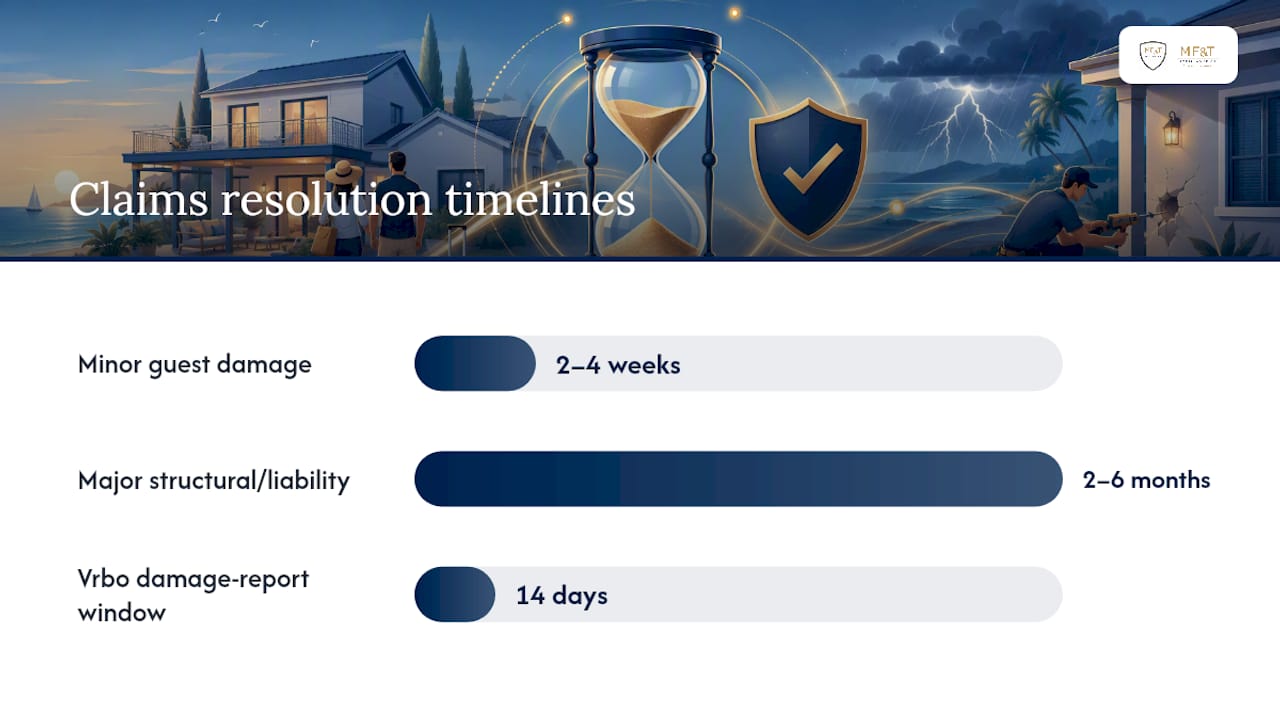
Most claims move through five stages: intake, adjuster assignment, inspection, estimate, and payout. A minor guest-damage claim might resolve in two to three weeks; a major structural or liability claim can take several months, particularly if a third party is involved or the damage requires contractor estimates.
Here's the general timeline for two common scenarios:
Minor guest-caused damage (broken furniture, stained carpet, damaged appliance):
- Report the claim within days of discovering the damage, ideally with photos taken immediately after checkout.
- An adjuster reviews documentation, sometimes without an in-person inspection for smaller claims.
- Payout typically follows within two to four weeks once documentation is complete.
Major structural or liability claim (guest injury, significant water or fire damage):
- Report immediately; most policies require prompt notice, often within 24 to 72 hours.
- An adjuster schedules an in-person inspection, sometimes alongside a contractor for damage estimates.
- Liability claims may involve legal review if a guest pursues a bodily injury claim.
- Full resolution can take two to six months, depending on complexity and whether repairs are ongoing.
Keep a claims folder ready before you ever need it. It should include:
- Time-stamped photos of the property before and after each guest stay
- Receipts for major furniture, appliances, and renovations
- Guest communication logs, especially anything related to reported damage
- Police or incident reports for theft or significant liability events
- Booking confirmation records from your platform, showing dates and guest identity
If damage occurred during a stay booked through Airbnb or Vrbo, file the platform's own incident report at the same time you notify your insurer. Vrbo's security-deposit damage claims carry a firm 14-day window from checkout, so delaying that report can forfeit protection you'd otherwise be entitled to, per Vrbo's host protection guidance. Coordinate both processes rather than treating them as separate tracks. Some losses may be partially covered by platform protection and partially by your private policy, and your agent can help sort out which coverage applies where.
Pro Tip: Photograph the property after every single turnover, not just when something looks off. The habit costs five minutes and becomes the difference between a documented claim and a denied one.
How An Independent Agent Evaluates A Short Term Rental Risk
An agent evaluating your property looks at six things in roughly this order: location, occupancy pattern, contents value, amenity exposure, claims history, and the liability limit you actually need. Walking through a hypothetical evaluation shows how those pieces come together into an actual quote.
Take a mid-range vacation rental: a four-bedroom coastal home, not in a federally designated flood zone, booked around 200 nights annually across Airbnb and Vrbo, with a hot tub and roughly $70,000 in contents.
- Location review. The agent checks flood maps and wildfire risk data first, since these determine whether separate flood or earthquake coverage needs to be added.
- Occupancy analysis. Two hundred nights a year signals frequent commercial use, ruling out a homeowner endorsement and pointing toward a standalone commercial policy.
- Contents valuation. At $70,000 in furnishings, the agent recommends replacement-cost valuation rather than actual cash value, since depreciation on furniture adds up fast.
- Amenity exposure. The hot tub triggers a specific amenity liability endorsement, since general liability alone may not adequately address it.
- Claims history check. No prior claims supports a more favorable premium.
- Limit recommendation. Given the amenity risk and guest volume, $1,000,000 in liability is the baseline recommendation, with $2,000,000 offered as an option for a modest premium increase.
For this property, a typical recommended package looks like this: $1,000,000 liability, replacement-cost contents coverage, business income written on an actual-loss-sustained basis, and an amenity liability endorsement covering the hot tub. Pricing for a package like this commonly lands in the middle of the broader $1,000 to $2,000 annual range, though the specific amenity and occupancy profile can push it toward the higher end.
The most common mistake we see isn't a host skipping insurance altogether. It's a host who bought the right idea, a short-term rental policy, but the wrong version of it: one still carrying a guest-damage sublimit, or business-income wording that pays a flat daily rate instead of actual lost revenue. The gap only shows up the day they file a claim.
The Mistake We See Most Often With Rental Hosts
I've watched the same mistake play out more times than I can count: a host relies entirely on Airbnb or Vrbo's built-in protections, or keeps an owner-occupied homeowners policy in place, and assumes that's coverage enough. It isn't, and the gap usually surfaces at the worst possible moment, mid-claim, after a guest has already been injured or a pipe has already burst.
The fix is rarely complicated once someone actually looks at the policy. We add business-income wording that pays actual losses instead of a token daily rate. We strip out guest-damage sublimits that would have left a $15,000 repair only half covered. We confirm the named insured actually matches how the property is titled, since a mismatch there can void a claim entirely regardless of everything else being correct.
None of this requires overhauling how you run your rental. It requires one honest conversation about what your current policy actually says, versus what you assumed it said, and that conversation is exactly where the next step starts.
Get A Short Term Rental Insurance Quote Built For Your Property
If you've read this far, you already know the gap between platform protections and a real private policy, and you know what a comprehensive short-term rental policy should include. The next move is getting a quote that reflects your actual property, not a generic template.
M F and T North America works as an independent agency, which means we compare options across multiple carriers rather than pushing a single company's form regardless of fit. For a host trying to replace a gapped homeowners policy with real commercial-grade coverage, that comparison is where the savings and the coverage improvements usually show up together, not one at the expense of the other.
Before your first call, have these ready: your current declarations page, a rough occupancy and nightly-rate history, a list of high-value contents, and details on any amenities like a pool or hot tub. On that first call, expect us to walk through your booking channels, current coverage gaps, and the liability limit that actually fits your exposure, no pressure to decide on the spot. If you're also weighing whether your existing homeowners policy has other gaps beyond short-term rental use, our homeowners insurance FAQ is a good place to start. When you're ready, request a tailored quote and we'll walk you through exactly what a commercial-grade vacation rental policy would look like for your specific property.
Sources
Verifying coverage details directly against platform and carrier terms is worth the extra ten minutes, especially before a claim is on the line.
When you're preparing a claim or double-checking coverage boundaries, pull the platform's own policy page rather than relying on summarized host forum advice. Programs and dollar limits get updated periodically, and the source page reflects the current terms tied to your booking.
This article is general information, not a substitute for advice from a qualified financial advisor. Consult a qualified financial professional about your own circumstances before acting on anything here.