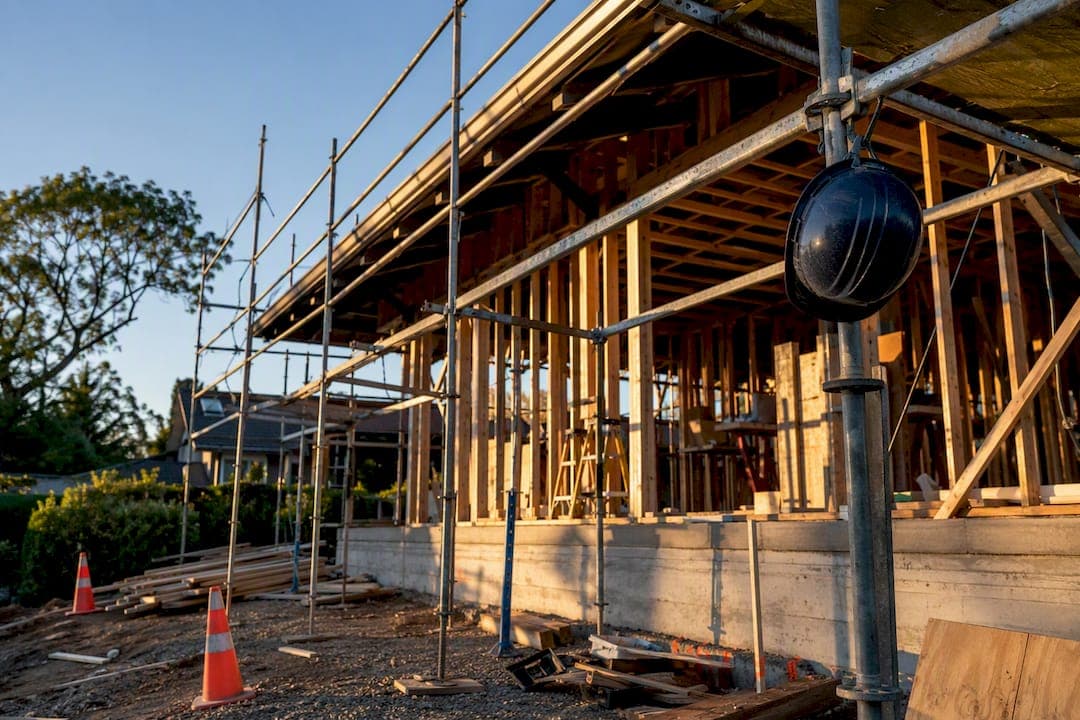
Yes, most renovation projects need builders risk insurance when they involve structural work, additions, full remodels, lengthy durations, or vacant properties during construction. If your lender requires proof of coverage before releasing draws, that answer is already made for you.
The owner should hold the policy in most cases. When the contractor is named insured instead, claim proceeds can get tied up in disputes over who's owed what, especially after a fire or storm loss.
Before you sign anything, take three steps:
- Verify your contractor's certificate of insurance shows both general liability and workers' compensation.
- Document your home's current completed value, including the existing structure.
- Open a builders risk policy that explicitly includes existing-structure coverage if you're renovating rather than building new.
Pro Tip: Ask your contractor for their COI before the first check is written, not after work starts. A verbal promise of coverage means nothing if a subcontractor gets hurt on your property next week.
Key Takeaways
Renovation projects need builders risk insurance sized around completed value, existing-structure sub-limits, and endorsements that a standard homeowners policy simply doesn't provide.
| Point | Details |
|---|---|
| Owner as named insured | Naming the owner instead of the contractor prevents claim-payment disputes after a loss. |
| Existing-structure value | Document and separately quantify existing-structure value to avoid ACV disputes later. |
| Watch the idle period rule | Idle projects past 60 days can trigger reduced coverage or policy termination. |
| Verify contractor COI | Confirm active general liability and workers' compensation before work begins. |
| Work with MF&T North America | MF&T North America maps endorsements, verifies COIs, and coordinates lender wording during placement. |
Table of Contents
- What Does Builders Risk Cover During a Renovation?
- Who Should Be the Named Insured on the Policy?
- How Does Policy Valuation Work for Renovation Projects?
- Which Endorsements Close Renovation Coverage Gaps?
- What Documents Do Underwriters Need for a Renovation Submission?
- How Much Does Builders Risk Insurance Cost for a Renovation?
- When Does Builders Risk Coverage End or Change?
- How Does MF&T North America Place Builders Risk for Renovations?
- Get Your Renovation Project Covered Before Demolition Starts
- Sources
What Does Builders Risk Cover During a Renovation?
Builders risk insurance for a renovation project covers new materials on site, work already installed, temporary structures like scaffolding, and debris removal after a covered loss such as fire, wind, or vandalism. That's the baseline most policies share, whether you're gutting a kitchen or adding a second story.

Renovations create wrinkles that new construction doesn't. Your existing home isn't automatically covered at full value. Unless you specifically request existing-structure coverage, many builders risk coverage forms treat your standing structure as a sub-limit or exclude it entirely, leaving a gap between what you think you're insured for and what actually pays out after a loss.
Common exclusions include:
- Flood and earthquake damage, which require separate endorsements in most states.
- Contractor-owned tools and equipment, which typically fall under the contractor's own inland marine policy.
- Materials in transit or stored off-site, unless you add a specific endorsement.
- Theft of stored fixtures and appliances, often capped well below their replacement value.
This matters because your regular homeowners policy usually stops protecting you once major construction starts or the home sits vacant for an extended stretch. That's the gap builders risk is built to close, and it's why pairing the two isn't optional so much as necessary.
Pro Tip: If you're renovating an occupied home, tell your carrier the exact rooms under construction. A policy written for "kitchen remodel" won't respond the same way to a claim involving the whole first floor.
Who Should Be the Named Insured on the Policy?
Naming the owner as the primary policyholder is the safer default for most renovation projects, because it keeps claim proceeds flowing directly to the person who's financially exposed if something goes wrong. Letting the contractor hold the policy can work, but it shifts leverage in a claim dispute toward someone who isn't paying your mortgage.
If you have a lender, they'll usually want to appear on the policy as mortgagee or loss payee, which protects their financial interest in the property until the loan is satisfied. A few things worth confirming before work begins:
- Ask your contractor for a current certificate of insurance and check the expiration date, not just the coverage limits.
- Add any subcontractors handling major trades (electrical, plumbing, structural) as additional insureds if your contract allows it.
- Confirm your lender's exact legal name and loan number for the mortgagee clause.
How Does Policy Valuation Work for Renovation Projects?
Renovation projects can use a completed value form, a reporting form, or an inland marine variant, and the right choice depends on how much your project's value will shift over the build. A completed value form locks in a target number upfront, which works well for a defined scope like a bathroom addition. A reporting form lets you adjust value monthly as costs accumulate, better suited to a phased whole-house renovation.
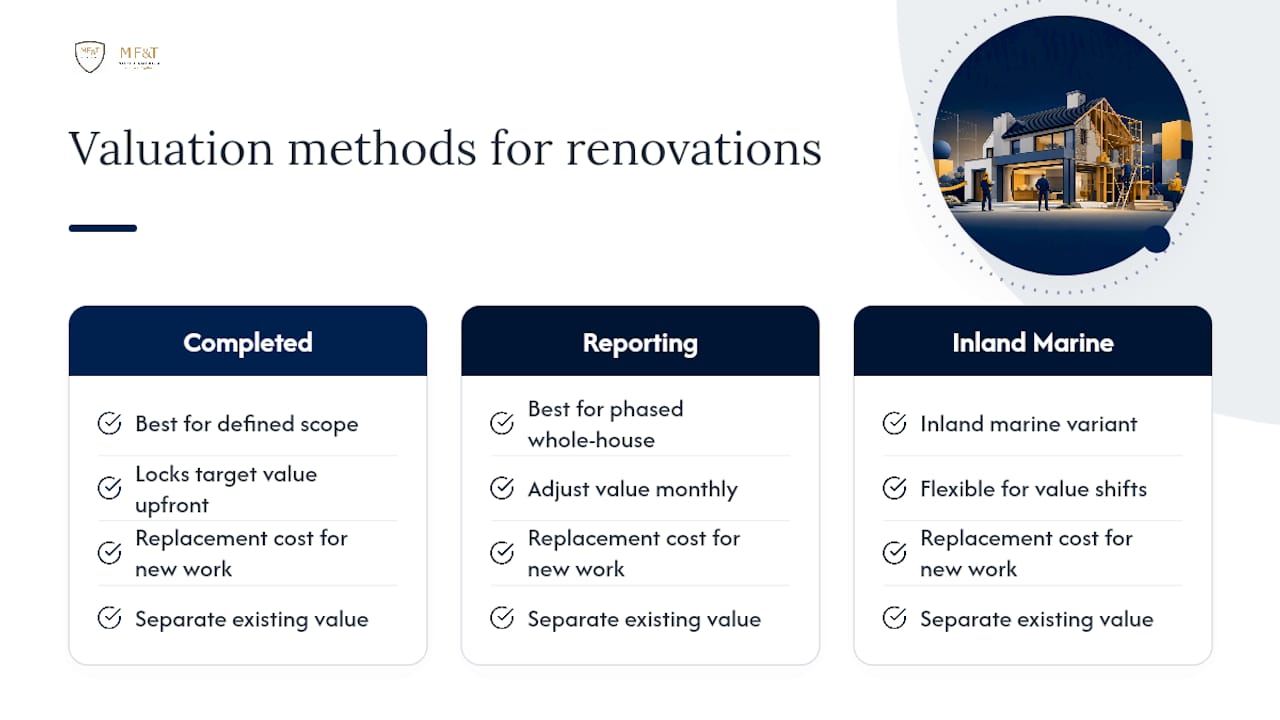
Replacement cost valuation is almost always the better call for new work. It pays to rebuild at today's material and labor prices rather than depreciated value. Where things get messy is your existing structure: applying actual cash value (ACV) to a 1920s farmhouse creates real ambiguity, since depreciation calculations on century-old materials vary wildly by adjuster and jurisdiction, a problem industry analysis on insuring existing property flags directly.
The practical fix: list your completed project value separately from your existing-structure value, and negotiate an agreed amount or sub-limit for the existing property. That single step prevents the most common post-loss argument between owners and carriers.
Which Endorsements Close Renovation Coverage Gaps?
A handful of endorsements do most of the heavy lifting on renovation-specific risk. Time element, sometimes called delay in completion, covers soft costs like extended loan interest or lost rental income if a covered loss pushes your completion date out by months.
- Existing-structure sub-limits or agreed amount endorsements, addressing the ACV ambiguity described above.
- Installation floaters for materials purchased but not yet installed, particularly custom cabinetry or fixtures with long lead times.
- Waiver of subrogation and waiver of coinsurance, which prevent your carrier from pursuing your own contractor after paying a claim.
- Partial occupancy endorsements for phased renovations where you're living in half the house while the other half gets rebuilt.
Pro Tip: If your renovation involves a tax credit for historic preservation or energy efficiency, ask specifically about time element wording. A generic delay endorsement won't account for how a construction delay affects credit eligibility.
What Documents Do Underwriters Need for a Renovation Submission?
A clean submission moves faster, and underwriters are consistent about what they want to see. Prepare these before you contact a carrier:
- Project address, full scope of work, and construction schedule with start and target completion dates.
- Estimated completed value, itemized separately for new work and existing structure if you're keeping any part of the current building.
- Percentage of work already complete, if construction has started before the policy is bound.
On the contractor side, underwriters want:
- General contractor's name, license number, and years in business.
- A current certificate of insurance showing general liability and workers' compensation.
- A list of major subcontractors handling structural, electrical, or plumbing work.
- Signed contract, plans or specifications, and lender contact information if applicable.
How Much Does Builders Risk Insurance Cost for a Renovation?
Premium is driven primarily by your completed project value, with additional cost layered on for structural complexity, project duration, and location-specific risk. Remodeling projects frequently cost more to insure than comparable new construction, because the underwriter is pricing in unknowns about the existing structure's wiring, plumbing, and framing condition.
Some carrier programs advertise policies starting around $375 for small, short-duration projects in many states, but that figure is a floor, not an expectation. Structural work, vacant properties, phased occupancy, and older buildings with unknown conditions all push premiums well above that starting point.
- Higher completed value directly increases premium, roughly proportional in most rating models.
- Structural or foundation work typically carries a higher rate than cosmetic upgrades.
- Vacant properties and high-theft neighborhoods usually trigger underwriting scrutiny and added cost.
When Does Builders Risk Coverage End or Change?
Coverage doesn't run indefinitely, and the end date can arrive faster than owners expect. Builders risk policies typically terminate at the earliest of project completion, sale or closing, or occupancy. Many policies treat a project sitting idle for a specified period as a trigger for reduced coverage or outright termination.
- Confirm your policy's exact idle-period language before a permitting delay or contractor dispute pauses work.
- Partial occupancy during a phased renovation can unintentionally shorten coverage unless you've added the right endorsement.
- Time element coverage measures a defined period of restoration, so vague start and end dates in your policy paperwork create real problems at claim time.
A project that sits untouched for two months over a permit dispute isn't just delayed. Depending on your policy's language, it may have already lost its coverage without anyone sending a cancellation notice.
How Does MF&T North America Place Builders Risk for Renovations?
Placing a clean builders risk policy on a renovation takes more coordination than a standard homeowners quote, and the sequence matters:
- Review the project scope and construction schedule during intake.
- Verify contractor COI, confirming both general liability and workers' compensation are active.
- Quantify existing-structure value separately from new work to avoid ACV disputes later.
- Map the endorsements your specific project needs, from time element to installation floaters.
- Present policy options with clear pricing and coverage tradeoffs.
- Bind the policy with explicit start and end dates tied to your actual construction timeline.
MF&T North America also handles lender wording and loss payee designations directly with your mortgage company, and stays involved if a claim happens so documentation flows correctly from day one.
Pro Tip: Photograph your existing structure room by room before demolition starts. That documentation becomes your strongest evidence if a valuation dispute comes up after a loss.
What Mistakes Show Up Most on Renovation Submissions?
The most common mistake is assuming a homeowners policy still applies once major construction begins. It usually doesn't. Close behind that: owners who never document their existing-structure value, then get blindsided by an ACV adjustment after a loss, and contractors whose workers' comp lapsed months earlier without anyone noticing. A structured intake checklist catches all three before a policy binds, not after a claim exposes them.
Get Your Renovation Project Covered Before Demolition Starts
MF&T North America places builders risk policies specifically built around renovation risk, not repurposed new-construction forms that leave your existing structure underinsured. That distinction saves owners real money and real arguments after a loss, since we quantify existing-structure value and map the right endorsements before your contractor picks up a hammer.
We coordinate directly with lenders on mortgagee wording, verify contractor COIs before you sign a contract, and walk you through completed-value versus reporting-form decisions in plain language. If you're weeks from breaking ground, start with our builders risk insurance page to see coverage options, or reach out directly for a free quote tailored to your project's scope and timeline. The earlier you call, the more coverage gaps we can close before they become someone else's excuse to deny a claim.
Sources
- Builder's risk insurance - Wikipedia
- Builders-Risk-Complexities-Insuring-Existing-Property.pdf
- Understanding Builder's Risk Insurance for Construction Projects
This article is general information, not a substitute for advice from a qualified financial advisor. Consult a qualified financial professional about your own circumstances before acting on anything here.