
Most home-based business owners need coverage beyond a standard homeowners policy, because that policy typically caps business property with a limit around $2,500 and excludes liability tied to your work. Prioritize three things: business personal property coverage, general liability, and business interruption protection, often bundled into a Business Owner's Policy (BOP). If you have employees or use a vehicle for work, your state may require workers' compensation or commercial auto coverage too. Talk to a licensed agent to match coverage to your actual setup.
TL;DR:
- A home business needs coverage beyond a standard homeowners policy, especially for equipment, liability, and income protection, with a typical cap of only $2,500 on business property.
- A Business Owner's Policy offers a cost-effective bundle of commercial property and liability coverage, suitable for businesses with high-value equipment or regular client visits.
- Homeowners policies often exclude business interruption, off-site equipment, product liability, and employee injuries, exposing owners to significant financial gaps.
- Costs vary widely based on industry risk, revenue, location, and coverage limits, with full BOPs generally costing more but providing broader protection than endorsements.
- Consulting an agent and accurately assessing equipment, liability, and interruption risks ensures appropriate coverage without overpaying or facing unexpected gaps.
Table of Contents
- Types of Home Business Insurance You Should Know About
- Why Your Homeowners Policy Leaves Gaps
- How to Choose the Right Coverage and Limits
- What Home Business Insurance Typically Costs
- Getting Insured: Your Action Checklist
- What 30 Years of Writing These Policies Has Taught Me
- Get a Home Business Policy Built Around Your Actual Risk
- Sources
- FAQ
Types of Home Business Insurance You Should Know About
A home-based bakery, a freelance photographer, and a bookkeeper working out of a spare bedroom face different risks, but they draw from the same pool of coverage options. Knowing what each one actually does helps you avoid paying for protection you don't need while skipping the coverage you do.
Business Owner's Policy (BOP). A BOP bundles commercial property and general liability into a single, often cost-effective package, especially useful if you carry meaningful equipment value, see clients regularly, or operate at more than one location. Most carriers let you add endorsements for cyber liability or business interruption coverage.
Homeowners policy endorsements. If your operation is small, an endorsement to your existing homeowners policy can raise business-equipment limits in modest increments, sometimes from $2,500 up to $5,000 or $10,000. It may also add limited liability protection for occasional visitors, but the ceiling stays low.
Commercial property / business personal property coverage. This protects equipment, inventory, and supplies, including items you take off-site for jobs or shows, where a homeowners policy typically stops paying once your gear leaves the house. Our commercial property coverage guide breaks down valuation methods in more detail.
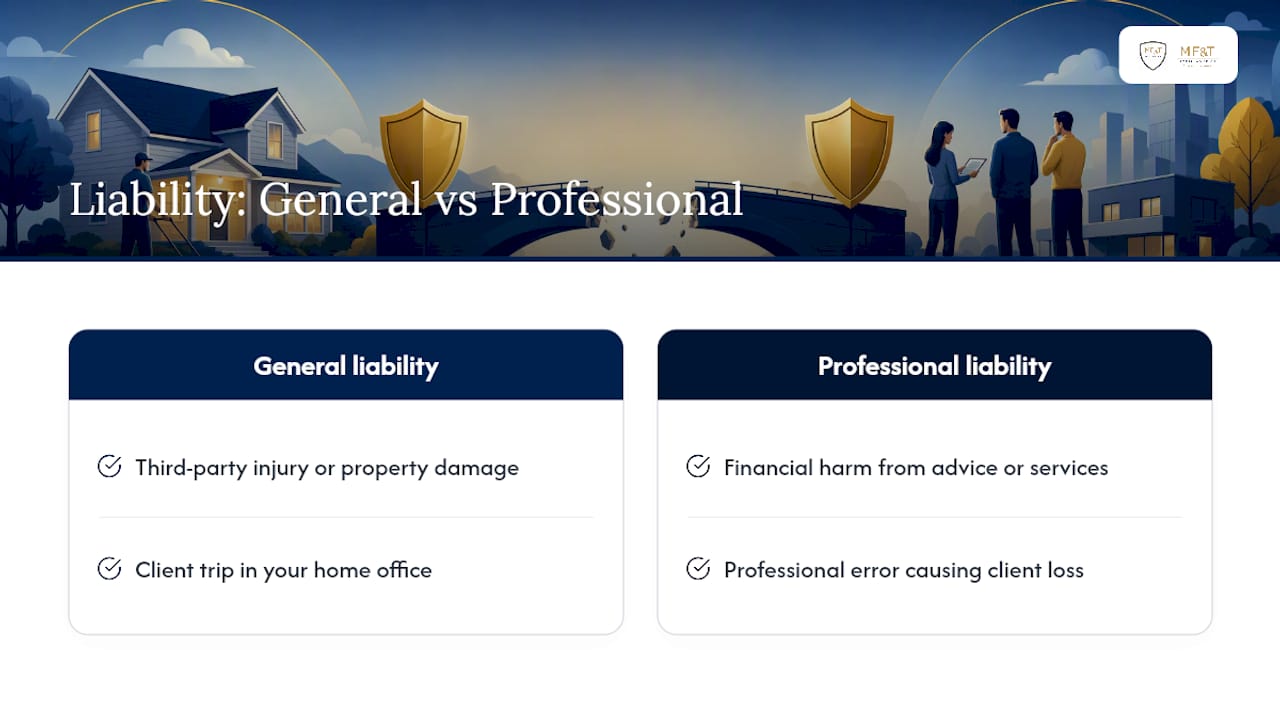
General liability vs. professional liability. General liability covers third-party injury or property damage, think a client tripping in your home office. Professional liability (errors and omissions) covers financial harm from your advice or services, which matters more for consultants, designers, and bookkeepers than for product sellers. Review the distinctions in our general liability explainer.
Cyber liability. If you store customer payment data or personal information, a data breach can trigger notification costs and legal exposure that no standard policy touches, a risk that grows alongside your reliance on cloud tools and remote backups (worth pairing with strong data backup practices).
Commercial auto and workers' compensation. Once you use a vehicle regularly for business or hire even one employee, personal auto and homeowners coverage generally stop applying, and state law usually requires separate commercial auto or workers' comp policies.
Why Your Homeowners Policy Leaves Gaps
Homeowners insurers write personal policies to protect personal property, not commercial operations, and the fine print shows it fast.
The $2,500 problem: Most standard homeowners policies cap business equipment coverage at around $2,500, a number that hasn't kept pace with the cost of laptops, cameras, or specialized tools many home businesses depend on.
Beyond that low cap, homeowners policies typically exclude:
- Lost income if your business stops operating after a covered loss (business interruption)
- Product liability if something you make or sell injures a customer
- Inventory or equipment stored or used off-premises
- Employee injuries, which fall under workers' compensation, not homeowners liability
Picture a wedding photographer with $15,000 in camera bodies and lenses stolen from a car after a shoot. A homeowners policy might pay $2,500 toward that loss, leaving a $12,500 gap. An online seller with a garage full of holiday inventory faces the same math if a pipe bursts. These aren't edge cases. They're the ordinary cost of doing business from home without the right policy in place.
How to Choose the Right Coverage and Limits
Matching coverage to your actual risk, not a generic package, keeps you from overpaying or getting caught short. The SBA frames insurance as a financial planning decision: buy protection for costs you couldn't absorb yourself, not costs you'd merely prefer to avoid.
- Inventory your equipment at replacement cost. List every laptop, camera, tool, and piece of inventory with receipts or serial numbers where possible. A consultant might total $8,000 in equipment; a home baker with commercial-grade mixers and refrigeration could easily hit $20,000.
- Estimate your liability exposure. Do clients visit your home? Do you sell a physical product that could cause harm? Do you give advice that clients rely on financially? Each answer points toward general liability, product liability, or professional liability.
- Calculate your business interruption number. Add your average monthly fixed costs, rent, loan payments, payroll, plus your typical profit, rather than gross revenue, to avoid underinsuring your real cash-flow exposure. Our business income insurance guide walks through the math.
- Decide between an endorsement and a full BOP. If your equipment value and liability exposure are modest and stable, an endorsement may suffice. If you're growing, hold high-value equipment, or see clients regularly, a BOP usually delivers broader protection for the price.
Pro Tip: A lower deductible means a higher premium. If cash flow is tight month to month, a $1,000 deductible with a lower monthly cost often beats a $250 deductible that inflates your premium year-round.
What Home Business Insurance Typically Costs
Several factors drive your premium more than any single policy choice does.
- Industry risk. A dog walker faces different liability math than a data consultant.
- Revenue and payroll. Higher revenue and any employees raise your exposure and your premium.
- Location and claims history. Your state, local claims trends, and your own history all factor in.
- Limits and deductible. Higher limits and lower deductibles both push cost up.
Illustrative pricing from Insureon shows that BOPs and standalone commercial property policies can be affordable options for lower-risk home businesses, though actual quotes vary by carrier and state.
A basic general liability endorsement can run relatively cheap for a low-risk service business, while a full BOP with higher property limits and business interruption coverage costs more but closes far more gaps. Workers' compensation and commercial auto premiums vary by state regulation, so a business with even one employee or company vehicle should expect those line items to shift the total noticeably.
Getting Insured: Your Action Checklist
Once you know what you need, the process moves fast if you come prepared.
- Gather your documents. Equipment list with values, last year's revenue, any client contracts, employee details if applicable, and how often you use a vehicle for work.
- Compare quotes apples to apples. Confirm each quote uses the same limits, deductibles, covered perils, and sub-limits, not just the bottom-line price. Check the carrier's financial rating too.
- Ask pointed questions. What's excluded? What's my sub-limit for off-site equipment? How fast can I get a certificate of insurance if a client requires one?
- Watch for red flags. Vague answers about exclusions or pressure to skip liability coverage entirely are both signs to get a second opinion. Our step-by-step quote guide walks through what to expect timeline-wise, often just a few business days from application to bound coverage.
What 30 Years of Writing These Policies Has Taught Me
The biggest mistake I see isn't buying the wrong policy. It's assuming a homeowners policy already handles it. Clients often insure their $3,000 laptop setup for years without realizing their sub-limit tops out at $2,500, and they only find out during a claim.
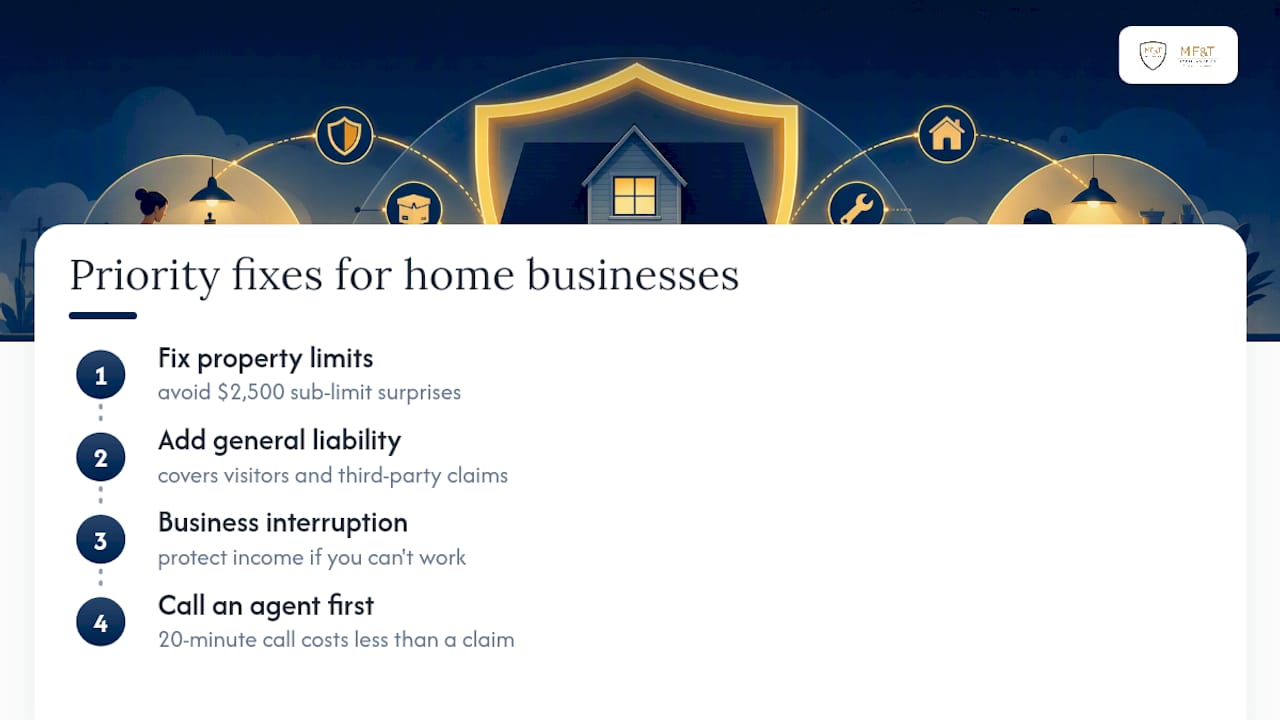
My priority order for home-based clients is consistent: fix property limits first, because that's the gap most likely to hit unexpectedly. Add general liability next, especially if anyone ever sets foot in your workspace. Business interruption comes third, since it matters most once your income depends entirely on your ability to keep working.
The shortcut that actually works is calling an agent before a loss, not after one. A twenty-minute conversation almost always costs less than the surprise of an underinsured claim.
— Mike
Get a Home Business Policy Built Around Your Actual Risk
An independent agency with extensive experience helps owners avoid coverage gaps like the $2,500 sub-limit that catches home-based businesses off guard. Some agencies compare BOPs against simple endorsements, assess property and liability exposure honestly, and bundle homeowners and business coverage under one relationship to simplify renewals and pricing.
Whether you run a design studio out of a spare room or store inventory in your garage, the right next step is a real conversation about your numbers, not a generic quote form. Request a free quote and we'll walk through your equipment list, liability exposure, and interruption risk together to build a policy that actually matches how you work.
This article is general information, not a substitute for advice from a qualified financial advisor. Consult a qualified financial professional about your own circumstances before acting on anything here.
Sources
- Get business insurance | U.S. Small Business Administration
- Insuring Your Home-based Business - Insurance Information Institute (III)
- What insurance do I need to run a business from home? - Texas Department of Insurance
- Small Business Insurance – Insureon
FAQ
Do I need home business insurance if I already have homeowners coverage?
Most home-based businesses do, since homeowners policies typically cap business property around $2,500 and exclude business interruption and liability tied to your work.
What does a Business Owner's Policy cover that homeowners insurance doesn't?
A BOP bundles commercial property coverage at realistic limits with general liability protection, both areas where homeowners policies fall short for active businesses.
When do I need workers' compensation for a home business?
Once you hire even one employee, most states require workers' compensation coverage, since homeowners liability doesn't extend to employee injuries.
Will a claim on my business insurance affect my homeowners policy?
A separate business policy, like a BOP or endorsement, generally keeps business claims from directly affecting your homeowners claims history, though carriers may review your full account when setting renewal terms.
How much does home business insurance typically cost?
Cost depends heavily on industry risk, revenue, location, and the limits you choose, with basic endorsements costing far less than a full BOP with higher property and interruption limits, according to illustrative pricing from Insureon.