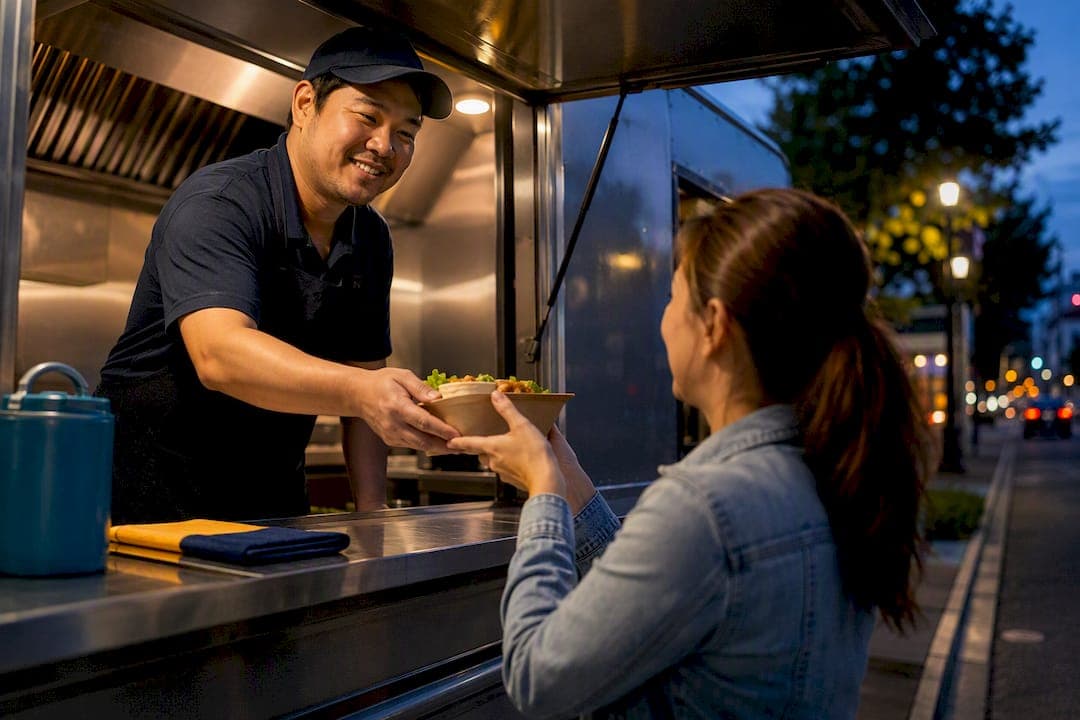
Two coverages come first: commercial auto and general liability, ideally with limits at $1 million per occurrence and $2 million aggregate if you plan to work festivals or events. Before you request a single quote, pull three things together: your truck's VIN, a current equipment value estimate, and a driver list with motor vehicle records. Everything else in your coverage plan builds from those.
TL;DR:
- Commercial auto and general liability with at least $1 million per occurrence and $2 million in total are essential for food truck operations, especially during festivals or events.
- Short-term event policies can be more cost-effective for seasonal vendors, offering liability protection by the day or month instead of year-round coverage.
- Premium costs vary based on vehicle value, location, driver records, and number of employees, with auto insurance comprising 40-60% of total premiums.
- Proper documentation of equipment, revenue, and driver records is crucial before requesting quotes to ensure accurate coverage and pricing.
- Working with an experienced independent agency speeds up policy placement, produces quick certificates of insurance, and provides tailored advice for your specific business needs.
Table of Contents
- What Does Food Truck Insurance Actually Cover?
- What Add-On Coverage Do Festivals and Events Require?
- How Much Does Food Truck Insurance Cost in 2026?
- What Should You Prepare Before Requesting Quotes?
- How Do You Get Coverage in Place Fast?
- Why Trust an Agency That Specializes in Commercial Coverage?
- The Checklist Beats the Sales Pitch
- Ready to Get Your Food Truck Covered?
- Sources
What Does Food Truck Insurance Actually Cover?
Your personal auto policy stops covering you the moment you start selling food from that vehicle. Insurers classify commercial use differently than personal use, and a claim filed after an accident while operating for business will likely get denied outright. Commercial auto insurance is legally required to drive a food truck on public roads, and it's one of two coverages Forbes Advisor identifies as mandatory for most operators.
General liability is the second must-have. It responds when a customer claims your food made them sick, when someone trips over your generator cord, or when your fryer starts a fire that damages a rented commissary kitchen. Product liability, a component of GL, specifically covers claims tied to what you served. Skip it, and one foodborne illness claim could end your business.
Workers' compensation becomes mandatory in most states the moment you hire your first employee, even part time. Operating without it when required doesn't just risk a fine. It exposes you personally to a worker's medical bills and lost wages if you get sued directly.
Round out the core lineup with:
- Commercial property or inland marine coverage for the truck's built-in equipment, generators, and point-of-sale systems, separate from physical damage to the vehicle itself
- A business owner's policy (BOP) that bundles GL and property into one contract, often at a lower combined rate, though BOPs typically exclude commercial auto and workers' comp
- Physical damage coverage under your commercial auto policy for collision and comprehensive claims on the truck itself
What Add-On Coverage Do Festivals and Events Require?
Annual policies cover you year-round, but plenty of operators only need protection for specific bookings. Short-term event policies, sometimes called FLIP-style coverage, let seasonal vendors buy liability protection by the day or month instead of paying for months they're not working.
A few coverages matter enough to call out on their own:
- Spoilage coverage reimburses you when a freezer failure or power outage ruins perishable inventory, a real risk given how much cash sits in a truck's cooler
- Equipment breakdown coverage pays for mechanical or electrical failure of your fryers, refrigeration units, and generators, which standard property policies often exclude
- Hired and non-owned auto coverage protects you when you rent a vehicle or an employee uses a personal car for business errands
- Liquor liability applies if you serve alcohol at any event, even occasionally
- Umbrella policies extend your liability limits above your GL and auto policies when a large festival demands more coverage than your base limits provide
Venues frequently specify exact endorsement language, particularly additional-insured status. Read those requirements before you sign a booking contract, not after.
How Much Does Food Truck Insurance Cost in 2026?
A typical full-coverage program runs from a few thousand dollars to around ten thousand dollars per year for most operators, with solo operators paying less than those with one or two employees, according to StreetLegal's market rate analysis. Where you land in that range depends heavily on your state, your truck's value, and your claims history.
Commercial auto is almost always your biggest line item. MoneyGeek's 2026 provider analysis puts it at 40% to 60% of total premium, with general liability, workers' comp, and equipment coverage splitting the remainder. A $60,000 custom-built catering rig will cost meaningfully more to insure than a used step van worth $18,000 since replacement cost drives the auto premium directly.
The main levers that move your price:
- Location and state — urban areas and states with higher accident or litigation rates push premiums up
- Driving record — a clean MVR across all listed drivers keeps auto rates down
- Payroll and headcount — every employee added increases workers' comp exposure
- Limits and deductibles — higher liability limits raise premium; higher deductibles lower it
Bundling your GL, auto, and property into a single business owner's policy typically saves 10% to 20% versus buying each line separately, and it simplifies claims handling since one carrier manages the whole file. Pay-as-you-go workers' comp programs, which base premium on actual payroll rather than an annual estimate, also help seasonal operators avoid overpaying during slow months.
What Should You Prepare Before Requesting Quotes?
Carriers price food truck policies based on specifics, not guesses. Walk into the quoting process with these ready:
- Vehicle identification number (VIN) and current mileage
- Complete equipment inventory with serial numbers and replacement values, not depreciated book value
- Estimated annual revenue and payroll figures
- Driver list with MVRs for anyone who operates the truck
- A record of any prior claims from the last three to five years
When you talk to carriers or agents, ask direct questions: does this policy cover built-in equipment or just the vehicle chassis? Is spoilage included or an add-on? How fast can you turn around a certificate of insurance with additional-insured wording? Event organizers commonly require $1 million per occurrence and $2 million aggregate along with a COI naming them as additional insured, so confirm your carrier can meet that standard before you commit.
Pro Tip: Request every quote using identical limits and deductibles across carriers. A quote that looks $400 cheaper often hides a lower liability limit or a higher deductible buried in the fine print.
How Do You Get Coverage in Place Fast?
Getting from application to active coverage doesn't need to drag on for weeks.
- Document your values — truck, equipment, payroll, and revenue estimates, all in writing
- Request quotes from at least three carriers using the same limits so you're comparing apples to apples
- Ask for your COI with additional-insured language matching exactly what the venue or festival requires
- Confirm your effective date and payment before your first scheduled event, not the morning of
If you're only working a handful of events this season, a short-term policy can get you covered without locking into a full annual term. Whichever route you choose, ask about claims turnaround before you buy. A carrier that drags out claims processing can leave your truck sidelined and off the schedule for weeks.
Why Trust an Agency That Specializes in Commercial Coverage?
M F and T North America has spent more than 30 years writing commercial insurance across multiple states, including the fleet and auto coverage that food truck operators depend on. The agency's published guides on commercial auto insurance and commercial property coverage walk through the same coverage decisions food truck owners face every season. Rather than handing you a generic policy, an independent agency compares carriers on your behalf and matches coverage to how your business actually operates, from single-truck startups to multi-vehicle catering operations.
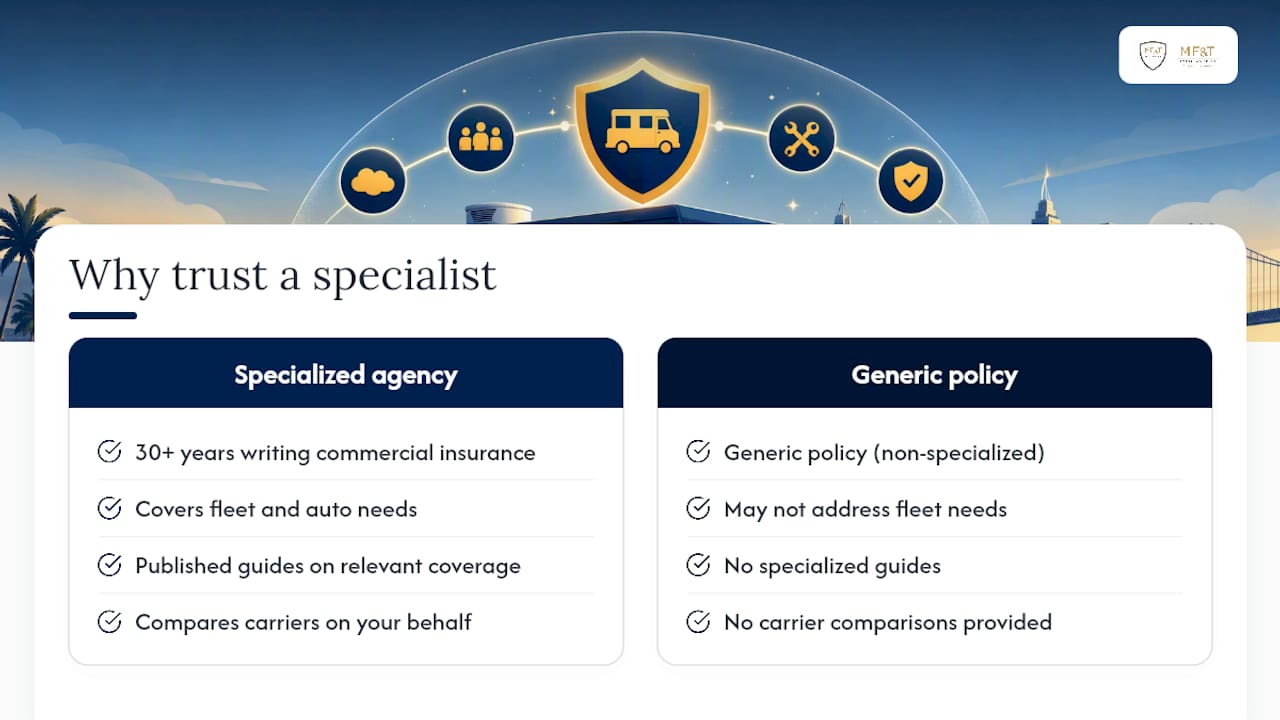
The Checklist Beats the Sales Pitch
Most food truck insurance content online reads like a coverage glossary. It lists eight types of policies and leaves you to figure out which three actually matter for your operation. That's backward. The research is clear that commercial auto and general liability are non-negotiable, workers' comp kicks in the moment you hire, and everything else, spoilage, equipment breakdown, liquor liability, gets layered on based on how you actually work, not what a generic checklist assumes.
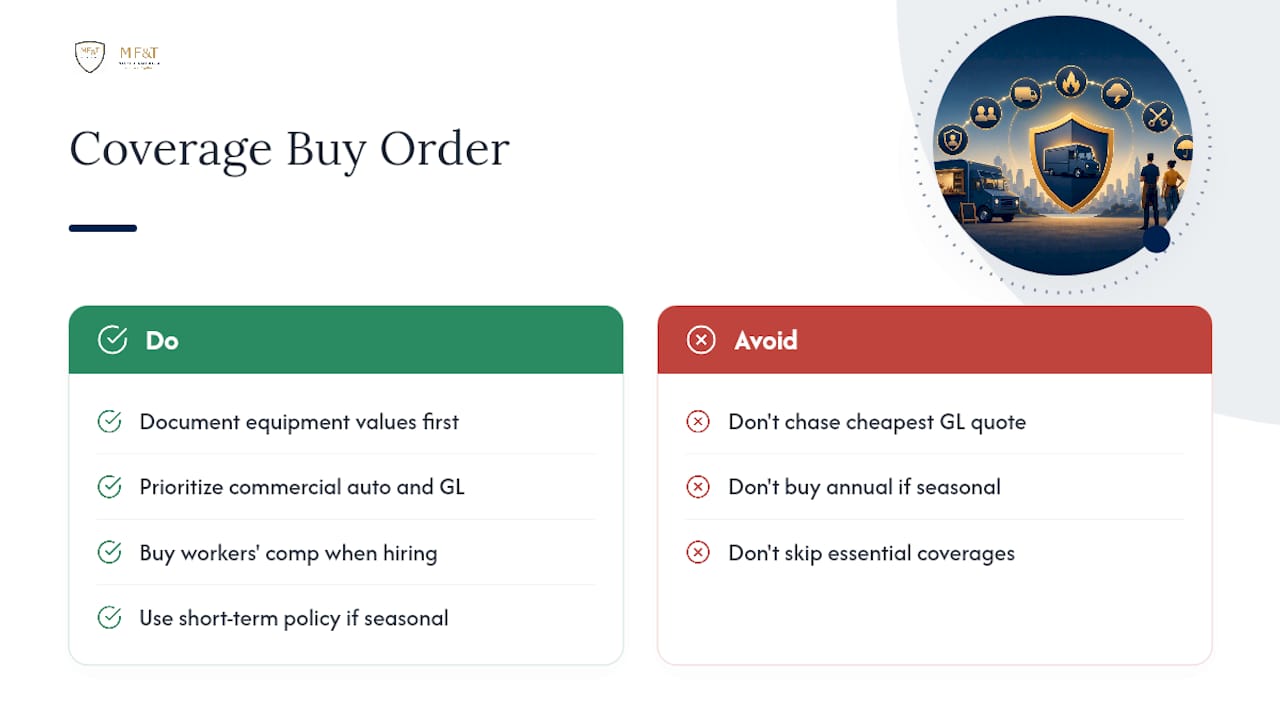
The biggest mistake I see operators make isn't skipping coverage. It's buying it in the wrong order, chasing the cheapest GL quote before they've nailed down accurate equipment values, then getting hit with a lowball claims payout later. Document your numbers first. Quote second. And if you're seasonal, don't let an agent sell you a full annual policy when a short-term event policy fits your actual calendar and saves real money.
Get the documentation right, and the rest of this decision gets a lot easier.
— Mike
Ready to Get Your Food Truck Covered?
M F and T North America gives food truck owners a faster path to the two coverages that matter most: properly rated commercial auto and general liability with the limits venues actually require. Unlike shopping carrier by carrier on your own, working with an independent agency means one point of contact who compares multiple carriers, produces COIs with additional-insured wording quickly when a festival deadline is looming, and advises on workers' comp obligations specific to your state.
Before you reach out, gather your truck's VIN, a rough equipment value estimate, and a payroll estimate if you have employees. That's enough to start a real conversation. Request a custom quote from M F and T North America and get coverage that matches how your truck actually operates, not a generic policy built for a restaurant that never leaves the building.
This article is general information, not a substitute for advice from a qualified financial advisor. Consult a qualified financial professional about your own circumstances before acting on anything here.
Sources
- Food Truck Insurance: What You Need, What It Costs, | StreetLegal
- Insurance
- Food Truck Insurance: Coverage & Costs – Forbes Advisor
- Best Insurance For Food Trucks & Trailers (2026) | MoneyGeek